1. Introduction
Tea is bought by habit. In the large tea-drinking markets of South Asia and East Africa, a household typically settles on a brand and a pack size and repurchases them for years, often from the same small shop. Brands that have been present for generations benefit most from this pattern. Their packs are recognised at a distance, their names are asked for at the counter, and in rural districts they may be the default by which other teas are judged. The managers of such a brand hold an asset that is durable and also slow.
Growth in value, meanwhile, comes from elsewhere. Younger city dwellers encounter tea as a cafe drink, a wellness product or a gift, in green, flavoured and single-origin forms, sold through modern retail and online. To them the old brand may signal their parents' kitchen. Keller's account of brand revitalisation describes the standing choice in these circumstances: reinforce the meanings the brand already has, or change them to reach new buyers, at the risk of losing those who valued it as it was (Keller, 1999). Studies of ageing brands record the same dilemma from the other side, with brands that grew old alongside their customers because nothing was changed (Lehu, 2004).
This article sets out a planning framework for a heritage tea brand that wants to win urban millennials while keeping its rural customers. It is a methodological proposal assembled from published theory and evidence on branding. It does not describe an actual company, and it has not been applied or validated here. The aim is to give planners an ordered set of decisions, each with a reason and a safeguard, where at present they have general principles.
2. Background
Positioning, in the sense given to the term by Ries and Trout (1981), is the place a brand occupies in the buyer's mind relative to its competitors. In Keller's model of customer-based brand equity that place consists of associations held in memory, which are valuable to the extent that they are strong, favourable and unique (Keller, 1993). Repositioning means altering some of those associations. Two bodies of work explain why this is delicate for an old brand that serves two different audiences.
2.1. Heritage as asset and constraint
Urde et al. (2007) describe a heritage brand as one that makes its history part of its present identity, and they identify five elements by which the strength of that heritage can be judged: a track record, longevity, core values, the use of symbols, and a belief within the organisation that its history matters. Heritage of this kind is hard for competitors to copy. It also carries an expectation of continuity. Beverland (2005), writing about wine, shows that authenticity has to be actively maintained through visible commitment to tradition and craft, and that it is damaged when commercial motives become too apparent. Work on retro brands adds that a brand's past can be made attractive to people who never lived it, provided the story is retold and not merely repeated (Brown et al., 2003). The past, in other words, can speak to a young urban audience, but only if the brand has not discarded it.
2.2. Two audiences under one name
Research on extensions explains the risk to the existing base. New products that contradict what buyers believe about a brand can weaken those beliefs for the parent (Loken and John, 1993). Kirmani et al. (1999) found that current owners of a brand respond differently from non-owners when its line is stretched upward or downward in price, and that sub-branding can protect the parent when a stretch would otherwise be resented. Against this caution stands the evidence on how brands grow. Sharp (2010) argues that growth comes mainly from reaching more buyers, most of them light and occasional, and that the customer profiles of competing brands differ less than managers suppose. On that view a tea brand should hesitate before treating rural and urban buyers as separate worlds, and should above all avoid damaging the memory cues and the distribution on which every sale depends.
Writers on rebranding reach a compatible conclusion. Muzellec and Lambkin (2006) place rebranding on a continuum from evolutionary to revolutionary change, and Merrilees and Miller (2008) propose that a successful revision keeps enough of the core to form a bridge from the old brand to the new, while meeting the needs of new segments and carrying internal stakeholders along. The framework below is an attempt to turn that advice into a sequence of decisions.
3. The Proposed Framework
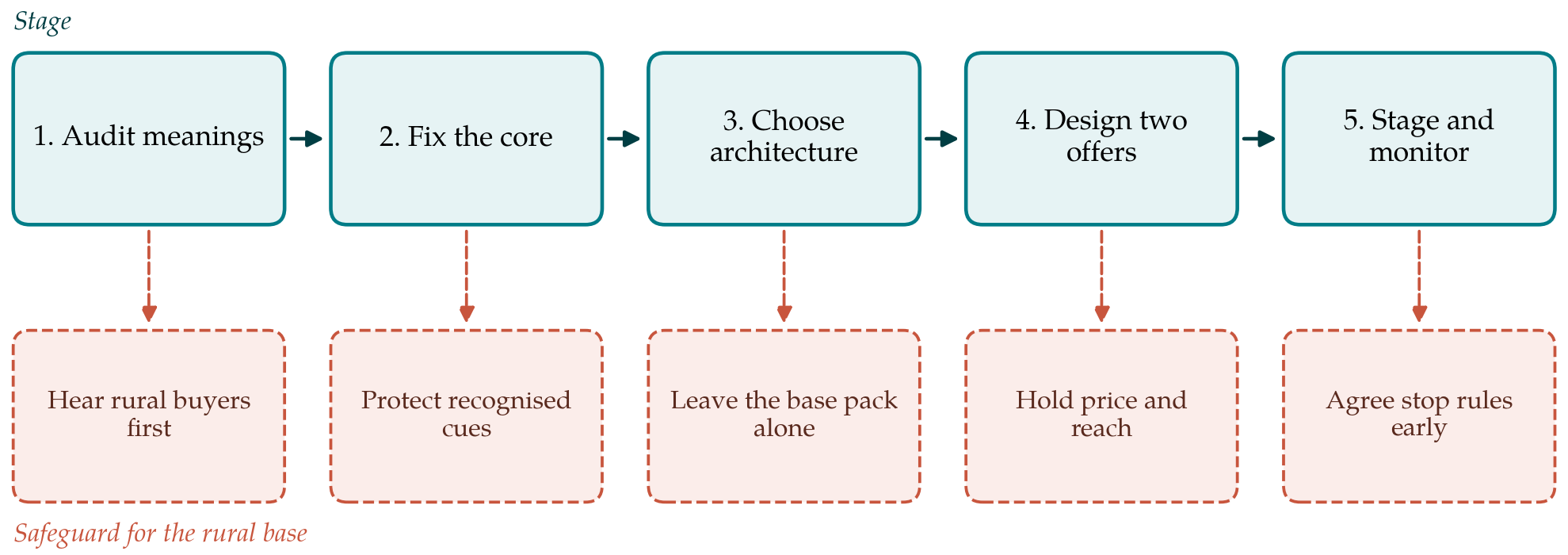
The framework has five stages, shown in Figure 1. Each stage is paired with a safeguard for the rural base, on the principle that the existing customer should be considered at every decision and not only at the end, when the new design is already fixed.
3.1. Stage 1: Audit what the brand means to each audience
The first task is to find out what is actually held in memory. For rural buyers this means qualitative work in the places where tea is bought and made: which features identify the pack, what the brand is trusted for, what would make a buyer suspect a change. Laddering interviews, which move from product attributes to their consequences and then to personal values, are suited to the purpose (Reynolds and Gutman, 1988). The same exercise is run with urban millennials. The planner also lists the brand's distinctive assets, the colours, shapes and phrases that trigger recognition, and how widely each is known (Romaniuk and Sharp, 2016). The safeguard at this stage is one of order: the rural study is commissioned first and reported first, so that its findings frame the brief for everything that follows.
3.2. Stage 2: Fix the core
The audit is then used to divide the brand's elements into those that are fixed and those that may be adapted. Table 1 offers a starting classification for a tea brand. It is a template for the audit to correct, not a finding. The governing rule is that anything rural buyers use to recognise or trust the brand is fixed unless there is strong reason otherwise, and that the heritage story is treated as common property of both audiences, to be told differently to each but never contradicted.
| Element | Role for the rural base | Scope for the urban offer | Suggested status |
|---|---|---|---|
| Name and logo | Asked for by name; main recognition cue | Retain beside a sub-brand name | Fixed |
| Pack colour and symbol | Found on the shelf by colour and emblem | Same palette in new formats | Fixed in base |
| Blend and taste | Familiar strength and colour in the cup | New variants: green, spiced, single-origin | Fixed in base |
| Price and pack size | Small, affordable units for daily purchase | Premium pricing for new formats only | Fixed in base |
| Distribution | Presence in small rural shops | Modern retail, cafes, online | Extended, not moved |
| Story and tone | Trust, family, hospitality | Provenance, craft, self-expression | Shared; tone adapted |
3.3. Stage 3: Choose the architecture
With the core fixed, the planner decides how the urban offer will be named. Aaker and Joachimsthaler (2000) describe a spectrum of options running from a single master brand, through sub-brands and endorsed brands, to wholly separate brands. For a heritage tea the two ends are unattractive. Changing the master brand itself puts the whole base at risk, and a separate brand throws away the heritage that is the main advantage with younger buyers. The framework therefore recommends a sub-brand or an endorsed range as the default: new formats carry the parent's name and symbol together with a descriptor of their own. The safeguard is that the base pack is left exactly as it is while the new range is introduced. Any modernisation of the base pack is treated as a separate, later project.
The choice between the two forms depends on what the audit shows. Where urban non-buyers respect the parent name, a sub-brand that leads with it is appropriate. Where the name itself is the obstacle, an endorsed range gives prominence to a name of its own and shows the parent as guarantor, which keeps some distance while still drawing on the heritage. The ownership findings of Kirmani et al. (1999) suggest that existing buyers of an everyday brand tend to accept an upward stretch, which is a further reason to prefer a visible link to concealment.
3.4. Stage 4: Design two offers and their channels
The urban range is then designed as a complete offer: product, pack, price, outlets and communication. Trade-offs between attributes such as format, origin claim and price can be explored with conjoint analysis before anything is produced (Green and Srinivasan, 1990). Separation of channels does much of the protective work. If the new range is sold where rural buyers seldom shop and advertised in media they seldom see, the two audiences rarely meet each other's version of the brand. Separation is never complete, since families span village and city and social media travel, so the urban communication should be checked for anything that a rural buyer would read as disrespect for the original. The safeguard is commercial: the price, pack sizes and rural distribution of the base product are held constant through the launch. Affordability in small units is central to low-income markets (Prahalad, 2005), and a base that sees its sachet price rise as a premium range appears will draw the obvious inference.
3.5. Stage 5: Stage the launch and monitor both audiences
The launch is staged, beginning with a limited number of cities, and monitored in both audiences. Among urban buyers the planner tracks awareness, trial and repeat purchase of the new range and whether it changes perceptions of the parent. Among rural buyers the measures are defensive: base volume by district, retailer stocking, and periodic checks on trust and on any belief that the product has changed. The safeguard is a set of stop rules agreed before launch. These state which movements in the rural measures would pause the roll-out, who decides, and what corrective action follows. Thresholds agreed in advance are harder to argue away than those invented under pressure.
4. Using the Framework in Practice
Three practical matters will shape how the framework is used. The first is the trade. Distributors and small retailers are often the first to hear rumours that a familiar product is changing, and they pass on reassurance or alarm. They should be told plainly that the base product is untouched. The second is the organisation itself. A heritage brand has custodians, among them long-serving staff, estate managers and sometimes a founding family, whose support Urde and colleagues treat as part of the heritage. The audit and the fixed core give them a defined role. The third is scale. A smaller company can compress the stages by using a modest qualitative audit and a single test city, but it should not drop the ordering, because the ordering is what keeps the rural customer in view.
A fourth matter is time. Habits in a staple category change slowly, and the measures in Stage 5 need a baseline taken before any change is visible in the market. Planners should allow at least one full seasonal cycle of tea buying before reading the rural figures, since festivals, harvest incomes and movements in tea prices all shift volumes for reasons unrelated to the brand. Judgements made in the first weeks, whether triumphant or alarmed, will mostly reflect noise.
5. Limitations and What Remains to Be Shown
The framework is proposed and has not been validated. It rests on research conducted mostly in other product categories and often in high-income markets, and its transfer to tea and to rural buyers in low-income settings is assumed, not demonstrated. Several of its premises could be wrong in a given case. Rural buyers may be less attached to pack cues than the framework supposes, or more pleased than offended to see their brand in fashionable form. Urban millennials may not value the heritage at all. Channel separation may prove weaker than hoped as smartphones spread.
The framework is also silent on matters that may decide the outcome. It assumes that the base product is of consistent quality, that the company can supply new formats to a standard that justifies a premium, and that competitors do not use the launch period to court rural retailers. It treats urban millennials and rural customers as two blocs, whereas each contains differences of income, region and language that an actual plan would have to respect.
Three kinds of evidence would be needed before the framework could be recommended firmly: documented applications by brand owners, with rural measures reported before and after; comparisons between sub-branded launches and redesigns of the master brand; and studies of how far communication aimed at city audiences reaches rural ones. Until such evidence exists, the framework is best used as a checklist of questions that a careful planner would ask in any case. Those who do apply it are encouraged to report the rural measures alongside the urban ones, including results that are unfavourable to the approach, so that later users can judge it on evidence.
6. Conclusion
A heritage tea brand does not have to choose between its past customers and its future ones, but it does have to decide in what order to consider them. The framework proposed here puts the rural base first at each of five stages: listen to it before writing the brief, protect what it recognises, leave its pack alone, hold its price and availability, and agree beforehand what would halt the launch. The urban offer is built around that fixed core as a sub-branded range that retells the same history. The approach is cautious by design, and whether its caution is justified is a question for practice to settle.
Conflict of interest
To be declared by the author(s) before publication.
Funding
To be declared by the author(s) before publication.