1. Introduction
Technetium-99m has been the principal radionuclide of diagnostic nuclear medicine for more than half a century. Its 140 keV gamma ray suits the gamma camera, its six-hour half-life limits patient dose while leaving time for imaging, and its chemistry allows it to be attached to a wide range of compounds supplied as freeze-dried kits (Richards et al., 1982; Eckelman, 2009). Bone, cardiac, renal, thyroid and lung studies all rely on it. The practical basis of this success is the generator: a shielded column on which the parent, molybdenum-99, is adsorbed and from which the daughter is washed out with saline as needed.
The generator solves the problem of distribution only in part. Molybdenum-99 decays with a half-life of about 66 hours, so roughly one per cent of any quantity is lost every hour, and a generator is useful for about a week. Nothing in the chain can be held in reserve. Every week, uranium targets must be irradiated, dissolved and purified, generators loaded and tested, and consignments flown to hospitals on several continents. When prolonged outages affected two of the main producing reactors, NRU in Canada and the High Flux Reactor in the Netherlands, in 2009 and 2010, examinations were postponed or cancelled in many countries (Gould, 2009; Ballinger, 2010; Van Noorden, 2013).
The extensive literature that followed dealt mainly with reactor capacity, economics and the conversion of targets from high-enriched to low-enriched uranium. Much less has been written about what security of supply means for countries that produce nothing, buy little and lie far from the processing sites. This review addresses that gap by reading the established literature with those countries in mind.
2. Scope and Approach
This is a narrative review of published material: reports of the OECD Nuclear Energy Agency and the United States National Academies, technical publications of the International Atomic Energy Agency (IAEA), and peer-reviewed articles on isotope production and on the state of nuclear medicine in low- and middle-income countries. Sources were chosen for their standing and relevance, and no systematic search was undertaken. The phrase "developing regions" is used loosely for settings with limited domestic production, small or dispersed demand and constrained health budgets. The review is confined to diagnostic imaging. Therapeutic radionuclides raise related but distinct supply questions and are not covered.
3. The Molybdenum-99 Supply Chain
Nearly all molybdenum-99 in commercial use has been made by fission of uranium-235 in targets irradiated in research reactors. The fission route gives a product of very high specific activity, which is what allows the very small mass of molybdenum involved to be held on a small alumina column and eluted in a few millilitres. After irradiation the targets are moved quickly to a processing facility, dissolved, and the molybdenum separated from the other fission products. The purified solution goes to generator manufacturers, who sell activity calibrated to a reference date several days ahead, a convention that makes the cost of decay in transit visible in the price (National Research Council, 2009).
The economic study carried out by the OECD-NEA (2010) set out why this chain proved fragile. For decades a handful of government-funded multipurpose reactors, most of them built in the 1950s and 1960s, supplied the bulk of world demand. Irradiation was priced as a by-product, at a level that did not cover a fair share of reactor costs, let alone replacement. There was consequently little commercial reason to build new capacity or to pay for idle reserve capacity that could be called on when a reactor went down. Processing was similarly concentrated, and each processor was tied by geography and target design to particular reactors. Figure 1 sets the stages of the chain beside the weakness most often associated with each.
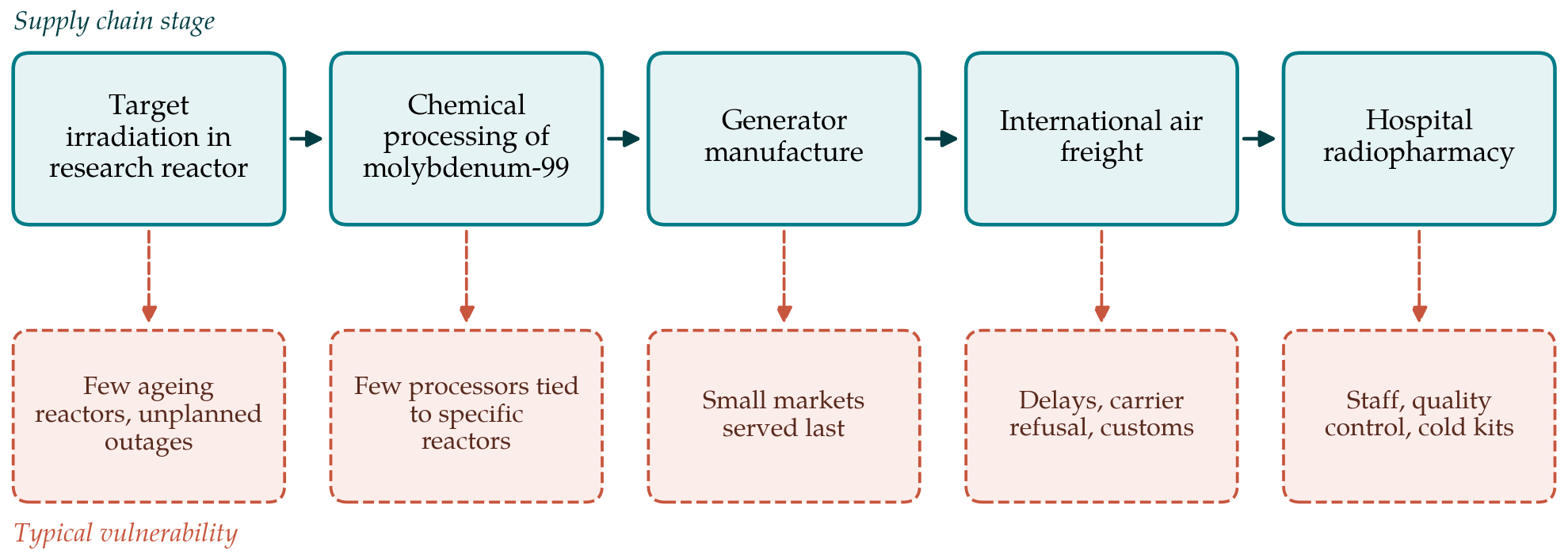
The policy response, developed through the NEA High-level Group on the Security of Supply of Medical Radioisotopes, rested on two ideas: that irradiation services should be priced at full cost, and that reserve capacity should be paid for by the supply chain (OECD-NEA, 2011). A later assessment by the National Academies (2016) found that supply had become more reliable, through better coordination of reactor schedules and new irradiation and processing capacity, while observing that progress toward full-cost pricing was uneven and that the system remained exposed to unplanned outages.
4. Alternative Production Routes
The shortage revived interest in ways of making molybdenum-99 or technetium-99m that do not depend on fission of enriched uranium in a few reactors. The main options are reviewed by Pillai et al. (2013) and in an IAEA report on non-HEU technologies (IAEA, 2013). They differ in maturity, and, more importantly for the present purpose, in how well they fit a small national programme. Table 1 summarises them.
| Option | Principle | Advantages | Limits in developing regions |
|---|---|---|---|
| Regional pooling and central radiopharmacy | Shared procurement and dispensing of unit doses | Better use of each generator, shared expertise | Needs transport links and agreed regulation |
| Option | Principle | Advantages | Limits in developing regions |
|---|---|---|---|
| Fission molybdenum-99 from LEU targets | Uranium-235 fission in research reactors, central processing | High specific activity, standard generators | Wholly imported, exposed to air freight and price |
| Neutron activation of molybdenum-98 | Capture in natural or enriched molybdenum targets | Simple targets, little waste, any research reactor | Low specific activity needs different generators |
| Cyclotron technetium-99m | Proton irradiation of enriched molybdenum-100 | Uses medical cyclotrons, no uranium | Serves only nearby sites, daily production |
| Accelerator molybdenum-99 | Photonuclear reaction on molybdenum-100 with electron linac | No reactor, no fission waste | Low specific activity, new facilities required |
| Gallium-68 generator | Long-lived germanium-68 parent yields PET nuclide on site | PET without a cyclotron, months of use | Costly generator, limited tracer range |
Neutron activation is the oldest alternative and the one most accessible to countries that already operate a research reactor. A molybdenum target is irradiated and the product used without the complex chemistry and waste of fission. The drawback is specific activity: the radioactive atoms are diluted in a far larger mass of stable molybdenum, which an ordinary alumina column cannot hold. Dash et al. (2013) assess the separation technologies that work around this, including gel generators, solvent extraction and column systems with high-capacity sorbents. Each is workable, and several have been used routinely in national programmes, but each demands more of the user than a conventional generator.
Direct production of technetium-99m in cyclotrons was proposed early in the shortage (Ruth, 2009; Guérin et al., 2010) and has since been demonstrated at a scale relevant to clinical use on conventional medical cyclotrons (Bénard et al., 2014). The IAEA has published guidance on targets, processing and quality control (IAEA, 2017). Because the product is the six-hour daughter and not the parent, it must be made daily and used within a short radius. The route therefore suits cities that already have a cyclotron with spare capacity and offers little to dispersed rural services.
5. Supply Conditions in Developing Regions
Surveys of nuclear medicine practice have documented wide disparities between and within regions. Dondi et al. (2011) reported that equipment and trained staff are concentrated in a limited number of urban centres in many developing countries, with large populations lacking any access, and Paez et al. (2015) described a similar unevenness across Latin America and the Caribbean. The Lancet Oncology Commission on imaging placed these findings in a global frame and argued that scaling up imaging, including nuclear medicine, would bring substantial health and economic returns (Hricak et al., 2021). Any such expansion presupposes a dependable supply of radionuclides, and four conditions distinguish that supply from the one seen by a hospital in a producing country.
5.1. Distance and transport
A generator shipped to a neighbouring country loses a few hours of activity. One that crosses two continents, changes aircraft and waits for customs clearance may lose a day or more, and the buyer pays for activity that has decayed. Radioactive consignments travel under the IAEA transport regulations (IAEA, 2018), which are well established, but compliance does not oblige a carrier to accept them. Refusal or delay of shipments by airlines and ports has been a recurring concern in international discussion of transport, and its effects fall hardest on destinations served by few routes. A missed connection can mean a week without a generator.
5.2. Small markets
Generator manufacturers allocate limited material according to contracts and volumes. A country that buys a few generators a week has little leverage, and during a shortage it is likely to be served after larger customers. The move toward full-cost pricing, sound as it is for the sustainability of production, raises prices for all buyers, and health systems that pay in a weak currency feel the increase most. The NEA analysis itself noted that the price of the isotope is a small part of the cost of a procedure in wealthy health systems (OECD-NEA, 2010); the proportion is less favourable where staff and overhead costs are low and imported consumables dominate.
5.3. Regulatory and radiopharmacy capacity
Using a generator safely requires a licensed facility, radiation protection arrangements in line with the international basic safety standards (IAEA, 2014), and a radiopharmacy able to elute, test and compound to an acceptable standard. IAEA operational guidance describes graded levels of hospital radiopharmacy practice and the staffing and quality systems appropriate to each (IAEA, 2008). Where these are thin, the alternatives to fission molybdenum are hardest to adopt, because low specific activity generators and locally produced radionuclides shift quality assurance from the manufacturer to the user. Supply security and human resource development are in this sense the same problem.
5.4. Dependence on a single source
Many small programmes rely on one supplier and one route. Diversification is the standard advice, but a second supplier requires a second product registration and enough volume to interest the vendor. Regional arrangements can help: joint procurement, a shared central radiopharmacy that dispenses unit doses to several hospitals, or supply from a research reactor in a neighbouring country. Such arrangements depend on harmonised regulation and reliable surface or air links, and they are easier to recommend than to build.
6. Positron Emitters
Positron emission tomography raises the supply question in a different form. Fluorine-18, with a half-life of about 110 minutes, cannot be imported over long distances at all. It is made in medical cyclotrons, whose characteristics and production methods are described in IAEA technical reports (IAEA, 2009), and distributed within a few hours' travel. Supply security for fluorine-18 is thus a matter of local infrastructure: the cyclotron, its maintenance, a stable electricity supply, enriched water and trained operators. A single machine serving a whole country is a single point of failure of a kind the technetium community knows well.
Gallium-68 offers a partial way round. It is eluted from a generator whose parent, germanium-68, has a half-life of about 271 days, so one generator serves a department for many months and can be shipped without urgency (Rösch, 2013). The range of tracers is narrower than for fluorine-18 and the radiochemistry is done on site, which again places demands on radiopharmacy skills (Velikyan, 2015). For a centre with a PET scanner and no cyclotron within reach, however, it changes the supply problem from a daily one to an occasional one.
7. Gaps and Future Work
The published record has clear limits. Demand and capacity projections are prepared for the world market and say little about delivery to individual low-income countries. Systematic data on how often generators arrive late, by how much, and with what loss of usable activity are not, as far as this review could establish, available in the open literature for most developing regions, although hospitals and distributors hold the records from which they could be compiled. Without them the reliability of supply is discussed by anecdote.
Comparative assessments of the alternative routes have also been written largely from a technical standpoint. What a ministry of health needs is an appraisal in its own terms: the cost per patient dose delivered, the staff required, the regulatory approvals involved and the consequences of a failure, for each realistic option in its own geography. Work of that kind, together with documentation of regional pooling arrangements where they exist, would add more to supply security in these regions than further refinement of global capacity forecasts.
8. Conclusion
Security of supply of diagnostic radionuclides has usually been framed as a question of how much molybdenum-99 the world's reactors can produce. For developing regions that framing is incomplete. They are affected by global capacity, but also, and more routinely, by the length and fragility of the route from processor to hospital, by their weak position as buyers, and by the limited radiopharmacy and regulatory capacity that determines which alternatives they can use. The measures most likely to help are correspondingly practical: transport facilitation, regional procurement and dispensing, investment in radiopharmacy staff, and selective adoption of activation-based molybdenum, cyclotron production and long-lived generator systems where local conditions suit them.
Conflict of interest
To be declared by the author(s) before publication.
Funding
To be declared by the author(s) before publication.