1. Introduction
An aneurysm that spans the diaphragm involves the segment of aorta from which the coeliac, superior mesenteric and renal arteries arise, and usually many of the intercostal and lumbar arteries that feed the spinal cord. Repairing it means replacing or excluding that segment while keeping the abdominal organs and the cord perfused. Open repair, developed and refined by Crawford and his successors, does this through a thoracoabdominal incision with the aorta clamped (Crawford et al., 1986). In experienced hands the results are good, yet the largest published experience still records meaningful rates of death, paraplegia, renal failure and respiratory failure, concentrated in the most extensive aneurysms and the least fit patients (Coselli et al., 2016).
The hybrid operation was introduced as a way round the most punishing parts of that procedure. Quiñones-Baldrich et al. (1999) reported bypass grafting to the visceral arteries through the abdomen followed by endovascular exclusion of the aneurysm, with no thoracotomy and no clamp on the thoracic aorta. Others adopted the approach for patients considered unfit for open repair (Black et al., 2006). The appeal is obvious. The difficulty is that the people selected for it are, by definition, those with the least reserve, and a laparotomy with four arterial reconstructions is far from a minor intervention.
This article does not describe a patient. It proposes a framework that a multidisciplinary aortic team could use when considering hybrid repair for a high-risk patient with a complex thoracoabdominal aneurysm. The framework draws on guidelines and on the published literature. It has not been tested prospectively, and that limitation is taken up in a later section.
2. Background
Thoracoabdominal aneurysms are described by the Crawford classification, which grades their extent from the left subclavian artery to the aortic bifurcation. Extent II, involving most of the descending thoracic and abdominal aorta, carries the highest risk of spinal cord injury after open repair, and extent IV, confined largely to the visceral and infrarenal segment, the lowest (Svensson et al., 1993). The classification remains the common language for comparing series and for estimating risk.
Three treatments now exist. Open repair is the reference. Wholly endovascular repair with fenestrated or branched stent grafts avoids both thoracotomy and laparotomy, and comparative series have reported outcomes that compete with open surgery in selected patients (Greenberg et al., 2008); it requires suitable anatomy, a device that is often made to order, and a centre with the necessary experience. Hybrid repair sits between the two. A meta-analysis of published hybrid series found that early mortality, spinal cord ischaemia and renal failure remained considerable, and its authors cautioned against regarding the procedure as low risk (Moulakakis et al., 2011).
Spinal cord injury is the complication that most shapes planning. The collateral network concept holds that the cord is supplied by an interconnected web of segmental, subclavian and hypogastric inputs, and that it tolerates the loss of segmental arteries if the remaining inputs and the perfusion pressure are preserved (Griepp and Griepp, 2007). A randomised trial in open repair showed that drainage of cerebrospinal fluid reduced paraplegia (Coselli et al., 2002), and a European position paper extends the same protective principles to endovascular and hybrid procedures (Etz et al., 2015).
3. The Proposed Framework
The framework has seven steps, listed in Table 1 with the question each answers and the record it should leave. They are intended to be worked through in order at one or more meetings of the aortic team, which should include vascular and cardiac surgery, interventional radiology, anaesthesia and, for older patients, geriatric medicine.
| Step | Question answered | Record |
|---|---|---|
| 1. Indication and anatomy | Does the aneurysm warrant repair, and what exactly must be treated? | Measured imaging report with extent |
| 2. Patient risk | Which organ systems and functional limits define the risk? | Structured assessment by system |
| 3. Comparison of options | Why hybrid, and why not open, endovascular or no repair? | Team decision with reasons |
| 4. Debranching design | Which inflow, which targets, in what order? | Operative plan and graft map |
| 5. Staging | One procedure or two, and how long between? | Stated interval and rationale |
| 6. Organ protection | How will cord and kidneys be protected? | Written perioperative protocol |
| 7. Surveillance | What imaging, when, and who acts on it? | Follow-up schedule |
3.1. Step 1: Confirm the indication and define the anatomy
The first question is whether the aneurysm should be repaired at all. Guidelines base the indication on diameter, rate of growth, symptoms and underlying cause, with repair of degenerative thoracoabdominal aneurysms generally considered at a diameter of about 6 cm and earlier in heritable disorders of connective tissue (Isselbacher et al., 2022; Riambau et al., 2017). Thin-slice computed tomographic angiography from the arch to the femoral arteries, analysed on a workstation with centreline reconstruction, should establish the Crawford extent, the proximal and distal landing zones, the origin and quality of each visceral and renal artery, the state of the iliac arteries as inflow and access, and the patency of the left subclavian and hypogastric arteries. Published reporting standards for thoracic endovascular repair supply a ready vocabulary for this description (Fillinger et al., 2010).
3.2. Step 2: Characterise what makes the patient high risk
The label high risk conceals different problems with different consequences. Severe obstructive lung disease argues strongly against thoracotomy and less strongly against laparotomy. Coronary disease and poor ventricular function, summarised for non-cardiac surgery by the revised cardiac risk index (Lee et al., 1999), bear on every option. Chronic kidney disease raises the stakes of renal bypass and of contrast exposure alike, and baseline function should be recorded in the terms used to define postoperative kidney injury (KDIGO, 2012). Frailty, assessed with an explicit instrument such as the phenotype of Fried et al. (2001), predicts poor recovery from any major operation. The team should write down which of these apply, because the argument for hybrid repair is strongest when the dominant risk is pulmonary and weakest when it is global frailty.
3.3. Step 3: Compare the options explicitly
Each of four courses should be considered and a reason recorded for setting it aside: open repair, fenestrated or branched endovascular repair, hybrid repair, and continued medical management with surveillance. The European guideline on descending aortic disease treats hybrid repair as an option for patients unfit for open surgery when a wholly endovascular solution is not feasible (Riambau et al., 2017). In practice that means anatomy unsuited to available devices, or an aneurysm too large or too symptomatic to wait for a custom-made graft. Declining to operate is a legitimate outcome of this step. If life expectancy is short for other reasons, or if no option offers a reasonable chance of returning the patient to an acceptable quality of life, the framework ends here with a documented discussion.
3.4. Step 4: Design the debranching
Debranching reroutes the blood supply of the abdominal organs so that the aortic segment bearing their origins can be covered. The plan should name the inflow site, usually a common iliac artery, the infrarenal aorta or an existing aortic graft, and confirm that it lies outside the intended distal landing zone. It should name each target vessel and the order of reconstruction, chosen so that only one organ is ischaemic at a time and for as short a time as possible. Each native origin is ligated or occluded after its bypass is completed to prevent retrograde filling of the aneurysm sac. Target arteries that are small, heavily diseased or already supplying a poorly functioning organ should be identified in advance, since a decision to sacrifice a vessel is better made at the planning table than in theatre.
3.5. Step 5: Decide between one stage and two
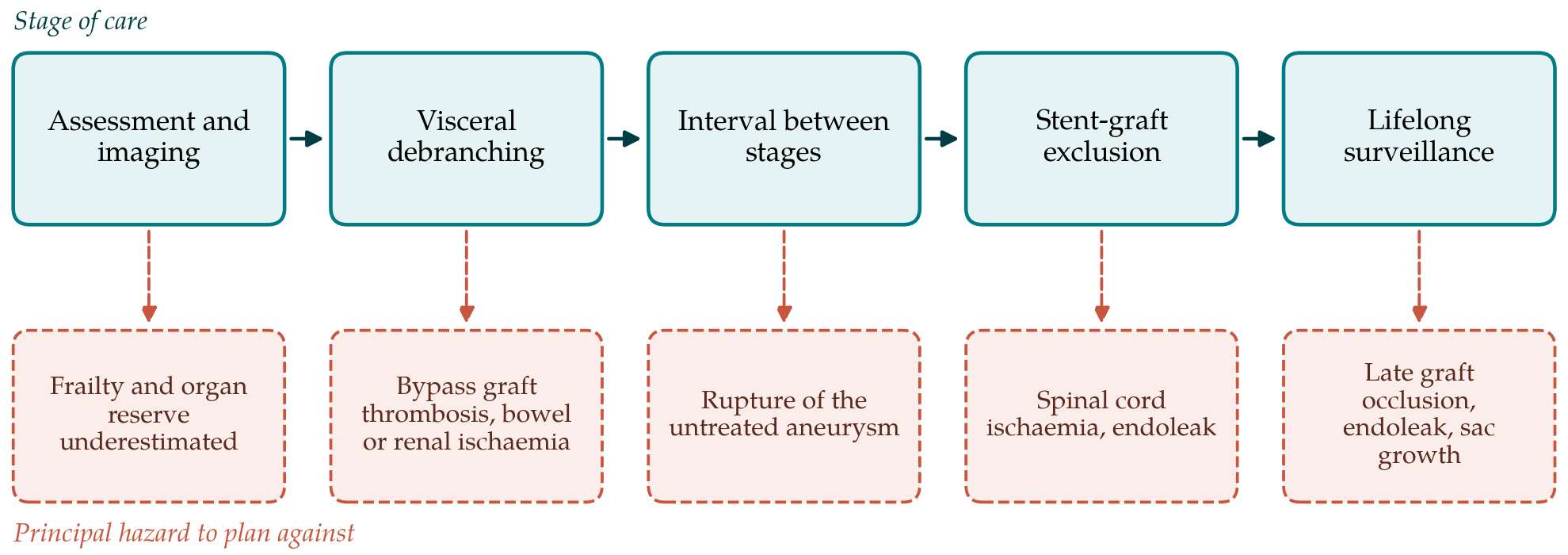
The stent graft can be deployed under the same anaesthetic as the bypass grafts or at a second procedure days or weeks later. A single stage removes the possibility that the aneurysm ruptures while the patient waits, and the abdominal aorta or the iliac limb of the bypass graft is available for access while the abdomen is open. A staged approach shortens each operation, lets the patient recover from the laparotomy, allows the kidneys to recover before contrast is given, and may give the spinal cord collateral circulation time to adapt, an argument that follows from the collateral network concept (Etz et al., 2015). Neither policy has been shown to be superior. The framework asks the team to choose, to state the planned interval, and to state what would trigger earlier completion, such as pain or rapid enlargement. Figure 1 sets the stages of care against the hazard that dominates each.
3.6. Step 6: Plan protection of the spinal cord and kidneys
Long coverage of the aorta, previous aortic surgery, an occluded subclavian or hypogastric artery and perioperative hypotension are the recognised contributors to cord ischaemia after endovascular exclusion. The protective measures endorsed in the position paper are maintenance of arterial pressure, cerebrospinal fluid drainage in patients at elevated risk, preservation or revascularisation of the left subclavian and hypogastric arteries, and early neurological assessment so that a deficit can be treated by raising the pressure and draining fluid (Etz et al., 2015). Drainage has complications of its own, and its use should be a recorded decision and not a reflex. For the kidneys the plan should limit ischaemic time during bypass, limit contrast volume, and avoid hypovolaemia and nephrotoxic drugs, in keeping with general guidance on acute kidney injury (KDIGO, 2012).
3.7. Step 7: Agree surveillance in advance
A hybrid repair is never finished in the way an open graft is. The bypass grafts can stenose or occlude, and the stent graft can leak at its ends, at its junctions or through collateral vessels. Guidelines recommend lifelong imaging after endovascular aortic repair (Erbel et al., 2014; Isselbacher et al., 2022). Before the operation the team should fix the schedule, choose the modality with renal function in mind, and name the clinician responsible for reviewing each scan. A patient who is unlikely to attend follow-up is a weaker candidate for a repair that depends on it.
4. Fitting the Framework to Practice
The framework assumes a centre that can offer all three operative options, or that has an agreed referral route to one that can. Where only open and hybrid repair are available, step 3 should include a recorded decision on whether referral elsewhere for endovascular assessment would serve the patient better. The earlier American guideline on thoracic aortic disease already advised that complex aortic surgery be concentrated in experienced units (Hiratzka et al., 2010), and nothing in the hybrid literature weakens that advice.
The steps also provide a structure for consent. A patient facing this decision needs to understand that the comparison is not between an operation and safety, but between several courses that each carry a serious chance of death or disability, including the course of doing nothing. Presenting the options in the order of step 3, with the team's reasons, gives the patient and family something concrete to weigh and to question.
5. Limitations and What Remains to Be Shown
The framework is a proposal and has not been validated. Its content reflects guidelines and case series, and case series of hybrid repair are small, retrospective and subject to selection that differs from one centre to the next. No randomised comparison of hybrid repair with open or branched endovascular repair exists, and one is unlikely given the rarity and variety of these aneurysms. The framework therefore organises a decision. It does not supply the probabilities on which the decision ultimately turns.
Several things would need to be shown before it could be recommended with confidence. It should be established that teams using it reach more consistent decisions than teams that do not, that the recorded reasons at step 3 correspond to what is later found at operation, and that the record improves the quality of registry data. As branched devices become more widely available, the group for whom hybrid repair is the preferred option is likely to shrink, and the framework will need revision to reflect that. It should also be said plainly that structured planning cannot remove the hazard of the operation, and may lead more often to a decision not to operate.
6. Conclusion
Hybrid repair offers a route to treating a complex thoracoabdominal aneurysm in a patient who cannot undergo thoracotomy and has no endovascular alternative, at a risk that published series show to be high. The seven-step framework proposed here asks the aortic team to justify the indication, to say precisely why the patient is high risk, to compare all the options including no repair, and to settle the design, staging, organ protection and surveillance before the first incision. Whether working in this way improves decisions or outcomes is a question for prospective study.
Conflict of interest
To be declared by the author(s) before publication.
Funding
To be declared by the author(s) before publication.