1. Introduction
Modern broilers reach market weight in a few weeks, and their skeleton and gait bear the cost. A large survey of commercial flocks in the United Kingdom found impaired walking to be widespread, with risk rising with age and differing with genotype and stocking density (Knowles et al., 2008). The causes range from developmental disorders of the growth plate to bacterial infection of bone and joint and contact dermatitis of the foot (Bradshaw et al., 2002). Lame birds change their behaviour: they lie for longer and visit the feeder less often (Weeks et al., 2000). They also select feed containing an analgesic when given the choice, which is evidence that the condition is painful (Danbury et al., 2000).
Detection depends on people. A stockworker removes birds that cannot reach feed or water, and welfare audits score the gait of a sample of birds late in the cycle. By then there is little that management can do for the flock in the house. An indicator that showed, in the third or fourth week, that walking ability was deteriorating faster than usual would allow lighting, feeding and litter management to be adjusted while they could still have an effect.
This article proposes a procedure for obtaining such an indicator from fixed overhead cameras. It describes the method and the reasoning behind each choice. It does not report an application to a flock, and the procedure remains to be validated.
2. Background
Two bodies of work underlie the design: the visual scoring systems that define what is meant by a gait score, and the attempts made so far to automate the assessment.
2.1. Visual gait scoring and its limits
The reference method is the six-point scale of Kestin et al. (1992), which runs from 0 for a bird that walks normally to 5 for a bird that cannot walk. Garner et al. (2002) tightened the category definitions to improve agreement between observers, and Webster et al. (2008) proposed a three-point version for use in the field. The six-point scale is the one adopted in the Welfare Quality protocol for broilers (Welfare Quality, 2009). All of these require an observer to make each bird walk and to judge it against a verbal description. Training is needed, scores drift between assessors and over time, and only a small sample can be scored in a house of many thousands of birds.
2.2. Automated approaches to date
Three lines of automation have been explored. The first treats the flock as a moving texture. Dawkins et al. (2009) computed optical flow from overhead video and found that the statistical distribution of flow across the image was related to the gait scores of the flock, without any bird being identified. The second measures activity. Aydin et al. (2010) showed that image-based activity differed between groups of birds with different gait scores, and Silvera et al. (2017) related the output of a commercial camera system to gait score in commercial flocks. The third follows individuals: Aydin (2017) derived step and speed variables from images of single birds, and kinematic studies have quantified how the gait of lame birds differs in velocity and stride characteristics (Caplen et al., 2012).
Flock-level methods are robust and cheap but say nothing about which birds are affected or how severely. Individual-level methods describe gait directly but have mostly been developed in corridors or pens with one bird in view. The procedure proposed here takes a middle course. It follows individual birds for short bouts in the ordinary house and reports a summary for the flock.
3. The Proposed Procedure
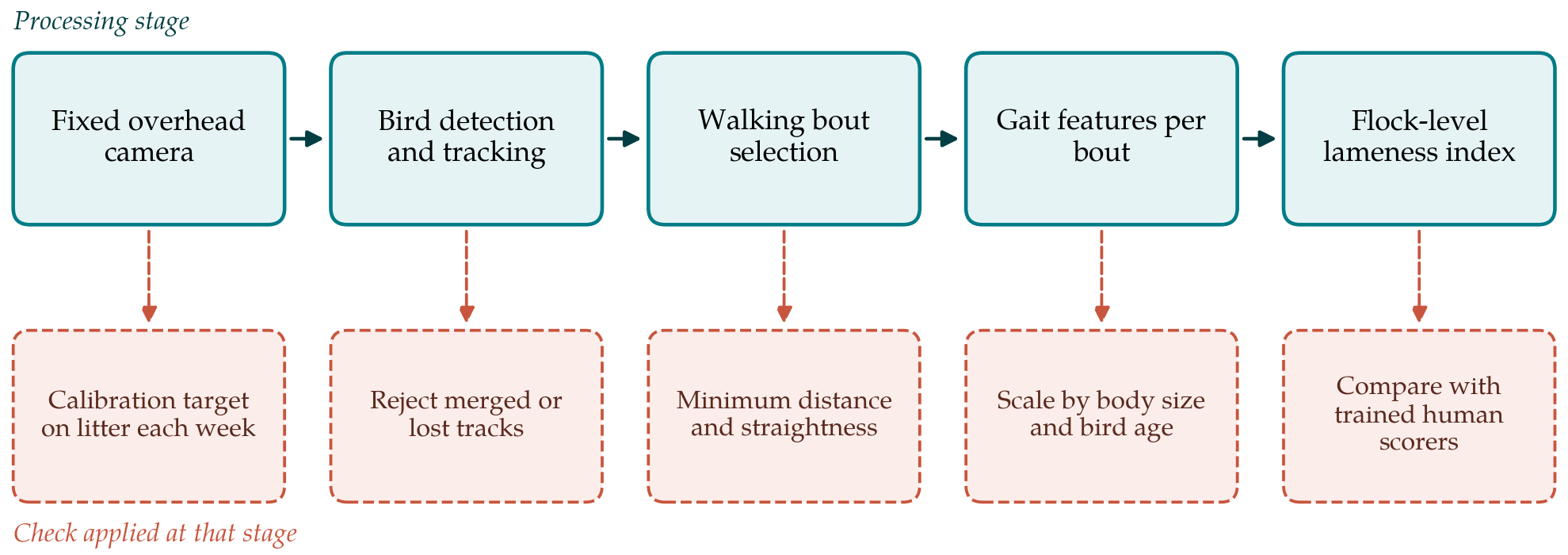
Table 1 lists the six parts of the procedure with the output of each. Figure 1 shows the processing chain and the check attached to each stage, since an automated measure is only as trustworthy as the controls on its inputs.
| Part | What is done | Output |
|---|---|---|
| 1. Camera set-up | Mount cameras vertically above open litter; calibrate image scale | Calibrated field of view |
| 2. Recording schedule | Record fixed periods daily under the same light phase | Comparable video segments |
| 3. Detection and tracking | Locate each bird in each frame and link positions over time | Tracks with identity and position |
| 4. Bout selection | Keep tracks in which a bird walks far enough in a nearly straight line | Usable walking bouts |
| 5. Gait features | Compute speed, bout length, lateral sway and tendency to sit | Feature values per bout |
| 6. Index and alert | Summarise features per day; compare with the expected course for age | Daily flock index and alert |
3.1. Part 1: Camera placement and calibration
Cameras are mounted on the roof structure looking straight down at areas of open litter between feeder and drinker lines, where birds must walk to reach resources. A vertical view avoids most occlusion of one bird by another and keeps the scale nearly constant across the image. Each camera is calibrated for lens distortion with a planar target, following the standard method of Zhang (2000), and a target of known size laid on the litter gives the conversion from pixels to distance. Because litter depth changes and cameras are knocked during cleaning, the scale check is repeated weekly.
3.2. Part 2: Recording schedule
Broiler activity varies with the lighting programme, feeding and the presence of staff. Segments are therefore recorded at fixed times in the light phase, away from routine inspections, and for long enough to yield an adequate number of walking bouts. A short period following the daily walk-through is recorded as well, since birds made to move by a passing person provide bouts comparable to those elicited in manual scoring.
3.3. Part 3: Detection and tracking
Birds are located in each frame with a convolutional object detector of the single-stage kind introduced by Redmon et al. (2016), trained on annotated frames from the house type and ages concerned. Detections are linked from frame to frame into tracks. White birds on pale litter at high density are a hard case, and tracks that merge or break are frequent late in the cycle. The procedure does not attempt to repair them. Any track in which two detections overlap or the identity is uncertain is discarded, on the principle that fewer clean bouts are preferable to many doubtful ones. Where finer description is wanted, markerless pose estimation can place points on the head, body centre and tail (Mathis et al., 2018).
3.4. Part 4: Selecting walking bouts
Most of what a broiler does is not walking. A bout is accepted when a tracked bird moves from rest, travels at least a set number of body lengths and does so without sharp turns. The thresholds are fixed before recording begins and expressed in body lengths, so that they scale with the growth of the bird.
3.5. Part 5: Gait features
Four features are computed for each bout, chosen because each corresponds to something a human scorer looks for in the scale of Kestin et al. (1992) and has support in the kinematic literature (Caplen et al., 2012). They are walking speed in body lengths per second, the distance covered before the bird stops, the side-to-side sway of the body centre about the line of travel, and whether the bout ends with the bird sitting down. Speed and distance fall, and sway and sitting increase, as gait worsens. Body length measured in the image serves to normalise the features and gives a rough check on growth.
3.6. Part 6: Flock index and alert rule
The features are standardised and combined into one value per bout, and the daily index is the proportion of bouts beyond a chosen cut-off together with the median. Gait deteriorates with age in every flock, so the index is read against a reference course for the genotype and house, built from earlier flocks. An alert is raised when the index departs from that course for several consecutive days. The weights, the cut-off and the alert rule are all quantities to be estimated in a validation study and cannot be stated in advance.
4. Checking the Index Against Human Scorers
The procedure can be trusted only to the extent that it agrees with competent visual scoring. The check proposed is simple in outline. On set days, two trained assessors independently score a sample of birds in the camera's field of view by the six-point scale, and the same birds are identified in the video by temporary marks. Agreement between the assessors is reported first, because it sets the ceiling for any automated method. Agreement between the bout-level value and the human score is then reported with weighted kappa (Cohen, 1968), which gives partial credit for near misses on an ordered scale. The ability of the daily index to distinguish flocks that later show a high prevalence of poor gait is a question of diagnostic accuracy and should be reported according to the STARD guidance (Bossuyt et al., 2015). Houses used to set the weights must be kept separate from those used to test them.
5. Fitting the Procedure to a Commercial House
Commercial houses are dusty, humid and dim. Cameras need sealed housings and lenses that can be wiped down, and light levels in many programmes are low enough that near-infrared illumination may be required. Processing on a small computer at the house avoids sending video over poor rural connections. A few cameras cover only a small part of the floor, and lame birds may avoid the open areas where the cameras look, so placement near resources matters. The procedure is intended to support the stockworker's daily inspection and the assessments required by welfare schemes. It is no substitute for either.
6. Limitations and What Remains to Be Shown
This is a proposed procedure and nothing in it has been validated here. It is not yet known whether clean tracks can be obtained in sufficient numbers at commercial density in the last weeks, when lameness is most prevalent and birds are most crowded. Birds that walk least contribute fewest bouts, so the index may understate severe lameness; the sitting and distance features are meant to offset this, but whether they do is an empirical matter. An overhead view cannot see the legs, and conditions that alter leg placement without changing speed or sway will be missed. A detector trained in one house type may fail in another. Finally, earlier warning is useful only if there is an effective response, and that link also needs to be demonstrated.
7. Conclusion
Overhead cameras offer a way to follow the walking ability of a broiler flock every day instead of once near slaughter. The procedure proposed here selects short, clean walking bouts from ordinary house video, describes them with four features tied to the established gait scale, and reports a daily index against the expected course for age. Each stage carries its own check. The value of the index for early detection is an open question that only a validation against trained scorers, across several houses and flocks, can settle.
Conflict of interest
To be declared by the author(s) before publication.
Funding
To be declared by the author(s) before publication.