1. Introduction
Writing about the natural world in Britain has long been composed in the past tense. Raymond Williams showed that each generation of English rural writing locates the true countryside a little earlier, in the childhood of the writer or of the writer's parents, so that the lament for a vanished order recedes like a moving staircase through the centuries (Williams, 1973). What has changed in the present century is the object of the lament. The loss recorded in recent books is less a way of life than the living world itself: farmland birds, insects, hedgerows, ice.
A vocabulary for the feeling involved has come from outside literary studies. Albrecht et al. (2007) proposed solastalgia for the distress of people whose home landscape is transformed around them, and Cunsolo and Ellis (2018) defined ecological grief as the grief felt in relation to experienced or anticipated ecological losses. Both terms have travelled quickly into journalism and into the humanities. They name an emotion, however, and say little about how that emotion is given shape on the page. That is a question about genre, structure and voice, and it belongs to criticism.
This article reviews what critics have written on that question for one national tradition: the British non-fiction of place and species that has been called the new nature writing since Cowley (2008) used the phrase for an issue of Granta. It asks which narrative forms the criticism identifies as vehicles of ecological grief, what objections have been raised against them, and where the scholarship is thin.
2. Scope and Approach
The review is narrative in kind. It draws on monographs, journal articles and essays that are widely cited in ecocriticism and in the study of contemporary British non-fiction, together with the social-science papers from which the term ecological grief derives. No database search with formal inclusion criteria was attempted, and the selection reflects a reader's judgement of which contributions have shaped the discussion. Primary texts are referred to only where the critical conversation treats them at length: the essay collections of Kathleen Jamie, the travel and landscape books of Robert Macfarlane, Helen Macdonald's H is for Hawk and Richard Mabey's Nature Cure. The discussion is confined to writing from England, Scotland and Wales published since the turn of the century.
3. Naming the Feeling
The concept of solastalgia came out of fieldwork in the Upper Hunter Valley of New South Wales, where residents lived beside expanding open-cut coal mines. Albrecht and colleagues described a homesickness felt by people who had not left home: the place had changed while they remained in it (Albrecht et al., 2007). Cunsolo and Ellis, working from research with Inuit communities in northern Canada and with farmers in the Australian wheatbelt, distinguished grief for physical losses already suffered, grief for the disruption of environmental knowledge and identity, and grief for losses that are anticipated (Cunsolo and Ellis, 2018). The third category matters for literature because it describes mourning in advance of the event, a temporal position that conventional elegy, which looks back at a death, does not occupy.
Philosophers and cultural theorists have supplied a second line of thought. Butler's account of grievability asks whose loss a community recognises as loss, and whose passes without public mourning (Butler, 2004). Essays collected by Cunsolo and Landman (2017) extend that question to rivers, species and landscapes, and treat the absence of rituals for such losses as a political fact. van Dooren (2014) presents extinction as a slow unravelling of relationships and not a single moment, and proposes that mourning is a way of learning what was entangled with the lost form of life. Head (2016) argues that grief is a necessary companion to any honest reckoning with the Anthropocene and that the cultural pressure to remain hopeful can prevent it from being acknowledged. Heise (2016) observes that stories of endangered species are overwhelmingly cast as elegy or tragedy, and that the choice of those templates shapes which species and which losses receive attention.
4. The New Nature Writing and the Pastoral Inheritance
The label new nature writing was a publishing event before it was a critical category. Cowley's introduction to the Granta issue distinguished the work he had gathered from an older pastoral and lyrical tradition and stressed that its authors wrote as participants in damaged places and not as detached observers (Cowley, 2008). The fullest academic account, by Smith (2017), organises the field by kinds of place and reads it as a literature preoccupied with how locality is made and known under conditions of environmental change.
The pastoral inheritance remains the usual starting point for formal analysis. Gifford (1999) separated the pastoral of idealised retreat from an anti-pastoral that exposes rural hardship, and proposed a post-pastoral that keeps the sense of awe while accepting responsibility for what is done to the land. Much of the criticism surveyed here can be read as testing whether recent prose earns that third term. Table 1 lists the books that recur most often in the discussion, with the kind of loss each addresses and the form through which it does so.
| Work | Loss addressed | Dominant form |
|---|---|---|
| Nature Cure (Mabey, 2005) | A personal breakdown set against a diminished home landscape | Recovery memoir with natural history |
| Sightlines (Jamie, 2012) | A mother's death; Arctic ice; whale skeletons in a museum | Linked essays of close attention |
| H is for Hawk (Macdonald, 2014) | A father's death; a managed and depleted countryside | Grief memoir, falconry narrative and literary biography |
| Landmarks (Macfarlane, 2015) | Disappearing words for features of land and weather | Essays with glossaries |
| Underland (Macfarlane, 2019) | Melting ice, buried waste and the deep future | Descent journey in three parts |
| Surfacing (Jamie, 2019) | Eroding coasts and thawing archaeological sites | Excavation essays and short fragments |
5. Forms of Mourning
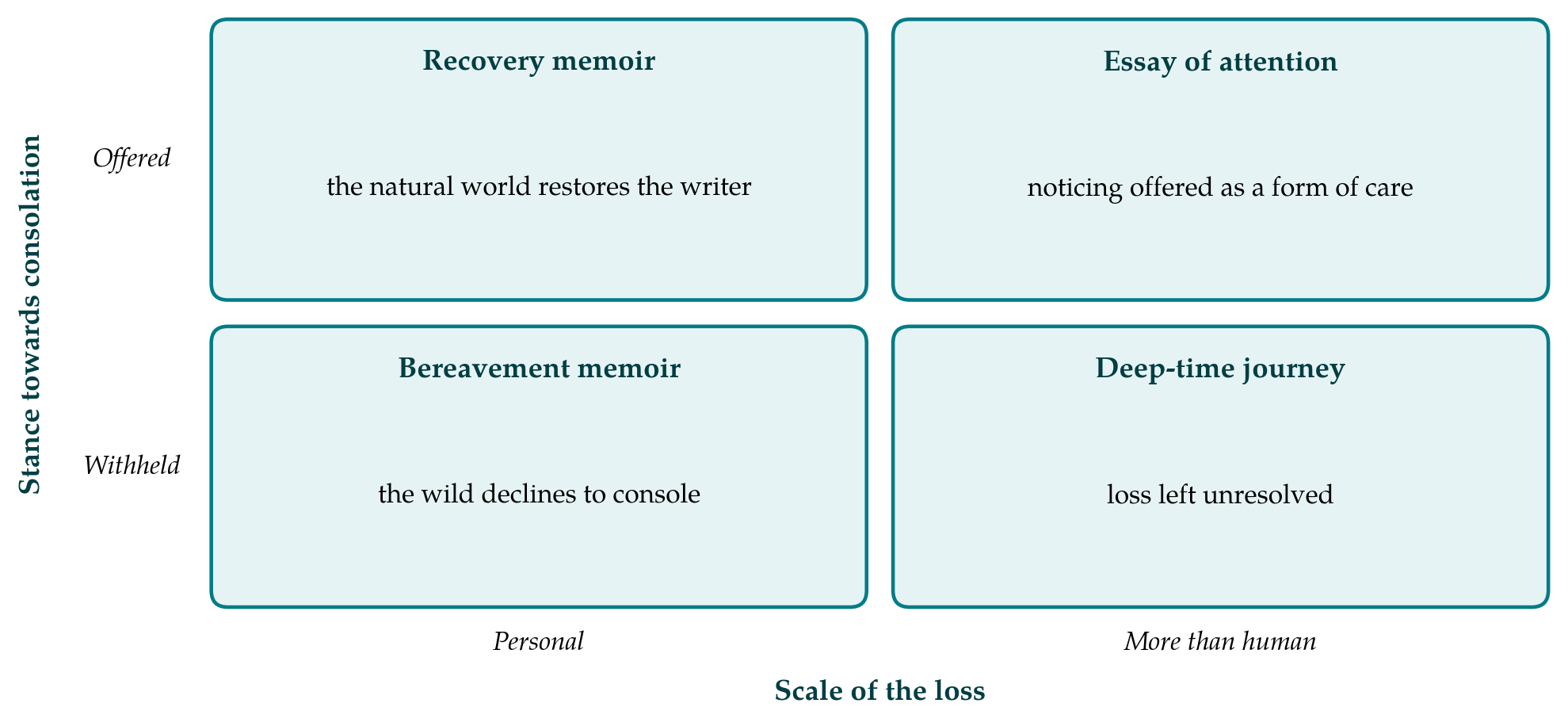
Across this criticism the elegiac mode is the common ground, and four book-length forms built on it can be distinguished. They are not exclusive, and several of the books in Table 1 combine two of them. Figure 1 arranges the four along two axes that the literature uses repeatedly: whether the loss mourned is primarily personal or extends to places and species, and whether the text moves towards consolation or withholds it.
5.1. Elegy and the question of consolation
The theory of elegy that critics bring to this prose descends from Freud's distinction between mourning, in which attachment to the lost object is gradually withdrawn, and melancholia, in which the loss is not relinquished (Freud, 1957). Sacks (1985) read the English elegy from Spenser to Yeats as a performance of successful mourning: the poem substitutes a figure, a flower or a star or the poem itself, for the dead and so arrives at consolation. Ramazani (1994) argued that the modern elegy characteristically refuses that bargain and stays with anger, guilt and unfinished grief.
Ecocritics have found Ramazani's version the better fit. A loss that is continuing, partly anticipated and partly caused by the mourner's own way of life cannot easily be closed by substitution. Morton (2007) goes further and argues that environmental writing has depended on an idea of Nature as a distant aesthetic object, and that an ecological criticism worth the name should remain with the melancholy that follows once that idea is given up. Clark (2015) adds the problem of scale: an individual scene of loss, however precisely rendered, sits awkwardly beside planetary processes, and inherited habits of literary attention may flatter readers that feeling strongly about a place is a response adequate to the facts.
5.2. Memoir: recovery and bereavement
The most commercially visible form has been the memoir in which a personal crisis is worked through in a landscape. Mabey's Nature Cure recounts a severe depression and a move from the Chilterns to Norfolk (Mabey, 2005). The book resists its own title: Mabey is sceptical of nature as therapy and insists that the wetland country he comes to know is itself drained, farmed and diminished. Even so, the arc is one of return to health, and the form invites the reading that the non-human world exists to restore the human one.
Macdonald's H is for Hawk is the test case for the darker variant. After her father's sudden death the narrator trains a goshawk and withdraws from human company, and the narrative is interleaved with a critical biography of T. H. White, who wrote about his own failed attempt to train the same species (Macdonald, 2014). The book can be read as a deliberate dismantling of the nature cure: identification with the hawk deepens the narrator's isolation, and recovery comes through people, not through wildness. The English countryside and the hawk itself are meanwhile shown as products of history, management and loss. The private bereavement gives the reader a recognisable structure of mourning, and the environmental loss travels inside it. Whether that is a strength, because it makes a diffuse grief legible, or an evasion, because the human death takes precedence, is disputed.
5.3. The essay of attention
Jamie's essays offer a different solution. They are short, unhurried and built around acts of looking: at gannets, at whale skeletons in a Bergen museum, at cells under a pathologist's microscope (Jamie, 2012). There is no single plot and no crisis to be resolved. The form is often connected to her well-known review of Macfarlane's The Wild Places, which objected to the figure of the solitary male adventurer who discovers wilderness on the reader's behalf and asked for a writing more alert to those who live and work in such places (Jamie, 2008).
For the study of ecological grief the interest of the form lies in what it does without. Loss is registered as a detail noticed, such as a shoreline that has moved, and the essay ends before a conclusion is drawn. In Surfacing the method is applied to archaeological sites exposed by coastal erosion and thawing ground, so that the recovery of a past and the evidence of a changing climate are the same event (Jamie, 2019). The stance is close to what Nixon asks of writing about slow violence: a way of making visible harm that is gradual, dispersed and undramatic (Nixon, 2011).
5.4. The journey into deep time
Macfarlane's work supplies the fourth form. Landmarks gathers regional words for features of land and weather and presents their disappearance from common use, and from a children's dictionary, as a narrowing of what can be noticed (Macfarlane, 2015). The elegy here is for language, and its consolation is the glossary: the lost word is put back into circulation.
Underland changes the scale. It is organised as a series of descents, into caves, mines, catacombs, glacial meltwater shafts and a repository for nuclear waste, and it sets human lifetimes against geological ones (Macfarlane, 2019). The book reads as an attempt to answer the objection about scale directly, by building deep time and deep futures into the structure of a journey. The question it raises is whether the traditional shape of the quest, with its returning narrator, can carry material that has no return. Its closing emphasis on what the present will leave to those who come after can be taken as a turn from grief to obligation, or as a consolation that the preceding chapters have not earned.
6. Objections to the Genre
The sharpest criticism has come from within. Cocker (2015) argued that the new nature writing had become a literary fashion more interested in the writer's sensibility and in fine prose than in the condition of the wildlife it described, and that it risked offering readers a pleasurable melancholy in place of knowledge or action. The charge is formal as well as political: a first-person, lyrical narrative centres the feeling subject, and grief becomes an accomplishment of style.
A second objection concerns who and what is left out. The landscapes mourned are disproportionately upland, coastal and remote, and the best-known authors share a narrow social and educational background. Loss as it is experienced in cities, on working farms or by communities with roots elsewhere appears less often, and Butler's question of whose grief counts can be turned on the genre itself (Butler, 2004). Heise's caution applies as well: an elegiac template selects charismatic and visible losses and may leave unglamorous ones, soil organisms or common insects, without a story (Heise, 2016).
7. Gaps and Directions for Further Work
Several limits of the existing scholarship are apparent. Most of it is concerned with a small number of prominent authors, and the same half-dozen books are asked to stand for the field. Writing in Welsh and Gaelic, where the loss of a language and the loss of a landscape have long been thought together, is seldom brought into the same frame as writing in English.
The link between text and reader is also largely assumed. Claims that a form consoles, numbs or mobilises are made on the evidence of the critic's own reading. Studies of how these books are actually read, by whom and with what consequences for feeling or conduct, would allow the central dispute, between those who see literary grief as a preparation for responsibility and those who see it as a substitute, to be argued on firmer ground. Finally, the social-science concept deserves closer scrutiny from literary scholars. Cunsolo and Ellis developed it with communities whose livelihoods depend directly on land and ice (Cunsolo and Ellis, 2018). Applying it to the leisure reader of a prize-winning memoir may stretch the term.
8. Conclusion
The criticism reviewed here agrees on more than its disputes suggest. It agrees that recent British non-fiction of place is elegiac in mode, that the classical elegy's movement to consolation fits ecological loss poorly, and that writers have responded by adapting other forms: the memoir of recovery or bereavement, the essay of attention, the journey through deep time. It disagrees about whether those adaptations make a diffuse and anticipatory grief available to readers or convert it into a private literary experience. For now the concept of ecological grief is best used in literary study as a question put to particular forms, and not as a label that explains them.
Conflict of interest
To be declared by the author(s) before publication.
Funding
To be declared by the author(s) before publication.