1. Introduction
When the first transgenic crops were approved, regulators had to decide what the object of assessment was. Two answers were given. In the United States and Canada the question asked was about the plant: does it have a novel trait, is it compositionally different, does it pose a plant pest or food safety concern. In the European Union the question asked was about the method: was the plant produced by a technique listed in the legislation, and if so the whole apparatus of authorisation applies regardless of what the plant turns out to be. For twenty years the difference was largely theoretical, because every crop in question carried a bacterial gene and both tests flagged it.
Genome editing has made the difference decisive. A crop carrying a deletion of a few bases in a susceptibility gene is, as a plant, indistinguishable from one carrying the same deletion after chemical mutagenesis, a technique that has produced thousands of commercial varieties under no particular scrutiny. The Court of Justice of the European Union held that organisms obtained by directed mutagenesis fall within the GMO Directive and are not covered by its mutagenesis exemption (Court of Justice of the European Union, 2018), while the same plant may be treated as conventional elsewhere (Waltz, 2016). The regulatory status of an identical seed now depends on where it was made (Jones, 2015; Wolt et al., 2016).
This article argues that the product-based test should be preferred, and makes that argument on distributional grounds rather than on the usual ones about scientific consistency. The question is not only which test is more logical but who bears the cost of the less logical one.
2. The Two Triggers in Practice
The practical difference is a matter of who must prove what. Under a process trigger, a developer who used an editing technique must assemble a dossier that typically includes molecular characterisation, compositional analysis, allergenicity and toxicity assessment, environmental risk assessment and a detection method, and must do so before a field trial in some jurisdictions. Under a product trigger, the developer first asks whether the plant could have been obtained by conventional breeding or mutagenesis; if it could, the obligation is often a notification and a record, and the full dossier is reserved for plants whose traits are genuinely new (Sprink et al., 2016).
Several countries have moved to a version of the second approach for edited plants that contain no foreign DNA, using a case-by-case determination of whether a novel combination of genetic material is present. Others have retained the process trigger. Table 1 summarises the main positions and the instruments behind them. The pattern is not a simple division between rich and poor countries: several agricultural exporters in Latin America adopted product-oriented determinations early, while some high-income jurisdictions have not (Menz et al., 2020).
| Feature | Process-based trigger | Product-based trigger |
|---|---|---|
| Question asked | Which technique produced the plant | What the plant is and what the trait does |
| Edited crop with no foreign DNA | Regulated as a GMO (Court of Justice of the European Union, 2018) | Often handled as a conventional variety (Menz et al., 2020) |
| Cost structure | Largely fixed per approval | Scaled to novelty of the trait |
| Treatment of chemical mutagenesis | Exempt by history rather than by risk | Assessed on the same basis as any other variety |
| Effect on small-market crops | Approval cost exceeds likely return | Approval cost can be met by a public programme |
| Main criticism | Inconsistent with the risk evidence (Sprink et al., 2016) | Harder to trace and to label (Jones, 2015) |
3. Why a Fixed Cost Falls Hardest on Smallholders
The core of the argument is arithmetic rather than ideological. A process trigger imposes a cost that is close to fixed: the dossier for a disease-resistant banana is not much cheaper to prepare than the dossier for a herbicide-tolerant maize, because the same studies are required. The return, by contrast, varies enormously with the size of the seed market. The consequence is a threshold below which no crop can be improved by these methods, whatever the benefit to the people who grow it.
Below that threshold sit most of the crops that matter to smallholder agriculture: cassava, cowpea, sorghum, pearl millet, teff, plantain and banana, pigeonpea, sweet potato, and the vegetable landraces grown and saved locally. These are crops with no large proprietary seed market, often propagated vegetatively or from saved seed, and developed when they are developed at all by national research institutes and international centres working on public budgets. The evidence from the transgenic era is that regulatory cost and delay, rather than scientific difficulty, kept such crops out of farmers hands (Paarlberg, 2008; Smyth, 2017), and the figure shows the allocation problem in general form. Figure 1 maps assessment depth against the novelty of the resulting plant and identifies the quadrant where a process trigger places the familiar edited crop.
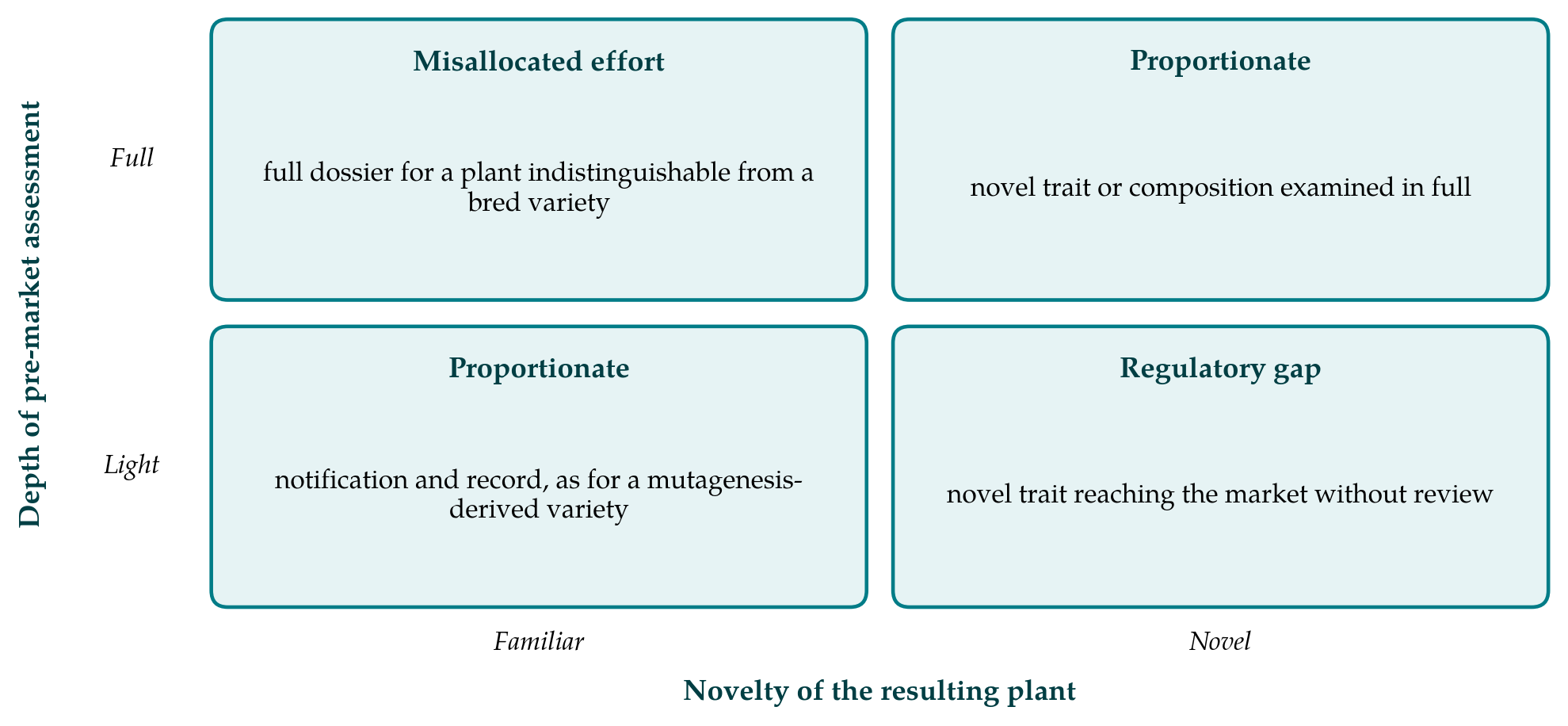
The traits in question are also the kind for which editing is unusually well suited. Resistance to bacterial blight or to a viral disease is often conferred by disabling a host susceptibility gene, which is a deletion and needs no foreign DNA. Reducing an antinutrient, removing a toxin, extending shelf life or delaying bolting are similar cases. These are subtractive changes, close to what mutation breeding has done for decades, and they are exactly the changes that a product-based assessment would recognise as familiar (Zaidi et al., 2019; Tripathi et al., 2019).
There is a second distributional effect. Where approval is expensive, only organisations with regulatory departments can obtain it, which concentrates the technology in a small number of large firms. That concentration is itself one of the principal objections raised against agricultural biotechnology, and a process trigger makes it worse rather than better. The experience of insect-resistant cotton in India, where smallholders adopted the technology widely and where the economic analysis has been examined closely (Kathage and Qaim, 2012; Qaim, 2009), shows that uptake by small farms is not the obstacle; getting a product to the point of release is.
4. The Counter-Arguments
Three objections deserve a serious answer. The first is that process matters because unintended effects depend on how a change was made. Off-target edits and tissue culture variation are real, but they are not peculiar to editing, and the comparator is not an unchanged plant: it is a variety produced by chemical or radiation mutagenesis carrying thousands of uncharacterised changes. The assessment of genetically engineered crops conducted by the National Academies found no evidence that the method of production as such predicts risk (National Academies of Sciences, Engineering, and Medicine, 2016), and a product trigger does not prevent a regulator from asking for molecular data where the trait warrants it.
The second is consumer choice. If edited crops are not tracked, a consumer who wishes to avoid them cannot. This is a legitimate interest, but it is an interest in labelling and in supply chain documentation, not in pre-market risk assessment, and conflating the two makes both work badly. Organic certification already operates as a process-based standard without governing food safety approval, and a similar separation is available here.
The third is trade. A country that exempts edited crops risks shipments being rejected by importers that do not, and for an exporting economy that risk is immediate while the benefit is diffuse (Smyth, 2017). This is the strongest objection and it is not answerable by argument within one jurisdiction. It is, however, an argument for convergence, and the international instruments that exist, the Cartagena Protocol and the Codex principles for foods derived from modern biotechnology (Secretariat of the Convention on Biological Diversity, 2000; Codex Alimentarius Commission, 2003), were written with enough generality to accommodate a product-oriented reading.
A fourth objection is political rather than technical. Opposition to agricultural biotechnology is organised around the category of the genetically modified organism, and moving edited crops out of that category can be read as evading a debate rather than resolving it (Herring, 2008). Regulators who take the product route should expect that reading and should meet it with transparency about what was changed and why, rather than with silence.
5. What a Product-Based System Would Have to Provide
Preferring the product trigger is not the same as preferring deregulation. A workable system needs a published definition of what counts as achievable by conventional breeding, applied by a competent authority rather than asserted by the developer. It needs a public register of determinations, so that the reasoning is visible and so that a later concern can be traced to the crops it affects. It needs post-release monitoring proportionate to the trait, with real capacity to act. And it needs the determination to be free or nearly free for public-sector applicants, since a fee that is trivial for a multinational is prohibitive for a national institute.
None of this is beyond the capacity of a middle-income regulator, and several have built it already. What it requires is a decision to assess the plant rather than the laboratory it came from.
6. Conclusion
The process trigger was a reasonable approximation when the technology it governed was uniform. It has become a poor one, and the cost of keeping it is not distributed evenly. Large firms working on large markets absorb regulatory cost as a line item; public breeding programmes working on cassava and cowpea cannot. A product-based system, properly specified and publicly accountable, would apply scrutiny where novelty actually lies and would let the modest, subtractive edits that smallholder crops most need reach the farmers who would use them. The case for it rests less on consistency than on who is kept out by the alternative.
Conflict of interest
To be declared by the author(s) before publication.
Funding
To be declared by the author(s) before publication.