1. Introduction
Titanium and its alloys are chosen for airframes, engine components, chemical plant and orthopaedic implants because few other metals offer the same balance of strength, density and corrosion resistance (Lütjering and Williams, 2007). The same alloys have a poor reputation wherever surfaces must slide. Under unlubricated contact titanium tends to adhere to the opposing body, to transfer material and to generate loose debris, and designers have usually responded by coating, nitriding or otherwise modifying the surface instead of relying on the bulk alloy (Budinski, 1991).
Additive manufacturing (AM) has become an established route for titanium components over the past two decades. Powder bed fusion with a laser or an electron beam, and directed energy deposition, build parts layer by layer from powder or wire, which suits an expensive metal that is difficult to machine (Herzog et al., 2016). The thermal history of these processes differs sharply from that of casting or forging. Melt pools are small, cooling is rapid and each layer is reheated by those deposited above it, so the resulting microstructures, residual stresses and defects have no close equivalent in conventionally processed stock (DebRoy et al., 2018).
Mechanical properties of AM titanium have been reviewed many times, with attention concentrated on tensile and fatigue behaviour (Lewandowski and Seifi, 2016; Liu and Shin, 2019). Tribological behaviour has received less systematic treatment, although AM parts increasingly include bearing surfaces, threads, sliding joints and implant interfaces. This article reviews what is known about friction and wear of AM titanium alloys in dry sliding, and asks whether the change of manufacturing route alters the long-standing picture of titanium as a metal that wears badly.
2. Scope and Approach
The article is a narrative review of the published literature. It draws on established texts and reviews of titanium metallurgy and of AM, on the classical studies of titanium wear, and on experimental papers that compare AM titanium with cast or wrought material in unlubricated sliding. No formal search protocol was applied and no claim of completeness is made. Coverage is limited to commercially pure titanium (CP-Ti) and Ti-6Al-4V, which account for most of the reported work, and to sliding in ambient air at room temperature. Lubricated sliding, fretting, tribocorrosion in simulated body fluid and titanium matrix composites are mentioned only where they clarify the dry sliding case.
3. Why Conventional Titanium Wears Poorly
Any assessment of AM titanium needs the behaviour of wrought material as its reference. The classical account attributes the poor wear resistance of titanium to a combination of properties. The metal has a low resistance to plastic shearing and work hardens little, so surface layers deform readily under tangential load. Its native oxide film is thin and is easily broken, exposing reactive metal that bonds to the counterface. Its thermal conductivity is low, so frictional heat is concentrated at the interface and the contact temperature rises faster than it would on steel or aluminium under the same conditions (Budinski, 1991; Hutchings and Shipway, 2017).
Molinari et al. (1997) examined Ti-6Al-4V in dry sliding and described two regimes: oxidative wear at low sliding speeds, where a brittle surface oxide forms and spalls without protecting the metal, and delamination at higher speeds, where subsurface plastic deformation leads to the detachment of metallic flakes. Straffelini and Molinari (1999) showed that the outcome also depends on the counterface and on the combination of load and speed. Work with metallic, polymeric and ceramic counterfaces has confirmed that transfer of titanium to the opposing surface is common and that friction traces are often unsteady (Qu et al., 2005). Against hardened steel, increasing the sliding speed can change both the wear rate and the dominant mechanism (Alam and Haseeb, 2002).
These observations sit within general frameworks of sliding wear. The Archard relation takes wear volume to be proportional to load and sliding distance and inversely proportional to hardness (Archard, 1953), and wear-mechanism maps set out how the governing mechanism shifts with contact pressure and velocity (Lim and Ashby, 1987). On many alloys a compacted, oxidised layer of debris forms at elevated interface temperature and lowers wear (Stott, 1998). On titanium the mechanically mixed layer produced by transfer and back-transfer (Rigney, 2000) is generally reported to be poorly adherent at room temperature, which is one reason why hardness alone predicts titanium wear less well than the Archard relation would suggest.
4. What Additive Manufacturing Changes
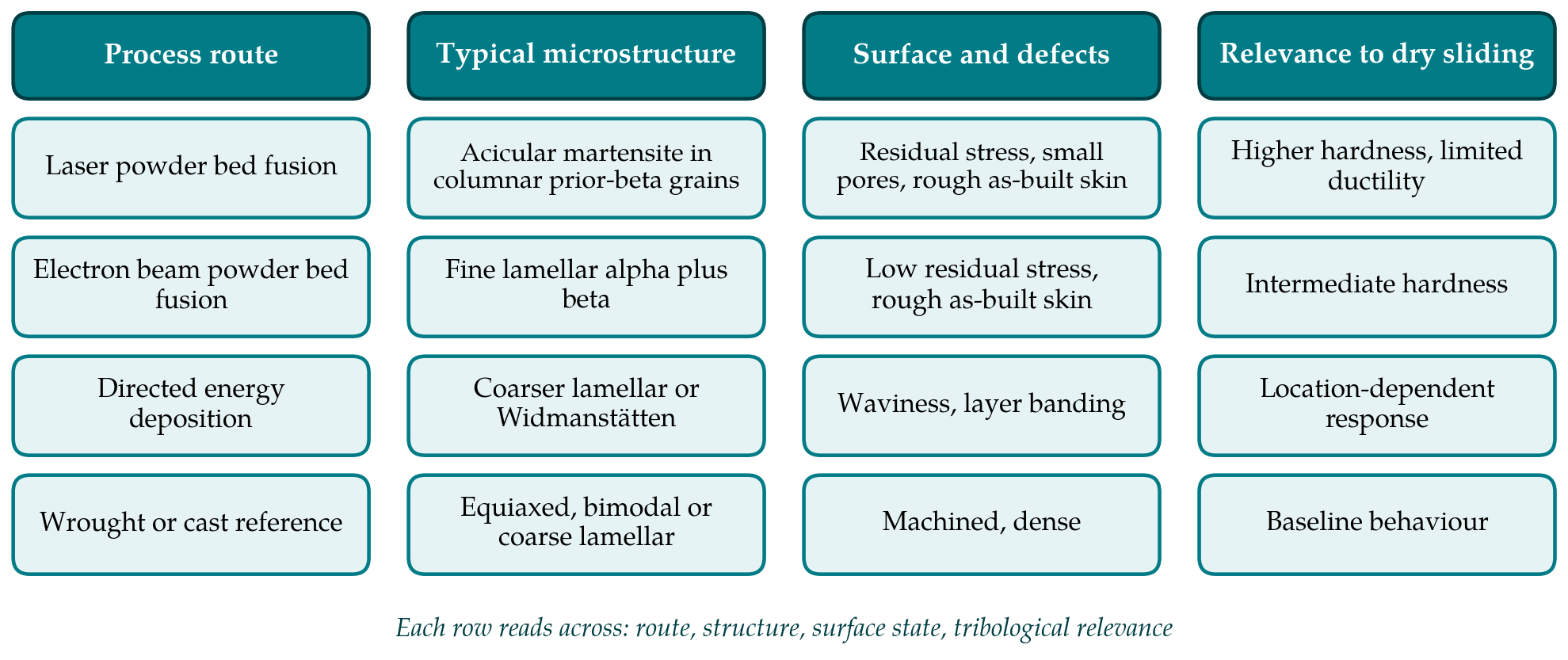
The features of AM titanium that matter for sliding contact can be grouped under microstructure, defects and surface condition. Figure 1 summarises how they differ between the main process routes and the conventional reference.
4.1. Microstructure and hardness
In laser powder bed fusion the cooling rate is high enough for the beta phase of Ti-6Al-4V to transform to acicular alpha prime martensite, arranged within columnar prior-beta grains that grow through successive layers along the build direction (Thijs et al., 2010). The as-built alloy is stronger and harder than annealed wrought material and less ductile. Electron beam powder bed fusion holds the powder bed at elevated temperature throughout the build, so the martensite decomposes in situ and the final structure is a fine lamellar mixture of alpha and beta with lower residual stress (Murr et al., 2009). Directed energy deposition uses larger melt pools and usually gives coarser structures that vary with position in the part (DebRoy et al., 2018).
Post-build heat treatment complicates the comparison. Stress relief and annealing below the beta transus decompose the martensite of laser-processed Ti-6Al-4V into alpha and beta lamellae, restoring ductility at the cost of strength and hardness (Vrancken et al., 2012). Hot isostatic pressing, commonly specified for fatigue-critical parts, closes internal pores and coarsens the structure further. A part described simply as additively manufactured may therefore present anything from a hard martensitic surface to one barely distinguishable from mill-annealed plate.
4.2. Porosity, residual stress and surface condition
AM material can contain gas pores and irregular lack-of-fusion voids, the latter usually lying between layers. Process parameters that give insufficient energy input leave unmelted regions, while excessive input can cause keyhole porosity (Herzog et al., 2016). Laser powder bed fusion also leaves substantial residual stress unless parts are stress relieved. The as-built surface carries partly fused powder particles and layer steps, so it is far rougher than a machined surface, and its roughness depends on orientation relative to the build direction (Liu and Shin, 2019). Most tribological specimens are ground and polished before testing, which means that reported results describe the bulk material and not the surface a part would have if used as built.
5. Reported Dry Sliding Behaviour of AM Titanium
Experimental comparisons of AM and conventional titanium share a common design: flat specimens cut from AM builds and from cast or wrought stock are polished and slid against a harder ball or pin, and wear volume, friction coefficient and worn surface morphology are compared. Table 1 gathers the main factors that these studies and the wider literature identify, with the direction of their reported or expected effect.
| Factor | Origin in the AM process | Reported or expected influence on wear | Representative sources |
|---|---|---|---|
| Fine or martensitic structure | Rapid solidification and cooling | Higher hardness; wear resistance equal to or better than cast material | Attar et al., 2015; Bartolomeu et al., 2017 |
| Build temperature | Heated powder bed in electron beam processing | Lamellar structure; wear resistance reported above the as-cast alloy | Toh et al., 2016 |
| Porosity | Insufficient or excessive energy input | Lower load-bearing area; pores can initiate cracking and trap debris | Gu et al., 2012 |
| Heat treatment | Stress relief, annealing, hot isostatic pressing | Lower hardness, higher ductility; effect on wear seldom isolated | Vrancken et al., 2012 |
| Anisotropy | Columnar grains along the build direction | Orientation-dependent response; findings not consistent | Thijs et al., 2010 |
| Surface oxide | Unchanged by the process route | Thin, non-protective film; surface treatment still needed | Dong and Bell, 2000 |
5.1. Wear resistance relative to cast and wrought material
For commercially pure titanium, Gu et al. (2012) related the densification, microstructure and wear performance of laser-processed material to the processing parameters and found that the parameter sets giving dense, refined, martensitic structures also gave the best wear performance. Attar et al. (2015) compared laser-processed and cast CP-Ti directly and reported better wear resistance for the AM material, which they attributed to its finer martensitic microstructure and higher hardness. The comparison is helpful because CP-Ti has no second phase and no alloy partitioning, so the difference can be assigned to structure and defect content.
For Ti-6Al-4V the reported picture is similar. Toh et al. (2016) compared electron beam melted parts with the as-cast alloy and reported superior wear resistance for the AM material, in line with its higher hardness. Bartolomeu et al. (2017) tested alloy made by selective laser melting, hot pressing and casting against an alumina counterbody and again associated the best wear behaviour with the route giving the hardest and finest structure. Taken at face value these studies suggest that AM does no harm to the wear resistance of titanium and may improve it. The size of the reported advantage varies from study to study, however, and none of the papers claims that the AM alloy becomes a wear-resistant material in any absolute sense.
5.2. Mechanisms on the worn surface
The worn surfaces described for AM titanium show the features long known from wrought alloys: ploughed grooves parallel to the sliding direction, smeared and adhered patches, delaminated platelets, and fine oxidised debris that acts as a third body. Authors accordingly describe the wear as a mixture of abrasion, adhesion, delamination and oxidation, with the balance depending on load and speed in the manner set out by Molinari et al. (1997) for the conventional alloy. No mechanism peculiar to AM material has been established. What differs is the resistance of the near-surface layer to plastic flow. A martensitic or fine lamellar structure resists subsurface shear more strongly than a coarse one, which is consistent with the shallower grooves and lower wear volumes that the comparative studies report.
Porosity introduces a complication. A pore that intersects the sliding surface reduces the real load-bearing area and provides an edge at which cracks can start, and partially bonded powder particles may be pulled out and become abrasive debris. The association between density and wear performance found by Gu et al. (2012) is consistent with this reasoning. Open pores can also collect debris and so remove abrasive particles from the contact, an effect well known from sintered materials, and the net outcome for titanium has not been resolved.
5.3. Friction
Friction receives less comment than wear in this literature, and for good reason. The friction coefficient of titanium in dry sliding is governed mainly by adhesion and transfer at the interface, which depend on the counterface material and the environment more than on the microstructure beneath (Qu et al., 2005). Studies that compare AM and conventional titanium generally report friction coefficients in the same range for both, with the irregular traces typical of a contact in which transfer layers repeatedly form and break away. There is little evidence that the manufacturing route by itself changes the frictional behaviour of the bare alloy.
6. Test Methods and the Problem of Comparability
Most of the studies cited use a pin-on-disc or ball-on-flat arrangement of the kind standardised in ASTM G99 (ASTM International, 2017) or a linearly reciprocating ball-on-flat test as in ASTM G133 (ASTM International, 2016). Within one study the conditions are held fixed and the ranking of materials is meaningful. Between studies almost everything varies: the counterface may be bearing steel, alumina, silicon nitride or cemented carbide; loads, speeds and sliding distances differ by large factors; humidity is often unreported; and wear is expressed variously as mass loss, volume loss, track width or specific wear rate.
Since titanium wear is sensitive to the position of the test on the load and speed map (Lim and Ashby, 1987; Straffelini and Molinari, 1999), absolute wear rates from different laboratories cannot be pooled, and statements such as "AM titanium wears less than wrought titanium" are safe only as summaries of within-study rankings. The description of the AM material is often incomplete as well. Density, heat treatment, build orientation of the tested face and the depth of material removed in preparation all bear on the result and are not always given.
7. Gaps and Directions for Further Work
Several questions follow from the state of the literature. The first concerns the as-built surface. Parts with internal channels or lattice regions cannot be machined everywhere, and the sliding behaviour of a surface carrying sintered particles and a different near-surface microstructure is largely uncharacterised. The second concerns heat treatment. Service parts are rarely used as built, yet the comparative wear studies mostly test the as-built condition, in which hardness is highest. Whether the advantage over cast material survives stress relief or hot isostatic pressing has seldom been tested directly.
A third question is anisotropy. Columnar prior-beta grains and layered defects make it plausible that wear depends on whether sliding takes place on a plane parallel or perpendicular to the build direction, but the published findings do not agree. A fourth is the interaction between AM substrates and the surface treatments that titanium needs in any serious tribological duty. Thermal oxidation, for example, is known to improve the wear resistance of conventional titanium markedly (Dong and Bell, 2000), and the response of a martensitic, residually stressed substrate to such treatments deserves systematic study. Finally, the field would benefit from a small number of agreed test conditions and reporting items so that results from different laboratories could be set side by side.
8. Conclusion
The published evidence supports a measured view. Additively manufactured CP-Ti and Ti-6Al-4V wear in dry sliding by the same combination of adhesion, abrasion, delamination and oxidation as their cast and wrought counterparts. Where direct comparisons exist, the finer and harder structures produced by powder bed fusion usually give wear resistance that matches or modestly exceeds that of the conventional alloy, provided the material is dense. Friction is essentially unchanged. The underlying weaknesses of titanium as a sliding material, a non-protective oxide and a strong tendency to transfer, are properties of the metal and not of the manufacturing route, so surface engineering remains necessary. Firmer conclusions await studies that test heat-treated and as-built surfaces, report the material condition fully and use comparable test conditions.
Conflict of interest
To be declared by the author(s) before publication.
Funding
To be declared by the author(s) before publication.