1. Introduction
The apple orchard of the last half century has been reshaped by the rootstock. Trees on vigorous seedling roots took a decade or more to fill their space and formed large, round canopies whose interiors were dark. Clonal dwarfing rootstocks, of which M.9 is the best known, produce trees a fraction of that size that crop within two or three years of planting, and this precocity is what makes it economic to plant several thousand trees per hectare (Webster and Wertheim, 2003; Robinson, 2003). The shift has been described and analysed many times, and the general biology behind it is set out in standard texts (Jackson, 2003).
For red and bicoloured cultivars, yield is only part of the return. Packing standards grade fruit by the share of the surface that is red and by the depth of that colour, and poorly coloured fruit is downgraded however good its eating quality. Red colour in apple skin is due to anthocyanins, mainly cyanidin 3-galactoside, and their synthesis depends on light reaching the fruit itself (Saure, 1990; Lancaster, 1992). Anything that changes where the fruit hangs in relation to the light, including the rootstock, can therefore be expected to change colour.
This article reviews the published evidence on that chain of influence: from rootstock to canopy, from canopy to light, and from light to pigment. It asks in particular how far the better colour commonly associated with dwarf trees is an effect of the rootstock as such and how far it follows from the tree form and planting system that the rootstock allows.
2. Scope and Approach
The article is a narrative review of the published literature. It draws on the foundational papers on orchard light relations, on the physiological and molecular literature on anthocyanin synthesis in apple skin, and on reviews and long-term reports of rootstock and planting-system work. No formal search protocol was applied and no quantitative synthesis is attempted. Sources were chosen because they are widely cited in the field and because they report mechanisms or comparisons that bear on the question. The emphasis is on temperate production of red and bicoloured dessert cultivars, where colour carries most commercial weight.
3. Light Interception and Orchard Productivity
The idea that dry matter production by a crop is proportional to the radiation it intercepts was put in general form by Monteith (1977) and was applied to orchards in the detailed treatment of Jackson (1980). An orchard differs from an arable crop in being discontinuous. Alleys are needed for machinery, so part of the incoming light always falls on the floor, and the fraction intercepted depends on tree height, canopy width, row spacing and row direction as well as on leaf area. Palmer (1989) reviewed how these dimensions can be manipulated.
Comparisons across training systems established that apple yield rises with the fraction of light intercepted. Robinson and Lakso (1991) showed that differences in yield among orchard systems on the same site were explained largely by differences in interception and in the partitioning of dry matter to fruit. Later work refined the picture by separating shoot types: interception by spur leaves was more closely related to yield than interception by extension shoots, because spur leaves develop early and supply the fruit during cell division (Wünsche et al., 1996).
Interception is not the whole account. A canopy can capture most of the available light and still leave a large part of its volume in deep shade, and fruit quality depends on how the intercepted light is shared. Corelli-Grappadelli and Lakso (2007) argued for this reason that maximising interception is not always the right goal and that an orchard intercepting somewhat less light, but distributing it evenly, may give a better return. The distinction between total interception and distribution runs through the rest of this review.
4. Light Distribution Within the Canopy and Fruit Quality
Light falls off steeply with depth into an apple canopy. Classic shading experiments showed that reduced light lowers flower bud formation, fruit set, fruit size and colour, with different thresholds for each (Jackson and Palmer, 1977). Work in large 'Delicious' trees mapped fruit size, soluble solids and colour against the light measured at each spur and found all three to decline from the outer to the inner canopy (Robinson et al., 1983). Tustin et al. (1988) showed that the position and orientation of fruiting laterals alter both light penetration and the quality of the fruit they carry.
Two generalisations follow from this body of work and are repeated in the reviews of Palmer (1989) and Jackson (2003). The first is that red colour is the quality attribute most sensitive to shade: fruit in positions receiving only a small fraction of full sunlight remain green or poorly blushed even when their size and sugar content are acceptable. The second is that the depth of the well-lit shell of a canopy is limited, so that a thick canopy always contains a zone where fruit cannot colour properly. Table 1 summarises the main routes by which rootstock and canopy interact with fruit colour and the kind of evidence that supports each.
| Route | Mechanism | Representative sources | Strength of evidence |
|---|---|---|---|
| Canopy size | Thinner canopy leaves a smaller shaded core | Jackson, 1980; Robinson et al., 1983 | Strong and consistent |
| Planting system | Narrow tall rows spread light over more fruiting wood | Robinson, 2003; Lordan et al., 2018 | Strong, system dependent |
| Shoot growth | Early cessation of extension growth reduces late-season shading | Webster, 1995; Webster and Wertheim, 2003 | Good for growth, indirect for colour |
| Fruit maturity | Advanced ripening brings earlier colour development | Autio, 1991 | Reported, confounds comparisons |
| Crop load and assimilate supply | Sugar availability to the fruit affects pigment synthesis | Saure, 1990; Musacchi and Serra, 2018 | Moderate |
| Mineral status | Lower nitrogen status favours red colour | Saure, 1990; Fazio et al., 2015 | Plausible, rootstock specific |
5. How Light Drives Anthocyanin Synthesis
The sensitivity of colour to shade has a clear biochemical basis. Anthocyanin synthesis in apple skin proceeds through the flavonoid pathway, and the genes encoding its enzymes are expressed together in response to light. Saure (1990) and Lancaster (1992) assembled the physiological evidence: fruit bagged or shaded on the tree do not redden, colour develops within days of re-exposure, and ultraviolet and visible wavelengths both contribute. Low night temperatures before harvest favour pigment accumulation, and high temperatures suppress it.
Molecular studies identified the regulator behind these responses. An R2R3 MYB transcription factor, described as MdMYB1 by Takos et al. (2006), as MdMYBA by Ban et al. (2007) and as the allelic MdMYB10 by Espley et al. (2007), activates the structural genes of the pathway, and its transcript level rises in light and falls in darkness. Heat lowers colour by altering the regulatory complex in which the MYB protein takes part (Lin-Wang et al., 2011).
Two consequences matter for orchard design. Because the signal is perceived by the fruit skin, good illumination of the leaves near a fruit does not substitute for exposure of the fruit. And because synthesis is concentrated in the weeks before harvest, the light environment late in the season counts for more than the seasonal mean. A canopy that is open in June but closed by vigorous shoot growth in August will colour its fruit poorly. The same reasoning lies behind the practice, followed in some production regions for high-value red cultivars, of removing the leaves around each fruit and turning the fruit on its stalk shortly before harvest so that the shaded side is exposed. Such hand work is costly, and a canopy that lights its fruit without it is the cheaper solution.
6. Routes by Which the Rootstock Affects Colour
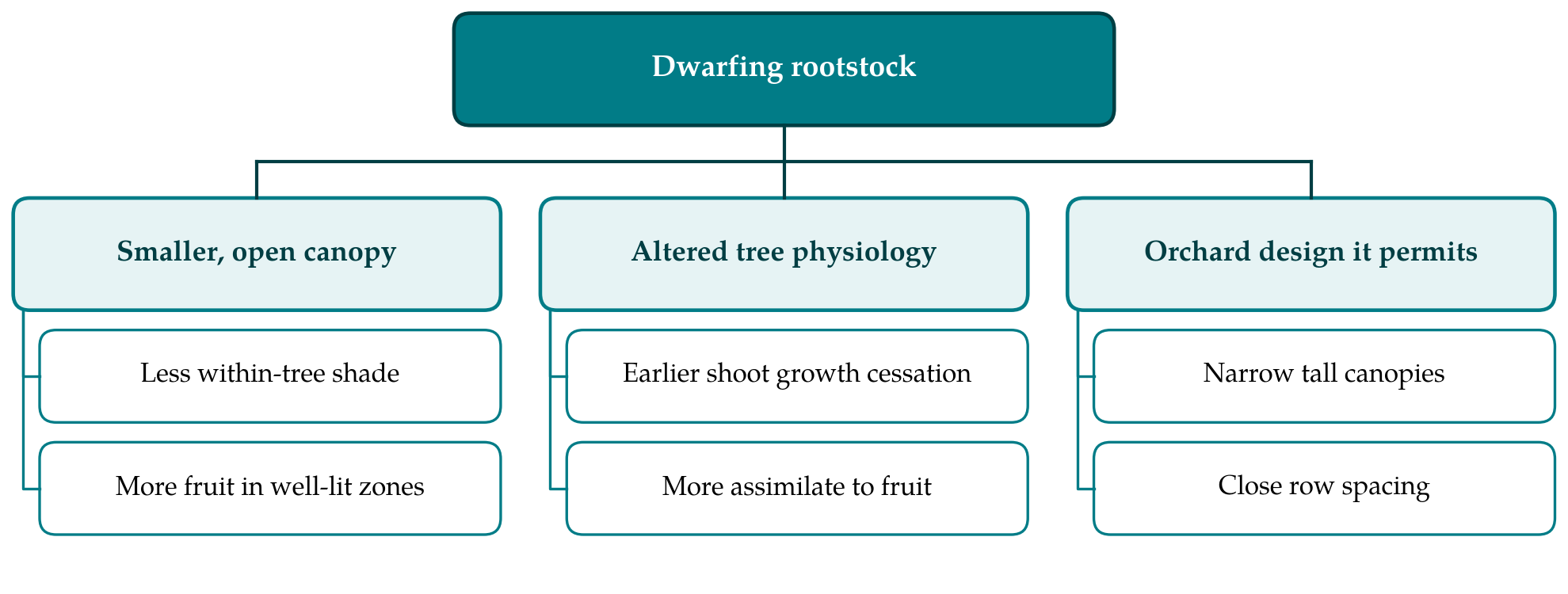
Figure 1 groups the possible influences of a dwarfing rootstock into three branches: the smaller canopy it produces, the changes it brings about in the physiology of the scion, and the orchard design that it makes possible. The first and third are indirect and act through light. The second includes effects that would persist even if light exposure were held equal.
6.1. Canopy size and openness
The most direct consequence of dwarfing is geometric. A tree on M.9 or a rootstock of similar vigour has shorter shoots, fewer of them, and a shallow canopy, so that little of its volume lies beyond the reach of useful light. The mechanisms of dwarfing are still debated; reviews point to altered hormone transport across the graft union, reduced hydraulic conductance and earlier termination of shoot growth (Webster, 1995; Webster and Wertheim, 2003), and two major loci, Dw1 and Dw2, account for much of the genetic control (Foster et al., 2015). Whatever the mechanism, the result is a canopy in which a larger proportion of fruit hangs in positions bright enough for full colour development.
Early cessation of extension growth adds to the effect. Dwarfed trees set terminal buds sooner, so the canopy stops thickening during the period when the fruit is most responsive to light. On vigorous rootstocks the same cultivar continues to produce shoot leaves into late summer, and summer pruning is commonly needed to let light in before harvest.
6.2. The planting system
Dwarfing rootstocks are seldom used in isolation; they are the basis of spindle, tall spindle and planar systems in which trees are closely spaced along the row and trained as narrow walls (Robinson, 2003). These systems reach high light interception early in the life of the orchard and keep the canopy thin. A long-running comparison of planting density and tree shape reported by Lordan et al. (2018) illustrates how the performance of a system depends on the combination of density, shape and rootstock and not on any one of them. From the standpoint of colour, the important feature is that the rootstock allows the grower to hold canopy thickness within the depth to which light penetrates.
Density can be pushed too far. Where rows are close in relation to tree height, the lower canopy is shaded by the neighbouring row for much of the day, and fruit there colours poorly whatever the rootstock. Reflective ground covers laid in the alley before harvest raise the light reaching the lower canopy and improve colour, as shown for 'Gala' by Layne et al. (2002), which is itself evidence that light, and not the root system, is the limiting factor in such positions.
Row orientation and the ratio of tree height to alley width set how long each face of the canopy is in direct sun. Rows running north to south light both faces for part of the day, whereas the shaded face of an east to west row depends on diffuse light for most of it, and fruit on that face colours later and less fully. Jackson (1980) and Palmer (1989) treat these relations quantitatively. They are properties of the planting plan and are fixed on the day the orchard is set out, which is one reason why colour problems in a mature block are so hard to correct by pruning alone.
6.3. Physiological effects on the scion
A smaller literature reports rootstock effects on fruit that are not obviously explained by light. Autio (1991) found that rootstock affected ripening and other quality attributes of 'Delicious', and advanced maturity on dwarfing stocks has been noted repeatedly since. Because red colour increases as fruit ripens, a rootstock that advances maturity will appear to improve colour if all trees are picked on the same date. Comparisons made at equal maturity are fewer, and they generally show smaller differences.
Dwarfed trees also partition more of their dry matter to fruit, and the carbohydrate supply to the fruit influences anthocyanin synthesis (Saure, 1990). Crop load interacts with this: heavily cropped trees colour less well, and precocious rootstocks are easily over-cropped in their early years (Musacchi and Serra, 2018). Mineral nutrition is a further route. High nitrogen status has long been associated with poor red colour, and rootstocks differ in their uptake of nitrogen, potassium and other elements; such differences are documented for the Geneva series (Fazio et al., 2015). How much they contribute to colour under commercial fertiliser regimes is not well resolved.
7. Weighing the Evidence
The literature supports a clear ranking of these influences. The effect of light exposure on colour is large, mechanistically understood and repeatable across cultivars and regions. The effect of rootstock on canopy size and on the planting system is equally well established. The step that joins them, that dwarfing rootstocks improve colour chiefly because they improve fruit exposure, is supported by the consistency of the two bodies of work and by the observation that colour on vigorous trees can be raised by pruning, training or reflective mulch.
Direct physiological effects of the rootstock on colour are plausible and probably real, but they are smaller and harder to isolate. Many rootstock trials were designed to compare yield and tree size, with fruit colour recorded as a secondary trait at a single harvest date, and they cannot separate exposure, maturity, crop load and nutrition. This is a limitation of design and not a criticism of the trials, which were set up to answer other questions.
One further development complicates the comparison of older and newer work. Nurseries now supply highly coloured sports of the main bicoloured cultivars, among them strains of 'Gala', 'Fuji' and 'Delicious' that develop red colour earlier and over more of the surface than the original selections. Such strains redden acceptably in positions where the parent cultivar would stay pale, and they lessen, without removing, the dependence of pack-out on fruit exposure (Musacchi and Serra, 2018). A rootstock comparison made on a blushed strain may therefore show a colour effect that would not appear on a full-red strain of the same cultivar, and reports should state which strain was used.
8. Gaps and Directions for Further Work
Several questions remain open. Newer rootstocks bred for resistance to fire blight and replant disease are replacing the Malling series in some regions (Fazio et al., 2015), and their effects on canopy light climate and fruit colour at equal maturity are less fully documented than their yield performance. Warm production regions pose a second problem: where pre-harvest temperatures are high, light exposure may be necessary but not sufficient for colour (Lin-Wang et al., 2011), and exposed fruit is at risk of sunburn, so the optimum canopy may differ from that of cool regions. A third gap concerns planar, two-dimensional canopies designed for mechanisation, in which nearly all fruit is exposed and any remaining rootstock effect on colour should be easier to detect. Trials that record light at the fruit, harvest at defined maturity and adjust crop load would allow the direct and indirect routes to be separated.
9. Conclusion
Red colour in apple depends on light reaching the fruit in the weeks before harvest, and the regulation of that response is now understood at the level of the genes involved. Dwarfing rootstocks favour colour mainly by producing small trees that stop growing early and by permitting thin, closely planted canopies in which most fruit is well lit. Additional effects through maturity, assimilate supply and mineral status exist but are secondary and are often confounded in the available comparisons. For the grower, the rootstock is best regarded as a means of controlling canopy thickness; the gain in colour is realised only if spacing, training and crop load keep the fruit in the light.
Conflict of interest
To be declared by the author(s) before publication.
Funding
To be declared by the author(s) before publication.