1. Introduction
Inflammation of the mammary gland costs dairy farmers milk, discarded product, treatment and culled cows, and the losses fall hardest where a household owns only a few animals (Halasa et al., 2007). A century of research has turned mastitis control in large commercial herds into a routine of hygiene, dry cow management and targeted treatment (Ruegg, 2017). Much of that routine depends on a milk culture result. Smallholders seldom have one. A cow with a swollen quarter is treated with whatever intramammary tube or injectable product the local shop sells, and the choice is repeated when the first product fails.
Use of this kind selects for resistant bacteria, and the volume of antimicrobials given to food animals is expected to rise fastest in the regions where smallholder dairying is expanding (Van Boeckel et al., 2015). The global action plan adopted by the World Health Organization asks every country to build surveillance of resistance in animals as well as in people (WHO, 2015). For mastitis pathogens in smallholder herds that surveillance exists mostly as a scatter of single surveys. They differ in how herds were chosen, in what counted as a case, in the laboratory method and in the criteria used to call an isolate resistant, so their percentages cannot be placed side by side with any confidence.
This article proposes a protocol intended to make such surveys comparable. It is written for a district or regional laboratory with an incubator, a biosafety cabinet and conventional media, and it favours methods already described in recognised standards. No survey is reported here. The protocol is a proposal, and its untested points are stated near the end.
2. Background
Three bodies of prior work shape the design: the bacteriology of mastitis, the standards for testing bacteria from animals, and the epidemiology of sampling animals that are grouped in herds.
2.1. Pathogens and why the species matters
Mastitis pathogens are conventionally divided into contagious organisms that spread from cow to cow at milking, chiefly Staphylococcus aureus and Streptococcus agalactiae, and environmental organisms such as Streptococcus uberis, Escherichia coli and Klebsiella species. The non-aureus staphylococci form a third and very frequent group, a heterogeneous collection of species with differing resistance traits (Becker et al., 2014). Resistance statements are only meaningful at species or group level. Penicillin resistance in S. aureus lowers the chance of cure (Barkema et al., 2006), whereas a Gram-negative isolate is intrinsically resistant to penicillin and reporting it as such tells nobody anything. Reviews of the field have repeatedly noted that pooled figures across unlike organisms mislead (Oliver and Murinda, 2012).
2.2. Standards for susceptibility testing
Disk diffusion, standardised by Bauer et al. (1966), remains the practical method for a laboratory without automated equipment. Its results depend on the medium, the inoculum density, the disk content and the incubation conditions, and they can be interpreted only against zone diameter criteria derived for that exact procedure. The Clinical and Laboratory Standards Institute publishes the procedure for bacteria isolated from animals as document VET01, with veterinary breakpoints in a companion supplement (CLSI, 2018). Schwarz et al. (2010) list the faults that recur in veterinary susceptibility papers: unnamed methods, missing quality control and human breakpoints applied to animal isolates. Clinical breakpoints also differ in purpose from epidemiological cut-off values, which separate wild-type from non-wild-type populations (Kahlmeter et al., 2003).
3. The Proposed Protocol
The protocol has eight stages. Figure 1 shows their order, and Table 1 lists what each produces and the record it should leave. The stages are described in turn.
| Stage | Output | Record kept |
|---|---|---|
| 1. Sampling frame | Random list of herds by area | Herd definition, source list, sample size reasoning |
| 2. Screening | Quarters classed as clinical or subclinical | Test scores and treatment questionnaire |
| 3. Milk collection | One aseptic sample per selected quarter | Time, collector, transport temperature |
| 4. Culture | Isolates identified to species or group | Plate readings and identification tests |
| 5. Susceptibility test | Zone diameters in millimetres | Media batch, disk lot, control strain results |
| 6. Interpretation | Category for each isolate and drug | Breakpoint source and edition |
| 7. Analysis | Proportions with intervals, by species | Analysis script and data dictionary |
| 8. Reporting | Herd feedback and survey report | Isolate archive and raw data file |
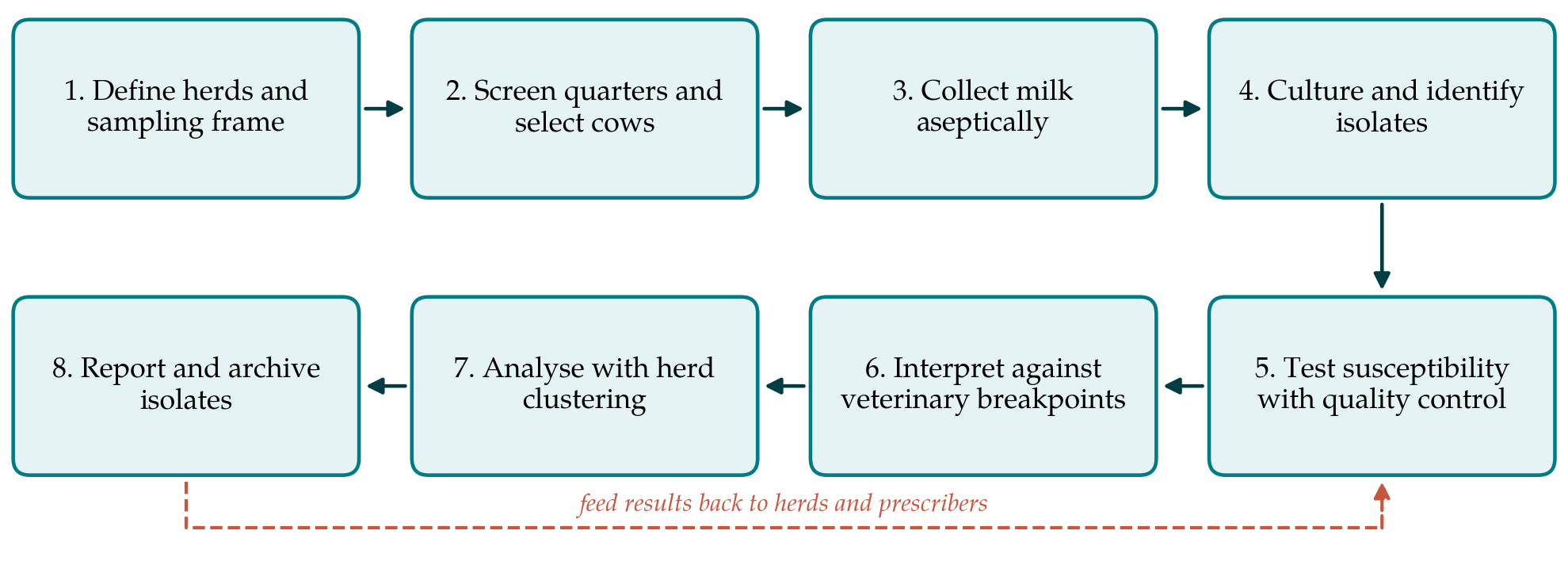
3.1. Stage 1: Define the herds and the sampling frame
The survey needs a written definition of a smallholder herd, for example by number of milking cows, and a list from which herds can be drawn. Cooperative membership lists, milk collection centre registers and vaccination records each cover a different part of the population, and the report should say which was used and whom it leaves out. Herds are selected at random from the list within each administrative area. Selection by willingness, or from the clients of one clinic, produces a sample enriched for herds with treatment failures. The number of herds is set with a standard formula for estimating a proportion, inflated by a design effect because isolates from one herd resemble each other (Dohoo et al., 2009).
3.2. Stage 2: Screen quarters and select cows
Within each herd all lactating cows are examined. Quarters with visible changes in milk or udder are classed as clinical. The remaining quarters are screened with the California mastitis test, a cow-side reagent test that estimates the somatic cell content of milk (Schalm and Noorlander, 1957), and those above a chosen score are classed as subclinical. The two classes are kept apart throughout, since their pathogen profiles and their treatment histories differ. A short questionnaire records, for each sampled cow, the products given in the current lactation and the source of advice. Recall of drug names is poor, so the enumerator asks to see the packaging.
3.3. Stage 3: Collect milk aseptically
A resistance survey built on contaminated samples describes the skin and the bedding. Collection follows the procedure in the National Mastitis Council handbook: clean and dry the teat, discard the first streams, scrub the teat end with alcohol, and collect a small volume into a sterile tube held nearly horizontal (National Mastitis Council, 2017). Samples are chilled at once and reach the laboratory within a day, or are frozen if that is impossible, with the fact recorded. One sample per quarter is the practical choice for a survey. The diagnostic consequences of relying on a single sample were worked out by Dohoo et al. (2011), and their definitions of intramammary infection are adopted so that a plate with a few colonies of a minor organism is not counted as a case.
3.4. Stage 4: Culture and identify
A measured loop of milk is streaked on blood agar and on MacConkey agar and read after one and two days of aerobic incubation. Plates with three or more colony types are recorded as contaminated and excluded. Staphylococci are separated into S. aureus and non-aureus species by coagulase testing, streptococci by the CAMP reaction and aesculin hydrolysis, and Gram-negative rods by the standard biochemical tests, as the handbook describes (National Mastitis Council, 2017). Where a reference laboratory offers mass spectrometry or sequencing, a random subset is sent for confirmation, and the agreement is reported. Every isolate that enters susceptibility testing is stored frozen in glycerol broth under a code that links it to herd, cow and quarter.
3.5. Stage 5: Test susceptibility with quality control
Disk diffusion is performed on Mueller-Hinton agar, with blood added for streptococci, from an inoculum adjusted to a 0.5 McFarland standard, exactly as VET01 prescribes (CLSI, 2018). The panel is fixed before the survey starts. It contains the drug classes sold locally for mastitis, taken from the Stage 2 questionnaire and a visit to suppliers, together with agents of concern for human health, guided by the World Health Organization list of critically important antimicrobials (WHO, 2019). Cefoxitin is included for staphylococci as the screening agent for methicillin resistance, which matters because livestock-associated strains, including those carrying the mecC gene first found in bovine milk, can pass to people (García-Álvarez et al., 2011). The reference strains named in the standard are tested with every new batch of medium or disks and at least weekly. A run in which a control zone falls outside its permitted range is discarded.
3.6. Stage 6: Interpret against veterinary breakpoints
Zone diameters are recorded in millimetres, never only as a category, so that the data can be reinterpreted when criteria are revised. Each diameter is then classified with the bovine mastitis breakpoint where one exists. Few do. For the remaining drug and organism pairs the report must state whether a breakpoint for another animal species, a human breakpoint or an epidemiological cut-off was borrowed, and such results are presented in a separate table with a caution. Isolates are described as multidrug resistant only under the published definition of non-susceptibility to at least one agent in three or more antimicrobial categories (Magiorakos et al., 2012), and intrinsic resistances are left out of the count.
3.7. Stage 7: Analyse with herd clustering
Results are tabulated by organism, by drug and by clinical or subclinical origin. The proportion of non-susceptible isolates is given with a confidence interval that allows for clustering within herds, which a survey procedure or a mixed model with herd as a random effect will provide (Dohoo et al., 2009). Only one isolate of a given species per cow is counted. Organisms represented by a handful of isolates are listed without percentages. Associations between reported drug use and resistance may be explored, but a cross-sectional design cannot show which came first, and the text should not suggest otherwise.
3.8. Stage 8: Report and archive
Each farmer receives the culture and susceptibility result for the cows sampled, in plain language and through the local veterinarian or extension worker, since a survey that takes milk and returns nothing will not be welcomed twice. The survey report names the method, the standard and its edition, the control strains and the breakpoint source, and it publishes the zone diameter distributions. Isolates are kept so that later work can look for resistance genes.
4. Fitting the Protocol to Smallholder Conditions
Several choices were made with field conditions in mind. Herds are scattered and roads slow, so sampling is organised around milk collection routes, with a cool box and a fixed hand-over time. Farmers milk by hand, often twice a day at home, and the team must arrive before milking and not after it. Animal ethics review and informed consent are required in most jurisdictions even for milk sampling, and the consent conversation is the moment to explain what feedback will come. Laboratories with unreliable electricity should plan for incubator temperature logs and for backup storage of the isolate archive. None of these points is technically demanding, but each is a common reason for surveys to end with fewer usable isolates than planned.
5. Limitations and What Remains to Be Shown
The protocol has not been run, and a pilot in a small number of herds should come before any full survey. The pilot would show whether the sampling frame can be assembled, what share of samples are contaminated or culture-negative, and how many isolates of each species a given number of herds yields, which is the figure on which the sample size finally depends. It would also test whether conventional identification agrees well enough with a reference method for the non-aureus staphylococci and the streptococci other than S. agalactiae.
Some weaknesses are built in. Disk diffusion gives no minimum inhibitory concentration. The shortage of mastitis-specific breakpoints means that a number of categories will rest on borrowed criteria. A cross-sectional survey describes resistance at one season and cannot follow trends unless it is repeated with the same methods. And a laboratory category is an imperfect guide to cure in the udder, where drug distribution and the chronic nature of some infections matter as much as the organism's susceptibility (Barkema et al., 2006).
6. Conclusion
Resistance surveys in smallholder dairy herds are worth doing only if their results can be compared across places and years. The protocol proposed here ties each stage to a published standard, keeps organisms and case types separate, records zone diameters and control results, and accounts for the herd structure of the data. It asks for discipline more than for equipment. Whether it is workable at the scale of a district laboratory is a question for a pilot study, which this article recommends as the next step.
Conflict of interest
To be declared by the author(s) before publication.
Funding
To be declared by the author(s) before publication.