1. Introduction
Early hypertension is the stage at which lifestyle measures matter most. The European guideline defines grade 1 hypertension as an office pressure of 140-159 mmHg systolic or 90-99 mmHg diastolic (Williams et al., 2018), and the American guideline places the threshold for stage 1 at 130-139 or 80-89 mmHg (Whelton et al., 2018). Both advise that people at this level who are otherwise at low cardiovascular risk begin with changes in diet, weight, physical activity and alcohol intake before or alongside any medication. That advice gives naturopathy, which works largely through diet and regimen, a legitimate field of action.
Two of its characteristic methods are hydrotherapy, the therapeutic use of water at different temperatures as baths, packs and affusions, and fasting, which ranges from short periods on water or juices to longer supervised programmes followed by a plant-based diet. Practitioners report that blood pressure falls during such programmes, and they publish cases to show it. The difficulty is that a single case, as usually written, cannot distinguish an effect of treatment from the many other reasons why a blood pressure reading goes down.
This article does not present a case. It proposes a protocol for documenting one, addressed to clinicians in naturopathic hospitals and teaching institutions who intend to report their experience. The protocol has not been tried on patients for this article, and it makes no recommendation about which hydrotherapy or what kind of fast should be given.
2. Background
Three bodies of knowledge inform the design: what is established about diet, fasting and water treatments in hypertension, how blood pressure should be measured, and what a case report can and cannot show.
2.1. What is established and what is not
The dietary evidence is strong. The DASH trial showed that a diet rich in fruit, vegetables and low-fat dairy foods lowers blood pressure (Appel et al., 1997), and its successor showed a further fall with reduced sodium (Sacks et al., 2001). Weight loss, physical activity and moderation of alcohol are likewise supported by trials and endorsed for primary prevention (Whelton et al., 2002). Fasting stands on weaker ground. Uncontrolled series from a residential centre have described substantial falls in pressure during medically supervised water-only fasting in people with hypertension and with borderline values (Goldhamer et al., 2001; Goldhamer et al., 2002), and a large observational study of periodic fasting reported falls in blood pressure with few serious adverse events (Wilhelmi de Toledo et al., 2019). Physiological reasons to expect an effect exist, including sodium loss and weight loss (de Cabo and Mattson, 2019). None of these studies had a control group, all were accompanied by a low-salt plant-based diet, and how long the falls last after normal eating resumes is uncertain.
For hydrotherapy the evidence is thinner still. Warm immersion dilates skin vessels and lowers pressure for a time, while cold application raises it acutely through sympathetic activation. A review of the physiological literature lists a range of cardiovascular effects of water treatments and few adequately controlled trials in hypertension (Mooventhan and Nivethitha, 2014). Whether a course of baths or packs lowers resting pressure in a lasting way is not established.
2.2. Measuring blood pressure
Blood pressure varies from minute to minute and is raised in many people by the clinic itself. Guidelines therefore ask for validated automatic upper-arm devices, a cuff of the correct size, a seated rest of five minutes, and the average of repeated readings (Stergiou et al., 2021). Home measurement over seven days, with duplicate readings each morning and evening and the first day discarded, gives a more reproducible estimate than office readings and is recommended for confirming the diagnosis (Parati et al., 2008). A case of early hypertension that rests on two or three clinic readings has not established its own starting point.
2.3. What a case report can show
Case reports have a recognised place. They generate hypotheses, describe how an intervention is delivered and record harms (Vandenbroucke, 2001). The CARE guidelines set out thirteen items that a report should contain, among them a timeline, a full description of the intervention, follow-up and outcomes, and the patient's own perspective (Gagnier et al., 2014; Riley et al., 2017). What a case report cannot do is estimate an effect. Its value lies in the completeness and honesty of the record.
3. The Proposed Protocol
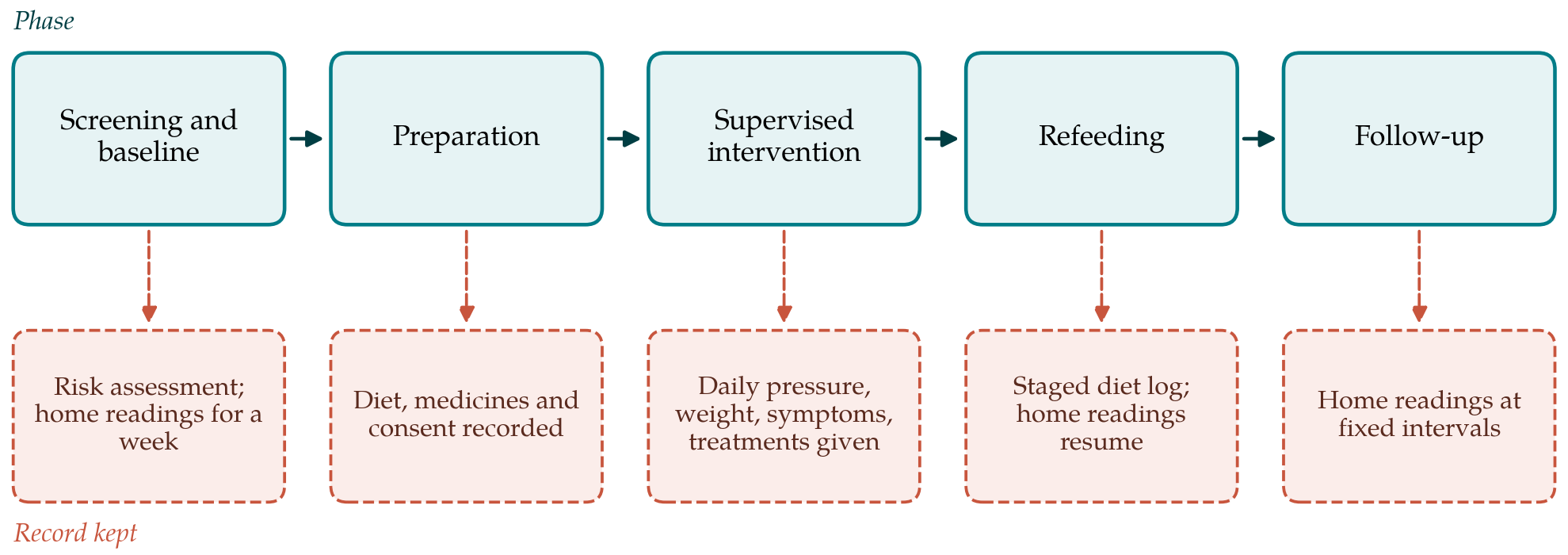
The protocol divides the case into five phases. Figure 1 shows them with the principal record kept in each. The content of the treatment is whatever the supervising clinician would ordinarily provide; the protocol governs what is written down.
3.1. Phase 1: Screening and baseline
The first task is to confirm that the person has early, uncomplicated hypertension and that fasting is safe for them. A medical assessment records history, current medicines, cardiovascular risk factors and evidence of organ damage, and excludes secondary causes as far as the guidelines require. Published consensus on fasting therapy lists the conditions in which it is contraindicated or needs particular caution, such as pregnancy, eating disorders, advanced kidney or liver disease and frailty (Wilhelmi de Toledo et al., 2013). People taking antihypertensive or glucose-lowering medicines need a physician to manage those medicines throughout. Baseline pressure is then established by a week of home readings to the standard schedule, together with weight, waist circumference and a brief record of usual diet.
3.2. Phase 2: Preparation
Before the intervention the report fixes what will be done and what will be measured. The planned hydrotherapy is written out by type, water temperature, duration, body region and frequency, and the planned dietary regime by its composition, energy content where known, fluid and salt intake, and intended length. Any change in medication is recorded with its date and reason. Written informed consent is obtained for treatment and for publication. Stating the plan in advance is what later allows a reader to see whether the report describes what was intended or only what turned out well.
3.3. Phase 3: Supervised intervention
During the programme, blood pressure and pulse are taken at the same times each day with the same device, seated and after rest, and also standing, since a postural fall is a known hazard of fasting. Weight is recorded daily. Every hydrotherapy session actually given is logged against the plan. Symptoms are asked about with a fixed list that includes dizziness, headache, weakness, palpitations and sleep disturbance, and laboratory tests are ordered when the clinician judges them necessary. The record states in advance the findings that would stop the fast, and the guideline thresholds at which pressure calls for urgent medical referral.
3.4. Phase 4: Refeeding
The return to food is part of the intervention and is documented in the same detail: what was eaten on each day, the salt content of the diet as far as it can be judged, and weight. Home readings resume on the standard schedule once the person is back in ordinary surroundings.
3.5. Phase 5: Follow-up
A fall in pressure on the last day of a residential programme is the least informative number in the case. The protocol asks for a week of home readings at fixed points after discharge, for example at one, three and six months, with weight, current diet, activity and medication at each. If follow-up is lost, the report says so. The patient's own account of the experience and of what they have continued to do is included, as CARE requires.
4. Guarding Against Misleading Conclusions
An uncontrolled fall in blood pressure has several explanations other than the treatment, and Table 1 sets them against the part of the record that helps a reader to judge each. The most important is regression to the mean. People are usually referred or enrolled when their readings are high, and a variable measured with error will, on average, be closer to its true mean at the next measurement (Bland and Altman, 1994). A stable week of baseline readings, taken before any treatment, is the best protection. Repeated measurement across phases also gives the case something of the logic of a single-case design, in which a change is more persuasive when it coincides with the start of the intervention and follows a steady baseline (Kazdin, 2011).
| Source of error | How it arises | Record required by the protocol |
|---|---|---|
| Regression to the mean | Enrolment follows unusually high readings | One week of home readings before treatment |
| White-coat effect | Pressure is higher in clinic than at home | Home readings at baseline and follow-up |
| Measurement inconsistency | Different devices, cuffs, postures or times | Validated device and fixed procedure throughout |
| Co-interventions | Salt restriction, weight loss, rest, medicines | Daily diet, weight and medication log |
| Residential setting | Removal from work and usual stresses | Follow-up readings in ordinary life |
| Selective reporting | Only favourable cases or readings are written up | Plan fixed in advance; all readings reported |
| Unrecorded harms | Adverse effects are not asked about | Daily symptom list and stopping criteria |
The second lesson of the table is that hydrotherapy and fasting cannot be separated from what accompanies them. A person who spends two weeks resting in a residential centre, eating no salt and losing weight has received several interventions at once. The report should describe the result as that of the whole programme and should not credit it to any single component.
5. Limitations and What Remains to Be Shown
The protocol is a proposal and has not been tested in use. Whether busy naturopathic units can keep records of this kind, whether patients complete home monitoring after discharge, and whether reports written to it are judged more useful by readers are all open. It adds work, and some of it, such as validated devices for patients to take home, has a cost.
More fundamentally, a well-documented case remains a case. A series of consecutive cases reported to the same protocol would show how often pressure falls, by how much and for how long, and what harms occur, and it would indicate whether a controlled trial is justified. Only a comparison with a group receiving dietary advice alone could show whether fasting or water treatments add anything to the measures that guidelines already recommend. Nothing in this article should be read as advice to replace antihypertensive medication, or to fast without medical supervision.
6. Conclusion
Naturopathic experience with hydrotherapy and fasting in early hypertension is seldom recorded in a form that others can assess. The protocol proposed here asks for a confirmed diagnosis and a stable baseline, a full description of what was done, standard measurement of pressure through five phases, an active search for harms, and follow-up in ordinary life. Used consistently, it would turn scattered anecdotes into a body of comparable observations and a sounder basis for deciding which questions deserve a trial.
Conflict of interest
To be declared by the author(s) before publication.
Funding
To be declared by the author(s) before publication.