1. Introduction
Fraud that exploits the wish for a partner is old. Its online form is distinctive for its reach, its low cost to the offender and the length of time over which a single victim can be exploited. Rege (2009) gave one of the first criminological descriptions, linking dating scams to identity fraud and to organised groups working across borders. Whitty and Buchanan (2012) then argued, on the basis of a national survey in Great Britain, that the offence was far more common than police figures suggested and deserved to be treated as a serious cybercrime. Since then a specialised literature has grown up, drawing on psychology, criminology, victimology and communication research.
The harm is not only financial. Interview studies report shame, depression and a grief that victims compare to bereavement, compounded by the reactions of family and officials who cannot see how anyone could send money to a stranger (Whitty and Buchanan, 2016). Wider research on fraud shows that such effects are common across fraud types and are routinely underestimated (Button et al., 2014). Explaining victimization therefore matters for prevention and for the way victims are treated.
This article reviews the explanations on offer and the evidence behind them. It is organised by theory and not by discipline, because the same theory is often used by researchers from different fields. A closing section sets out what the literature has not yet established.
2. Scope and Approach
This is a narrative review of published, peer-reviewed research and of a small number of official and book-length sources. It concentrates on studies that address why individuals are targeted, why they comply and why they continue to pay, and it draws on the general fraud victimization literature where studies specific to romance fraud are lacking. It does not claim to be exhaustive and reports no new data. A scoping review by Coluccia et al. (2020) offers a complementary, more formal mapping of the psychological studies and reaches a similar judgement about the modest size of the evidence base.
3. The Anatomy of the Offence
Any explanation has to fit what offenders do. The most widely cited description is the Scammers Persuasive Techniques Model of Whitty (2013), derived from interviews with victims and analysis of their accounts. It proposes that the fraud unfolds in stages, shown in Figure 1. A person who wants an ideal partner meets a profile built to match that ideal. A period of grooming follows, with frequent and increasingly intimate contact, until the offender judges that a request will succeed. The request arrives as a crisis: a medical emergency, a customs fee, a business deal gone wrong. If the victim pays, further crises follow. Some victims are drawn into sexual acts on camera that are later used for blackmail, and some are approached again after the fraud is exposed, by offenders posing as police or recovery agents.
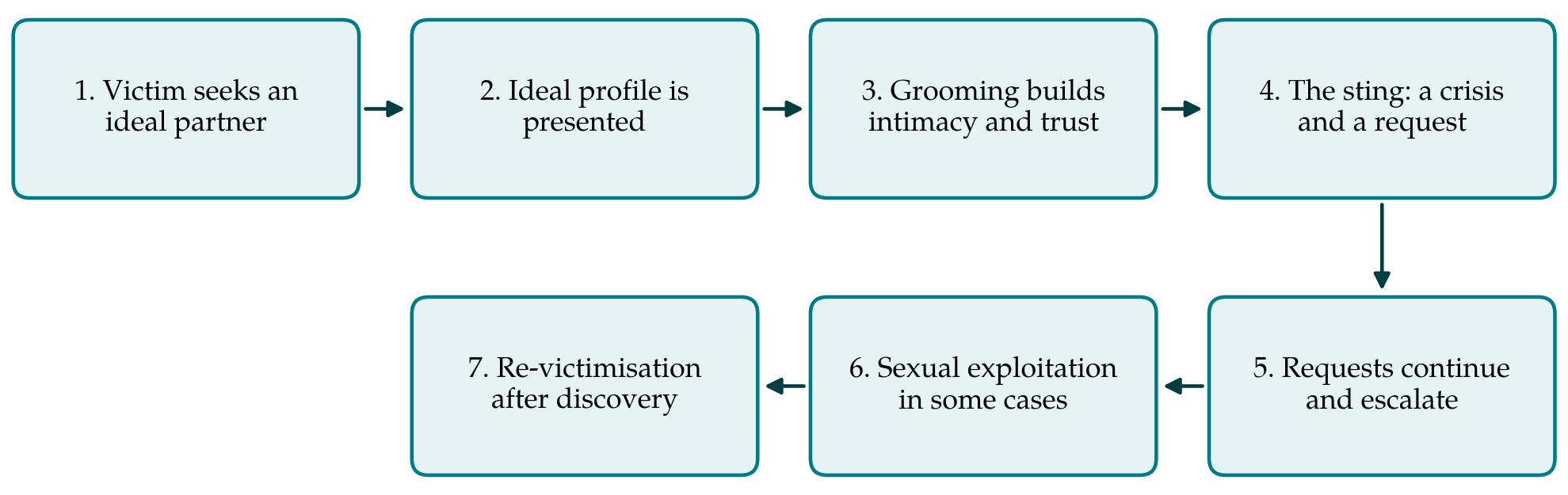
Studies of the offenders' material support this outline. Fraudulent profiles and opening messages follow recognisable story lines, such as the widowed professional working abroad, which are written to appeal to particular audiences (Kopp et al., 2015). The regularity of these scripts is strong enough for machine classifiers to separate fraudulent from genuine dating profiles with useful accuracy (Suarez-Tangil et al., 2020). What the stage model describes is thus a designed process. Theories of victimization differ in which part of that process they treat as decisive.
4. Theoretical Explanations
Table 1 summarises the five lines of explanation discussed in this section, with the type of evidence each has relied on and its principal weakness.
| Explanation | Core claim | Representative sources | Main limitation |
|---|---|---|---|
| Opportunity and routine activities | Exposure online brings suitable targets into contact with motivated offenders | Pratt et al., 2010; Holt and Bossler, 2009 | Explains targeting better than compliance |
| Self-control and personality | Impulsivity or idealised romantic beliefs raise the chance of compliance | Holtfreter et al., 2008; Buchanan and Whitty, 2014; Whitty, 2018 | Modest effects; traits measured after the event |
| Persuasion and visceral influence | Offenders use general compliance techniques and arouse strong emotion | Cialdini, 2009; Langenderfer and Shimp, 2001 | Describes technique, not who resists |
| Hyperpersonal communication | Text-based contact allows idealisation and rapid intimacy | Walther, 1996 | Rarely tested directly on fraud cases |
| Coercive control | Offenders isolate, monitor and psychologically abuse victims | Cross et al., 2018; Carter, 2021 | Based on small qualitative samples |
4.1. Opportunity and routine activities
Routine activity theory holds that crime occurs when a motivated offender meets a suitable target in the absence of a capable guardian (Cohen and Felson, 1979). Yar (2005) asked whether the framework survives the move online, where offender and target never share a place, and concluded that it does so only in part. Empirical work has nonetheless found it useful. Pratt et al. (2010) showed that time spent online and remote purchasing predicted being targeted by internet fraud, while Holt and Bossler (2009) found that ordinary computer use predicted online harassment victimization less well than a person's own involvement in computer deviance. For romance fraud the implication is straightforward: people who use dating platforms and disclose personal details are exposed. The limitation is equally plain. Exposure explains who is approached. It says little about why, among those approached, some send money and most do not.
4.2. Self-control and personality
The general theory of crime attributes offending to low self-control (Gottfredson and Hirschi, 1990), and victimologists have extended it to victims on the argument that impulsive people place themselves in risky situations. Holtfreter et al. (2008) found low self-control associated with fraud victimization in a consumer sample once routine activities were taken into account. Evidence specific to romance fraud is mixed. Buchanan and Whitty (2014) tested several plausible dispositions and found that loneliness and sensation seeking did not distinguish victims, whereas a tendency to idealise romantic partners did. A later comparison by Whitty (2018) characterised victims as more often middle-aged, well educated and somewhat more impulsive than non-victims. These findings contradict the popular image of the victim as naive or uneducated. They also come from cross-sectional surveys in which traits were measured after the fraud, so that the experience itself may have shaped the answers.
4.3. Persuasion and visceral influence
A third line treats the fraud as applied social influence. The principles catalogued by Cialdini (2009), among them reciprocity, commitment and consistency, authority, liking and scarcity, are all visible in offenders' scripts: small gifts and declarations invite reciprocation, an early small payment commits the victim to the story, and deadlines create urgency. Langenderfer and Shimp (2001) added that scams work by arousing visceral states, such as desire or fear, that narrow attention and crowd out scrutiny. In romance fraud the visceral reward is the relationship itself, which helps to explain why warnings from banks and relatives so often fail. These accounts describe the offender's technique convincingly. They are weaker on individual differences, since everyone is subject to the same principles.
4.4. Mediated intimacy
Communication research supplies a mechanism for the speed and depth of attachment. The hyperpersonal model of Walther (1996) proposes that text-based exchange can produce relationships more intense than those formed face to face: senders present themselves selectively, receivers fill gaps with idealised assumptions, and asynchronous messaging gives time to craft replies. An offender who is available at all hours and mirrors the victim's hopes exploits each of these features. The model is frequently cited in the romance fraud literature, but mostly as background. Direct tests, for instance of whether victims who moved quickly to private messaging channels formed stronger attachments, are scarce.
4.5. Coercive control and the language of abuse
The most significant recent shift is away from asking what is wrong with the victim. Cross et al. (2018) reanalysed interviews with Australian victims using categories from research on psychological abuse in intimate relationships and found the same tactics: isolation from family and friends, monopolisation of attention, degradation, and alternation of affection with threats. Carter (2021) reached a compatible conclusion from close linguistic analysis of the messages in a fraud, showing how the offender's language made requests for money appear to arise from the victim's own decisions. On this view continued payment is not a failure of intelligence. It is the expected result of sustained manipulation by someone the victim has reason to trust. The framing has consequences for policy, since advice that tells people to be more careful assumes a freedom of action that the offender has worked to remove.
5. Victim Blaming and the Response to Victims
How victimization is explained affects how victims are received. Christie (1986) observed that public sympathy goes to the ideal victim, who is weak, blameless and attacked by a stranger. The romance fraud victim, who sent money voluntarily, fits poorly. Cross (2015) documented the resulting discourse of blame, in which victims are described as greedy or gullible, and showed that victims absorb it. Low reporting follows. Fraud of every kind is under-reported, and victims of online fraud who do come forward describe being passed between agencies that do not take ownership of the complaint (Cross et al., 2016). A related ethical problem, still unsettled, is how far banks and police may override the wishes of a victim who refuses to accept that the relationship is false.
6. Gaps in the Empirical Evidence
The first weakness is sampling. Most studies recruit through victim support organisations, reporting centres or online panels. People who have reported, sought help or agreed to be interviewed are unlikely to represent all victims, and those who were approached but did not pay are seldom studied as a comparison group. Without them, statements about risk factors remain provisional.
The second is design. Almost all quantitative evidence is cross-sectional and retrospective. Dispositions such as impulsivity or romantic idealisation are measured after the event and may be coloured by it. No published study known to the author follows dating platform users forward in time to see who is later defrauded, although the platforms hold data that would make this possible.
Third, offenders are known mainly through their texts and through victims' recollections. Work on how fraud is organised suggests a range from loose networks to structured enterprises (Levi, 2008), but systematic research with romance fraud offenders is rare. Fourth, theory testing has been piecemeal. Studies usually examine one explanation at a time, so the relative weight of exposure, disposition and offender technique is unknown, and the stage model, though much cited, has not been tested for whether the stages occur in the proposed order across cases.
Fifth, prevention is under-evaluated. Awareness campaigns, platform warnings and bank interventions at the point of payment are widely used, yet rigorous evaluations of their effect on victimization are hard to find. Finally, the evidence is geographically narrow. The core studies come from the United Kingdom and Australia, with some from North America. Little is known about victims in Asia, Africa or Latin America, or about how cultural expectations of courtship and of financial support between partners alter the dynamics that the existing models describe.
7. Directions for Future Research
Several steps would address these gaps. Prospective studies in partnership with dating platforms and payment providers could compare users who complied with those who disengaged, using data recorded before the outcome was known. Studies that measure exposure, disposition and persuasion variables together would allow competing explanations to be weighed against one another. Research on offenders, through court records and interviews where access is possible, would test assumptions that currently rest on inference. Trials of warnings and payment-stage interventions, with victimization as the outcome, are needed before further investment in campaigns. Comparative work beyond the English-speaking countries would show which findings travel. Throughout, the coercive control perspective suggests measuring what offenders do to victims over time, in addition to what victims were like at the start.
8. Conclusion
The literature on romance fraud victimization has moved in a decade from description to a set of competing explanations. Opportunity theories account for who is approached. Dispositional research has dispelled the stereotype of the foolish victim while finding only modest and unevenly replicated predictors. Persuasion and communication theories explain how offenders build compliance, and the comparison with coercive control explains why victims stay. None of these accounts has yet been tested with designs strong enough to establish cause, and the practical measures now in use rest more on plausibility than on evaluation. Better evidence is within reach if researchers gain access to the records that platforms and banks already hold.
Conflict of interest
To be declared by the author(s) before publication.
Funding
To be declared by the author(s) before publication.