1. Introduction
A green roof is a roof carrying a growing substrate and vegetation over a waterproof membrane. Extensive roofs have a shallow substrate and low, drought-tolerant plants, often Sedum, while intensive roofs have deeper substrate and can support shrubs and irrigated plantings. They are installed mainly to retain stormwater and insulate buildings, and habitat for wildlife is commonly listed among their further benefits (Oberndorfer et al., 2007). Pollinating insects are the group most often mentioned, and cities can indeed support diverse bee communities: a comparison across British landscapes found bee species richness to be higher in urban areas than in farmland (Baldock et al., 2015).
Whether roofs contribute to that diversity is less clear. Williams et al. (2014) reviewed the claims and found that most were supported by little evidence. What exists is concentrated in cool, humid cities, and it describes who is present on a roof far more often than what the insects do there. This note concerns the second question in a setting where it has scarcely been asked: the network of visits between flowers and insects on roofs in semi-arid cities.
2. What Temperate Roofs Have Shown
Early collecting on roofs in Toronto showed that a range of wild bees use green roofs (Colla et al., 2009). In Chicago, bee abundance and richness were lower on green roofs than in nearby parks and prairie remnants (Tonietto et al., 2011). Work in Zurich found that the arthropod communities of roofs were shaped by their connection to other green space as well as by conditions on the roof, with mobile groups such as bees and less mobile ground-dwelling groups responding differently (Braaker et al., 2014). Together these studies suggest that roofs act as supplementary foraging patches for part of the urban fauna. None of them is a full visitation network, with every plant species observed and every visitor recorded against the flower it used.
3. Why Semi-Arid Roofs Are Likely to Differ
In semi-arid climates, where annual rainfall falls well short of potential evaporation, an unirrigated roof is a severe environment. Surface temperatures in summer can far exceed air temperature, wind is stronger than at street level and the shallow substrate dries within days. Planting therefore relies on succulents and native xerophytes, or on irrigation, and flowering may be confined to short pulses after rain or sustained artificially through the dry season. In the second case a roof may offer nectar and pollen when the surrounding city offers almost none.
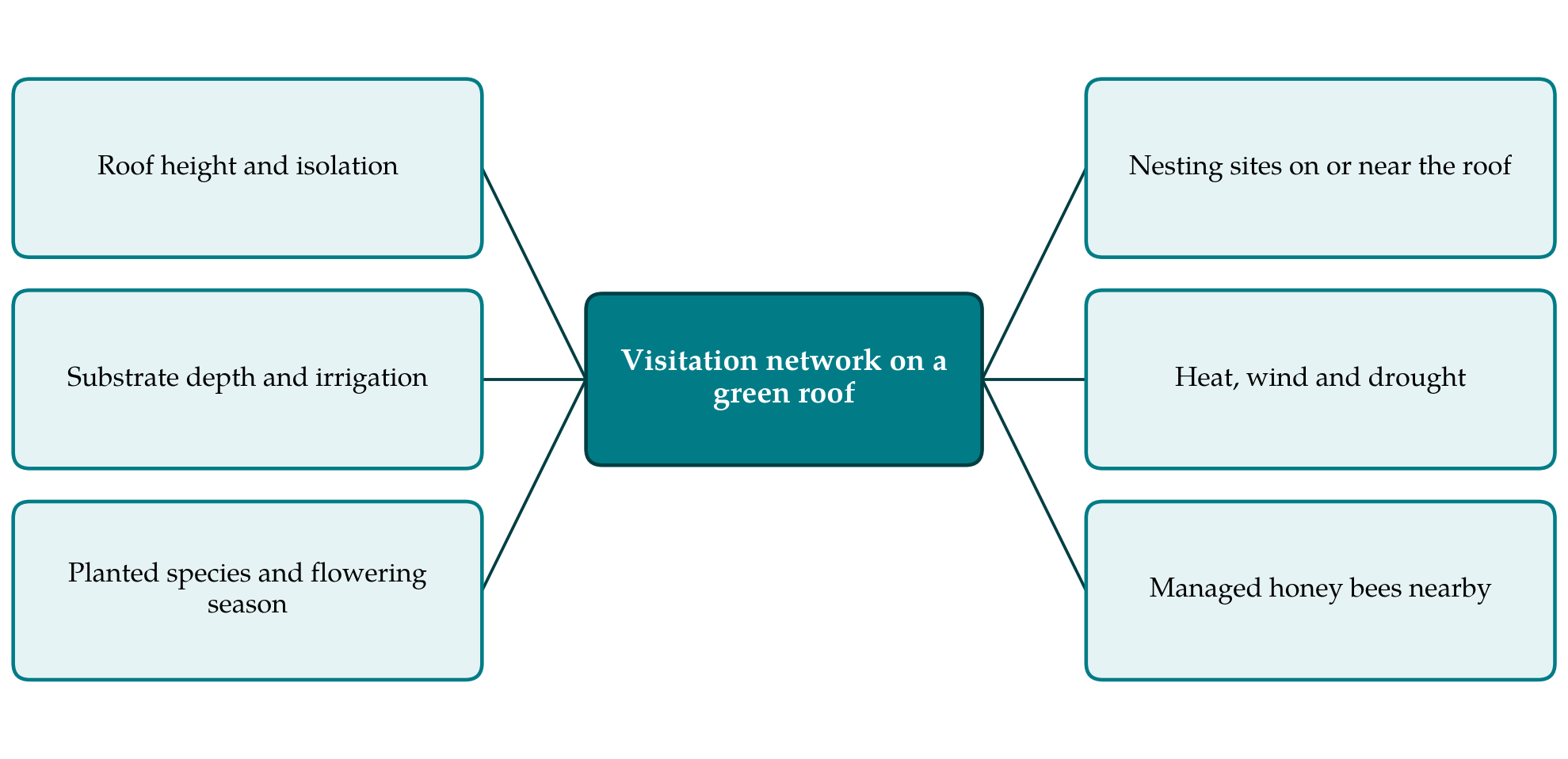
The insect fauna also differs. Warm, dry regions are centres of bee diversity, and most of their species are solitary and nest in bare ground, a resource that paved cities lack and that roof substrate could conceivably supply. Many are specialists on a few plant genera and fly for only a few weeks. Managed honey bees, where hives are kept on or near roofs, may dominate visits. Figure 1 gathers the factors expected to shape a roof network; Table 1 then lists what a first record needs to contain if these influences are to be separated.
| Element | Minimum requirement | Reason |
|---|---|---|
| Roof description | Height, area, age, substrate depth, irrigation, plant list | Allows comparison between roofs |
| Observation unit | Timed watches of each flowering species; visits touching anthers or stigma | Standardises effort per plant |
| Season covered | Whole flowering period, at intervals of two weeks or less | Short-lived specialists are otherwise missed |
| Identification | Vouchers to species or stated morphospecies; honey bees kept separate | Lists remain checkable |
| Completeness | Accumulation curves for visitors and for interactions | Shows how much was missed (Chacoff et al., 2012) |
| Metrics | Connectance, nestedness, H ' with null 2 models | Small networks give unstable values |
| Ground reference | Same protocol at a nearby ground-level site | Separates roof effects from city effects |
4. Minimum Requirements for a First Record
A visitation network is a table of plant species against visitor species, with each cell holding the number of visits observed. The approach dates from early community-wide webs such as that of Memmott (1999) and now has standard tools. Because networks are sensitive to how they are sampled (Jordano, 2016), a record made without stated effort cannot be compared with any other.
Two of these elements deserve comment. The first is completeness. In a desert plant-pollinator network in Argentina, sampling over several seasons detected most of the plant and pollinator species but a much smaller share of the interactions estimated to exist (Chacoff et al., 2012). A roof with a dozen plant species observed for one season will be less complete still, and the accumulation curves should be shown so that readers can judge.
The second is the choice of metrics. Connectance, the proportion of possible links that are realised, and nestedness, the tendency of specialists to interact with subsets of the partners of generalists (Bascompte et al., 2003), both vary with network size and sampling effort. The specialisation index H2' was designed to be less sensitive to these (Blüthgen et al., 2006). All three can be calculated, and compared with null models that hold the marginal totals fixed, in the bipartite package for R (Dormann et al., 2008). Reporting the raw interaction matrix alongside the metrics lets others recalculate them as methods change.
5. Cautions in Interpretation
A visit is not a pollination event. Without data on pollen carried or seed set, a roof network describes foraging and no more. Nor does foraging show that a roof sustains a population: bees may nest elsewhere and merely commute. Nesting on the roof needs direct evidence, from emergence traps or observed burrows. A roof might even draw insects away from ground-level plants, or expose them to heat stress, and a first record cannot settle whether its net effect is positive.
Comparison among roofs also has a design problem. Roofs differ at once in height, age, planting and surroundings, and a single roof is a sample of one. The paired ground site controls for the city and the season. Conclusions about height or substrate need many roofs, and the purpose of standard first records is to make such a synthesis possible later.
6. Conclusion
Semi-arid cities are building green roofs, and their bee faunas are among the richest anywhere, yet the interaction between the two is essentially undescribed. The first networks recorded from such roofs will be small and incomplete. They will still be valuable if they state their effort, voucher their identifications, show their completeness, publish the interaction matrix and include a ground-level comparison. This note sets out those requirements in the hope that the first records, when they are made, can be read together.
Conflict of interest
To be declared by the author(s) before publication.
Funding
To be declared by the author(s) before publication.