1. Introduction
The shell of a hen's egg is almost entirely calcium carbonate in the form of calcite, laid down on the shell membranes over a period of roughly twenty hours in the shell gland (Hincke et al., 2012). Each shell contains about two grams of calcium, which is a large fraction of the calcium circulating in the bird at any moment and must be replaced daily (Etches, 1987). As the flock ages, eggs become larger while the mass of shell deposited on each egg changes little, so the shell is spread more thinly and the proportion of cracked and downgraded eggs rises (Roberts, 2004). With laying cycles being extended well beyond the traditional end point, this late decline has become the main limit on how long a flock can be kept (Bain et al., 2016).
Nutritionists respond in several ways, and one of the simplest is to alter the physical form of the calcium source: more of the limestone is supplied as coarse grit or oyster shell and less as fine powder. This note considers what that change can be expected to do to the shell when it is made late in the cycle. It offers a reading of the published evidence and of the underlying physiology, and it reports no trial.
2. Why Particle Size Matters More in Older Hens
Hens eat during the light period, but most of the shell is formed in darkness, when the gut is emptying. Fine limestone dissolves and is absorbed within a few hours of being eaten. Coarse particles are retained in the gizzard, dissolve slowly in its acid contents, and continue to release calcium into the night. Zhang and Coon (1997) showed that larger particles of lower in vitro solubility stayed longer in the gizzard and were associated with higher calcium retention, and Rao and Roland (1989) described the corresponding pattern of calcium solubilisation in the living bird. When dietary calcium runs short during the night, the hen draws on medullary bone, a labile reserve built for the purpose and refilled between eggs (Whitehead, 2004). Figure 1 sets out this daily cycle.
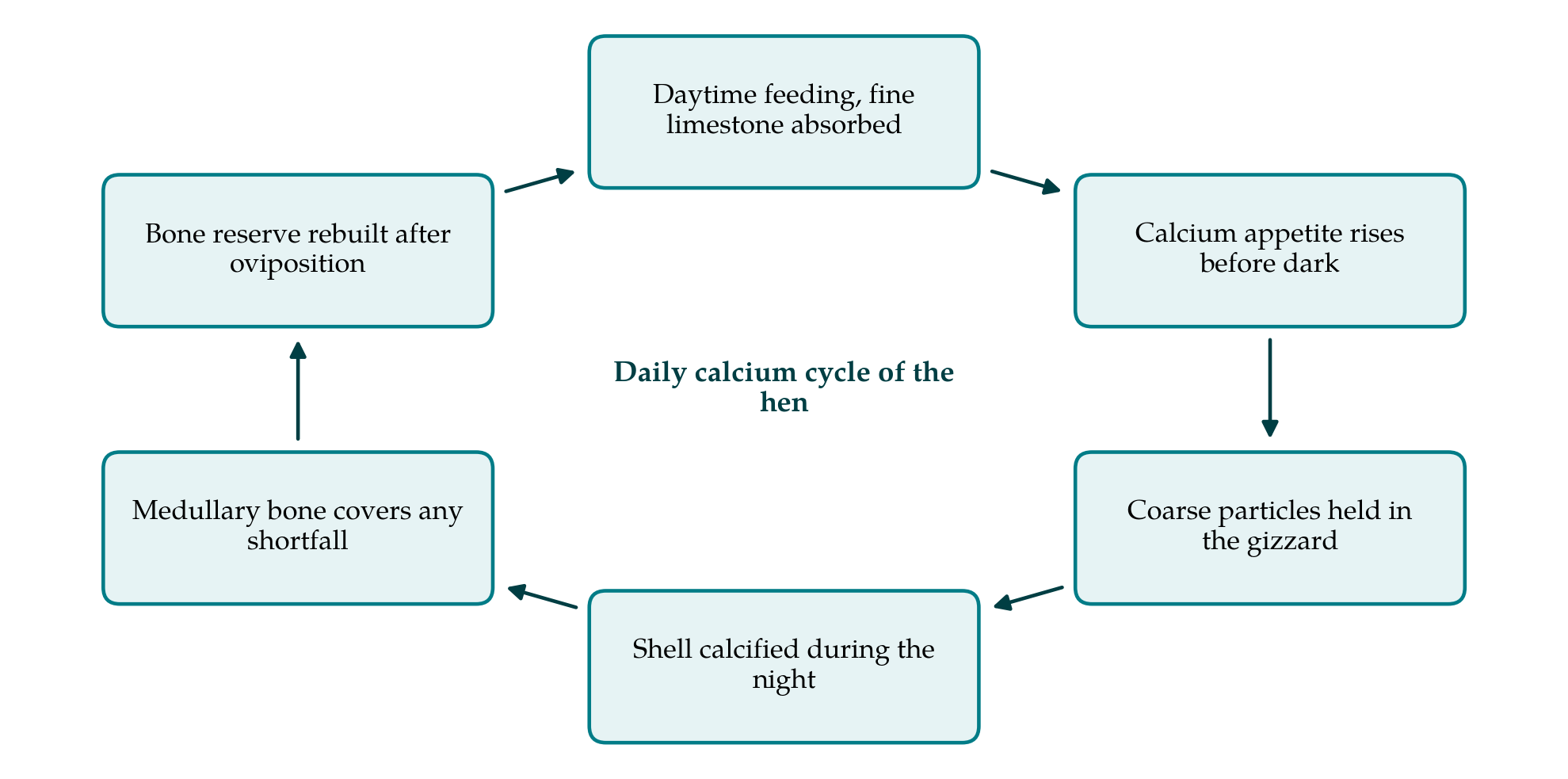
Age widens the gap between supply and demand. Intestinal calcium uptake has been found to decline in older hens (Al-Batshan et al., 1994). An older hen therefore gains more than a young one from a calcium source that is still dissolving when the shell is being formed, and she is less able to make up the difference from bone without cost to her skeleton.
3. What a Late Adjustment Can and Cannot Change
The experimental record is consistent in direction and modest in size. Coarse particles improved shell quality and bone mineralisation in the work of Guinotte and Nys (1991). In a longer comparison, Saunders-Blades et al. (2009) found the clearer benefit of large particles in bone quality, with smaller effects on the shell. A reasonable expectation after a late-cycle change is therefore a slowing of the decline in shell thickness and strength, not a return to the shell of a young flock. Table 1 lists the usual measures and how each may be expected to behave.
| Measure | What it reflects | Expected behaviour |
|---|---|---|
| Shell weight and shell percentage | Amount of calcium carbonate deposited | Most directly responsive; small improvement or slower decline |
| Shell thickness | Deposition relative to egg surface | Follows shell weight; limited by increasing egg size |
| Specific gravity | Proportion of shell in the whole egg | Useful flock-level indicator; affected by egg storage |
| Breaking strength | Thickness together with shell structure | May improve less than thickness |
| Cracked and downgraded eggs | Shell strength and handling damage | Slow to respond; confounded by equipment |
| Bone ash or keel condition | State of the calcium reserve | Likely to benefit; not a shell measure |
Some features of the old hen's shell do not depend on calcium supply. The organic matrix that directs crystal growth changes with age, and the resulting defects of ultrastructure reduce strength at a given thickness (Hincke et al., 2012). Egg size is governed by other nutrients and by the age of the bird. Disease, heat and disturbance during shell formation each leave their own marks (Roberts, 2004). A flock whose shells fail for these reasons will show little response to coarser limestone, and the absence of a response is itself informative.
4. Practical Points When Making the Change
Particle size is a proxy for solubility, and limestones differ. A hard, dense stone dissolves more slowly than a soft one of the same sieve size, so a supplier's statement of size should be accompanied by a solubility test where one is available (Zhang and Coon, 1997). The usual recommendation is to keep both fractions in the diet, fine for rapid absorption during the day and coarse for the night, and to raise the coarse share gradually. Total calcium should still meet the published requirement for the level of feed intake (NRC, 1994). An excess does not strengthen the shell, and it can depress intake.
Two mechanical matters deserve attention. Coarse particles separate from mash in bins and along chain feeders, so hens at the far end of the line may receive a different diet from those at the start. Hens also select particles, and their appetite for calcium rises late in the day; a feed run in the afternoon gives them the opportunity to take coarse limestone when it is most useful. Lighting programmes that include a short period of light at night for feeding act on the same principle.
The result should be judged on measurements taken before and after the change on eggs of similar age, collected at the same time of day and stored alike, using methods whose sources of error are understood (Hamilton, 1982). Shell weight relative to egg weight and specific gravity are the most practical on a farm. Since shell quality would have gone on declining without any change, a flat line may represent a gain. Several weeks should be allowed before a judgement is made, and the proportion of cracked eggs recorded at the packing station, though it is the figure that matters commercially, should be read alongside the shell measurements and not in place of them.
5. Conclusion
Raising the coarse fraction of dietary calcium late in the laying cycle is a sound practice with a clear physiological basis. The published work suggests that it slows the loss of shell thickness and protects the skeleton, and that it will not restore shell structure or offset the effect of increasing egg size. Producers who expect a limited improvement, measure it properly and attend to limestone solubility and feed segregation are the ones most likely to find the adjustment worthwhile.
Conflict of interest
To be declared by the author(s) before publication.
Funding
To be declared by the author(s) before publication.