1. Introduction
Food is among the last things migrants give up. Language may fade within two generations and dress within one, yet a way of seasoning rice or a sweet made once a year for a particular feast can persist long after both. Observers of immigrant life noticed this early, and for much of the twentieth century they explained it as retention: the stomach was conservative, and foodways were the residue of a culture otherwise dissolving in the host society.
Scholarship since the 1980s has replaced that picture with a more active one. The anthropology of food grew into an established field (Mintz and Du Bois, 2002), diaspora became a leading concept in the study of migration, and the two met in a body of work that treats cooking, eating and feasting as means by which communities define who they are. Festivals hold a special place in it, because they are occasions when food is prepared in quantity, according to rule, and in public. This review surveys that work.
2. Approach of the Review
The survey is a narrative review of published books and articles. It makes no claim to exhaustive coverage and reports no systematic search. Works were chosen because they are widely cited, because they introduced a concept that others took up, or because they represent a line of inquiry. "Recent" is read generously, to take in the studies of the 1980s and 1990s on which current writing still builds. The literature is strongest on communities in North America and Britain, and the balance of the review reflects this while noting it as a limitation. The review by Mintz and Du Bois (2002) remains a useful entry point to the wider field.
3. Concepts
Three terms need brief definition. Diaspora was first applied to peoples dispersed from a homeland who keep a memory of it and a sense of separateness where they live (Safran, 1991). Later writers loosened the criteria. Clifford (1994) stressed routes and lateral ties over roots and return, and Brubaker (2005) proposed treating diaspora as a stance or claim that people make and not a bounded group to which they belong. Identity has undergone a similar revision: Hall (1990) described cultural identity in diaspora as a matter of becoming as well as being, produced through difference and never finished.
Foodways denotes the whole pattern of what a group eats and how it obtains, prepares, serves and thinks about it. Two older arguments still frame its study. Douglas (1972) showed that a meal has a grammar, and that who may share which kind of meal maps the boundaries of intimacy. Fischler (1988) argued that because food is taken into the body, eating is tied to the sense of self more closely than other forms of consumption: people become what they eat, in imagination as well as in substance. Together these ideas explain why a change of diet can be felt as a change of person.
4. The Home Kitchen
The largest share of research concerns domestic cooking. Its central theme is memory. Sutton (2001), working with Greek islanders and those who had left, showed how taste and smell call up whole situations from the past, and how food sent or carried across distance keeps relationships alive. A review by Holtzman (2006) sorted the growing literature on food and memory and noted how often it turns on nostalgia, loss and the experience of displacement. In a diasporic household the daily meal is thus a routine act of recollection.
Ethnographic studies add detail and complication. In his study of Bengali-American households Ray (2004) found that meals were not uniformly conserved: dinner tended to remain Bengali, built around rice and fish, while breakfast and lunch were given over to American convenience. Families were making choices about where tradition mattered. Histories of earlier migrations point the same way. Diner (2001) compared Italian, Irish and Jewish migrants to the United States and showed that their different experiences of hunger and plenty at home led to very different investments in food as a marker of identity abroad.
Conservation in the kitchen always involves substitution. Ingredients that were ordinary at home may be unobtainable or costly abroad, and cooks replace them with what the local market offers, adjust techniques to new stoves and working hours, and in time come to regard the adapted dish as the proper one. Histories of immigrant cooking in the United States record many dishes that took shape in this way and were later taken up by the wider public (Gabaccia, 1998). The literature therefore tends to describe diasporic cooking as a cuisine with its own history, related to that of the homeland without being a copy of it.
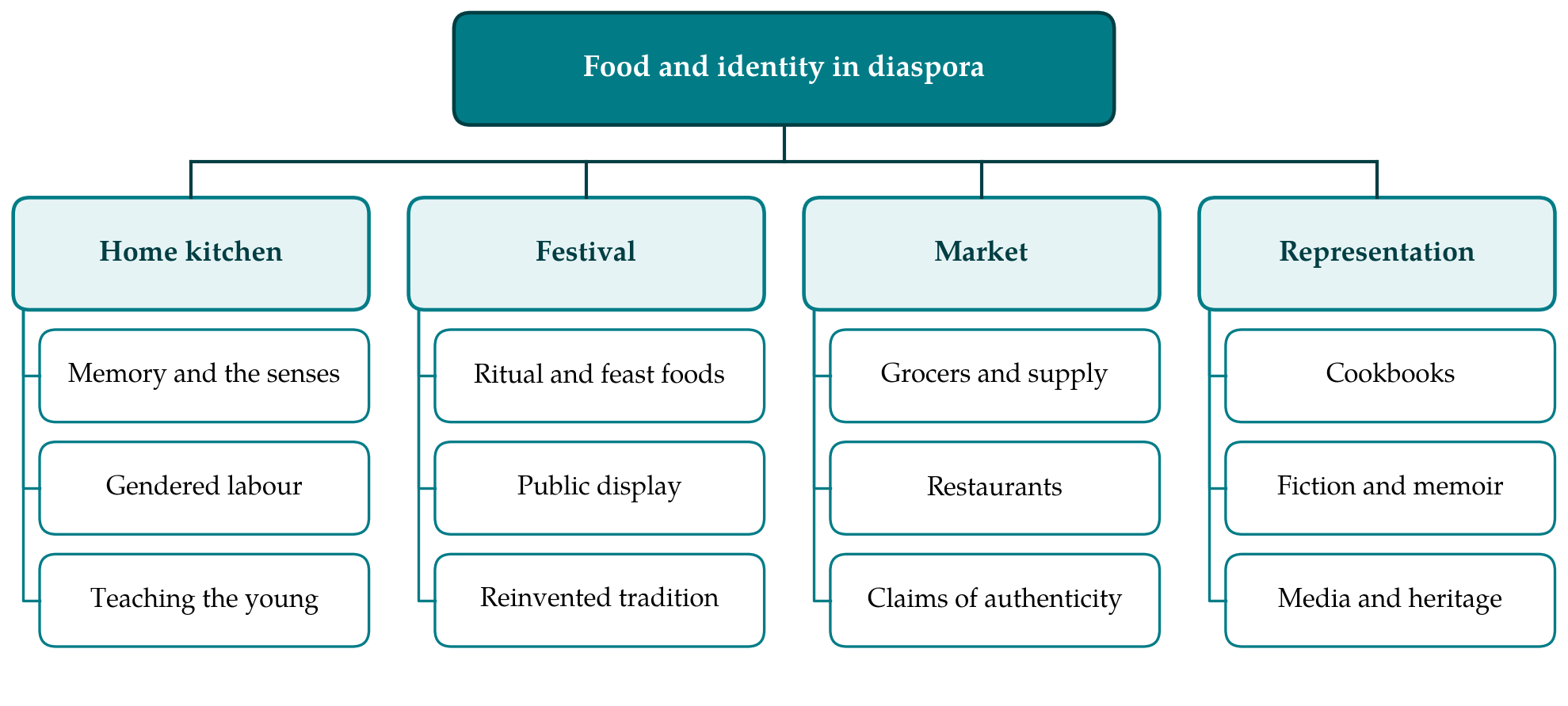
The kitchen is also a place of work, and the work is unequally shared. Responsibility for feeding a family in the proper way, and for teaching children to recognise and want that food, falls mainly on women, who may experience it as a burden, a source of standing, or both (Ray, 2004). Figure 1 places the home kitchen beside the three other settings discussed below.
5. Festival and Ritual Food
Festivals concentrate what everyday meals disperse. The classic anthropology of ritual describes them as time set apart, in which ordinary rules are suspended or reversed and a sense of fellowship is produced among participants (Turner, 1969). Particular dishes belong to particular days and are often laborious, requiring many hands, so that preparation is itself an occasion. In diaspora such foods may be the only ones still made strictly by rule, and their ingredients the ones families go furthest to obtain.
Festivals also face outward. Cohen (1993) followed the Notting Hill Carnival in London over several decades and argued that a celebration brought by Caribbean migrants became a vehicle through which a community organised and asserted itself politically. Studies of Hindu communities overseas describe how festivals were consolidated and standardised as dispersed groups came to present themselves as a single community (Vertovec, 2000). The food stalls of a street festival are where many outsiders first meet a cuisine, and where a community decides which dishes will stand for it.
Timing changes as well as content. Feasts tied to a lunar or agricultural calendar at home are often moved to the nearest weekend, shortened, or merged with public holidays of the host country, and domestic rites may shift into hired halls and places of worship where food is cooked by committees of volunteers. Such adjustments alter who does the work and who is fed, and they make the place of worship a centre of culinary as well as religious life (Vertovec, 2000).
Two cautions recur. The first is that much festival practice is newer than it appears. The concept of invented tradition (Hobsbawm and Ranger, 1983) has been applied to diaspora celebrations that are larger, more uniform or differently timed than anything in the homeland. The second is that festival food may signal attachment without demanding much of it. Gans (1979) called this symbolic ethnicity: for later generations, identity can be expressed through occasional, enjoyable acts of consumption that cost little and commit to little. Whether a feast-day dish is a living practice or a token of this kind is an empirical question in each case.
6. Markets, Restaurants and Authenticity
Cuisine is also commerce. Migrant grocers, bakers and restaurateurs supply their own communities and, in time, the wider public. Gabaccia (1998) traced how foods that arrived in the United States with particular groups crossed over to become general fare, carried by ethnic entrepreneurs and then by mass producers. Ray (2016) examined the restaurateur as a figure whose skill and labour are routinely undervalued, and showed that the standing of a cuisine in a city follows the social standing of the people associated with it.
The key word in this setting is authenticity, and the literature treats it with suspicion. Heldke (2003) criticised the adventurous diner's quest for the authentic and exotic as a form of cultural colonialism. Narayan (1995) examined curry as a category shaped by colonial history and asked what eating the food of others does and does not signify. Abarca (2004) proposed that cooks be credited with originality instead of being held to a standard of authenticity that freezes their food in time. Underlying all three is the observation that judgements of taste rank people as well as dishes. Table 1 sets these debates beside those of the other three settings.
| Theme | Central question | Representative sources |
|---|---|---|
| Memory and the senses | How do taste and smell sustain ties to a remembered place? | Sutton, 2001; Holtzman, 2006 |
| Domestic practice | Which meals are conserved, which adapted, and by whose labour? | Ray, 2004; Diner, 2001 |
| Festival | How does feast food mark community for insiders and outsiders? | Cohen, 1993; Vertovec, 2000 |
| Symbolic ethnicity | Is food a deep practice or an occasional token of belonging? | Gans, 1979; Kalcik, 1984 |
| Commerce | Who profits and who gains standing when a cuisine is sold? | Gabaccia, 1998; Ray, 2016 |
| Authenticity | Who decides what counts as the real dish? | Heldke, 2003; Abarca, 2004 |
| Representation | How do texts codify and circulate a cuisine? | Appadurai, 1988; Mannur, 2010 |
7. Cookbooks, Fiction and the Making of Cuisines
A cuisine becomes an emblem partly by being written down. Appadurai (1988) showed how English-language cookbooks written for the Indian urban middle class assembled regional dishes into something that could be called a national cuisine. The process has parallels in diaspora, where community cookbooks compiled by temples, churches and associations fix recipes, select what is representative and pass over what is thought too humble or too strange. Wilk (1999) described a related case in which a national food emerged in Belize through migration, return and the expectations of foreigners, a reminder that homeland cuisines are themselves shaped from abroad.
Literary scholars have examined how food works in the fiction, memoir and film of diaspora. Mannur (2010) argued that culinary scenes in South Asian diasporic writing carry nostalgia and also question it, and that the readiness of publishers and audiences to consume such scenes can confine writers to the role of cultural caterer. Earlier folklorists had already noted that foodways are performed for audiences, and that groups emphasise or play down distinctive foods according to who is watching (Kalcik, 1984).
8. Criticisms, Gaps and Future Work
Several criticisms are made from within the field. One is a tendency to celebrate. Writing about food is pleasurable, and accounts of diaspora cuisine can slide into an appreciation that overlooks who cooks, who is paid and how badly. A second concerns the homeland, often treated as a fixed point from which diaspora practice departs, when cuisines at home are changing too. A third is that multicultural food festivals may display difference in an agreeable form while leaving inequality untouched, a point pressed by critics of culinary tourism (Heldke, 2003).
The gaps are of coverage and of method. Most studies concern migrants from Asia, southern Europe, Latin America and the Caribbean living in North America, Britain and Australia; much less is written on diasporas within Asia and Africa. The first generation is better studied than the third, for whom the questions raised by the idea of symbolic ethnicity matter most. Religion and food rules deserve closer attention in the festival literature, as do the effects of online recipe sharing and food media on how recipes travel between generations and across borders. Longitudinal and comparative designs remain uncommon in a field built largely from single-community ethnographies.
9. Conclusion
The scholarship surveyed here agrees on a basic point: in diaspora, food is a practice through which belonging is worked out and never merely a relic of somewhere else. It is remembered in the kitchen, formalised at the festival, sold in the market and codified in print, and at each stage it is open to dispute about who may speak for the community. The field's best work keeps the pleasure of its subject in view together with the labour and the inequalities that lie behind the table.
Conflict of interest
To be declared by the author(s) before publication.
Funding
To be declared by the author(s) before publication.