1. Introduction
For most of the history of obesity medicine the practical ceiling of drug treatment was a loss of a few per cent of body weight beyond what lifestyle advice achieved. The incretin-based agents changed that. Liraglutide at its obesity dose gave a moderate but dependable effect (Pi-Sunyer et al., 2015), once-weekly semaglutide roughly doubled it (Wilding et al., 2021), and tirzepatide, which acts on both the glucagon-like peptide-1 (GLP-1) and the glucose-dependent insulinotropic polypeptide receptors, produced average losses that approach those seen after some bariatric procedures (Jastreboff et al., 2022). Semaglutide has since been shown to lower the rate of major cardiovascular events in people with established cardiovascular disease and overweight or obesity but without diabetes (Lincoff et al., 2023).
Success on treatment raises an obvious question about what follows it. People stop these medicines for many reasons: nausea and other gastrointestinal effects, cost and insurance rules, shortages, pregnancy planning, or a belief shared by patient and clinician that a target weight marks the end of a course. The idea of a course is borrowed from acute illness and sits uneasily with the modern description of obesity as a chronic, relapsing disease process (Bray et al., 2017). Whether weight returns after withdrawal, how fast, and with what consequences are therefore questions of direct clinical weight.
This article reviews the published evidence on weight trajectories in adults with obesity after incretin-based therapy is stopped, and sets that evidence against what was already known about the biology of weight regain.
2. Scope and Approach
This is a narrative review of the published literature. It draws on the randomised trials that included a planned withdrawal or an off-treatment follow-up, on physiological studies of weight loss maintenance that predate the current drugs, and on reports of treatment persistence in routine practice. The focus is adults treated for obesity or overweight with weight-related complications; trials in type 2 diabetes are mentioned only where they clarify mechanism. No formal search protocol or quantitative synthesis was undertaken, and the selection reflects the author's judgement of which sources are most informative. Trial results are described in words and in approximate terms, and readers who need exact estimates should consult the original reports.
3. Why Weight Returns: The Physiological Background
Regain after weight loss is not peculiar to drug treatment. A pooled analysis of structured weight loss programmes in the United States found that, on average, well over half of the lost weight had returned within a few years, with a small fraction maintained at five years (Anderson et al., 2001). The explanation offered by physiology is that body weight is defended. Leibel et al. (1995) showed in inpatient studies that maintaining a reduced body weight is accompanied by a fall in energy expenditure larger than the change in body mass predicts, and follow-up of participants in an intensive televised weight loss competition suggested that this adaptation can persist for years (Fothergill et al., 2016).
Appetite appears to matter more than expenditure. Sumithran et al. (2011) measured circulating mediators of appetite before and after diet-induced weight loss and found that leptin, peptide YY and cholecystokinin remained lower, and ghrelin and subjective hunger higher, a year after the diet ended. Polidori et al. (2016) used the response to a sodium-glucose cotransporter 2 inhibitor to estimate the strength of the feedback and concluded that the drive to eat rises in proportion to weight lost and outweighs the accompanying fall in energy expenditure several times over. A person who has lost weight is, in this account, biologically pressed to eat more than a person of the same weight who was never heavier (Hall and Kahan, 2018).
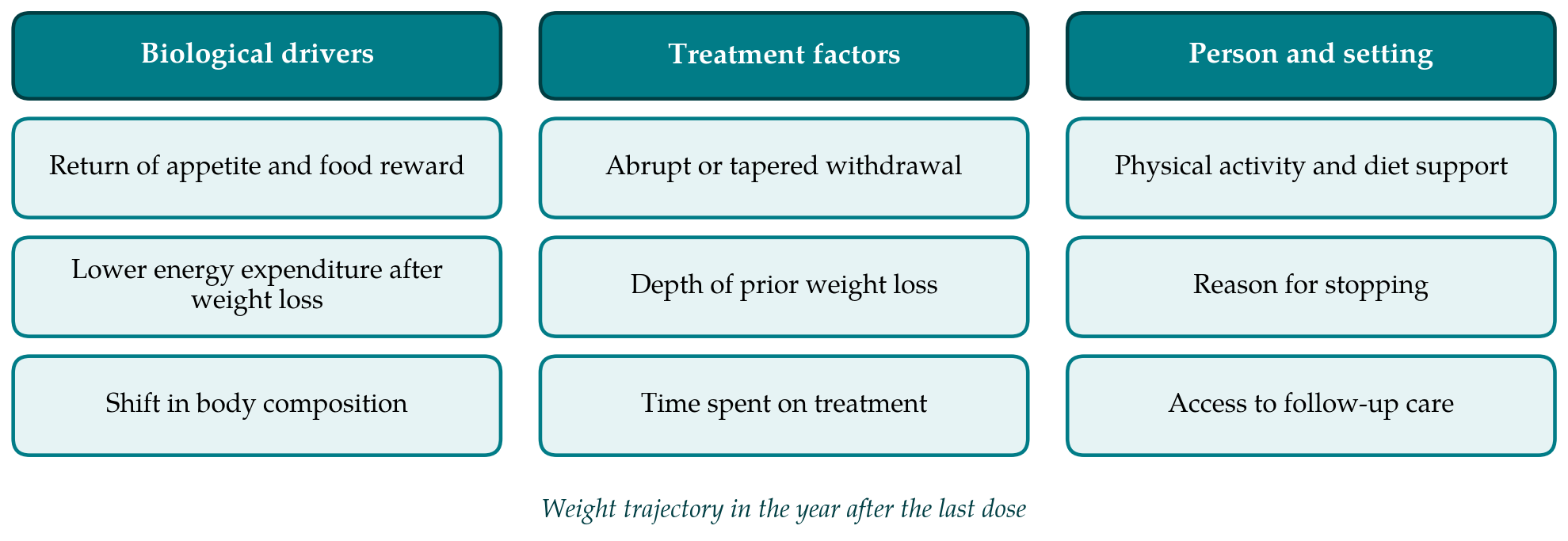
GLP-1 receptor agonists act on precisely this pressure. They reduce food intake through receptors in the hypothalamus and hindbrain, slow gastric emptying, and alter the reward value of food (Drucker, 2018; Müller et al., 2019). They do not, so far as is known, reset the defended weight. When the drug is cleared, the pharmacological brake on appetite is released at the moment when the endogenous signals favouring intake are at their strongest, because the person now weighs much less than before. On physiological grounds alone, regain after withdrawal is the expected outcome and sustained loss the one that would need explaining. Figure 1 groups the influences on the post-treatment trajectory that are discussed in this review.
4. Evidence From Withdrawal and Extension Studies
Four bodies of trial evidence bear directly on the question. Their designs differ in ways that affect interpretation, and Table 1 summarises them before each is discussed.
| Study | Design feature | Main observation after withdrawal | Caveat |
|---|---|---|---|
| STEP 1 extension (Wilding et al., 2022) | Off-treatment follow-up for about a year after 68 weeks of semaglutide | About two thirds of lost weight regained; risk factors drifted back | Subset of original trial; no continued-drug comparator |
| STEP 4 (Rubino et al., 2021) | Randomised switch to placebo after a 20-week run-in | Progressive regain on placebo; further loss with continuation | Only those who tolerated the run-in were randomised |
| SURMOUNT-4 (Aronne et al., 2024) | Randomised switch to placebo after a 36-week open-label lead-in | Substantial regain on placebo over 52 weeks; further loss on tirzepatide | Enriched for responders and tolerators |
| SCALE Maintenance (Wadden et al., 2013) | Liraglutide or placebo after diet-induced loss | Drug helped hold and extend prior loss | Tests maintenance by drug, not withdrawal |
| Exercise and liraglutide trial (Lundgren et al., 2021) | Four arms after a low-calorie diet | Combination gave the best maintenance and body composition | Single country; post-treatment data reported separately |
4.1. Semaglutide
In STEP 1, adults with obesity or with overweight and a related complication received semaglutide 2.4 mg weekly or placebo for 68 weeks alongside lifestyle intervention (Wilding et al., 2021). A subset of participants was then followed for about a further year after both the drug and the lifestyle programme had ended. In that extension, those who had taken semaglutide regained roughly two thirds of the weight they had lost, and the improvements in blood pressure, lipids, glycated haemoglobin and C-reactive protein moved back towards baseline in step with weight (Wilding et al., 2022). Net weight at the end of follow-up was still below the starting value, but the direction of travel had not levelled off convincingly.
STEP 4 approached the matter experimentally. All participants took semaglutide during a 20-week run-in, and those who reached the maintenance dose were randomised to continue or to switch to placebo for 48 weeks. Continued treatment brought further loss; substitution of placebo was followed by steady regain across the whole randomised period (Rubino et al., 2021). The contrast between the arms is the most direct demonstration that the weight effect of semaglutide depends on continued exposure. A two-year trial of uninterrupted treatment, STEP 5, complements this by showing that loss is held for as long as the drug is taken (Garvey et al., 2022).
4.2. Tirzepatide
SURMOUNT-4 used the same logic with a longer exposure. After 36 weeks of open-label tirzepatide, by which point average weight loss was already large, participants were randomised to continue or to receive placebo for 52 weeks. Those who continued lost more weight, while those moved to placebo regained a substantial share of what they had lost, although they remained lighter on average than at enrolment (Aronne et al., 2024). The pattern closely resembles that seen with semaglutide, which argues that regain is a property of withdrawing effective appetite suppression and not of one molecule.
4.3. Liraglutide and combined approaches
The liraglutide programme offers less direct evidence. SCALE Maintenance randomised people who had already lost weight on a low-calorie diet to liraglutide or placebo and showed that the drug helped to keep and extend that loss (Wadden et al., 2013); it tested maintenance by drug and did not test withdrawal. The trial by Lundgren et al. (2021) is of greater interest here. After an initial diet, adults were assigned to a supervised exercise programme, liraglutide, both, or placebo for a year. The combination maintained weight loss best and was the only strategy that improved body fat percentage while preserving lean mass. A later report from the same trial, covering the year after all interventions ceased, indicates that participants who had exercised held their weight and body composition better than those who had received the drug alone (Jensen et al., 2024). This is a single trial with modest numbers, yet it is the main randomised signal that anything done during treatment changes what happens afterwards.
5. What Is Regained, and What Else Is Lost
Total body weight is a blunt outcome. Any substantial weight loss includes fat-free mass as well as fat, in proportions that vary with the size and speed of loss, sex, age, protein intake and activity (Heymsfield et al., 2014). A long-standing concern in the weight cycling literature is that regain may restore fat more readily than lean tissue, leaving a person at the original weight with a less favourable composition. Whether this happens after incretin withdrawal is not established. The published withdrawal trials report weight and waist circumference, and detailed body composition during the off-treatment period is scarce. The question is of particular concern for older adults, in whom loss of muscle carries functional consequences.
The fate of cardiometabolic benefit is clearer. In the STEP 1 extension the improvements in risk factors tracked weight back towards baseline (Wilding et al., 2022). The cardiovascular outcome benefit shown for semaglutide was obtained with ongoing treatment (Lincoff et al., 2023), and there is no trial evidence that it outlasts the drug. It would be unsafe to assume a durable legacy effect from a time-limited course.
6. Stopping in Routine Care
Trials describe withdrawal under supervision in people selected for adherence. Routine care looks different. Analyses of dispensing records from health systems in the United States indicate that a large proportion of people who start an anti-obesity medicine are no longer collecting it a year later, with persistence varying by agent and related to the weight loss achieved (Gasoyan et al., 2024). Discontinuation is therefore the common experience, and much of it is unplanned. The trial populations, by contrast, stopped at a scheduled visit after reaching and tolerating a full dose. People who stop early because of side effects or cost will have lost less and may differ in other respects, so the proportion regained in trials cannot simply be transferred to them.
Practice has moved ahead of evidence on how to stop. Gradual dose reduction, longer intervals between injections, a switch to a lower maintenance dose, and intensified dietary and exercise support at the time of withdrawal are all in use. Each is plausible. None has been compared with abrupt cessation in an adequately sized randomised trial with body composition as an outcome, and reports of success with tapering come mainly from uncontrolled service evaluations. Guidelines written before the current agents already advised that pharmacotherapy be continued when it is effective and tolerated (Apovian et al., 2015), and nothing in the withdrawal trials contradicts that advice.
7. Gaps and Future Work
Several questions follow from the evidence reviewed. The first concerns heterogeneity. Average trajectories conceal individuals who maintain most of their loss after stopping, and it is not known whether they can be identified in advance by duration of treatment, behaviour change during treatment, starting weight or biology. The second concerns duration: the randomised withdrawal periods last about a year, and whether weight eventually settles below, at or above the pre-treatment level has not been observed. The third is the comparison of exit strategies, including tapering, lower-dose maintenance, and structured exercise, in trials that measure fat and lean mass, physical function and quality of life as well as the scale.
Two further matters deserve study. Repeated cycles of starting and stopping, driven by supply or payment, are now common and their metabolic and psychological effects are undescribed. And the experience of regain after a period of marked success, including its effect on mood, eating behaviour and willingness to re-engage with care, has received little systematic attention. Observational data from registries can describe these patterns, but confounding by the reason for stopping will limit causal inference, and randomised designs remain necessary for the questions about strategy.
8. Conclusion
The published trials agree with one another and with the older physiology. When semaglutide or tirzepatide is withdrawn from adults with obesity, weight rises progressively over the following year and the associated improvements in cardiometabolic risk factors recede. The effect is best understood as the removal of a treatment from a chronic condition whose underlying biology is unchanged. Supervised exercise during treatment is the one adjunct with randomised support for improving what follows, and that support rests on a single trial. Counselling before treatment starts should make the likelihood of regain after stopping explicit, and research should now turn from showing that regain occurs to finding out for whom, and by what means, it can be limited.
Conflict of interest
To be declared by the author(s) before publication.
Funding
To be declared by the author(s) before publication.