1. Introduction
The moduli space of stable curves of genus g, constructed by Deligne and Mumford (1969) and written here as Sg, with Sg,n for its version with n marked points, is an irreducible projective variety of dimension 3g − 3 for g at least 2. It is the one compactification of the moduli of smooth curves that almost every algebraic geometer has used. Its birational geometry became a subject in its own right when Harris and Mumford (1982) proved that it is of general type for large genus, overturning the classical belief, founded on Severi's work in low genus, that moduli of curves should always be unirational.
The questions that followed were formulated over the next decade or so. They ask where the transition from uniruled to general type takes place, what the cones of effective and nef divisors look like, and whether the intermediate birational models have modular interpretations. This Perspective looks back over roughly thirty years of work on those questions. It is an argument about the shape of the progress and about where effort is best directed, and it rests entirely on the published record. The survey of Chen et al. (2013) is the reference for most of the background on divisors.
2. The Questions as They Were Posed
Three groups of problems can be distinguished. The first concerns the Kodaira dimension. The canonical class of Sg is 13λ − 2δ minus a correction supported on the boundary component of curves with an elliptic tail, where λ is the Hodge class and δ the total boundary. An effective divisor of class aλ − bδ with slope a/b below 13/2 therefore forces general type. The Brill-Noether divisors used by Harris and Mumford and by Eisenbud and Harris (1987) have slope 6 + 12/(g + 1), which is below 13/2 exactly when g is at least 24. Harris and Morrison (1990) conjectured that no effective divisor has smaller slope, which would have made 23 the last genus not of general type.
The second group concerns cones. Fulton asked whether the cones of effective cycles on the genus zero spaces S0,n are generated by boundary strata, and the version for curves, extended to all genera, became the F-conjecture: a divisor is nef if and only if it meets every one-dimensional boundary stratum non-negatively. Keel and McKernan (1996) proved it for genus zero with at most seven points, and Gibney et al. (2002) showed that the statement for every Sg,n would follow from a symmetrised statement in genus zero. In the same years Hu and Keel (2000) introduced Mori dream spaces and asked whether S0,n is one.
The third group concerns models. Since λ and δ span the relevant part of the Picard group, and aλ − bδ is ample exactly when a exceeds 11b (Cornalba and Harris, 1988), one can ask for the birational models obtained from the log canonical divisors K + αδ as α decreases from 1 to 0, and for their meaning as moduli spaces. This is the program proposed by Hassett and Keel. Table 1 sets out the five problems with their current status.
| Problem | What is known | What remains open |
|---|---|---|
| Kodaira dimension | Unirational up to genus 14; general type from genus 22 (Farkas et al., 2020) | Genus 17 to 21 |
| Slope of the effective cone | Slope conjecture false (Farkas and Popa, 2005) | Whether slopes stay bounded away from zero as the genus grows |
| Nef cone (F-conjecture) | True in genus zero up to seven points; reduced to genus zero (Gibney et al., 2002) | The general case |
| Mori dream space in genus zero | Fails for many marked points (Castravet and Tevelev, 2015) | A few intermediate numbers of points |
| Log canonical models | First contraction and two flips constructed (Hassett and Hyeon, 2013; Alper et al., 2017) | Modular meaning of the later models |
3. What Three Decades Have Shown
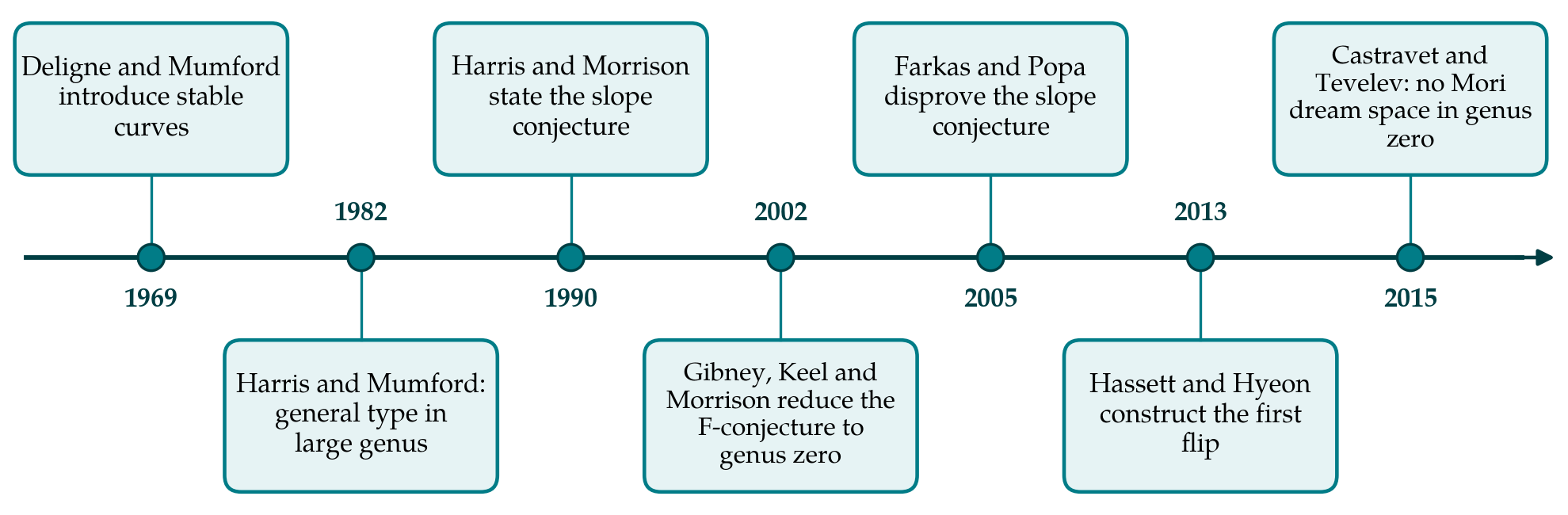
Figure 1 marks the main dates. On the Kodaira dimension the gap has narrowed from both sides. The space is unirational up to genus 14 and uniruled in genus 15 and 16 (Chen et al., 2013), and Farkas et al. (2020) proved that it is of general type in genus 22 and 23. Their proof constructs effective divisors of small slope from the failure of a maximal rank statement for curves with a suitable linear series and verifies the needed transversality by tropical and non-archimedean methods. Five genera, from 17 to 21, are left.
The slope conjecture is false. Farkas and Popa (2005) showed that in genus 10 the closure of the locus of curves lying on a K3 surface is a divisor of slope 7, smaller than the Brill-Noether value, and Farkas (2009) produced counterexamples in infinitely many genera from Koszul cohomology, that is, from loci where syzygies of the curve jump. What survives is an asymptotic question. The effective divisors constructed so far have slopes that approach 6 as the genus grows, while the known lower bounds decay like a constant divided by g, and nobody knows which behaviour is the true one.
On cones the news has been mixed. The nef side stands where it stood: the F-conjecture is open, though it has been checked in low genus. The effective side of Fulton's question fails already for six points in genus zero, where Vermeire (2002) exhibited an effective divisor that is not a sum of boundary divisors. And Castravet and Tevelev (2015) proved that S0,n is not a Mori dream space once n is at least 134, a bound that González and Karu (2016) lowered to 13. The Cox ring is not finitely generated, and the effective cone need not be polyhedral.
The Hassett-Keel program has advanced step by step. Hassett and Hyeon (2009) showed that at α = 9/11 the elliptic tails are contracted and the resulting model parametrises pseudostable curves, in which cusps replace elliptic tails. Hassett and Hyeon (2013) constructed the first flip at α = 7/10, where tacnodes appear in exchange for elliptic bridges, and Alper et al. (2017) described the second flip at α = 2/3. Each step required new stability analysis, and beyond the second flip no general modular description is available.
4. The Argument: Constructions Have Mattered More Than Machinery
Read together, these results suggest a simple thesis. Progress on the birational geometry of Sg has been limited by the supply of explicit geometric constructions, and not by the lack of general theory. Every improvement in the Kodaira dimension problem has come from a new family of effective divisors with a computable class: Brill-Noether and Petri divisors in the 1980s, the K3 locus and Koszul divisors in the 2000s, divisors from maximal rank loci in the most recent work. In each case the hard part was a transversality or non-emptiness statement about linear series on curves, and the class computation, although intricate, followed established patterns.
The general theory, by contrast, has given existence without description. Finite generation of the canonical ring guarantees that Sg has a canonical model in the general type range, but says nothing about what it parametrises. The cone theorem ensures that the part of the cone of curves that is negative on the canonical class is locally polyhedral, but does not identify its rays. The Hassett-Keel program is the place where the two meet, and its pace has been set by the classification of the singular curves to be admitted and by geometric invariant theory, not by the abstract existence of flips.
The same thesis accounts for the negative results. The divisors of Vermeire and the argument of Castravet and Tevelev both rest on explicit constructions: a specific map from S0,6 in the first case, a comparison with blow-ups of weighted projective planes in the second. The conjectures failed because the spaces contain more geometry than their boundary stratification records, and that geometry was found by people looking for particular subvarieties.
5. Objections
One objection is that the negative results show the original questions to have been naive, so that a balance sheet organised around them is misleading. If the effective cone of S0,n is not polyhedral, asking for its generators is the wrong question; if the slope conjecture is false, the slope may not be the right invariant. There is something in this. But the questions have been corrected and not abandoned. The asymptotic slope is a well-posed number. The F-conjecture concerns the nef cone, which is not affected by the failure of finite generation of the Cox ring, and its symmetric form involves far fewer divisor classes than the full cone. The subcone of divisors pulled back along forgetful and gluing maps remains tractable.
A second objection is that the thesis undervalues general methods, since the recent results on genus 22 and 23 depend on tropical geometry and limit linear series on chains of loops, which are general tools. The reply is that these tools were used to prove a specific transversality statement for a specific divisor. They enlarge the class of constructions that can be verified. They do not remove the need for the construction, and in the open genera from 17 to 21 no candidate divisor of slope below 13/2 is known.
A third objection is that the focus on Sg is itself dated, and that the questions are better asked for moduli of pointed curves, of spin and Prym curves, or of stable maps, where more is known. That is a fair description of where much current activity lies, but those spaces are studied largely through their maps to Sg, and the unsolved problems there are inherited from it.
6. Where to Look Next
If the thesis is right, three kinds of work deserve priority. The first is the search for geometrically defined divisors and covering families of curves in genus 17 to 21, where either a divisor of small slope or a uniruling would settle the Kodaira dimension. The second is the asymptotic slope: a single family of effective divisors with slope tending to a limit below 6, or a lower bound that does not decay, would change the picture more than any result in fixed genus. The third is a modular description of the next Hassett-Keel models, including the canonical model itself, for which even a conjectural list of the curves parametrised would be valuable.
On the nef side, the F-conjecture for genus zero with eight or more points is a concrete problem for each number of points and a natural target for a combination of geometric and computational methods. A counterexample would be as informative as a proof, since it would show that the boundary stratification fails to control positivity in the same way that it fails to control effectivity.
7. Conclusion
Thirty years of work have turned a set of optimistic conjectures about the moduli space of stable curves into a more exact map of what is true. The space is of general type from genus 22 on, its effective cone is richer than Brill-Noether theory predicted, its genus zero relatives are not Mori dream spaces, and its first log canonical models are moduli spaces of mildly singular curves. The nef cone, the intermediate genera and the asymptotics of slopes remain open. The record indicates that they will yield to new constructions of divisors and curves more readily than to further refinement of general theory, and that is where this Perspective suggests the effort should go.
Conflict of interest
To be declared by the author(s) before publication.
Funding
To be declared by the author(s) before publication.