1. Introduction
Ask a parent of a one-year-old what a paediatrician has said about screens and the answer is often short: none before two. The statement is easy to remember and, for most households, impossible to follow. Televisions run through the day, older siblings watch cartoons, grandparents appear on video calls, and the phone that entertains a toddler in a waiting room is the same one on which the clinic appointment was booked. A study in an urban paediatric clinic in the United States found that most children had begun using mobile devices before their first birthday (Kabali et al., 2015). The gap between advice and practice is wide enough that the advice risks being ignored altogether.
This Perspective takes the position that paediatricians owe families something better than a number. The case is not that screens have been proved harmful to infants, nor that existing recommendations are wrong in direction. It is that the guidance now offered is too blunt to help parents make the dozens of small decisions that add up to a child's media environment, and that the research base, though incomplete, is good enough to support advice of a more specific kind.
2. What Current Guidance Says
The principal statements are summarised in Table 1. The American Academy of Pediatrics advises avoiding digital media other than video chatting for children younger than 18 months, and allows high-quality programming watched with an adult from 18 to 24 months (AAP Council on Communications and Media, 2016). The World Health Organization, in guidelines framed around physical activity, sedentary behaviour and sleep, does not recommend sedentary screen time for infants or one-year-olds and sets a limit of one hour at age two (WHO, 2019). Canadian and Australian guidance take the same line for under-twos (Canadian Paediatric Society, 2017; Okely et al., 2017). The Royal College of Paediatrics and Child Health in the United Kingdom declined to set limits at any age, judging the evidence insufficient, and offered families a set of questions to ask themselves (RCPCH, 2019).
| Source | Advice for children under two | What it leaves open |
|---|---|---|
| AAP Council on Communications and Media, 2016 | Avoid digital media before 18 months except video chat; shared, high-quality content after | What counts as high quality; background and adult media |
| WHO, 2019 | Sedentary screen time not recommended under two; up to one hour at two | Video calls; content; the reasons for use |
| Canadian Paediatric Society, 2017 | Screen time not recommended under two; minimise, mitigate, be mindful, model | How to act on the principles in a short visit |
| Okely et al., 2017 | No sedentary screen time under two | Interactive and shared use |
| RCPCH, 2019 | No fixed limit; families review sleep, activity and control of use | Specific advice for infants and toddlers |
Three features of these documents stand out. They disagree on the threshold: 18 months in one, two years in others, and no threshold in the British statement. They are built around a single quantity, time, although the same authors acknowledge that content and context matter. And they are largely silent on forms of exposure that do not look like a child watching a programme. A paediatrician who repeats the headline has little to say when a parent replies that the child never watches television but the television is always on.
3. What the Evidence Supports
The research can be sorted into findings that rest on experiments and findings that rest on association, and guidance should treat the two differently.
3.1. Experimental findings
The best-established result is that infants and toddlers learn less from a screen than from a person doing the same thing in front of them. Anderson and Pempek (2005) reviewed the early studies and named the phenomenon the video deficit. Kuhl et al. (2003) showed it sharply for speech: nine-month-old infants exposed to a foreign language through live sessions with a speaker retained sensitivity to its sounds, while those given the same exposure by recording did not. Social contingency appears to be the active ingredient. Toddlers taught new words over a live video call, in which the adult responded to them, learned as they did face to face, and those shown a pre-recorded version of the same adult did not (Roseberry et al., 2014). This is the basis on which video chat is exempted in the American statement, and it is a distinction parents can grasp at once.
A second set of experiments concerns television that nobody is watching. With an adult programme playing in the room, children of one to three years played for shorter periods and with less focused attention than when the set was off (Schmidt et al., 2008), and parents spoke to and engaged with their children less (Kirkorian et al., 2009). These were short laboratory sessions, and they do not show long-term harm. They do show a mechanism, the displacement of adult speech and sustained play, that is independent of anything the child sees on the screen.
3.2. Observational findings
Cohort studies have linked greater screen exposure in the first years with lower scores on later developmental screening (Madigan et al., 2019), and a large Japanese birth cohort found that more screen time at age one was associated with delays in communication and problem solving at two and four (Takahashi et al., 2023). Daily touchscreen use in infants and toddlers has been associated with shorter sleep and later sleep onset (Cheung et al., 2017). Parents' own device use has been associated with more interrupted interactions and with reports of child behaviour problems (McDaniel and Radesky, 2018).
None of these studies can exclude confounding. Families in which infants watch a great deal differ from others in income, parental education, stress and mental health, and a child who is hard to settle may be given a screen more often, so that the direction of effect is uncertain. Reviews of the wider literature on children and adolescents describe the evidence as weak for most outcomes (Stiglic and Viner, 2019), and an analysis of a large survey of preschool children in the United States found little support for harm at the limits then recommended (Przybylski and Weinstein, 2019). Honest guidance has to say this. It can also say that the associations point in the same direction as the experiments, and that no study suggests infants benefit from solitary screen use.
4. Why the Present Guidance Falls Short
The first weakness is that a rule of abstinence gives no help to those who do not abstain. Once a family has crossed the line, as most do, the guidance has nothing further to offer, and the parent is left to conclude either that the harm is done or that the rule was never serious. Advice that grades exposure, distinguishing an occasional shared video from hours of solitary viewing, keeps the conversation open.
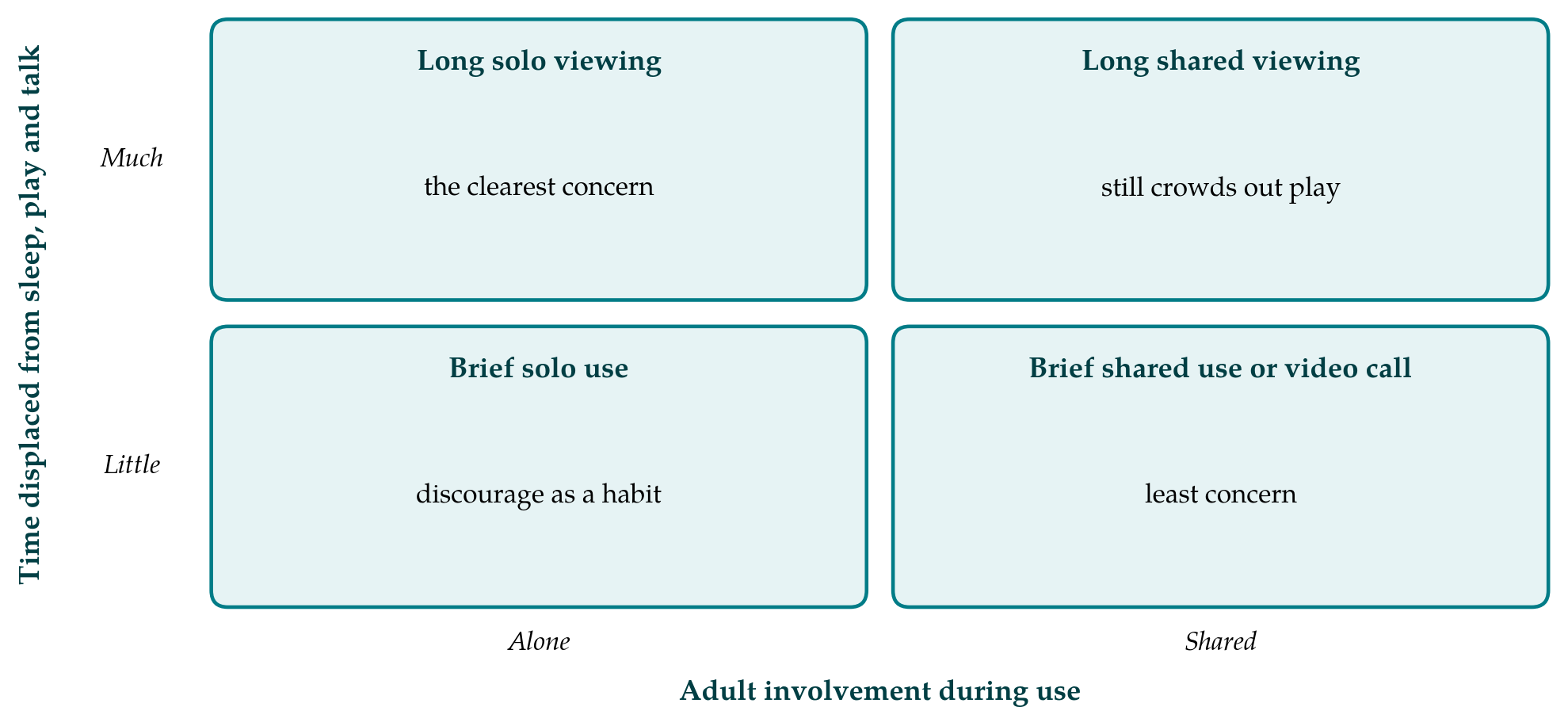
The second is that minutes per day measure the wrong thing. What the experimental work identifies as important is whether a responsive adult is involved and whether the screen displaces sleep, play and conversation. Figure 1 arranges common situations along those two dimensions. A ten-minute video call with a relative and ten minutes alone with an autoplaying feed are equal on a time measure and quite different on both axes. A classification of this kind gives parents a way to reason about situations that no list could anticipate.
The third is the omission of the adult. A toddler's exposure is determined by the household: the background television, the phone at the table, the tablet used to finish a meal or end a tantrum. Radesky et al. (2015) raised the concern that routine use of a device to calm a distressed child may displace the child's opportunities to learn to regulate emotion, while noting that this had not been tested. Parents ask about exactly these uses, and on these the published statements say least.
The fourth is inconsistency. Parents who search for advice find 18 months in one place, two years in another and no limit in a third. Differences that reflect reasonable judgements about thin evidence are read as disagreement about whether the matter is important at all.
5. What Clearer Guidance Would Contain
Clearer does not mean stricter. It means advice that states its grounds and can be applied. Four elements are proposed. The first is candour about certainty: infants learn language and much else from responsive people and not from recordings, which is well established; background television reduces adult talk and fragments play, which is shown in the short term; and long-term effects on development are plausible but unproven. Parents are capable of acting on graded statements of this kind.
The second element is a shift from time limits to protected activities. Sleep, floor play, shared reading and mealtimes without screens are concrete, observable and positive goals. The third is explicit mention of the uses now passed over: switch off a television nobody is watching; treat video calls with family as conversation and not as screen time; when a screen is used, sit with the child and talk about what is shown; avoid making a device the routine answer to distress or the routine companion to feeding. The fourth is attention to the adult's own use, raised without reproach, since a parent absorbed in a phone is unavailable to the child in the same way as a parent absorbed in anything else.
For the consultation itself, a single open question at the visits already scheduled for immunisation and developmental surveillance, asking what a usual day looks like for screens in the house, would bring out the family's real pattern and allow one or two specific suggestions. That is a realistic use of the minutes available, and more useful than a recited limit.
6. Objections
It may be objected that the evidence is too weak to justify any advice beyond the British position of leaving families to decide. The reply is that the experimental findings on the video deficit and on background television are among the more secure in developmental psychology, that they concern exactly the age group in question, and that advice to talk and play with an infant carries no plausible risk. Withholding guidance until cohort studies are free of confounding would mean withholding it indefinitely.
A second objection is that such advice moralises, and falls hardest on parents with the least help. A screen may be what allows a parent alone with several children to cook a meal. This is a reason for guidance to be graded and practical, not a reason for silence. Advice that recognises why screens are used, and concentrates on the changes that matter most, such as turning off background television, is less of a burden than a rule that most families break and feel judged for breaking.
A third is that paediatricians have no time. The proposal here replaces one sentence with one question and takes little longer. A fourth is that technology changes faster than guidance. That is true of devices and platforms, and less true of infants, whose need for responsive interaction does not change with the hardware.
7. Implications
For professional bodies, the implication is that the next revisions should converge on a common age framework, or explain their differences, and should address background media, adult use and the calming function directly. For researchers, the priorities are trials of advice itself: whether guidance of the kind described changes household media habits, and whether changes in those habits are followed by differences in language exposure, sleep or development. Measures of exposure need to move beyond parent-reported minutes to capture context. For the individual paediatrician, nothing prevents the adoption of a more specific conversation now.
8. Conclusion
Infants and toddlers are surrounded by screens, and the guidance offered to their parents has not kept pace with how those screens are used. The underlying message of existing recommendations, that children under two gain little from screens and much from people, is sound. What is missing is specificity: an honest account of what is known, attention to context and to adult habits, and advice framed around the activities worth protecting. Paediatricians are well placed to provide it, and families are asking for it.
Conflict of interest
To be declared by the author(s) before publication.
Funding
To be declared by the author(s) before publication.