1. Introduction
Withania somnifera (L.) Dunal, of the family Solanaceae, is a small shrub of the drier parts of India whose root has been used in Ayurveda for many centuries as a rasayana, a restorative. Modern interest centres on its steroidal lactones, the withanolides, and on claims relating to stress, sleep and physical performance. Reviews of the pharmacological literature describe a broad range of experimental activities and note that well-controlled clinical evidence is much thinner than the popularity of the drug would suggest (Mishra et al., 2000; Kulkarni and Dhir, 2008). Demand has nevertheless grown quickly, both in the domestic market and for export.
A large share of the domestic trade passes through local herb markets, where the root is sold whole, cut or, increasingly, ground. Grinding removes every character by which a buyer could judge the material: the shape and fracture of the root, its colour in section, the proportion of stem base attached. It also makes it simple to dilute root with cheaper matter. Overviews of the international literature have found that adulteration and contamination of herbal medicinal products are reported from many countries and product types (Posadzki et al., 2013), and a compilation of DNA-based studies concluded that a substantial proportion of commercial herbal products examined worldwide did not contain what the label stated (Ichim, 2019).
For ashwagandha powder in a particular regional market, however, a general impression is all that is usually available. This article sets out how a survey capable of replacing impression with evidence could be designed and run. It is a protocol. Nothing in it describes work that has been done.
2. The Drug and Its Vulnerabilities
A survey of adulteration needs a definition of the genuine article and a list of the departures from it that are plausible enough to test for.
2.1. What the standards define
The Ayurvedic Pharmacopoeia of India defines Ashwagandha as the dried mature root and gives a macroscopic and microscopic description together with limits for foreign matter, total ash, acid-insoluble ash and alcohol- and water-soluble extractives (Government of India, 2001). The monograph of the World Health Organization on the root is consistent with it and adds chemical identity tests (WHO, 2009). The definition matters because the plant part is the point at which most disputes arise. Roots and leaves of the species both contain withanolides, but in different proportions: comparative analyses show withaferin A to be far more prominent in the leaf, while the root has a distinct profile in which withanolide A and related compounds are characteristic (Chaurasiya et al., 2008; Mirjalili et al., 2009).
2.2. Forms that adulteration can take
Published analysis of commercial ashwagandha preparations in India found wide variation in withanolide content between products (Sangwan et al., 2004). Variation of that kind has several possible causes, and they call for different tests. The forms considered in this protocol, with the way each arises and the test best suited to revealing it, are set out in Table 1. Contamination with heavy metals is included although it is not adulteration in the strict sense, because surveys of Ayurvedic products sold in and exported from South Asia have repeatedly found lead, mercury or arsenic in a proportion of them (Saper et al., 2004; Saper et al., 2008).
| Form | How it arises | Primary test | Tier |
|---|---|---|---|
| Aerial parts in root powder | Stem and leaf milled with or instead of root | Powder microscopy; withanolide profile by HPTLC and HPLC | 1, 2 |
| Exhausted or deteriorated root | Previously extracted or long-stored material resold | Extractive values; marker assay | 1, 2 |
| Inert filler | Starch, flour, sand or other powder added for weight | Microscopy; total and acid-insoluble ash | 1 |
| Substitution by another species | Other roots sold under the name | Microscopy; HPTLC; DNA barcode | 1 to 3 |
| Fortification | Poor material spiked with leaf extract | Ratio of withanolides compared with reference root | 2 |
| Heavy metals | Soil, processing equipment or deliberate addition | Limit tests by atomic spectrometry | 4 |
| Microbial contamination | Poor drying, storage and handling | Microbial enumeration tests | 4 |
3. Design of the Market Survey
The purpose of the design is that the proportion of non-conforming samples found can be stated for a defined population with a known margin of uncertainty.
3.1. Population and sampling frame
The population is single-ingredient ashwagandha root powder offered for retail sale in a named set of cities in North India during a stated period. Multi-ingredient formulations, extracts, capsules and tablets are excluded, since each raises different analytical questions. Within each city the outlets are listed by type: traditional herb and grocery dealers selling loose powder, Ayurvedic pharmacies selling branded packs, and general retailers. The list is built by walking the main herb markets and from trade directories, and it is the frame from which outlets are drawn.
Sampling is stratified by city and outlet type, with outlets selected at random within each stratum. The number of samples follows from the precision wanted for the estimated proportion, using the standard results for stratified sampling (Cochran, 1977), and is fixed before purchasing begins. A survey that simply buys what is convenient can show that adulteration exists but cannot say how common it is.
3.2. Purchase and custody
Samples are bought as an ordinary customer would buy them, in a quantity sufficient for all tiers and a retained portion. Price, pack details, batch number where present, any licence number and the claims on the label are recorded at the time of purchase. Each sample is sealed, given a code that conceals its source from the analysts, and logged. Storage is cool, dry and dark until analysis, and the interval between purchase and testing is recorded.
3.3. Reference material
Every comparison depends on authentic root. Reference material is collected from cultivated plants identified by a taxonomist, with voucher specimens deposited in a recognised herbarium, and is dried and milled in the laboratory. Leaf and stem from the same plants are kept separately so that deliberate mixtures of root with aerial parts can be prepared as positive controls. Because withanolide content varies with chemotype and origin (Mirjalili et al., 2009), reference root from more than one growing area is included.
4. The Testing Tiers
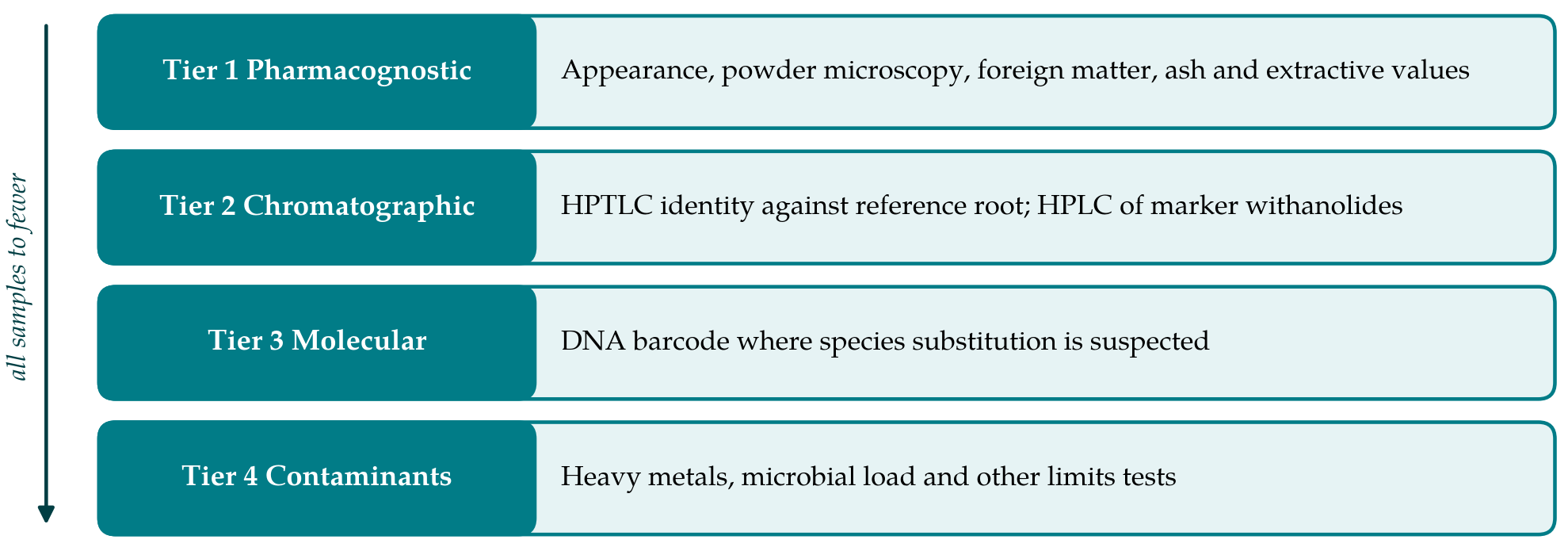
Laboratory work is arranged in four tiers, shown in Figure 1. All samples pass through the first two. The third is applied only where the earlier results point to a foreign species, and the fourth can be run on every sample or on a random subset according to resources.
4.1. Tier 1: Pharmacognostic examination
Colour, odour and texture are noted, and the powder is examined under the microscope after clearing and after staining for starch and lignin. Root powder has a characteristic assemblage of starch grains, vessels and parenchyma; epidermal fragments with stomata, covering trichomes and palisade tissue indicate leaf or herbaceous stem. Foreign matter, total ash, acid-insoluble ash and extractive values are determined by the pharmacopoeial procedures (Government of India, 2001) and the general methods of the World Health Organization (WHO, 2011). High acid-insoluble ash suggests sand or soil, and low extractives suggest exhausted material.
4.2. Tier 2: Chromatographic identity and marker assay
Each sample is run by high-performance thin-layer chromatography beside reference root, reference leaf and withanolide standards on the same plate, following established practice for herbal drug identification (Reich and Schibli, 2007). Selected withanolides are then quantified by reversed-phase liquid chromatography with ultraviolet detection. Published methods separate withaferin A, withanolide A, withanone and related compounds in a single run (Ganzera et al., 2003; Chaurasiya et al., 2008). The method chosen is verified in the laboratory for specificity, linearity, precision and recovery before any market sample is assayed. Interpretation rests on the profile as much as on the total: a powder with an unusually high proportion of withaferin A relative to the root markers is flagged as possibly containing aerial parts or leaf extract.
4.3. Tier 3: DNA barcoding
Where microscopy or chromatography indicates material that is not Withania, DNA is extracted and the ITS2 region is amplified and sequenced, this region having been validated for medicinal plant identification (Chen et al., 2010). The limits of the approach are respected. A barcode cannot distinguish root from leaf of the same species, and published compilations of market studies show that sequencing results on processed material need cautious reading (Ichim, 2019). Failure to amplify is recorded as inconclusive.
4.4. Tier 4: Contaminants
Lead, cadmium, mercury and arsenic are determined by atomic spectrometry after acid digestion, and microbial quality by standard enumeration methods. Results are compared with the limits set for Ayurvedic drugs in India and with the guidance of the World Health Organization on contaminants in herbal medicines (WHO, 2007).
5. Classifying and Reporting Results
Classification criteria are written before the codes are broken. A sample conforms if it meets the pharmacopoeial description and limits, gives a chromatographic profile consistent with reference root, and passes the contaminant limits. It is classed as adulterated only when two independent lines of evidence agree, for example leaf tissue under the microscope together with a leaf-type withanolide profile. A single deviant result places the sample in an intermediate category, substandard or inconclusive, with the reason stated. This two-evidence rule is deliberately conservative, because natural variation in the root is wide and a survey of this kind can damage legitimate sellers if it over-calls.
Results are reported as proportions for each stratum and overall, with confidence intervals, and every mixture control and blank is reported alongside. Outlets and brands are not named in publication. Samples that exceed contaminant limits by a margin that implies a risk to health are a different matter, and the protocol provides for them to be notified to the state licensing authority responsible under the Drugs and Cosmetics Act (Government of India, 1940).
6. Limitations and What Remains to Be Shown
The protocol is proposed and has not been validated or applied. Before use, the ability of the first two tiers to detect aerial parts should be measured on prepared mixtures of reference root with leaf and stem at graded proportions, so that the smallest admixture reliably detected is known and can be quoted with the results. The same is needed for starch and for exhausted root. The withanolide ratio used to flag aerial parts requires a reference range from authentic roots of several origins, and that range does not yet exist in a form agreed between laboratories.
Other limits follow from the design. A survey gives a picture of one period in the cities sampled and should not be generalised beyond them. Purchases in physical markets leave out online sales. The protocol cannot detect every conceivable adulterant, only those it tests for, and a sample that conforms has been shown to be free of the listed problems and nothing more. Nor does conformity with identity and purity tests say anything about clinical effectiveness.
7. Conclusion
How often ashwagandha powder in local markets is adulterated is an empirical question that has mostly been answered by anecdote. The protocol proposed here combines a probability sample of outlets, blinded handling, authenticated reference material and a tiered sequence of pharmacognostic, chromatographic, molecular and contaminant tests, with classification rules fixed in advance. Carried out as written, and after the validation steps identified above, it would yield an estimate that regulators, traders and consumers could rely on. That work remains to be done.
Conflict of interest
To be declared by the author(s) before publication.
Funding
To be declared by the author(s) before publication.