1. Introduction
A packing line for soft fruit asks something awkward of a machine. The product varies in size, shape and ripeness from one piece to the next, it arrives in random orientation, and its skin and flesh fail at loads that a person barely feels. Human packers manage this with compliant fingertips and continuous tactile feedback. A conventional parallel-jaw gripper has neither, and the usual result of trying one is fruit that looks sound at the end of the line and shows brown patches a day or two later on the shelf.
Soft and compliant grippers have been proposed as the answer for more than a decade. Reviews of the field describe a wide range of devices, from fluid-driven elastomer fingers to granular jamming pads and passively adaptive structures (Shintake et al., 2018; Hughes et al., 2016), and reviews written from the agricultural side list many applications to fresh produce (Blanes et al., 2011; Zhang et al., 2020). What these sources seldom provide is a route for the engineer who starts with a specific fruit and a specific line and has to end with drawings.
This article proposes such a route. It is organised as a design procedure in five stages, each with a defined output that feeds the next. The procedure is assembled from published principles and has not been applied to a gripper or tested on fruit here. Its purpose is to make the reasoning explicit, so that designers can follow it, criticise it and test it.
2. Background
Two bodies of knowledge have to be joined: what postharvest science says about how fruit is damaged, and what robotics offers by way of compliant gripping.
2.1. How soft fruit bruises
A bruise is subcutaneous tissue failure. When the stress in the flesh exceeds what the cell walls can carry, cells rupture, their contents mix, and enzymatic oxidation of phenolic compounds produces the familiar browning some hours later (Opara and Pathare, 2014). The delay matters for design, because damage cannot be judged at the moment of handling. Bruising arises from impact, from quasi-static compression and from repeated vibration, and a gripper can cause the first two: impact when the fingers close or the fruit is set down, compression while it is held and accelerated.
Fruit tissue is viscoelastic, and its response depends on loading rate, temperature, turgor and ripeness. For small deformations the contact between a convex fruit and a tool is commonly treated with Hertz theory, which relates load, curvature and elastic modulus to the contact area and peak pressure (Johnson, 1985; Mohsenin, 1986). Susceptibility to damage is usually expressed either as a threshold pressure or as bruise volume per unit of absorbed energy (Li and Thomas, 2014). Both forms point the designer in the same direction: increase the contact area, limit the closing speed, and keep the holding force only as high as the motion requires.
2.2. Families of compliant gripper
Compliance can be placed in the structure, in the actuator or in the contact surface. In fluidic elastomer fingers, a chambered silicone body bends when pressurised and wraps around the object (Ilievski et al., 2011; Mosadegh et al., 2014). Granular jamming grippers press a loose bag of particles onto the object and then stiffen it by vacuum (Brown et al., 2010). Fin Ray fingers are passive triangular frames that curl towards an applied load and need only a simple opening and closing drive (Crooks et al., 2016). Underactuated fingers driven by tendons adapt through their kinematics, and bellows suction cups rely on a soft lip and a pressure difference. Table 1 compares these families from the standpoint of soft fruit.
| Family | How it conforms | Advantage for soft fruit | Main limitation |
|---|---|---|---|
| Fluidic elastomer fingers | Chambered body bends under air pressure | Large wrap area; force set by pressure | Membrane fatigue; needs clean, regulated air |
| Fin Ray fingers | Passive frame curls towards the load | Simple, cheap, easy to clean and replace | Contact force depends on object size |
| Granular jamming pad | Loose grains mould, then lock under vacuum | Handles irregular shapes from one side | Must press onto fruit; membrane hygiene |
| Tendon-driven underactuated fingers | Joints close in sequence around object | Good force control with one motor | More parts and crevices to clean |
| Bellows suction cup | Soft lip seals on the skin | Fast top pick, no side clearance needed | Marks delicate skin; fails on rough or wet surfaces |
None of the families is best in general. Stiffness that can be changed during the grasp is attractive, since a finger can be soft while closing and firmer while moving, and several mechanisms for this have been reviewed (Manti et al., 2016). Each adds complexity, however, and complexity in a food plant has a cleaning cost. The procedure below therefore treats the choice of family as a decision that follows from the fruit and the line, not as a starting point.
3. The Proposed Design Procedure
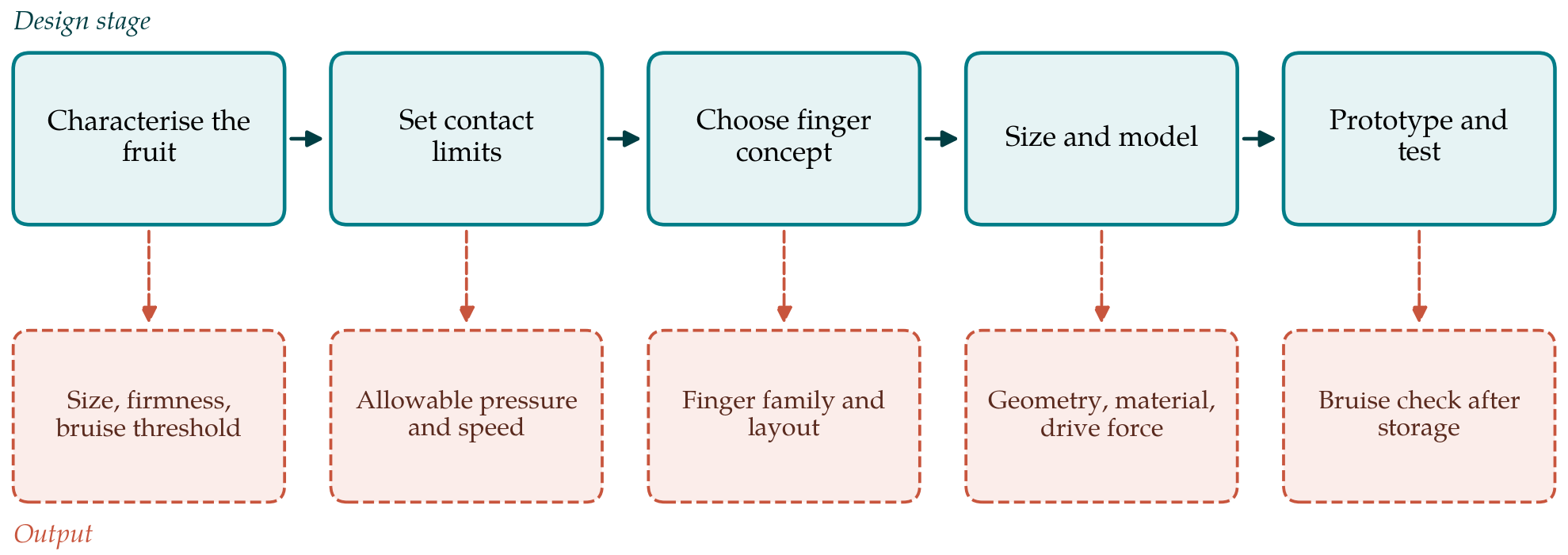
The procedure has five stages, shown with their outputs in Figure 1. Each stage narrows the design space for the next, and the last stage feeds back to the earlier ones when the bruise check fails.
3.1. Stage 1: Characterise the fruit
The designer first needs numbers for the product that will actually run on the line: the cultivars, the range of size and mass, the principal curvatures where a finger would touch, and the firmness at the ripeness stage at which packing takes place. Firmness is obtained by compressing whole fruit between flat plates or with a spherical indenter and recording force against deformation. The bruise threshold is estimated by loading samples to graded levels, storing them under the intended conditions and then cutting them to inspect the tissue. Published values are a useful check, but the spread between cultivars, seasons and storage histories is wide enough that measurements on the grower's own product should take precedence.
Two further properties are worth recording at this stage, because they are cheap to measure and expensive to guess. One is the friction of the skin against candidate pad materials, wet and dry. The other is the location of features that must not be touched, such as the calyx of a strawberry or the stem scar of a tomato, where the skin is already broken or the tissue is weakest. A simple map of permitted contact regions on the fruit narrows the later choice of grasp considerably.
3.2. Stage 2: Convert the characterisation into contact limits
The threshold from Stage 1 becomes a design limit by applying a safety margin for the softest fruit expected, not the average. Two limits follow. The first is an allowable contact pressure, which, for a given finger pad stiffness and fruit curvature, fixes the largest normal force per finger. The second is an allowable closing speed, since the energy delivered at first contact grows with the square of the approach velocity and with the moving mass of the finger. The holding force actually required is then found from the mass of the fruit, the peak acceleration of the robot and the friction coefficient between pad and skin, which should be measured wet as well as dry. If the required force exceeds the allowable one, either the motion profile or the grasp geometry has to change.
3.3. Stage 3: Choose the finger concept
With the limits in hand, the families in Table 1 can be screened. An enveloping grasp, in which fingers pass below the widest part of the fruit and support it by form, needs far less squeeze than a pinch that relies on friction, and grasp taxonomies make the distinction explicit (Cutkosky, 1989). Enveloping needs clearance around the fruit, though, and fruit lying in a tray or touching its neighbours may offer access only from above. The presentation of the fruit, the pack format and the available cycle time therefore decide as much as the fruit itself. The designer should record why each rejected family was rejected, because the reasons often change when the line changes.
The number of fingers follows from the same reasoning. Two opposed fingers suit elongated fruit presented in a known orientation. Three or four fingers arranged around a circle centre a roughly spherical fruit by themselves and tolerate error in its estimated position, which reduces what is demanded of the vision system. More fingers also divide the holding force among more contacts and so lower the pressure at each, at the price of a wider gripper that needs more room between neighbouring fruit.
3.4. Stage 4: Size and model the finger
Sizing sets finger length from the largest fruit, pad width from the pressure limit, and structural stiffness from the smallest fruit that must still be held. For passive structures such as Fin Ray fingers, the pseudo-rigid-body approach developed for compliant mechanisms gives a first estimate of deflection under load (Howell, 2001). For elastomer fingers, a nonlinear finite element model with a hyperelastic material law is the usual tool, since strains are large. In both cases the model should include the fruit as a deformable body with the stiffness measured in Stage 1, so that the output is the pressure distribution on the fruit and not merely the shape of the finger. Material choice is constrained at this point by fatigue life and by the rules on food contact discussed below.
3.5. Stage 5: Prototype and test against a delayed bruise criterion
A prototype is first checked on the bench with pressure-sensitive film or an instrumented dummy fruit to confirm that the peak pressure agrees with the model. Trials on real fruit then follow, at the full range of size and ripeness, with the robot running the intended motion profile. The decisive measure is the proportion of fruit showing bruising after the storage period used in Stage 1, compared with fruit handled by trained packers and with unhandled controls. Drops and failed grasps are counted separately, because a gripper that never bruises but loses fruit is no more acceptable than the reverse.
4. Fitting the Design to a Packing Line
A gripper that passes the bruise test must still survive the plant. Packing lines are wet, they are cleaned with detergents and sanitisers, and fruit juice and debris collect in any recess. European hygiene requirements for food machinery call for surfaces that are smooth, self-draining and free of crevices (CEN, 2009), and materials that touch the fruit must comply with the framework regulation on food contact materials (European Parliament and Council, 2004). These rules favour one-piece moulded fingers in food-grade silicone or thermoplastic polyurethane, mounted so that they can be removed without tools.
Cycle time pulls in the opposite direction from gentleness. Soft fingers are slow to settle, and fluid-driven ones are limited by the time needed to fill and vent their chambers, a point that motivated the faster pneumatic network designs (Mosadegh et al., 2014). The practical remedies are to shorten the fingers as far as the largest fruit allows, to shape the robot trajectory so that peak acceleration occurs when the grasp is most secure, and to accept more grippers working in parallel in place of one working fast. Wear should be planned for as well: elastomer parts are consumables, and the design should make their replacement quick and their condition easy to inspect.
5. Limitations and What Remains to Be Shown
The procedure has not been validated, and several of its assumptions are open to question. Hertz theory assumes small strains in a homogeneous elastic body, whereas ripe fruit is layered, viscoelastic and often loaded well beyond the small-strain range. A single threshold pressure may not capture damage that depends on both the duration and the rate of loading. Contact models for soft fingers on wet, waxy skin are also approximate, and friction in particular is known to be hard to predict in soft robotic contacts (Shintake et al., 2018).
A fair test would apply the procedure to at least two fruits of contrasting firmness, build the resulting grippers, and compare bruise incidence after storage with manual packing on the same batches. It would also report whether the pressure predicted in Stage 4 matched the pressure measured in Stage 5, since that agreement is what allows the procedure to replace trial and error. Durability over a season of washdown cycles is a separate question that only plant trials can answer.
6. Conclusion
Bruise-free robotic packing of soft fruit depends less on finding a novel gripper than on connecting the mechanical limits of the fruit to the geometry, stiffness and motion of whichever gripper is chosen. The five-stage procedure proposed here makes that connection explicit, from measurement of the fruit through contact limits, concept selection and modelling to a storage-based bruise test, and it places hygiene and cycle time alongside gentleness as design requirements. Whether it shortens development in practice remains to be demonstrated on real lines.
Conflict of interest
To be declared by the author(s) before publication.
Funding
To be declared by the author(s) before publication.