1. Introduction
Surveys in many countries find that a small but steady proportion of adults use homeopathy in any given year (Relton et al., 2017). Health systems have responded in different ways. India recognises homeopathy as one of the systems administered by its Ministry of AYUSH. Switzerland reimburses it under compulsory health insurance when it is provided by suitably qualified physicians. England has moved in the opposite direction: national guidance now advises that homeopathic products should not routinely be prescribed in primary care (NHS England, 2017). The World Health Organization's strategy on traditional and complementary medicine encourages member states to integrate such practices where appropriate, while insisting on evidence of safety, quality and effectiveness (WHO, 2013).
Against this background, family doctors are regularly asked whether they will refer to a homeopath, and some services have considered making referral a defined pathway. The question is generally framed as one of access and patient preference. This article takes the position that it is first a question of honesty. A pathway can be justified only by what can truthfully be said to the patient about what the treatment is and what it has been shown to do.
2. What Honest Appraisal Shows
The evidence has been examined repeatedly by bodies with no stake in the outcome. The comparative analysis published in The Lancet found that, in larger trials of higher quality, the effects of homeopathic remedies were compatible with placebo (Shang et al., 2005). A committee of the United Kingdom parliament reviewed the evidence and concluded that homeopathic products perform no better than placebos (House of Commons Science and Technology Committee, 2010). The Australian National Health and Medical Research Council found no health condition for which there was reliable evidence of effectiveness (NHMRC, 2015). The European Academies' Science Advisory Council reached the same view and added that the claimed mechanisms are implausible in the light of established chemistry and physics (EASAC, 2017). The most favourable reading available from within the field, a meta-analysis of individualised treatment, reported a small pooled effect and cautioned that almost none of the contributing trials could be considered reliable (Mathie et al., 2014).
A second body of evidence concerns the consultation. Patients who see homeopaths often report feeling better, and a factorial trial in rheumatoid arthritis attributed that benefit to the consultation process and not to the remedy (Brien et al., 2011). This agrees with the broader finding that a practitioner's warmth, attention and confidence influence subjective outcomes (Di Blasi et al., 2001). An honest appraisal therefore has two parts, and both must be stated: the medicines have not been shown to work, and the encounter may still help some people feel better.
3. Why Honesty Is a Precondition and Not a Courtesy
Referral is a clinical act with meaning. When a family doctor sends a patient to a cardiologist or a physiotherapist, the patient reasonably infers that the doctor believes the service offers effective treatment. A referral to a homeopath carries the same implied endorsement unless the doctor says otherwise. If the doctor does not believe the remedies are active, an unqualified referral communicates something the doctor holds to be false.
This matters for consent. Respect for autonomy, as developed in the standard account of biomedical ethics, requires that patients receive the information a reasonable person would want before accepting an intervention (Beauchamp and Childress, 2019). The fact that independent reviews have found no specific effect is plainly material to a decision to spend time and often money on treatment. Evidence-based medicine was defined from the outset as the integration of the best external evidence with clinical expertise and patient values (Sackett et al., 1996). Patient values cannot be exercised on information that has been withheld.
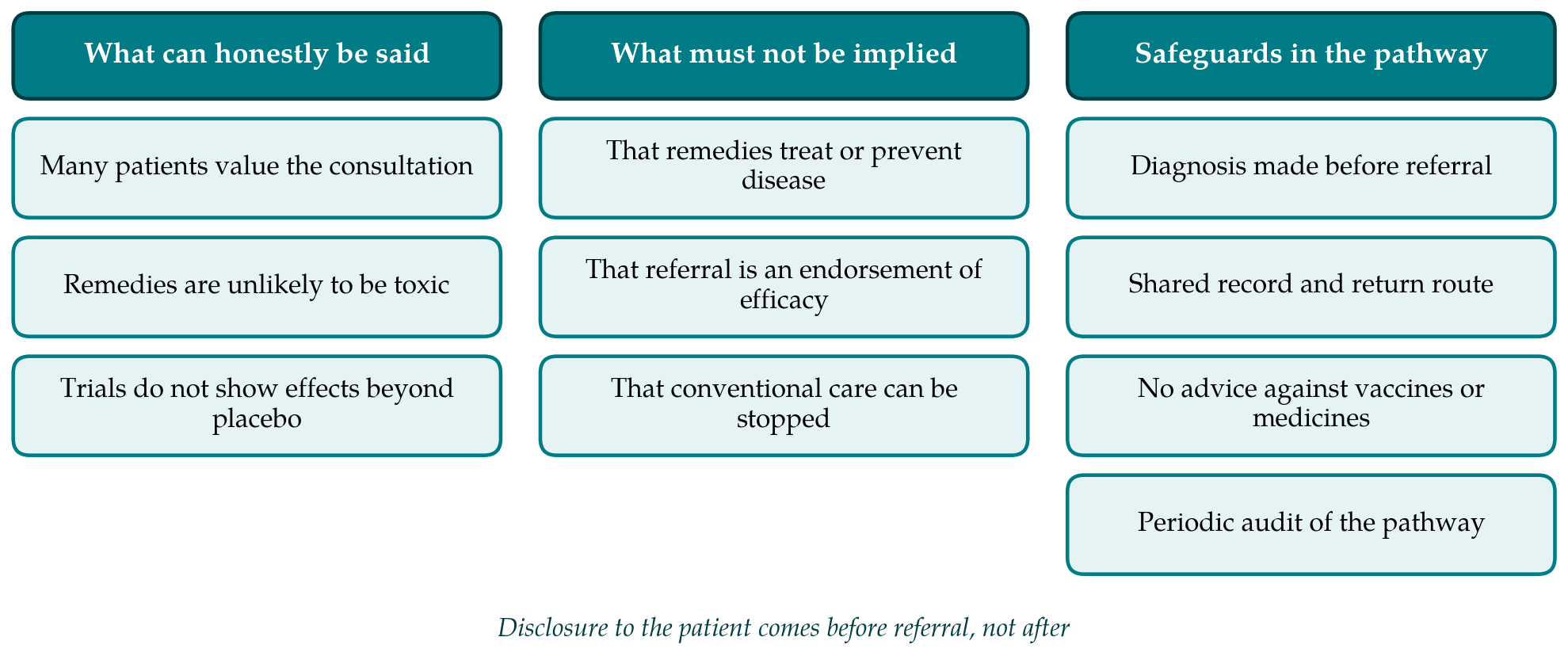
There is also a safety argument. The remedies themselves are rarely harmful, but case reports document serious outcomes where homeopathy was used in place of effective treatment (Posadzki et al., 2012). The risk rises when the patient believes, because the referral came from a doctor, that the homeopath is treating the disease. Ethical critiques have pointed to further costs: public funds diverted from effective care, erosion of trust in evidence, and the legitimacy that official support lends to unsupported claims (Shaw, 2010; Smith, 2012). Figure 1 separates what can honestly be said from what must not be implied, and lists the safeguards that follow.
4. The Counter-Arguments
The case for integration is made by thoughtful people and deserves a serious answer. Five arguments recur, and Table 1 summarises each with its strength and its limit.
| Argument | What is right about it | Why honesty is still required |
|---|---|---|
| Patient choice | Adults may choose treatments that medicine does not endorse | A choice made without the key facts is not informed |
| Low risk | High dilutions are unlikely to cause direct harm | Indirect harm from delay depends on what patients believe |
| Context effects | Attentive consultations can improve how patients feel | The same benefit can be offered without false claims |
| Existing demand | Patients will consult homeopaths anyway | Oversight is useful only if roles are stated truthfully |
| Reduced prescribing | Some patients may take fewer unnecessary drugs | Unproven as an outcome; needs honest evaluation |
The appeal to choice is the strongest. Competent adults are entitled to use homeopathy, and nothing in this article suggests otherwise. But a right to choose is not a right to be referred, and choice is respected by giving people accurate information, not by sparing them from it. The argument from low risk is true of the product and incomplete as an account of the practice, since the harm of concern arises from substitution and delay.
The argument from context effects needs the most care. If a long, sympathetic consultation helps people with persistent symptoms, a health system might wish to provide one. The difficulty is the assumption that the benefit depends on the patient believing in the remedy. Research on placebos given openly challenges that assumption: in a trial in irritable bowel syndrome, patients told plainly that they were receiving inert pills still reported more improvement than those given no treatment (Kaptchuk et al., 2010), and ethical analysis has concluded that such transparent use can be compatible with informed consent (Blease et al., 2016). That literature is young and its findings should not be overstated. It does suggest that candour and comfort are not opposites.
Lastly, there is the argument that patients will go regardless, so it is safer to bring homeopaths inside the system. This has force. A patient whose homeopath can see the medical record and knows when to send the patient back is better protected than one whose two practitioners never communicate. Continuity and coordination are among the features that make primary care effective (Starfield et al., 2005). The protection, however, comes from the coordination and not from any pretence about the remedies, and it is fully compatible with telling the truth.
A fifth argument, heard less often, is that patients who see a homeopath may take fewer antibiotics or analgesics. That would be a real gain if it were shown. It is, however, an empirical claim about outcomes that has not been reliably established, and it could be tested only in a pathway that records what patients are told and what they then do.
5. What an Honest Pathway Would Require
If a service decides to proceed, several conditions follow from the argument. Diagnosis comes first: referral should be considered only after the presenting problem has been assessed and any condition with an effective treatment has been offered that treatment. The scope should be confined to symptoms for which delay carries little risk, and should exclude infections needing antimicrobials, cancer, serious mental illness and any substitute for immunisation.
Disclosure should be explicit and recorded. The referring clinician should tell the patient, in ordinary words, that independent reviews have not found homeopathic medicines to work better than placebo, that some people nonetheless find the consultations helpful, and that the referral does not replace their usual care. Written information should say the same. Practitioners accepted into the pathway should agree not to advise against prescribed medicines or vaccines, to share notes with the practice, and to return patients promptly when agreed warning signs appear.
The pathway should then be audited: who was referred, for what, what they were told, whether conventional treatment was interrupted, and what they reported afterwards. Where public money is involved, the cost should be set against alternatives that offer time and attention without contested medicines, such as longer appointments, social prescribing or psychological support. A service unwilling to make these disclosures or collect these data has, in effect, conceded that the pathway cannot survive honest description.
6. Implications for Homeopathic Practitioners and Journals
These conditions ask something of homeopaths too. Practitioners who wish to work with primary care will need to accept that the referring doctor's description of the evidence will differ from their own, and to work within stated limits. Journals in the field can help by publishing null results and critical appraisals alongside favourable ones, and by holding claims about integration to the same evidential standard as claims about efficacy. A profession that engages openly with unfavourable evidence is a more credible partner than one that asks colleagues to look away from it.
7. Conclusion
Whether homeopathic practitioners should have a place in primary care referral pathways is a question on which health systems have reached different answers, and on which reasonable people will continue to differ. What should not be in dispute is the order of the steps. Appraisal of the evidence comes first, it must be reported to patients as it is, and any pathway must be designed around that disclosure. On present evidence, an honest referral says that the medicines are not known to work and that the consultation may still be valued. A pathway that can operate on those terms may be defensible. One that cannot should not be built.
Conflict of interest
To be declared by the author(s) before publication.
Funding
To be declared by the author(s) before publication.