1. Introduction
Pick up almost any bottle of washing-up liquid and count the environmental statements on it. There will be a leaf or a drop of water in the artwork, a line about recycled plastic, perhaps a reference to plants, and a symbol whose origin is not explained. The pack beside it will say much the same. Environmental claims began as a way of standing out, and they have become part of the background.
Complaints about this are not new. Content analyses from the early 1990s already found that a large share of environmental advertising claims were vague or misleading (Carlson et al., 1993), and a scale for measuring scepticism toward such claims was published before the decade ended (Mohr et al., 1998). What has changed is the volume and the venue. Sustainability has moved from occasional campaigns to the permanent surface of everyday goods, and the word now heard in trade discussion is fatigue: the sense that shoppers have stopped reading.
This perspective takes the fatigue seriously and argues that it is deserved. The position advanced is that weariness toward green claims on packaging is a rational adaptation to claims that cannot be verified, and that the remedy is to make fewer claims of a kind that can be checked. The article does not present new data. It assembles an argument from established research and from the direction that regulation has recently taken.
2. What Fatigue Consists Of
The term is used loosely, and three different things shelter under it. The first is overload. A shopper facing dozens of claims across a category, each using its own vocabulary and symbols, cannot compare them in the seconds a purchase takes. Chen and Chang (2013) found that perceptions of greenwashing were associated with consumer confusion and perceived risk, and that these in turn were associated with lower trust in green products. Confusion of this kind does not require anyone to have lied. It follows from quantity and inconsistency alone.
The second component is disbelief. Consumers hold a general scepticism toward advertising and develop knowledge of persuasion tactics that they use to discount messages (Friestad and Wright, 1994). Environmental claims attract a specific version of this response. Leonidou and Skarmeas (2017) show that scepticism toward green claims has identifiable causes in how consumers judge a company's motives, and consequences that include negative word of mouth and weaker purchase intentions. The third component is tedium, the ordinary wear-out that follows repetition of any message. A phrase seen on every pack loses the capacity to attract attention, whatever its truth.
The three reinforce each other but call for different responses. Overload is a problem of standardisation, disbelief a problem of proof, and tedium a problem of restraint. Treating fatigue as a single mood that a fresher campaign could lift misses all three.
3. Why the Package Feeds It
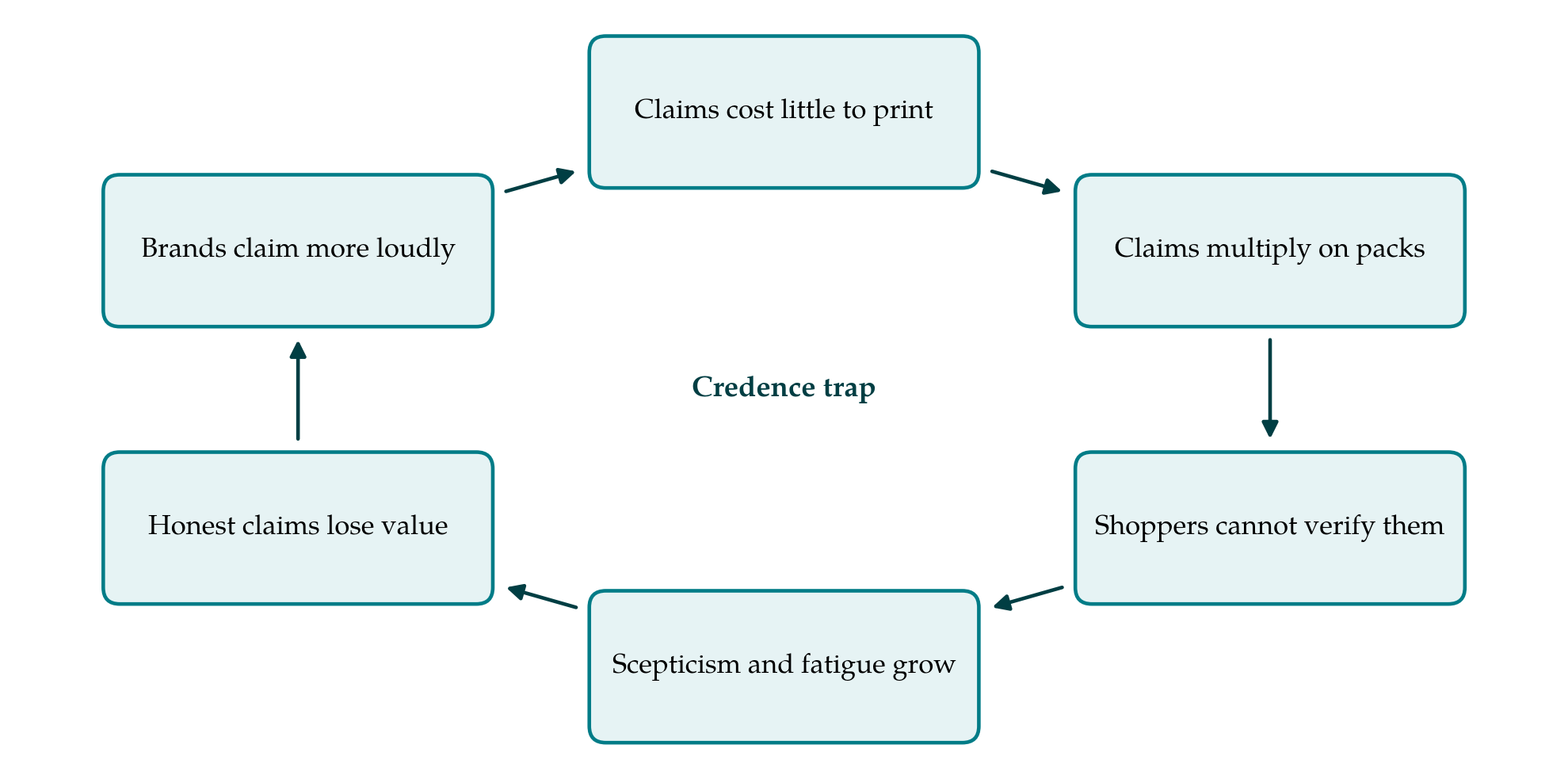
Environmental quality is a credence attribute in the sense defined by Darby and Karni (1973): the buyer cannot verify it before purchase or after use. Nobody can tell from washing dishes whether the bottle was made from recycled material or whether the manufacturer offset its emissions. Where quality cannot be observed, sellers of poor quality can imitate the signals of good quality, and the signals lose their value for everyone, the process that Akerlof (1970) described for the market in used cars. Figure 1 sets out how this works for claims on packs. Printing a claim costs almost nothing, so claims multiply; shoppers cannot check them, so they discount them all; honest claims then earn no premium, and the response of many brands is to claim more loudly.
Packaging has properties that make it an especially poor medium for this kind of information. Space is small, so claims are compressed into single words. The message is read in seconds, so qualification is impractical. And the pack communicates through colour, texture and imagery as much as through text. Parguel et al. (2015) demonstrated that nature imagery by itself can create an impression of environmental virtue, an effect they call executional greenwashing, and Schmuck et al. (2018) found that pleasant nature images can raise evaluations of an advertisement even when the accompanying claim is vague. A brown cardboard sleeve or a green cap makes a claim that no regulator can easily test and no shopper consciously weighs.
The claims are also made by the party with most to gain. Delmas and Burbano (2011) trace greenwashing to a combination of weak regulation, market pressure and organisational incentives, and Atkinson and Rosenthal (2014) show that trust in an eco-label depends on who issues it and rises when its argument is specific. The typical on-pack claim is self-declared and general, the reverse of what the evidence recommends.
4. Claims That Tire Fastest
Not all claims contribute equally. Table 1 groups common on-pack claims by type, with the reason each wears on the shopper and the condition under which it could be credible. The grouping is a judgement informed by the literature and by regulatory guidance, and is offered as a basis for discussion.
| Type of claim | Why it tires or misleads | What would make it credible |
|---|---|---|
| General virtue ("eco-friendly", "green") | No defined meaning; identical across competitors | Nothing short of recognised, certified excellence; otherwise omit |
| Material ("recyclable", "recycled content") | True in principle, often not where the buyer lives | State the proportion and the conditions for recycling |
| Climate ("carbon neutral") | Rests on offsets the buyer cannot see | Report actual reductions; keep offsets separate |
| Absence ("free from") | Often names a substance never used or already banned | Use only where the substance is common in the category |
| Imagery (leaves, earth tones) | Implies a benefit without stating one | Match imagery to a stated, substantiated claim |
| Self-awarded seal | Looks like certification but is not | Third-party scheme with public criteria |
Two points stand out. The claims at the top of the table are the commonest and the weakest, since a word like green asserts nothing that could be shown false. And several of the others are accurate yet still misleading in effect. Nyilasy et al. (2014) found that green advertising from a company with poor environmental performance produced worse attitudes than no green advertising at all, which suggests that consumers judge the claim against what they believe about the claimant and punish the mismatch.
5. Objections
Three objections deserve an answer. The first is that fatigue is exaggerated. People continue to tell researchers that they care about the environment, and sustainable ranges continue to be launched. This is true and beside the point. Fatigue as described here is weariness toward claims, and it can coexist with concern for the problem. It may even be sharpest among the most concerned, who have the strongest reason to resent being misled.
The second objection is that restraint will silence the honest. Firms that have made real improvements may stop saying so for fear of criticism or prosecution, a pattern studied under the name greenhushing (Font et al., 2017). Lyon and Montgomery (2015) review the many forms that greenwash takes and note that scrutiny shapes what firms are willing to say. The risk is real, but it argues for clear rules and not for the present abundance. A firm that can substantiate a specific claim has little to fear from a regime that asks for substantiation, and gains from the removal of unsupported rivals.
The third objection is that information is the wrong instrument altogether: if shoppers cannot be expected to evaluate environmental performance at the shelf, standards should be set upstream and the claims dropped. There is force in this. It leads to the same practical conclusion about packaging, which is that the pack should say less.
A fourth objection comes from within marketing: on-pack claims work, since products that carry them often sell well. Sales effects of that kind are hard to interpret. A claim may attract buyers while it is rare and lose its pull as competitors copy it, which is the cycle of Figure 1, and a gain for one brand may be bought at the cost of trust in the whole category. The evidence that mismatched claims backfire suggests that the gain is fragile as well.
6. Implications
Regulators have begun to act on similar reasoning. The international standard on self-declared environmental claims has long stated that vague expressions such as environmentally friendly should not be used (ISO, 2016). The Green Guides of the United States Federal Trade Commission warn against unqualified general benefit claims (Federal Trade Commission, 2012), and the United Kingdom's guidance requires claims to be truthful, clear, substantiated and mindful of the whole life cycle of the product (CMA, 2021). The European Union has gone furthest. A directive adopted in 2024 adds to the list of unfair commercial practices the making of generic environmental claims without recognised excellent performance, the display of sustainability labels not based on a certification scheme or set up by public authorities, and claims of climate neutrality that rest on offsetting (European Union, 2024). Its rules apply from September 2026.
For brand owners the implication is a change of habit. The front of the pack should carry at most one environmental claim, chosen because it is specific, material to the product's main impact and verified by a body the shopper has reason to trust. Supporting detail belongs on the back or behind a code that can be scanned. Designers should treat colour and imagery as claims and hold them to the same test. Advertising beyond the pack is the place for explanation, and it will persuade more by showing what was changed in the product than by declaring a commitment. A useful internal test is to ask of each proposed claim what evidence would be handed to a regulator who asked for it, and who outside the company has seen that evidence. A claim for which the answers are none and nobody should not reach the artwork.
Retailers have a part that is easily overlooked. They decide what is stocked and how the shelf is arranged, and their own-label ranges are heavy users of environmental language. A retailer that applied one standard of substantiation to every pack it sells, its own included, and grouped certified products under a common shelf marking, would reduce overload faster than any single manufacturer can. It would also relieve the shopper of a comparison that the shopper is poorly placed to make.
For researchers, fatigue itself needs definition and measurement. The existing scales capture scepticism, which is one component of three. Whether overload and tedium can be separated from disbelief empirically, how each develops with repeated exposure in a real shopping environment, and whether a reduction in the number of claims restores attention to those that remain are questions on which there is little published evidence. Studies in stores, and analyses of what happens to attention and sales when a retailer or a regulation removes a class of claims, would be more informative than further laboratory tests of single advertisements.
7. Conclusion
Shoppers who ignore the leaf on the label are behaving sensibly. They have learned that the symbol is free to print and tells them nothing they can check. The way to regain their attention is to make the environmental claim scarce and costly again: scarce by saying one thing where ten are said now, and costly by tying that one thing to independent verification. Regulation is moving in this direction, and brands that move ahead of it will find that a single claim a customer can believe is worth more than a pack full of adjectives.
Conflict of interest
To be declared by the author(s) before publication.
Funding
To be declared by the author(s) before publication.