1. Introduction
Few ideas have travelled as far in nutrition in so short a time as the claim that the degree of processing of a food, and not only its nutrient content, matters for health. The argument was put in a short commentary by Monteiro (2009) and developed into the NOVA classification, which sorts foods into four groups: unprocessed or minimally processed foods, processed culinary ingredients, processed foods and ultra-processed foods. The last group is defined as formulations of ingredients, mostly of exclusive industrial use, made by a series of industrial processes (Monteiro et al., 2019). Brazil built its national dietary guidelines around the scheme (Ministry of Health of Brazil, 2014), and other countries have since referred to it in advice to the public.
Food technologists encounter the concept from an awkward position. The products placed in the fourth group are the ones they design, and the features named as its markers, such as protein isolates, modified starches, emulsifiers, flavours and colours, are the tools of their trade. Retailers and brand owners now ask development teams to respond, sometimes by setting targets for reducing the share of a portfolio that is classified as ultra-processed. This perspective asks whether that is a sensible use of the classification.
2. What the Classification Is and What It Has Shown
NOVA was devised as an instrument for describing diets in populations, and as such it has been productive. Prospective cohort studies in several countries have associated higher consumption of ultra-processed foods with higher risks of cardiovascular disease and other outcomes, and an umbrella review of meta-analyses found the associations to be consistent in direction across many health outcomes, with the strength of evidence varying from one outcome to another (Lane et al., 2024). Observational studies cannot exclude confounding, but the pattern is not easily dismissed.
The most important single experiment is the inpatient crossover trial of Hall et al. (2019). Adults were offered an ultra-processed diet and a minimally processed diet for two weeks each, with the meals presented matched for energy, macronutrients, sugar, sodium and fibre, and were free to eat as much as they wished. They ate substantially more energy on the ultra-processed diet and gained weight. The trial was small and short, and it did not identify which property of the diets was responsible. It did establish that something about a diet composed of such foods, beyond its declared nutrient content, can alter intake.
3. The Argument: An Agenda, Not a Target
The position taken here is that these findings should set the agenda for reformulation, by identifying which categories and which hypotheses deserve attention, while the targets themselves should be expressed as measurable properties of foods. Three features of the classification make it unsuitable as a target.
3.1. It is categorical and offers no gradient
A reformulation target needs a scale. Sodium can be lowered in steps, and published benchmarks tell a developer what level to aim for in each category (WHO, 2021). NOVA has no equivalent. A product is in group four or it is not, and the criteria turn on whether certain kinds of ingredient are present at all. A breakfast cereal with one emulsifier and a confection with a dozen additives receive the same label. A developer who halves the sugar, doubles the fibre and preserves the wholegrain structure has, in NOVA terms, achieved nothing.
3.2. It is applied inconsistently
A target must be verifiable, and verification requires that different assessors reach the same answer. Braesco et al. (2022) asked food and nutrition specialists to assign foods to NOVA groups and found low agreement between them, including when ingredient information was supplied. Critics had earlier pointed to the breadth and ambiguity of the definitions (Gibney et al., 2017). A portfolio target built on a classification that experts apply differently cannot be audited with confidence.
3.3. It invites cosmetic compliance
Because group membership is inferred from the ingredient list, the cheapest way to leave the group is to change the list. An emulsifier can be replaced by a functionally similar ingredient with a kitchen-cupboard name, a flavouring by a concentrate, a colour by a vegetable extract. The product that results may be identical in energy density, texture, eating rate and nutrient content, and there is no reason to expect it to behave differently in the body. Scrinis and Monteiro (2018) made a related point from the other side: reformulation that adjusts a few nutrients leaves the ultra-processed character of a product intact. Both observations lead to the same conclusion. The label on the category and the properties that might cause harm are not the same thing, and effort aimed at the label can miss the properties.
4. What Technologists Can Target Instead
The research that NOVA has stimulated has produced a list of candidate mechanisms, and most of them correspond to things that can be measured in a laboratory. Table 1 sets them out. Energy density and eating rate are the best supported: Forde et al. (2020) showed that the foods in the trial by Hall and colleagues differed in both, and argued that soft textures which are eaten quickly, combined with high energy density, may account for much of the excess intake. Texture is squarely within the technologist's control. The physical structure of foods is a related candidate, since intact plant tissue and less refined matrices tend to be more satiating than reconstituted ones (Fardet, 2016). Conventional nutrient profile remains relevant, because many ultra-processed foods are high in sugars, sodium and saturated fat. Specific additives have been implicated in animal experiments, notably two emulsifiers that altered the gut microbiota and promoted inflammation in mice (Chassaing et al., 2015), though evidence in humans at dietary exposures is limited. Tobias and Hall (2021) have argued that the choice between eliminating and reformulating such foods depends on which of these mechanisms proves to matter.
| Proposed mechanism | Measurable property | Reformulation lever | Source |
|---|---|---|---|
| High energy density | Energy per gram as eaten | Water, fibre and air content; fat reduction | Forde et al., 2020 |
| Fast eating rate | Grams or energy consumed per minute; hardness, chewiness | Firmer, less uniform textures; larger particles | Forde et al., 2020 |
| Loss of food matrix | Degree of cell and tissue integrity; particle size | Milder size reduction; whole or kibbled ingredients | Fardet, 2016 |
| Poor nutrient profile | Sugars, sodium, saturated fat, fibre | Stepwise reduction against published benchmarks | WHO, 2021 |
| Specific additives | Identity and level of named additives | Substitution only where evidence supports it | Chassaing et al., 2015 |
| Displacement of whole foods | Share of diet, not a product property | Outside reformulation; portfolio and marketing choices | Monteiro et al., 2018 |
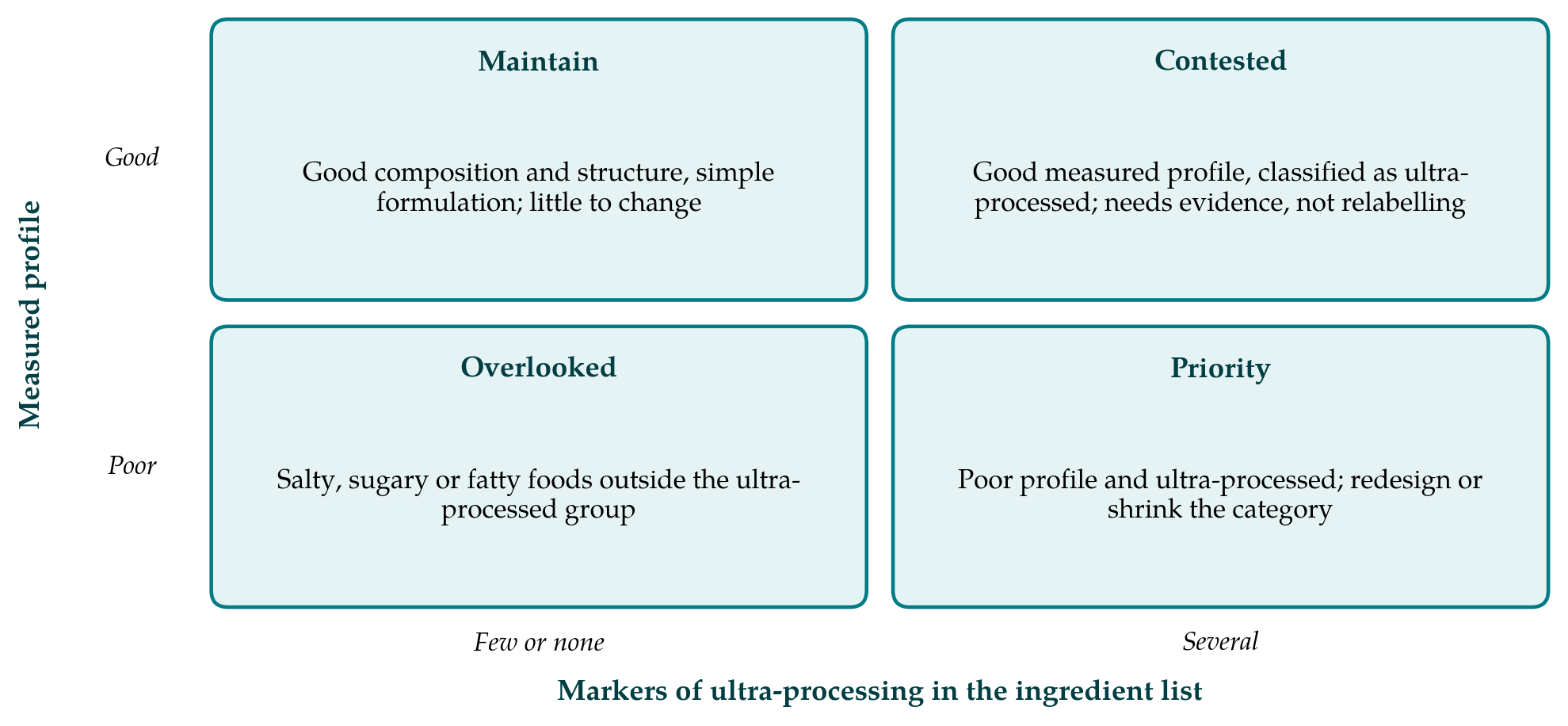
Setting processing markers against measured profile gives a simple way to sort a product portfolio, shown in Figure 1. Products that are both ultra-processed and poor on the measured properties are the clear priority. Those that are classified as ultra-processed but perform well on energy density, texture, fibre and nutrient profile are the contested cases, where the right response is to gather evidence. The quadrant most easily forgotten holds foods that escape the classification yet are salty, sugary or fatty. A target framed purely in NOVA terms would ignore them.
Evidence that the category is heterogeneous supports this sorting. In a large multinational cohort, Cordova et al. (2023) found that the association between ultra-processed food intake and multimorbidity was carried by some subgroups, including animal-based products and sweetened beverages, and was not seen for others such as breads and cereals or plant-based alternatives. Reviews written from within food science make the complementary point that processing as such serves safety, preservation and nutrient delivery, and cannot be treated as uniformly harmful (Knorr and Augustin, 2021).
5. Objections Considered
The first objection is precautionary. If the associations are consistent and the mechanisms unknown, targeting measurable properties risks optimising the wrong ones, and the safer course is to reduce ultra-processed foods as a class. This has force as advice to the public, and it is the reasoning behind the Brazilian guidelines. It does not translate into a product specification. A technologist cannot reduce the class by reformulating within it. The honest precautionary response from industry would be to make and market fewer such products, which is a commercial decision and not a formulation target.
The second objection is historical. Nutrient-based reformulation has been tried for decades, and its critics hold that it has mainly produced products that score well on a profile while remaining easy to over-consume (Scrinis and Monteiro, 2018; Monteiro et al., 2018). The point is fair, and it is the reason the targets proposed here extend beyond nutrients to energy density, texture and structure. It is an argument for better targets and offers no support for a categorical one.
The third objection is that the debate is not disinterested. Food manufacturers have an obvious stake in a conclusion that favours reformulation over reduction, and technologists employed by them share it. The reader should weigh the present argument with that in mind. The published exchange between a proponent and a critic of the concept shows that the disagreement persists among researchers without such a stake, and that both sides accept the need for mechanistic evidence (Astrup and Monteiro, 2022). The United Kingdom's scientific advisory committee likewise judged the associations a matter of concern while noting the limitations of the classification and of the evidence (SACN, 2023).
6. Implications
For product developers, the practical consequence is a change of brief. A request to take a product out of the ultra-processed group should be restated as a request to improve named properties: lower energy density, a texture that slows eating, more intact structure, a better nutrient profile, and no additive for which there is credible evidence of harm at the level used. Removing an ingredient solely to tidy the label should be recognised as marketing and not presented as a health measure.
For researchers, the need is for experiments that separate the candidate mechanisms: diets matched for processing category that differ in texture or energy density, and diets matched on those properties that differ in processing. Food technologists are well placed to make the test foods such trials require. For regulators and retailers, the implication is caution about writing the classification into procurement rules or portfolio targets before it can be applied reproducibly. Its proper use for now is as a prompt to ask what, in a given product, might be doing harm.
7. Conclusion
The classification of foods by degree of processing has drawn attention to real and consistent associations that nutrient-based thinking had missed, and food technologists should take it seriously. They should not adopt it as a target. A target must be measurable, graded and verifiable, and the classification is none of these. The better course is to let it direct attention to the products and mechanisms of concern, and then to set reformulation goals in terms of energy density, texture and eating rate, matrix structure, nutrient profile and specific ingredients for which evidence exists. That approach keeps faith with the evidence that prompted the concern and gives development teams something they can act on and be held to.
Conflict of interest
To be declared by the author(s) before publication.
Funding
To be declared by the author(s) before publication.