1. Introduction
A student in the seventh or eighth year of school who solves a linear equation wrongly can find out in several ways. The teacher may point to the slip while the student is still writing. A digital exercise may mark the answer the instant it is entered. The work may come back with comments the following day, or the class may go through the solutions together at the end of the lesson. Each route delivers the same information about the mathematics. They differ in when it arrives, and that difference shapes what the student has already done and what can still be done with it.
Formative assessment research has established that feedback is among the stronger influences on learning that a teacher controls (Black and Wiliam, 1998; Hattie and Timperley, 2007). It has also established that the effect is far from uniform. In the meta-analysis by Kluger and DeNisi (1996) a substantial minority of feedback interventions lowered performance, and the authors traced the harm to feedback that turned attention from the task towards the self. Self-efficacy, the belief that one can carry out the actions a task requires (Bandura, 1977), sits exactly at that junction between task and self.
The lower secondary years deserve separate attention. Mathematics becomes more abstract with the arrival of algebra and proportional reasoning, classes are often reorganised by attainment, and marks start to carry consequences. Eccles et al. (1993) described the resulting mismatch between what early adolescents need and what their classrooms offer, and declining confidence in mathematics across these years is a recurrent finding of motivation research. This article reviews what is known about the timing of formative feedback and asks what it implies for mathematics self-efficacy at this stage of schooling.
2. Scope and Approach
This is a narrative review of the published literature. It draws on the major reviews and meta-analyses of feedback, on the theoretical and empirical work on self-efficacy and its sources, and on experimental studies of feedback timing in the cognitive psychology of learning. No claim is made to have searched exhaustively or to have pooled effect sizes. The purpose is to connect two literatures that seldom cite one another and to state clearly where the connection rests on evidence and where it rests on inference. Studies with younger children and with university students are used where work with lower secondary students is lacking, and the text says so when that is the case.
3. What Is Known About Feedback Timing
The question of when to give feedback is one of the oldest in instructional psychology, and its history explains much of the present confusion. Behaviourist accounts of learning held that a response should be confirmed or corrected at once, and programmed instruction was built on that principle. Laboratory work then produced an awkward result: on tests of retention, feedback delayed by a day sometimes beat feedback given immediately, the delay-retention effect reported by Kulhavy and Anderson (1972). Their explanation was that an immediate correction competes with the error the learner has just made, whereas after a delay the error has faded and the correct answer is learned with less interference.
3.1. Laboratory and classroom findings
Kulik and Kulik (1988) brought order to these findings by separating the settings in which they arose. In applied studies using real classroom quizzes and course material, immediate feedback was generally the more effective. In laboratory studies of list learning and test-item acquisition, delayed feedback often did better. Later experiments confirmed that delay can help under controlled conditions: Butler et al. (2007) found better retention from multiple-choice tests when feedback was postponed, and Metcalfe et al. (2009) showed that the advantage of delay in children's vocabulary learning depended on how the interval between feedback and the final test was arranged. Part of what looks like an effect of delay is an effect of spacing: delayed feedback is a second, separated encounter with the material.
3.2. Task complexity and the learner
Shute (2008) drew the practical conclusion that no single timing is best. Her guidelines suggest immediate feedback for difficult tasks, for procedural skills and for learners who are struggling, and delayed feedback for simpler tasks and for learners capable of working through an impasse, where early intervention would short-circuit useful effort. The meta-analysis of computer-based feedback by Van der Kleij et al. (2015) points the same way: elaborated feedback that explains was more effective than feedback that only marks answers right or wrong, and immediate feedback had the advantage for lower-order outcomes while the picture for higher-order outcomes was less clear. A more recent synthesis found that the information content of feedback explains much of the variation in its effects (Wisniewski et al., 2020). Timing, in other words, interacts with what the feedback says and with what the task demands. Table 1 summarises these positions.
| Position | Main claim | Representative source |
|---|---|---|
| Immediate correction | Errors should be corrected before they are practised or consolidated | Kulik and Kulik, 1988 |
| Delay-retention effect | A delay lets the error fade, so the correct answer meets less interference | Kulhavy and Anderson, 1972 |
| Delay as spacing | Postponed feedback acts as a second, spaced study opportunity | Butler et al., 2007 |
| Contingent timing | Best timing depends on task difficulty and on the learner's prior attainment | Shute, 2008 |
| Content before timing | Elaborated feedback outperforms simple marking at any moment | Van der Kleij et al., 2015 |
| Level of feedback | Feedback about the task or process helps; feedback about the self does not | Hattie and Timperley, 2007 |
Nearly all of this work measured what students could later recall or do. Whether the student came away more or less confident was rarely recorded, and a timing that is best for retention need not be best for belief. The next section turns to what is known about how such beliefs form.
4. Mathematics Self-Efficacy and Its Sources
Self-efficacy is a judgement of capability for a specific kind of task, distinct from general self-esteem and from self-concept in a subject. Its importance in mathematics was shown in the path analysis of Pajares and Miller (1994), in which self-efficacy for solving particular problems predicted performance more strongly than mathematics self-concept, perceived usefulness or prior experience did. Students with firmer efficacy beliefs choose harder tasks, persist longer and manage their own work more effectively (Pajares, 1996; Zimmerman, 2000). Low efficacy is in turn bound up with mathematics anxiety, which depresses performance and leads students to avoid the subject when they are free to do so (Hembree, 1990).
Bandura (1997) proposed that efficacy beliefs are built from four kinds of information: mastery experience, meaning the interpreted results of one's own attempts; vicarious experience, meaning observation of others who are seen as similar; social persuasion, meaning what credible others say about one's capability; and physiological and emotional states. The review by Usher and Pajares (2008) found mastery experience to be the most consistent predictor across school studies, and their later validation study measured all four sources specifically for mathematics among students in the middle school years (Usher and Pajares, 2009). The word that matters in Bandura's definition is "interpreted". A correct answer raises efficacy only if the student credits it to something that will be there next time.
Feedback is one of the main ways in which a teacher influences that interpretation. Schunk (1983) showed with children learning subtraction that telling them their progress reflected ability or effort changed both their efficacy and their subsequent skill, even though the arithmetic content of the lessons was the same. Evaluation that invites comparison with classmates has different consequences from comments on the task: in the experiments of Butler (1988), comments alone sustained interest and performance, while grades, with or without comments, did not. Praise for intelligence leaves children more vulnerable after failure than praise for effort does (Mueller and Dweck, 1998). None of these studies varied timing, but each shows that the same result can be turned into quite different beliefs by the response that follows it.
5. How Timing May Act on the Sources of Self-Efficacy
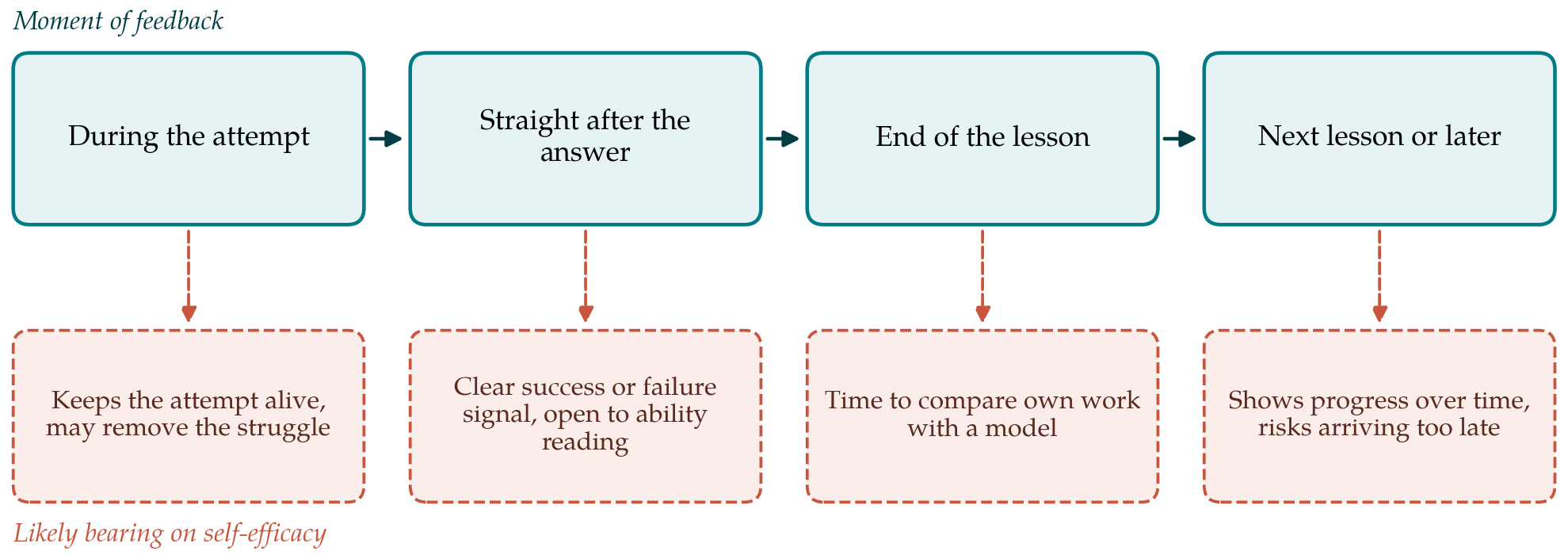
If timing matters for self-efficacy, it presumably does so through the four sources. This section sets out the plausible routes. It is an argument from theory and from adjacent findings, and it should be read as a set of hypotheses. Figure 1 places four common moments of feedback beside the bearing each is likely to have on efficacy beliefs.
5.1. Mastery experience
A mastery experience requires an attempt that the student recognises as their own. Feedback that arrives while a student is midway through a multi-step problem can rescue an attempt that was about to collapse, and for a student who has rarely succeeded this may be the only way a success happens at all. The same intervention can also take the success away, because the student may attribute the finished solution to the teacher. Sadler's account of formative assessment is relevant here: students improve when they come to hold a concept of quality and can compare their own work against it (Sadler, 1989). Feedback slightly delayed, after an answer has been committed but while the reasoning is still fresh, leaves room for that comparison. Feedback delayed by days may reach a student who can no longer reconstruct what they did, so that the correction registers as a verdict and not as information about a correctable step.
5.2. Persuasion and emotional state
Immediate marking, especially by software, tends to be terse. A run of instant "incorrect" messages is a concentrated dose of negative outcome information with no accompanying explanation, and the theory of Kluger and DeNisi (1996) predicts that such signals draw attention towards the self. For an anxious student the physiological source is engaged as well. Delay gives the teacher time to write a comment that names what was done well and what to change, which is the form of feedback most likely to act as credible persuasion. Against this, waiting has an emotional cost of its own for students who expect bad news, and a student who practises an erroneous method throughout a homework exercise accumulates failures that prompt feedback would have prevented.
5.3. Vicarious experience and self-regulation
Whole-class discussion of solutions at the end of a lesson is delayed feedback of a particular kind. It lets students see how peers reached an answer, including peers who erred and recovered, which is the coping model that social cognitive theory regards as especially informative. It also supports the self-assessment that Nicol and Macfarlane-Dick (2006) placed at the centre of good feedback practice, since students check their own work against the public solution before anyone else judges it. Wiliam (2011) makes a related practical point: feedback should cause thinking, and feedback delivered before the student has finished thinking cannot do so.
6. Gaps in the Evidence and Directions for Research
The principal gap is simple to state. Experimental comparisons of immediate and delayed feedback that take self-efficacy as an outcome, in ordinary mathematics lessons with students of lower secondary age, are scarce. The timing literature has measured retention; the efficacy literature has varied the content and source of feedback. The reasoning in the preceding section joins them by inference, and inference of this kind has been wrong before in feedback research.
Several features of a useful study follow from the review. Timing should be crossed with feedback content, so that an immediate tick or cross is not compared with a delayed written explanation and the difference then credited to timing. Efficacy should be measured at the level of the task, as Bandura recommended and as the mathematics instruments now allow, and the four sources should be measured alongside it so that the route of any effect can be traced. Prior attainment needs to be treated as a moderator, since the contingent view of timing predicts opposite effects for students at different starting points. Studies should also run long enough to separate a momentary lift in confidence from a durable change in belief.
Digital practice systems make such studies easier, because timing can be set precisely and logged. They also make them more urgent. Instant marking is the default in most such systems, adopted for reasons of engineering and engagement, and it is now a routine part of mathematics homework for many students at exactly the age when confidence in the subject is most at risk.
7. Implications for Practice
The evidence does not support a rule such as "always respond at once" or "always wait". It supports a small number of cautious working principles. Feedback on a procedural slip can usually be given promptly, since little is gained from letting an error be rehearsed. Feedback on a problem that requires reasoning is better held until the student has committed to an answer, so that the attempt remains theirs. Whatever the timing, feedback that explains and that refers to the task is safer for confidence than a bare mark. Teachers who use automatically marked exercises might follow them with a short discussion in which errors are treated as material for the class, which adds the vicarious and persuasive sources that the software omits. These are reasonable inferences from the literature, and they await direct test.
8. Conclusion
Research on feedback timing and research on mathematics self-efficacy have developed side by side with little contact. Read together, they suggest that the moment of feedback matters for confidence less through speed as such than through what the student is able to do around it: complete an attempt, understand an error as a fixable step, see how others solved the problem, and register progress. For lower secondary students, whose beliefs about their mathematical capability are still forming and often falling, that suggestion is worth testing directly. Until it has been, timing is best treated as one design decision among several, to be made with the task, the student and the content of the feedback in view.
Conflict of interest
To be declared by the author(s) before publication.
Funding
To be declared by the author(s) before publication.