1. Introduction
A song released to a streaming service enters a different contest from one sent to radio or pressed on a disc. It will most often be met inside a playlist, between tracks by other artists, by a listener who did not choose it and who can dismiss it with a tap. On the largest services a play is counted, and paid for, only once the listener has stayed for thirty seconds. From these facts a widely repeated argument follows: songs are being rebuilt so that nothing in the opening half minute gives a listener a reason to leave.
The argument is plausible and has some distinguished support. Morris describes artists and labels tuning tracks to the metrics that platforms expose, a process he calls the optimisation of culture (Morris, 2020). Pelly's account of the playlist system documents the commercial weight that editorial and mood playlists came to carry (Pelly, 2025). Yet plausibility is not evidence, and Hesmondhalgh has warned that commentary on streaming tends to recycle old anxieties about commerce and musical decline in simplified form (Hesmondhalgh, 2022).
This review asks what is in fact known. It considers two outcomes that the title names, the overall structure of songs and the length of their introductions, and one cause, the playlist as the dominant setting for listening. It separates what has been measured from what has been inferred, and what changed under streaming from what was already changing.
2. Scope and Approach
The article is a narrative review of the published literature and does not claim a systematic search. It covers Anglophone commercial popular music, mainly the United States charts, because that is where the corpus studies have been done. Sources were drawn from music theory and analysis, empirical musicology, media and platform studies, the economics of digital markets, and research published by engineers working with streaming data. Trade journalism is treated as testimony about industry belief and not as evidence of musical change.
"Playlist" is used broadly for any ordered set of tracks assembled by a service for its users. That includes editorial lists compiled by staff, algorithmic lists generated for each user, and the hybrid forms in which editors choose a pool and software orders it. The distinction matters for the argument, since an editor can hear that a song starts slowly whereas a recommender can only register that listeners left.
3. Song Form Before Streaming
Any claim about change needs a baseline. Analysts of rock and pop describe a small family of forms: the AABA design inherited from Tin Pan Alley, simple verse form, and the verse-chorus forms that dominated from the 1960s onward (Covach, 2005). Within verse-chorus form a typical song added an introduction, often a pre-chorus, a bridge and an outro. Summach traced how the pre-chorus emerged as a distinct section that builds momentum towards the chorus (Summach, 2011). Songs that withhold their main material until late, such as the terminally climactic forms identified by Osborn in rock, were always a minority practice (Osborn, 2013).
Formats have shaped these designs before. Katz shows that the playing time of a 78 rpm side, roughly three minutes, constrained what was composed and recorded for decades, and that musicians adjusted tempo, cut repeats and wrote to length (Katz, 2010). Radio brought the edited single and the intro over which a presenter could speak. The introduction is thus not a fixed element of the pop song that streaming suddenly attacked. Its length has always answered to the medium of delivery, and the long instrumental openings of some 1980s singles belong to a particular moment in radio and production practice.
Large-scale studies of recorded popular music confirm that stylistic drift is continuous. Analyses of audio features across several decades of chart music report shifts in timbre, harmony and loudness long before streaming (Serrà et al., 2012; Mauch et al., 2015), and a study of United Kingdom releases found measurable trends in mood and danceability among successful songs (Interiano et al., 2018). None of these studies measured song sections, but they establish that a change observed after the arrival of playlists cannot be credited to playlists without a comparison with the trend before.
4. Corpus Evidence on Introductions and Early Hooks
The most direct evidence comes from Léveillé Gauvin's study of top-ten singles in the United States from the mid-1980s to the mid-2010s (Léveillé Gauvin, 2018). Starting from the theory of the attention economy, in which a wealth of information produces a scarcity of attention (Simon, 1971; Davenport and Beck, 2001), he tested five features that might help a song hold a distracted listener: the number of words in the title, tempo, the time before the voice enters, the time before the title is first sung, and the self-focus of the lyrics. The clearest result concerned the introduction, which shrank over the period from more than twenty seconds on average to about five. Titles also became shorter and tempo rose slightly.
Two features of that result deserve emphasis. The decline in introduction length runs across the whole period studied. It was under way in the era of the compact disc and commercial radio and continued through downloads into streaming, so the data describe a long compression of the opening and not a break at the point where playlists arrived. And the sample is the top of one national chart. It says nothing about album tracks, about genres that seldom reach the top ten, or about the far larger body of music released outside the major-label system.
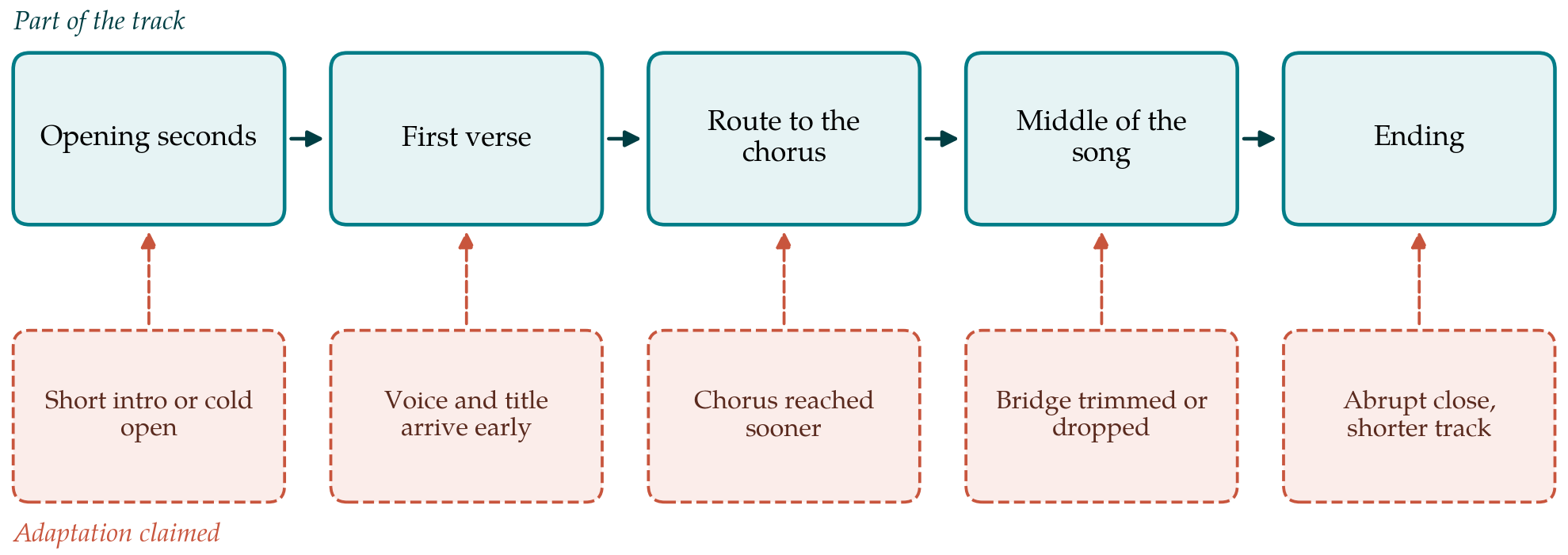
Beyond introductions, the published corpus evidence thins quickly. Figure 1 sets out the adaptations most often attributed to streaming, section by section. Only the first two, shorter openings and earlier entry of the voice and title, rest on a peer-reviewed corpus study. That choruses arrive sooner, that bridges are disappearing and that tracks are getting shorter are claims made repeatedly in the trade and general press, sometimes with counts drawn from chart data, but they have not yet been established in the scholarly literature with stated sampling and annotation methods. They may well be true. At present they are hypotheses with anecdotal support.
5. How Playlists Exert Pressure
If playlists reshape songs, there must be a route from the playlist to the writing room. The literature suggests three, summarised with the state of the evidence in Table 1. The first is plain market power. Aguiar and Waldfogel estimated the effect of inclusion on major Spotify playlists and found that placement raises a track's streams substantially, with the largest lists capable of making a song's commercial fortunes (Aguiar and Waldfogel, 2021). Prey describes the resulting position of the platform as curatorial power: control over which music is put in front of listeners at scale (Prey, 2020).
| Route | How it would act on songs | Evidence | Key sources |
|---|---|---|---|
| Placement power | Songs must suit the lists that deliver an audience | Strong for the effect of placement on streams | Aguiar and Waldfogel, 2021; Prey, 2020 |
| Skip-based feedback | Tracks abandoned early are shown to fewer listeners | Skips are logged and modelled; weighting is undisclosed | Brost et al., 2019; Bonini and Gandini, 2019 |
| Payment threshold | A play that ends too early earns nothing | Rule is public; effect on writing is inferred | Morris, 2020 |
| Context of listening | Mood and activity lists reward unobtrusive, uniform tracks | Documented by interviews and reportage | Pelly, 2025; Eriksson et al., 2019 |
| Listener habit | Skipping follows musical structure, so structure is adjusted | One large behavioural study | Montecchio et al., 2020 |
| Producer belief | Writers act on what they think the system rewards | Trade testimony; little systematic study | Seabrook, 2015; Morris, 2020 |
The second route is feedback from listener behaviour. Bonini and Gandini, drawing on interviews with people who work in playlist curation, describe a regime in which editorial judgement launches a track and performance data then decide whether it stays, so that human and algorithmic gatekeeping are intertwined (Bonini and Gandini, 2019). Skips are among the signals recorded. A dataset released by Spotify researchers for a public challenge consists of listening sessions annotated with whether and when each track was skipped, and the task set was to predict skipping (Brost et al., 2019). How heavily skip rates count in ranking is not disclosed, and the difficulty of observing these systems from outside is a recurring theme of platform research (Eriksson et al., 2019).
The third route runs through the listener directly. Montecchio and colleagues analysed skipping on a streaming service against the structure of the tracks and reported that skips are not spread evenly through a song: they are concentrated early and tend to coincide with boundaries between sections (Montecchio et al., 2020). This is the nearest thing in the literature to a demonstrated link between form and listener retention. It shows that structure affects skipping. It does not show that songwriters have changed structure in response, which is a separate claim.
Recommendation adds a further layer. Prey argues that streaming services do not address stable individuals so much as momentary contexts, serving music fitted to an activity or mood (Prey, 2018), and Morris and Powers describe the branded musical experience that services build around such curation (Morris and Powers, 2015). Research by Spotify staff found that listening driven by algorithmic recommendation is associated with less diverse consumption than listening that users organise themselves (Anderson et al., 2020). A track that must sit unobtrusively inside a mood list has reasons to avoid a long build, a sudden change of texture or an opening unlike its neighbours.
6. Reading the Evidence With Caution
Several problems of inference recur. The first is timing. Because introductions were already shortening, a causal claim about playlists needs to show an acceleration, or a difference between music exposed to playlist competition and music that is not, and no published study does this. The second is selection. Chart samples record what succeeded, so a change in the charts may reflect a change in which songs win and not a change in how songs are written. Under streaming the charts themselves were redefined to count streams, which alters the population being sampled.
The third problem is the definition of sections. Deciding where an introduction ends, or whether eight bars are a pre-chorus or part of the verse, requires analytical judgement, and analysts disagree (Moore, 2012). Much current pop also blurs the categories on which the claims depend: a track may open with a fragment of its chorus, build the hook from an instrumental figure, or cycle one harmonic loop throughout so that sections differ only in texture. A count of "songs without intros" is only as good as its coding scheme, and few of the widely quoted counts publish one.
The fourth is the tendency to treat platforms as the only actor. Nieborg and Poell describe cultural goods under platform conditions as contingent, continually revised in response to data (Nieborg and Poell, 2018), and that description fits the way singles are now tested, re-edited and re-released. Even so, the changes of the same years include short-video services that circulate fragments of songs, cheaper production tools, and the rise of hip-hop and electronic dance idioms with their own formal habits. Hesmondhalgh's caution applies here: accounts that derive musical form from a single feature of one technology explain too much too easily (Hesmondhalgh, 2022).
7. Gaps and Future Work
The questions left open are answerable. A corpus annotated for section boundaries, with a published coding scheme and inter-annotator checks, covering several decades and reaching beyond the top ten, would establish whether chorus timing, bridge use and track length have changed and when. Comparing repertoires with different exposure to playlists, for instance genres or national markets where streaming arrived later, would allow something closer to a causal estimate. Interview and ethnographic work with songwriters, producers and artist-and-repertoire staff, of the kind Seabrook undertook as a journalist (Seabrook, 2015), would show how beliefs about the system enter decisions at the desk.
Access is the main obstacle. The behavioural data that would settle the matter are held by the services, and released datasets are partial and anonymised. Researchers have relied on scraping, experiment and reverse engineering to observe platforms from outside (Eriksson et al., 2019). Agreements that give independent scholars access to skip and completion data linked to audio would do more for this field than any further speculation about what the recommender prefers.
8. Conclusion
The opening of the hit single has contracted over three decades, and the voice and the title now arrive early. That much is measured. Playlists concentrate attention, record abandonment and reward tracks that hold listeners through the first half minute. That is also well supported. What joins the two, the claim that writers have restructured songs because of playlists, remains an inference resting on timing, testimony and plausibility. The more defensible reading of the literature is that playlist listening sharpened a pressure on the song's opening that radio, the single and the skip button had long applied. Establishing how much further it has gone is a task for annotated corpora and for the people who write the songs.
Conflict of interest
To be declared by the author(s) before publication.
Funding
To be declared by the author(s) before publication.