1. Introduction
When a currency loses value quickly, jewellers and bullion dealers in many countries report busier counters. The pattern is familiar in South Asia, Turkey, the Middle East and parts of East Asia, and it is commonly read as a judgement by households that money held in the bank will buy less next year than it does today. Gold, on this reading, is the asset an ordinary saver can reach when confidence in the currency weakens. The idea is old. Jastram (1977) documented the long-run tendency of gold to hold its purchasing power in England and the United States, and the notion of gold as a store of value sits at the centre of most popular accounts of why people buy it.
The economic argument behind the pattern has three links. Depreciation raises domestic prices, or is expected to. Households notice and revise their expectations of inflation. Higher expected inflation then moves savings out of nominal assets and into gold. Each link has its own literature, and the three are rarely examined together. Research on inflation expectations has concentrated on advanced economies with stable currencies and on consumption decisions. Research on gold has concentrated on market prices and on the portfolio of an international investor. Neither starts from the household in an economy with a weak currency, which is where the question matters most.
This article reviews what each strand contributes to the question and how far the combined evidence supports the conventional account. It reports no new data. Its aim is to state clearly what is known, what is inferred, and what would be needed to settle the points that remain open.
2. Scope and Approach
The review is narrative. It draws on the published literature in monetary economics, household finance and commodity markets that the author judged most relevant, giving priority to studies that are widely cited and to survey articles that summarise a field. No claim is made to exhaustive coverage, and no formal protocol for search or screening was applied. The material is organised by the links in the argument: from the exchange rate to prices and expectations, from expectations to financial decisions, and from there to gold in particular. A separate section considers explanations for gold buying during depreciations that do not run through inflation expectations at all.
3. How Households Form Inflation Expectations
Household expectations of inflation differ from those of professional forecasters in level, dispersion and responsiveness. Surveys consistently show wide disagreement among households (Mankiw et al., 2003), and Carroll (2003) modelled household views as spreading gradually from news coverage of professional forecasts, so that at any time many people hold outdated beliefs. Later work has stressed how personal the inputs are. People weight the prices they meet most often, especially groceries (D'Acunto et al., 2021), and fuel prices have been shown to move household expectations far more than their share in consumption would justify (Coibion and Gorodnichenko, 2015).
Experience over a lifetime matters as well. Malmendier and Nagel (2016) showed that individuals who have lived through high inflation expect more of it, and that the effect persists for decades. Demographic characteristics and financial literacy are also associated with systematic differences in reported expectations (Bruine de Bruin et al., 2010). The survey by Weber et al. (2022) draws these findings together and concludes that household expectations are poorly anchored, upward biased relative to realised inflation, and strongly influenced by a small number of visible prices.
These features bear directly on depreciation episodes. The prices that respond first to a weaker currency are those of imported and traded goods, and fuel is prominent among them. In economies where earlier depreciations were followed by high inflation, a large share of the adult population carries that experience. In many emerging markets the exchange rate is itself a visible price, quoted daily and followed closely, so that households may read it as an indicator of inflation to come without waiting for shop prices to change. The existing literature, built mainly on surveys in the United States and Europe, has had little occasion to measure this last channel.
4. From the Exchange Rate to Prices
Whether such a reading is justified depends on exchange rate pass-through, the extent to which a change in the currency reaches domestic prices. Pass-through into import prices is incomplete even in the long run and varies across countries and products (Campa and Goldberg, 2005). Taylor (2000) argued that pass-through is lower where inflation is low and stable, because firms expect cost changes to be temporary, and the implication is that it is higher in the high-inflation environments where depreciations are most frequent. The review by Burstein and Gopinath (2014) confirms that pass-through to consumer prices is well below that to prices at the border, and adds that the currency in which trade is invoiced has a large influence.
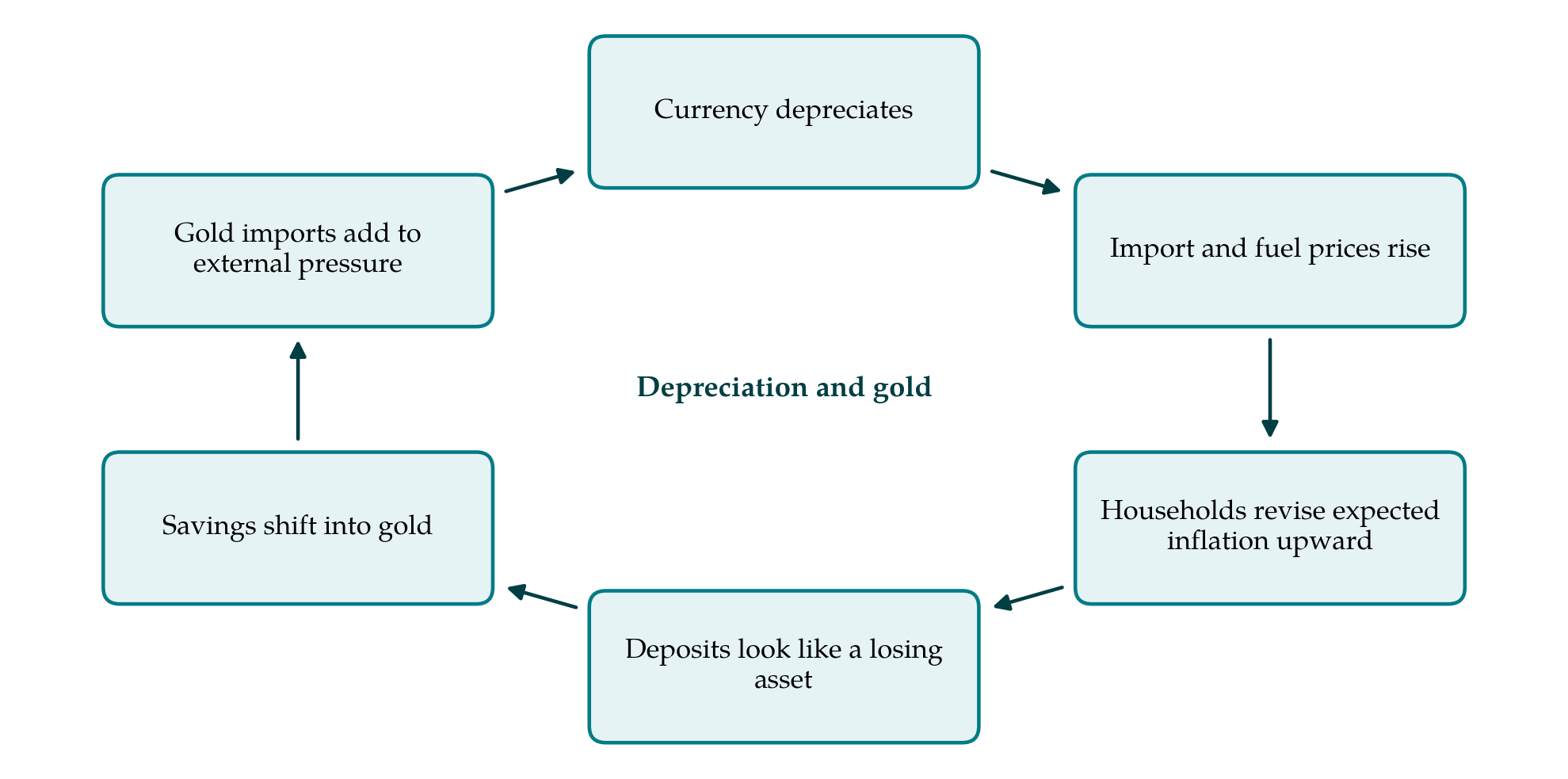
For the present question the point is that a household which expects a depreciation to raise prices is usually right about the direction and often wrong about the size. Overshooting of the exchange rate after a monetary shock, as in the model of Dornbusch (1976), means that the currency can fall by more than the eventual rise in the price level. A household that extrapolates from the exchange rate alone will then expect more inflation than occurs. Figure 1 sets out the sequence that the conventional account assumes, including the return path by which gold imports can add to pressure on the currency in countries that produce little gold of their own.
5. Do Expectations Change What Households Do?
Stated expectations would matter little if households did not act on them. The evidence that they do has grown but is not uniform. Bachmann et al. (2015) found only a weak relation between expected inflation and reported readiness to spend on durable goods in United States survey data. Experimental work is more supportive: Armantier et al. (2015) showed that the expectations people report in surveys are consistent with the choices they make in an incentivised investment task, at least among those with adequate numeracy. Information experiments, in which a random subset of households is given facts about inflation or policy, show that induced changes in expectations lead to changes in subsequent spending (Coibion et al., 2022).
Almost all of this work concerns consumption. Portfolio responses are less studied, and where they are studied the assets in question are deposits, equities, housing and mortgage choices. The idea that people who have experienced inflation avoid long-term nominal assets has support (Malmendier and Nagel, 2016), and it would be natural for the same households to favour real stores of value. Gold, however, hardly appears in this literature, for the plain reason that the major household surveys were designed in countries where few households hold it as a savings vehicle.
6. Gold as a Hedge: What the Financial Literature Shows
The financial literature asks a different question: whether gold in fact protects its holder. The answer depends on the horizon and on what gold is supposed to protect against. Over very long periods gold has roughly preserved purchasing power (Jastram, 1977), and cointegration studies find a long-run relation between the gold price and the general price level (Ghosh et al., 2004). Over the horizons that concern a household, a few years at most, the relation is loose. Erb and Harvey (2013) showed that the real price of gold swings widely and for long periods, so that gold bought at a high real price can lose purchasing power for many years. The link between gold and inflation also varies over time and appears to depend on monetary conditions (Batten et al., 2014).
The evidence is stronger for protection against currency weakness and market stress. Baur and Lucey (2010) distinguished a hedge, which is uncorrelated with another asset on average, from a safe haven, which is uncorrelated with it in times of stress, and found that gold served as a safe haven for equities in several developed markets for short periods. Baur and McDermott (2010) extended the analysis internationally and found the property present in developed markets and largely absent in large emerging ones. Gold has also been shown to move against the United States dollar (Capie et al., 2005; Reboredo, 2013). The survey by O'Connor et al. (2015) reviews this body of work in full.
A mechanical point deserves emphasis because it is easily missed. Gold is priced internationally in dollars. For a household in a country whose currency is falling against the dollar, the local price of gold rises with the depreciation even if the dollar price is unchanged. Gold held before a depreciation therefore protects against it almost by construction, which is a different matter from protecting against domestic inflation. A household that buys after the fall has already paid the higher price, and its protection depends on further depreciation. Table 1 summarises the roles claimed for gold and the relevance of each to a household in this position.
| Role | What the literature finds | Relevance to the household | Representative sources |
|---|---|---|---|
| Long-run inflation hedge | Purchasing power broadly preserved over very long periods | Limited: household horizons are far shorter | Jastram, 1977; Ghosh et al., 2004 |
| Short-run inflation hedge | Weak and unstable; real price swings are large | Timing of purchase dominates the outcome | Erb and Harvey, 2013; Batten et al., 2014 |
| Currency hedge | Gold tends to move against the dollar | Local gold price rises as the home currency falls | Capie et al., 2005; Reboredo, 2013 |
| Safe haven | Holds value in equity market stress, briefly | Matters where households also hold equities | Baur and Lucey, 2010; Baur and McDermott, 2010 |
| Substitute for foreign currency | Residents move out of domestic money when it is unstable | Gold is reachable where foreign exchange is restricted | Calvo and Végh, 1992 |
| Customary store of wealth | Physical demand responds to income, price and custom | Purchases may reflect habit more than forecasts | Starr and Tran, 2008 |
7. Physical Demand and Competing Explanations
Studies of prices say little about who buys. The literature on physical demand is small. Starr and Tran (2008) examined the determinants of physical gold demand across countries and found that they differ from the determinants of portfolio demand, and differ between developed and developing economies. Jewellery demand in the large consuming countries is sensitive to price and income and follows a seasonal calendar of festivals and weddings, none of which has to do with expectations of inflation. A rise in purchases during a depreciation therefore has to be measured against what would have been bought anyway, and in annual data the two are hard to tell apart.
Several explanations compete with the inflation-expectations account. The first is currency substitution. Where the domestic currency is unstable, residents shift into foreign money (Calvo and Végh, 1992), and where access to foreign currency is restricted or costly, gold is the nearest alternative. On this view gold buying is a flight from the currency as such and would occur even if households held no particular view on consumer prices. The second is financial access. Households without convenient access to inflation-indexed instruments, or to any formal savings product they trust, have few real assets to choose from apart from land and gold. The third is extrapolation. A rising local gold price attracts buyers who expect it to go on rising, a pattern familiar from other asset markets in which individual investors chase recent returns.
These explanations are not mutually exclusive, and each has a different policy implication. If expectations drive purchases, credible monetary policy and clear communication should reduce them. If the motive is flight from the currency, the remedy lies in the external accounts and in confidence more broadly. If the constraint is access, better savings instruments would redirect demand, which is the reasoning behind paper gold schemes and indexed bonds offered by some governments. If extrapolation is at work, purchases will reverse when the price does, and households that bought late will bear losses.
8. Gaps and Directions for Research
The chief gap is one of measurement. To test the conventional account directly, one needs the same households observed over time with their inflation expectations, their exchange rate expectations and their gold transactions recorded together. Central bank expectation surveys in emerging economies typically record the first of these and occasionally the second. Household finance surveys record asset holdings, sometimes including gold, but seldom expectations. Trade and industry statistics record aggregate gold flows without identifying buyers. Adding a short module on gold and foreign currency holdings to existing expectation surveys would be an inexpensive way to close the gap.
A second gap concerns identification. Depreciation, inflation and the local gold price move together, so that correlation in aggregate data cannot distinguish the channels described above. Information experiments of the kind used by Coibion et al. (2022) offer a way forward: a randomly chosen group of households receives information about inflation or about the central bank's objectives, and subsequent saving choices are compared. Such designs have not yet been applied to gold. A third gap is the separation of jewellery from bars and coins, since the two respond differently to price and serve different purposes, yet many data sources combine them.
Finally, the welfare question is open. Whether households that move into gold during depreciations end up better off depends on when they buy, what they pay in making charges and dealer margins, and what they would otherwise have held. The financial literature suggests that the outcome is highly sensitive to timing (Erb and Harvey, 2013), and timing is exactly what a household reacting to a fall that has already happened is least able to control.
9. Conclusion
The proposition that households buy gold during depreciations because they expect inflation is reasonable and fits what is known about how expectations are formed. Households attend to visible prices, remember past inflation and can observe the exchange rate directly. Gold, for its part, protects against a falling home currency more reliably than against inflation over short periods. What the literature does not yet provide is direct household-level evidence connecting the two, nor a clean separation of the expectations channel from currency substitution, limited financial access and price extrapolation. Until surveys record expectations and gold holdings together, the conventional account should be treated as a well-motivated hypothesis and not as an established finding, and policies built on it should be designed with the alternatives in view.
Conflict of interest
To be declared by the author(s) before publication.
Funding
To be declared by the author(s) before publication.