1. Introduction
Mountains compress climate. A walk of a few hours up a tropical slope crosses a range of temperature and humidity that would take weeks to cross on level ground, and amphibian communities change almost completely along the way. Many frogs and salamanders occupy elevational bands only a few hundred metres deep. Janzen (1967) argued that this narrowness is itself a product of climate: where seasons are weak, organisms never experience the conditions of the slope above or below them and evolve narrow tolerances, so that a tropical mountain pass is a greater physiological barrier than a temperate one of the same height. A fauna built in this way has little room to absorb change.
The broad pattern of response to recent warming is well established. Syntheses across plants and animals show that distributions have moved toward the poles and toward higher ground in a direction consistent with warming (Parmesan and Yohe, 2003; Chen et al., 2011). Amphibians are poorly represented in those syntheses, although they are the most threatened class of vertebrates and their unexplained declines have been concentrated in montane, stream-breeding species (Stuart et al., 2004). The gap matters because amphibians are not simply small ectotherms that follow isotherms. Water governs where they can live, when they can be active and whether they can breed.
This article reviews the published evidence on altitudinal range shifts of montane amphibians with particular attention to rainfall. It asks three things of the literature: why changes in moisture should be expected to move amphibian ranges, what shifts have in fact been documented, and how far those shifts can be attributed to rainfall as distinct from temperature, disease or habitat loss.
2. Scope and Approach
The article is a narrative review of the published literature. It draws on resurvey studies, long-term monitoring, physiological work and modelling papers that bear on elevational distributions of frogs, toads and salamanders, together with studies of other taxa where they clarify a mechanism. No systematic search was carried out and no quantitative synthesis is attempted, because the studies are too few and too varied in method to be pooled. Rainfall is taken broadly to include the amount, timing and intensity of precipitation and, on cloud-affected slopes, the frequency of mist and the height of the cloud base.
3. Why Moisture Constrains Amphibian Ranges
Three features of amphibian biology link distribution to water. They are treated separately here because each responds to a different aspect of rainfall.
3.1. Water balance and activity
Amphibian skin offers little resistance to evaporation in most species, and an animal away from water loses mass at a rate set by the vapour pressure deficit of the air around it (Wells, 2007). Foraging, calling and dispersal are therefore confined to humid nights and to the hours after rain. A drier climate does not need to kill adults outright to reduce a population. It shortens the time in which they can feed and find mates, and it does so most severely for terrestrial and arboreal species that cannot retreat to a stream. Because warm air holds more water vapour, warming without added rainfall increases evaporative demand, so temperature and moisture effects are physiologically coupled even when they are statistically distinct.
3.2. Breeding sites and hydroperiod
Most montane amphibians with aquatic larvae depend on pools, seeps and low-order streams whose persistence is set by seasonal rainfall. If a pool dries before metamorphosis the cohort is lost, and a run of short hydroperiods can remove a local population within a few generations. Direct-developing species, which lay eggs in moss or leaf litter, are freed from pools but are exposed to desiccation of the clutch itself. Reviews of precipitation effects stress that extremes count as much as means: both drought and scouring floods reduce recruitment, and the spacing of rain events can matter more than the annual total (Walls et al., 2013).
3.3. Cloud, mist and the montane moisture regime
On many tropical mountains a large share of the moisture reaching the forest arrives as cloud water intercepted by vegetation, and dry-season mist keeps litter and epiphytes damp when rain is absent. Climate simulations indicate that warming raises the altitude at which cloud forms during the dry season (Still et al., 1999), and regional modelling for Costa Rica suggests that clearing lowland forest upwind has a similar effect on the clouds of the adjacent cordillera (Lawton et al., 2001). A rising cloud base is, for a cloud forest frog, a change in rainfall regime that no rain gauge at the foot of the mountain will record.
4. Expected Directions of Shift
If temperature alone set range limits, the expectation would be simple: lower limits retreat upslope, upper limits advance, and species already at the summit run out of ground. Colwell et al. (2008) added that tropical lowlands have no warmer source fauna to replace the species that leave, and that gaps between a species' current and future ranges may be too wide to cross. Moisture complicates this picture. Figure 1 sets out the directions of shift that follow from combining the two drivers. Where warming is accompanied by drying, both push the lower limit upward. Where it is accompanied by wetting, the two pull in opposite directions and the net movement may be small, absent or downhill.
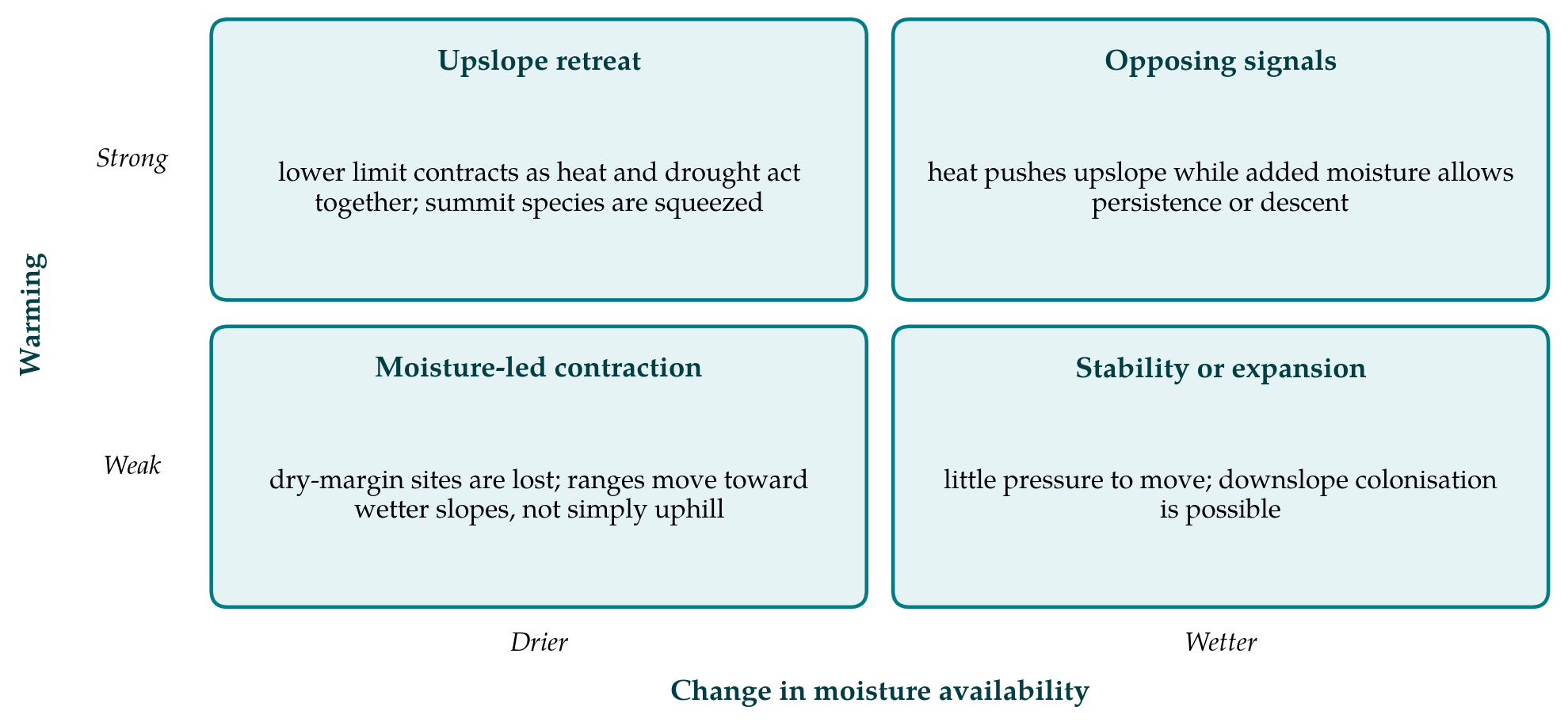
Evidence from other groups shows that the off-diagonal cases are real. Plant species in California moved their elevational optima downhill over the twentieth century, tracking an improved climatic water balance despite warming (Crimmins et al., 2011). Resurveys of birds in the Sierra Nevada found that rising temperature tended to push species upslope while increased precipitation pulled them down, giving a heterogeneous set of shifts (Tingley et al., 2012). A global synthesis concluded that a substantial fraction of documented shifts run against the simple poleward and upward expectation (Lenoir and Svenning, 2015). McCain and Colwell (2011) modelled montane vertebrates on elevational gradients worldwide and showed that projected risk rises sharply once changes in precipitation are considered alongside temperature. Amphibians, as the most water-dependent land vertebrates, should show these effects most strongly.
5. The Observational Record
Direct documentation of elevational shifts in amphibians comes from a small number of mountains. Table 1 summarises the principal studies and the role each assigns to moisture.
| Region and source | Evidence | What was reported | Role of moisture |
|---|---|---|---|
| Monteverde, Costa Rica (Pounds et al., 1999) | Long-term monitoring | Anuran population crashes; lowland birds colonising upslope | Central: fewer dry-season mist days |
| Cordillera Vilcanota, Peru (Seimon et al., 2007) | Repeat field surveys | Three anurans breeding in newly deglaciated terrain | Indirect: meltwater ponds created by ice retreat |
| Tsaratanana, Madagascar (Raxworthy et al., 2008) | Resurvey after a decade | Upslope displacement of amphibians and reptiles | Not separated from warming |
| Andes of Ecuador (Bustamante et al., 2005) | Historical comparison | Losses of species and abundance in seven communities | Considered with warming and disease |
| Neotropical highlands (Pounds et al., 2006) | Timing of disappearances | Harlequin frog extinctions clustered at mid elevations | Cloud cover altering temperature for a pathogen |
| Philippine forest (Scheffers et al., 2014) | Microclimate measurement | Microhabitats buffer frogs against extremes | Humid refuges may delay shifts |
5.1. Tropical cloud forests
The Monteverde study remains the clearest case in which moisture, and not temperature as such, was proposed as the driver. Pounds et al. (1999) linked the collapse of anuran populations in the late 1980s, including the disappearance of the golden toad, to an increase in the number of dry-season days without mist, and related that trend to sea surface temperatures. Over the same period bird species from lower slopes established themselves in the cloud forest and highland lizard populations declined. The pattern is one of a whole community responding to a lifting cloud base. What it does not show is a measured upslope movement of the amphibians themselves: on an isolated ridge with little higher ground, the response was loss.
5.2. The high Andes
At the other extreme of the gradient, Seimon et al. (2007) recorded three anuran species breeding in ponds on ground exposed by retreating glaciers in southern Peru, at elevations above any previously known for amphibians. Here the upper limit advanced because warming created new aquatic habitat, a hydrological effect and not a thermal one in the narrow sense. The same surveys detected the chytrid fungus Batrachochytrium dendrobatidis in these populations, a reminder that pathogens can travel upslope with their hosts. Historical comparisons in Ecuador found marked losses from Andean anuran communities, with climate, disease and their interaction all considered as causes (Bustamante et al., 2005).
5.3. Madagascar and other resurveys
On the Tsaratanana massif, Raxworthy et al. (2008) repeated elevational surveys of amphibians and reptiles after about a decade and reported that the ranges of many species had been displaced upslope, in the direction expected from regional warming. The authors described the appraisal as preliminary, since two survey periods cannot distinguish a trend from year-to-year fluctuation. The century-long resurvey of small mammals in Yosemite (Moritz et al., 2008) shows what a fuller record looks like: upward contraction of high-elevation species set against expansion of some lowland ones, with detection modelled at both dates. No amphibian data set of similar length and design has yet been published for a tropical mountain, and for the species-rich ranges of South and Southeast Asia the published assessments are largely projections (Bickford et al., 2010).
6. Confounding Factors
Attribution is difficult for amphibians because the period of climatic change coincides with the spread of chytridiomycosis. Pounds et al. (2006) proposed that warming, acting through cloud cover, had shifted temperatures at mid elevations toward the optimum of the fungus and so triggered the extinctions of harlequin frogs. Lips et al. (2008) reanalysed the timing of declines and argued that they are better explained by the wave-like spread of an introduced pathogen, with no need for a climatic trigger. Later work pointed to temperature variability associated with El Niño events as a contributing factor (Rohr and Raffel, 2010). The debate is unresolved in detail, but its lesson for range-shift studies is clear. A lower range limit that retreats upslope may record drought, heat, disease, or disease made worse by weather, and occurrence data alone cannot tell these apart.
Land use adds a further difficulty. Forest clearance is usually concentrated on lower slopes, so the loss of low-elevation populations to habitat conversion produces the same apparent upward shift in a species' lower limit as climate would. Clearance also alters local humidity and, as noted above, may change cloud formation over neighbouring mountains. Studies that report a shift without a record of habitat change at the resurveyed sites leave this alternative open.
7. Problems of Detection
Amphibians are hard to find, and how hard depends on the weather. Calling activity and surface movement rise after rain, so a survey in a dry year will record fewer species at the dry margin of a gradient than a survey in a wet year, even if nothing has changed. This creates a specific hazard: a change in rainfall can generate an apparent range shift through detection alone. Occupancy models, which estimate the probability of detection from repeated visits, were developed for this problem (MacKenzie et al., 2002), and Tingley and Beissinger (2009) showed how they can be applied to comparisons between historical and modern surveys. Few amphibian resurveys have used them, partly because the historical surveys were rarely repeated within a season.
Microhabitat adds a second complication. Tree holes, epiphytes, deep litter and rock crevices hold moisture and damp temperature swings, and animals using them experience a milder climate than a weather station records (Scheffers et al., 2014). Buffering of this kind may allow populations to persist at an elevation for years after the open-air climate has become unsuitable, so that the distribution lags behind the climate and then changes abruptly.
8. Gaps and Future Work
Four needs stand out. The first is repeated, standardised elevational transects with several visits per season, so that detection can be modelled and trends separated from fluctuation. The second is moisture data collected on the slope itself: rainfall, mist frequency, litter moisture and pool hydroperiod at the surveyed elevations, since lowland gauges and gridded climate products resolve mountain moisture poorly. The third is concurrent screening for chytrid infection and recording of habitat condition, without which disease and land use cannot be excluded. The fourth is geographic. The Western Ghats, the eastern Himalaya, the mountains of Southeast Asia and New Guinea, and the Eastern Arc of Africa hold large endemic amphibian faunas and have little published resurvey work.
Physiological measurements would strengthen inference. Rates of evaporative water loss, dehydration tolerance and the hydroperiod required for larval development can be measured for a species and used to predict where on a gradient a given change in rainfall should bite. Agreement between such predictions and observed changes at range margins would be stronger evidence for a rainfall effect than correlation with climate records alone.
9. Conclusion
The published record shows that montane amphibian distributions have changed on several mountains over recent decades and that some of those changes are upslope. It does not yet show how much of the change is due to rainfall. The physiological case for a strong moisture effect is sound, and studies of plants and birds confirm that water balance can move ranges against the direction set by temperature. For amphibians the decisive observations, long resurvey series with on-slope moisture measurements and disease screening, remain to be made. Until they are, projections of upslope retreat based on temperature alone should be read as one scenario among several.
Conflict of interest
To be declared by the author(s) before publication.
Funding
To be declared by the author(s) before publication.