1. Introduction
India's minimum support prices are recommended each season by the Commission for Agricultural Costs and Prices and announced by the central government before sowing. In law they are an offer and not an obligation: a farmer may sell to the state at the announced price if a purchasing agency is present. For rice and wheat, the Food Corporation of India and state agencies buy on a large scale to supply the public distribution system, and they do so chiefly in a small group of surplus states. A government committee that reviewed the system observed that only a small minority of the country's farmers sell to procurement agencies at all (Government of India, 2015).
Where procurement is dependable, the cropping pattern has narrowed around the two procured cereals. The same districts sit over aquifers that are being drawn down. Satellite gravity measurements have shown a large net loss of groundwater across north-western India, attributed mainly to irrigation withdrawals (Rodell et al., 2009). This note considers how price support contributes to the persistence of water-intensive cropping in such districts and why the pattern has proved so hard to shift.
2. How a Price Floor Shapes Crop Choice
Farmers allocate land on the prices they expect, a point formalised in the supply response model of Nerlove (1956). A support price raises the expected price of a crop, but its more important effect is on the spread of possible outcomes. Sandmo (1971) showed that a risk-averse producer facing an uncertain price produces less than one facing the same price with certainty. By the same logic, when one crop has an assured buyer at a known price and its alternatives do not, land moves towards the assured crop even if expected returns are similar. Paddy sold to a state agency carries little market risk. Maize, pulses or oilseeds sold in the open market in the same district carry all of it, and a nominal support price without a purchasing agency does not alter that.
Yield risk points the same way. Irrigated rice and wheat on the alluvial plains give stable yields from one year to the next, the product of decades of breeding and of assured water, whereas the alternatives are more exposed to pests, heat and waterlogging. A farmer comparing crops therefore sets a return that is nearly certain in both price and quantity against one that is uncertain in both. Tenants paying a fixed cash rent, and owners servicing loans, have particular reason to prefer the certain return.
The price signal is reinforced from the cost side. Electricity for pumping is supplied to farmers free or at flat rates in several states, so the marginal cost of water to the irrigator is close to zero and the scarcity of groundwater does not enter the comparison between crops (Badiani et al., 2012; Shah, 2009). Table 1 lists the main channels through which the arrangement favours the supported crops.
| Channel | How it favours rice and wheat | What would loosen it |
|---|---|---|
| Price assurance | Known price removes market risk for two crops only | Comparable assurance for alternative crops |
| Open-ended purchase | Any quantity offered is bought in procurement states | Purchase or deficiency payments not tied to one crop |
| Energy subsidy | Pumping cost does not reflect water scarcity Badiani et al., 2012 | Metering, or support paid independently of pumping |
| Specific assets | Tubewells, combines and rice mills are already paid for | Time; investment support for other crops |
| Market infrastructure | Dense market yards, agents and credit serve the two cereals | Buyers, storage and processing for alternatives |
| Knowledge and varieties | Research and extension have long centred on the two crops | Proven varieties and advice for other crops |
3. Why the Pattern Persists
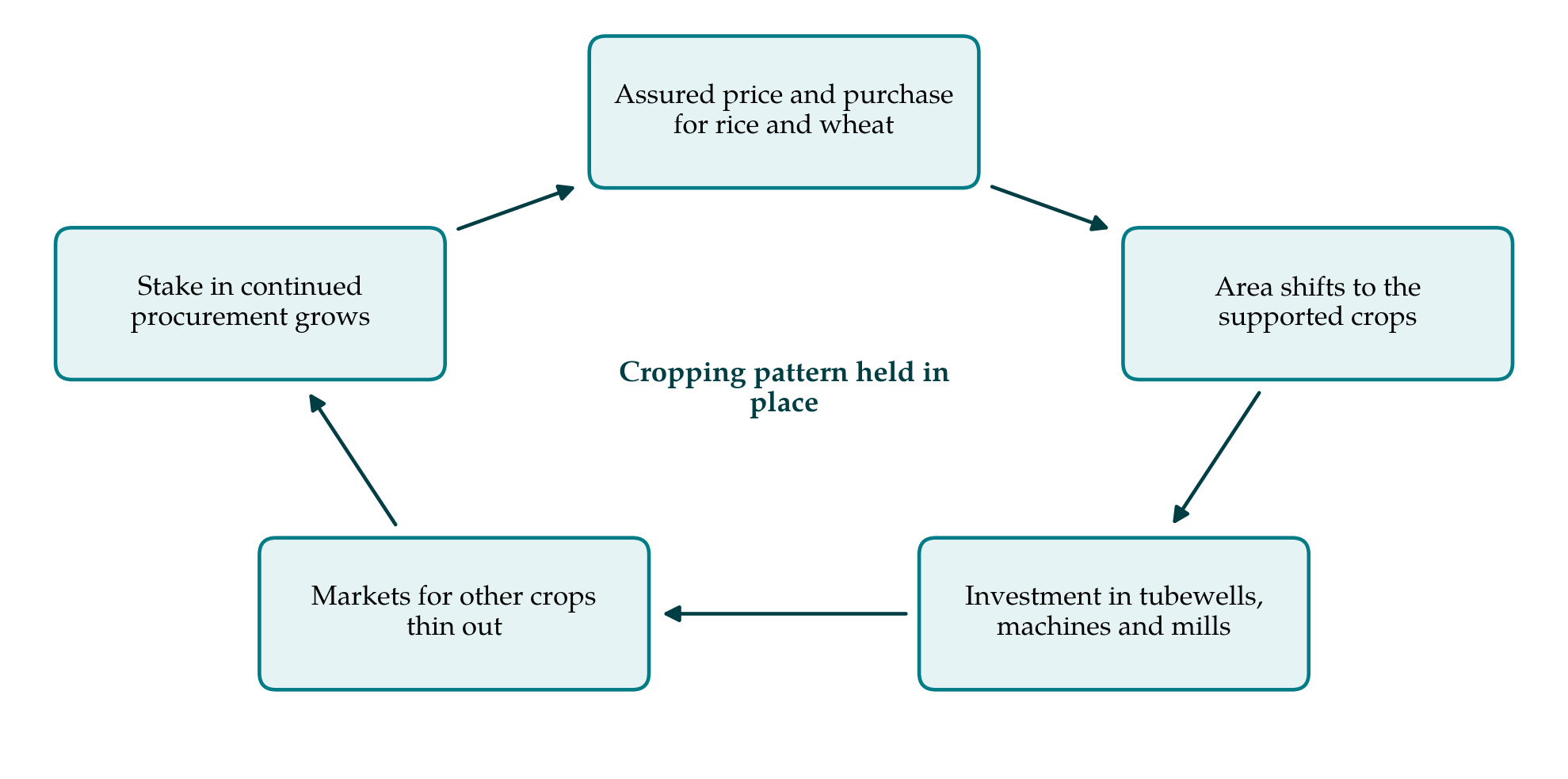
The rigidity is better understood as a self-reinforcing process than as a response to any single incentive. Arthur (1989) described how an option that gains an early lead can become locked in as complementary investments accumulate around it. Figure 1 applies the idea to cropping. Assured purchase draws area into rice and wheat. Farmers and traders then invest in tubewells, harvesting machinery, mills and market yards suited to those crops. As area leaves other crops, their buyers, processors and seed suppliers withdraw, which raises the risk of growing them. The number of households and intermediaries whose income depends on procurement grows, and with it the difficulty of changing the policy.
Groundwater regulation has so far worked around this loop instead of breaking it. Punjab and Haryana legislated in 2009 to prohibit the transplanting of paddy before a notified date, so that the crop's peak water demand falls closer to the monsoon. Assessments suggest that the measure slowed the fall in water tables without reversing it (Singh, 2009; Tripathi et al., 2016). The law changed when rice is planted and left untouched the reasons for planting it. Efficiency measures face a similar limit, since water saved per hectare can be spent on irrigating more intensively (Fishman et al., 2015).
4. Options and Their Trade-offs
If assurance is what holds the pattern, three kinds of response follow. One is to extend dependable purchase, or a payment covering the gap between market and support price, to crops that need less water. Agronomic work indicates that replacing part of the rice area with maize, millets or sorghum would reduce irrigation demand (Davis et al., 2018), but the fiscal cost and the storage and distribution of the additional grain are real constraints. A second is to pay support in a form that does not depend on the crop grown, which preserves farm income while restoring the comparison between crops to market returns. A third is to price or ration water and energy so that scarcity enters the farmer's calculation, which is effective in principle and has been politically difficult wherever it has been attempted (Shah, 2009).
None of these is costless, and each shifts risk onto farmers who invested in good faith under the existing rules. A credible transition would need to be announced well ahead, phased over several seasons and accompanied by investment in markets for the alternative crops. Useful empirical questions include how much area responds when assured purchase of an alternative crop is introduced in a procurement district, and whether the response differs between farmers who own tubewells and those who buy water.
5. Conclusion
In the districts where it is effective, the minimum support price is a guarantee as much as a price, and the guarantee covers only the crops that use the most water. The cropping pattern that has formed around it is sustained by investments, markets and interests that grew up under its protection. Changing the announced price of other crops, or regulating planting dates, leaves that structure intact. Policies for crop diversification in water-stressed districts are more likely to succeed if they offer comparable assurance for alternative crops and bring the cost of water into the farmer's decision together.
Conflict of interest
To be declared by the author(s) before publication.
Funding
To be declared by the author(s) before publication.