1. Introduction
Incretin-based drugs have changed the medical treatment of obesity. Once-weekly semaglutide and the dual agonist tirzepatide produce weight loss on a scale previously seen only after surgery (Wilding et al., 2021; Jastreboff et al., 2022), and their use has spread far beyond specialist clinics. Gastrointestinal symptoms are the price most often paid. In the registration trials nausea, vomiting, diarrhoea and constipation were common, usually mild to moderate, and concentrated in the period of dose escalation.
For most people these effects fade. Gastroenterologists are now asked to see the exceptions: patients with weeks or months of vomiting, early satiety and bloating, some of whom say that the symptoms continued after the drug was stopped. A pharmacoepidemiological analysis found that agonists prescribed for weight loss were associated with a higher risk of gastroparesis than a comparator weight loss drug (Sodhi et al., 2023). Such an association does not show how often true, lasting gastric motor failure occurs, and published guidance on how to investigate an individual patient is thin.
This article proposes a structured pathway for that investigation, written with one common presentation in mind: a middle-aged woman with apparently refractory gastroparesis after incretin-based weight loss therapy. It is a methodological proposal built from existing guidelines on gastroparesis and from the known pharmacology of the drugs. It describes no patient and reports no outcomes, and it has not been validated.
2. Background
Three bodies of knowledge inform the design: how these drugs affect the stomach, how gastroparesis is defined and measured, and why the demographic group in question is prone to diagnostic confusion.
2.1. Incretin drugs and gastric emptying
Glucagon-like peptide-1 delays gastric emptying through vagally mediated effects on fundic tone, antral contraction and pyloric resistance, and this contributes to its effect on glucose after meals (Drucker, 2018). The delay is subject to tachyphylaxis: with continuous exposure it weakens within hours to days (Nauck et al., 2011). Long-acting agonists therefore slow the stomach less at steady state than at the start of treatment, although a measurable delay can persist. In a trial of liraglutide in obesity, emptying of solids was clearly slowed after several weeks and less so after several months (Halawi et al., 2017). The practical consequence is that a delayed emptying test in someone still exposed to the drug shows an expected drug effect and says nothing about underlying gastric function.
2.2. Defining and measuring gastroparesis
Gastroparesis is defined by upper gastrointestinal symptoms together with objectively delayed gastric emptying in the absence of mechanical obstruction (Camilleri et al., 2022). The reference test is scintigraphy of a standard low-fat, egg-white meal with imaging to four hours, and retention of more than ten per cent of the meal at four hours is the accepted criterion for delay (Tougas et al., 2000; Abell et al., 2008). Shorter protocols and non-standard meals misclassify patients in both directions. Symptom severity is commonly recorded with the Gastroparesis Cardinal Symptom Index (Revicki et al., 2003). European consensus adds that symptoms correlate only loosely with the degree of delay (Schol et al., 2021).
2.3. Why middle-aged women are a difficult group
Women make up the great majority of patients with idiopathic gastroparesis in registry data (Parkman et al., 2011), and healthy women empty solids more slowly than men (Datz et al., 1987). Functional dyspepsia, defined by the Rome IV criteria (Stanghellini et al., 2016), produces the same symptoms, is also more frequent in women, and overlaps with gastroparesis to the point that the two have been described as interchangeable syndromes in tertiary care (Pasricha et al., 2021). A woman in midlife who starts weight loss therapy may thus have had mild, unrecognised symptoms beforehand. Rapid weight loss adds its own hazards, among them gallstone disease. Any pathway has to separate a drug effect from a coincident or unmasked disorder.
3. The Proposed Pathway
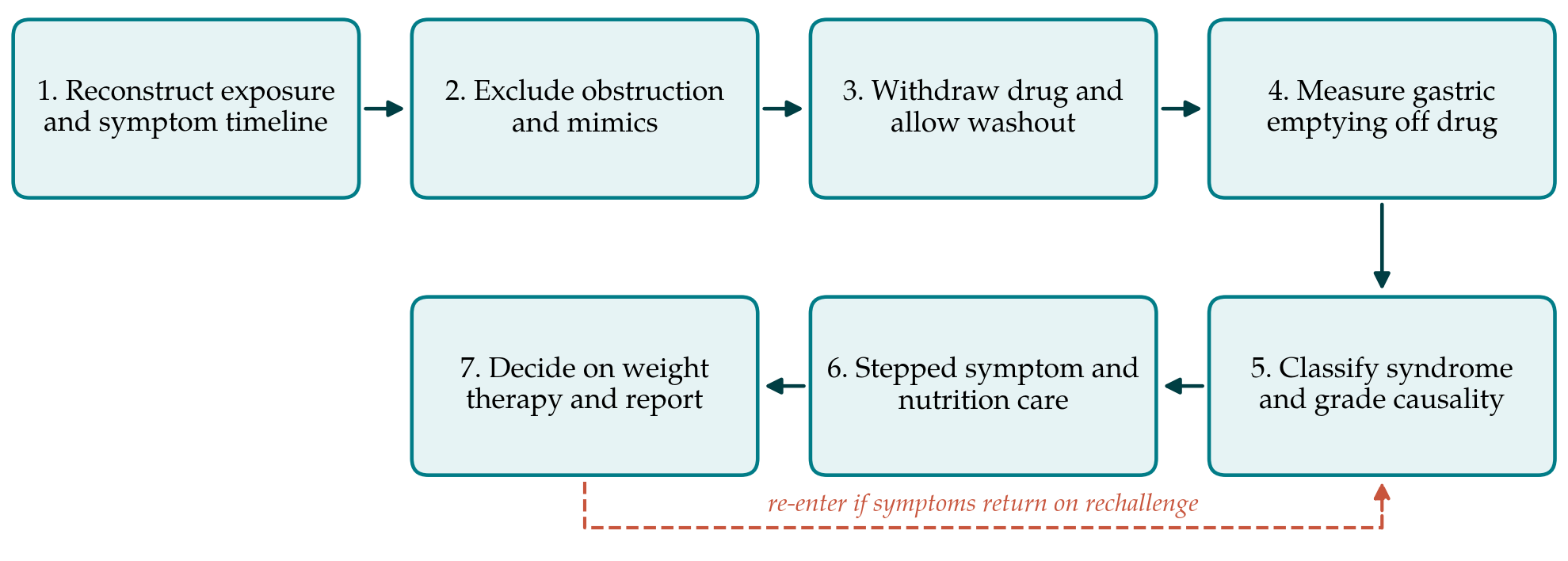
The pathway has seven steps, listed in Table 1 with the record each should leave in the notes. Figure 1 shows the sequence. The steps are intended to be taken in order, since each depends on information from the one before, but the first three can overlap in time.
| Step | Question answered | Record kept |
|---|---|---|
| 1. Timeline | Did symptoms begin, worsen or change with drug exposure? | Dated chart of doses, symptoms and weight |
| 2. Exclusion | Is there obstruction or another cause of vomiting? | Endoscopy, imaging and medication review |
| 3. Withdrawal and washout | Do symptoms improve when the drug is cleared? | Stop date and serial symptom scores |
| 4. Emptying test | Is emptying delayed when measured off the drug? | Standard four-hour scintigraphy report |
| 5. Classification | Which syndrome is present, and how likely is a drug cause? | Diagnosis and causality grade |
| 6. Stepped care | What controls symptoms and protects nutrition? | Treatments tried, response, weight |
| 7. Decision and reporting | Should weight therapy resume, and in what form? | Shared decision note; adverse event report |
3.1. Step 1: Reconstruct the timeline
The clinician draws up a dated record of the drug, its dose escalations, missed and final doses, and the onset and course of each symptom, set beside body weight. Symptoms that appeared at a dose increase and eased between increases suggest a pharmacological effect. Symptoms present before the first injection suggest a pre-existing disorder. The history should also establish whether the patient has diabetes, since long-standing diabetes is itself a cause of gastroparesis, and should record previous gastric or bariatric surgery, thyroid disease, and the use of opioids, anticholinergic drugs and cannabis.
3.2. Step 2: Exclude obstruction and mimics
Guidelines require mechanical obstruction to be excluded before gastroparesis is diagnosed (Camilleri et al., 2022). Upper endoscopy is the usual means, with cross-sectional imaging when small bowel obstruction is possible. In this setting the differential diagnosis is wider than usual. Gallstones and pancreatitis should be considered in anyone with pain after rapid weight loss, and pancreatitis and bowel obstruction were among the events associated with these drugs in the analysis by Sodhi et al. (2023). Rumination syndrome, cyclic vomiting and cannabinoid hyperemesis can each be mistaken for gastroparesis, and each is managed differently. Marked weight loss can, rarely, lead to compression of the duodenum by the superior mesenteric artery.
3.3. Step 3: Withdraw the drug and allow washout
If the drug has not already been stopped, it is stopped in agreement with the prescriber. The length of observation must respect pharmacokinetics. Semaglutide has an elimination half-life of about one week, so meaningful concentrations remain for more than a month after the last dose, and the picture for other weekly agents is similar. Symptoms are scored at regular intervals with a validated instrument through this period. Improvement that follows the expected clearance of the drug supports a drug effect. Persistence well beyond it is the finding that makes the label refractory worth using, and it is the point at which formal testing becomes informative.
3.4. Step 4: Measure gastric emptying under standard conditions
Scintigraphy is performed according to the consensus protocol, with the standard meal, imaging to four hours and prior withdrawal of other drugs that alter motility (Abell et al., 2008). In patients with diabetes the blood glucose is checked beforehand, because marked hyperglycaemia slows emptying. A test done while the incretin drug is still active should be labelled as such and not used to diagnose gastroparesis. Where scintigraphy is unavailable, a validated breath test is an accepted alternative (Camilleri et al., 2022).
3.5. Step 5: Classify the syndrome and grade causality
Three outcomes are possible. Delayed emptying with compatible symptoms after washout meets the definition of gastroparesis. Normal emptying with persistent symptoms points to functional dyspepsia or another disorder identified at Step 2. Resolution of symptoms before testing indicates a reversible drug effect. For the first two, the probability that the drug was responsible is graded with a structured instrument such as the adverse drug reaction probability scale of Naranjo et al. (1981), which weighs timing, response to withdrawal, alternative causes and rechallenge. The grade is recorded in words. In most cases it will be no stronger than possible or probable, and the notes should say so.
3.6. Step 6: Stepped symptom and nutritional care
Management follows existing guidance for gastroparesis and does not differ because of the suspected cause (Camilleri et al., 2022; Schol et al., 2021). It begins with dietary change towards small, low-fat, low-residue meals and with attention to hydration and micronutrients, which matter particularly after substantial weight loss. Antiemetic and prokinetic drugs are added according to licensed indications and local practice. For patients who remain symptomatic, the expert review by Lacy et al. (2022) describes the options, including neuromodulators, pyloric intervention in carefully selected patients with confirmed delay, and enteral feeding when oral intake fails. This article proposes no new treatment and no dosing.
3.7. Step 7: Decide on future weight therapy and report
The final step is a shared decision about obesity treatment, since the condition that prompted therapy remains. Options include no further incretin-based drug, a cautious retrial, or a different approach altogether. Rechallenge gives the strongest evidence on causality but exposes the patient to recurrence, and it should be considered only when symptoms resolved fully and the patient wishes it. A suspected serious reaction is reported to the national pharmacovigilance scheme whatever the causality grade.
4. Fitting the Pathway to Practice
The pathway asks for nothing that a general gastroenterology service does not already have, with the possible exception of four-hour scintigraphy, which many centres still shorten. Its main demand is patience: the washout period is long, and both patient and clinician will be tempted to test early. A shared record between the prescriber, who is often in primary care or a weight management service, and the gastroenterologist avoids repeated or contradictory advice. Anaesthetic colleagues should be told when endoscopy is planned for a patient recently exposed to these drugs, because retained gastric contents are a recognised concern.
5. Limitations and What Remains to Be Shown
The pathway is a proposal and has not been tested. Its central assumption, that delay persisting after washout identifies a distinct and clinically meaningful group, is unproven: the proportion of symptomatic patients who have delayed emptying once the drug has cleared is not known, nor is their long-term course. The suggested washout rests on half-life and not on direct studies of how quickly gastric function recovers. Causality scales were designed for adverse reactions in general and may perform poorly for a symptom complex as common as dyspepsia in the background population.
Validation would require a prospective series in which the pathway is applied consistently, with emptying measured by the standard method at defined intervals after withdrawal, and with comparison against patients who have similar symptoms and no drug exposure. The focus on middle-aged women reflects who is most often affected by diagnostic overlap. Nothing in the steps is specific to sex or age, and whether the pathway performs differently in other groups is a further open question.
6. Conclusion
Persistent vomiting and fullness after incretin-based weight loss therapy may be a prolonged drug effect, an unmasked functional disorder or, perhaps, lasting gastroparesis, and these cannot be told apart by a single emptying test done at the wrong time. The seven steps proposed here put the timeline first, insist on an adequate washout before standardised testing, make the grading of causality explicit and leave treatment to established guidance. Whether the approach improves diagnosis or outcomes remains to be demonstrated in prospective work.
Conflict of interest
To be declared by the author(s) before publication.
Funding
To be declared by the author(s) before publication.