1. Introduction
Walk through the commercial streets of a refugee-hosting neighbourhood in Kampala or Nairobi, or the market of a large settlement, and a good share of what is for sale is food prepared or traded by refugees: flatbreads, roasted coffee, milled flour, cooked meals, imported spices. Most of these enterprises stay small. A few add outlets, take on staff, move into wholesale or supply other towns. The owners of those larger businesses rarely borrow from a bank. Documentation requirements, the absence of collateral and uncertainty about legal status keep formal lenders at a distance, and growth is paid for by other means.
Those other means are the subject of a long literature on informal finance, and refugee livelihoods have been studied in their own right for some time (Jacobsen, 2005). What is missing is a close account of how informal credit and business growth interact over time in a single refugee-founded firm: which obligations are taken on at which stage, what they cost, who can enforce them, and when they begin to hold the business back. A question of that kind, about how and why a process unfolds in its setting, is the kind for which case study research is suited (Yin, 2018).
This article sets out a design for such a study. It is written for a researcher or a small team planning fieldwork, and it describes each step with the choices involved. No case has been studied for this article and no findings are reported. The design is proposed, not validated.
2. Background
The design draws on three areas of prior work: research on refugee economies in the region, the study of informal credit, and theories of how social ties shape economic action.
2.1. Refugee economies in East Africa
East Africa hosts large refugee populations from Somalia, South Sudan, the Democratic Republic of Congo, Burundi, Ethiopia and Eritrea, in cities and in designated settlements and camps. Host-country rules differ. Uganda's Refugees Act of 2006 gives refugees the right to work and to move freely, while Kenya has long followed a policy of encampment centred on Dadaab and Kakuma. Research in Uganda by Betts et al. (2017) showed that refugees are consumers, producers, employers and traders tied into national and cross-border markets, and that their economic lives vary sharply with regulation, location and nationality. Any single case has to be read against that variation.
2.2. Informal credit
Rotating savings and credit associations, in which members contribute a fixed sum at each meeting and take the pot in turn, are found throughout the region and were described comparatively by Geertz (1962) and Ardener (1964). Somalis know them as hagbad or ayuuto, Ethiopians as equb, and Kenyans often simply as a chama. Their economic logic, including why members who receive the pot early keep paying, was analysed by Besley et al. (1993). Other sources matter as much for a food business: goods advanced by wholesalers, remittances from relatives abroad, which among Somalis move through trust-based transfer networks (Lindley, 2010), and mobile money, which has changed how small sums are sent and stored in Kenya (Suri and Jack, 2016).
2.3. Embeddedness and its costs
Informal credit works because economic action is embedded in social relations (Granovetter, 1985). Portes and Sensenbrenner (1993) identified two mechanisms in immigrant communities, bounded solidarity and enforceable trust, and pointed out that the same ties that supply capital also impose claims, levelling pressures and limits on dealing with outsiders. The mixed embeddedness approach adds that migrant businesses are shaped jointly by their social networks and by the regulatory and market setting of the host country (Kloosterman et al., 1999). These ideas supply the sensitising concepts of the proposed study. They are starting points for interpretation and are not hypotheses to be confirmed.
3. The Proposed Design
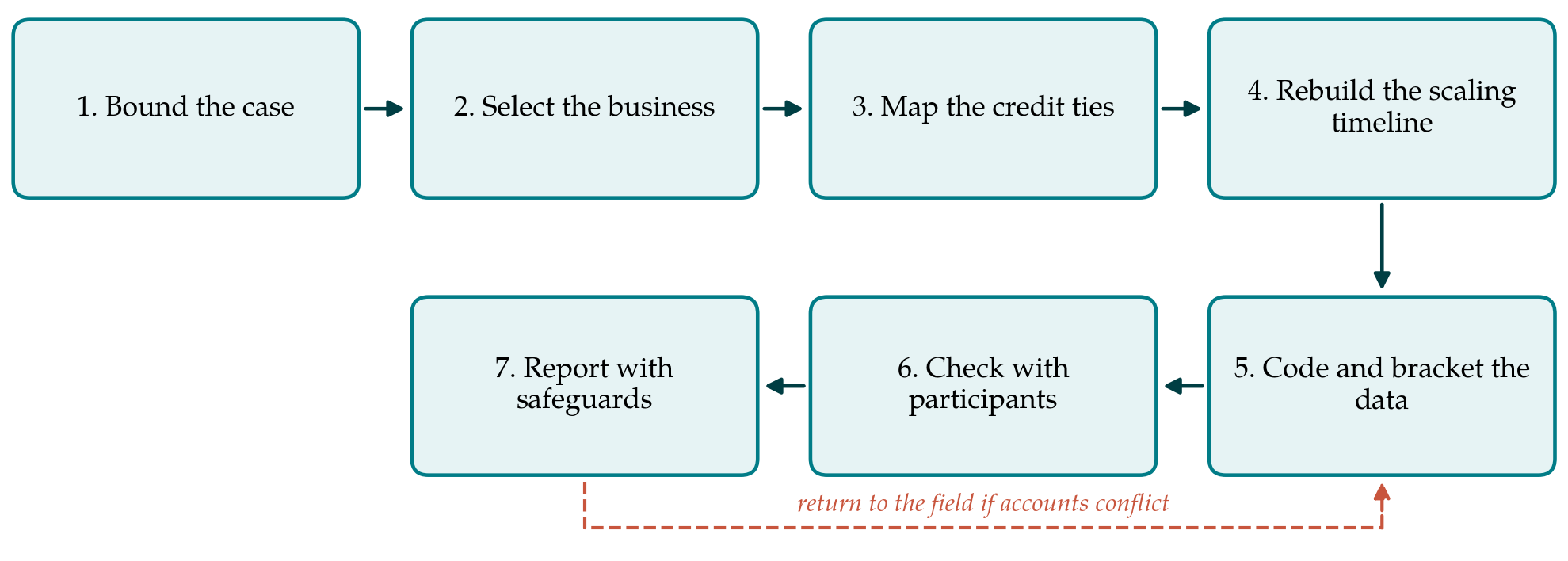
The design is a single, longitudinal case study with embedded units of analysis. The case is one refugee-founded food business followed over a period of growth. The embedded units are the individual credit relationships the business has entered into. Figure 1 shows the seven steps and the point at which the researcher may need to return to the field. The steps are described in turn.
3.1. Step 1: Bound the case
The first task is to say what the case is and where it ends. The proposal is to define the business as the set of activities controlled by the founder or founding family, even where these are registered in another person's name, which is common when refugees cannot register in their own. Scaling is defined in advance as a sustained increase in at least one of outlets, employees or volume handled. The period of study runs from founding to the present, with prospective observation over at least one year so that the account does not rest wholly on recall.
3.2. Step 2: Select the business
A single case is justified when it is revelatory or unusually rich in the phenomenon of interest (Yin, 2018), and Eisenhardt (1989) recommends choosing cases on theoretical and not statistical grounds. The business sought is one that has clearly grown, has relied mainly on informal finance, and whose owner is willing to open the books, such as they are. Access is best approached through people the owner already trusts, for example a traders' association or a community organisation, and the selection criteria and the cases considered and set aside should be recorded.
3.3. Step 3: Map the credit ties
This step produces the core data. Two instruments are proposed. The first is a financial diary adapted from the method of Collins et al. (2009), in which a researcher visits at regular intervals and records every inflow and outflow of money, goods on credit and repayments since the last visit. The second is a name-generator interview: for each stage of growth the owner is asked who provided money, goods or guarantees, on what terms, and how the two parties are connected. With consent, lenders, suppliers and group members are then interviewed themselves. Table 1 lists the sources of evidence and what each is for.
| Source | What it is used for | Main threat | Safeguard |
|---|---|---|---|
| Founder interviews | History, decisions, meaning of obligations | Hindsight and self-presentation | Repeat interviews; compare with others |
| Financial diary | Current flows of cash and credit | Under-reporting of sensitive flows | Trust built over repeated visits |
| Lender and supplier interviews | Terms and enforcement as creditors see them | Reluctance to disclose | Separate consent; no cross-reporting |
| Savings group observation | Rules, sanctions, order of payouts | Observer changes behaviour | Attend several cycles |
| Documents and ledgers | Dates, amounts, registrations, leases | Incomplete or informal records | Treat as partial corroboration |
| Staff and family interviews | How growth was experienced inside the firm | Loyalty to the owner | Private setting; anonymity |
3.4. Step 4: Rebuild the scaling timeline
From the interviews and documents the researcher builds a dated chronology of the business: each new outlet, product line, hire, move of premises and crisis, and beside each event the financing that preceded it. Life-history calendars anchored on events the owner remembers well, such as arrival in the host country, a birth or a change of premises, help to fix dates. The chronology is a working document, revised as accounts from different people are compared, and it becomes the backbone of the analysis.
3.5. Step 5: Code and bracket the data
Two analytic procedures are combined. Interview and observation material is coded inductively, moving from participants' own terms to researcher themes and then to aggregate dimensions, in the manner set out by Gioia et al. (2013). The chronology is analysed by temporal bracketing, one of the strategies Langley (1999) describes for process data: the history is divided into phases and the analyst asks how the credit arrangements of one phase shaped the options open in the next. Displays that set each credit tie against each phase, of the kind recommended by Miles et al. (2014), make the comparison explicit and keep the chain of evidence visible.
3.6. Step 6: Check with participants
A draft narrative is taken back to the founder and, where appropriate, to other participants, to correct errors of fact and to hear objections to the interpretation. Agreement is not required, but disagreements are recorded. Where accounts of the same loan or the same event conflict in ways that matter, the researcher returns to the field before settling the chronology.
3.7. Step 7: Report with safeguards
A single named business in a small community is easily recognised. The report should alter or withhold identifying details such as the precise location, the dish or product for which the business is known and the nationality of minor participants, and should say that it has done so. Amounts can be reported as ratios or ranges. The aim is a reader who can follow the mechanism without being able to find the shop.
4. Ethics and Safeguards
Research with refugees carries what Jacobsen and Landau (2003) called a dual imperative: it must be academically sound and it must not harm people whose position is precarious. In this study the risks are specific. Information about unregistered trading, cross-border transfers or debts could expose participants to officials, creditors or rivals. Lenders may be embarrassed or endangered if the terms they offer become known. Mackenzie et al. (2007) argue that consent in such settings should be negotiated repeatedly and that research should offer participants something in return.
The design therefore provides for consent to be confirmed at each visit, for separate consent from every creditor interviewed, and for a rule that nothing one participant says is repeated to another. Notes are kept under codes, with the key stored apart. The study would need approval from an ethics committee and from the relevant national authorities before any fieldwork begins, and the researcher should agree with the founder in advance what will be given back, for example a plain-language summary of the firm's finances.
5. Limitations and What Remains to Be Shown
A single case cannot show how common a pattern is. Its contribution is analytic: it can establish that a mechanism exists and specify the conditions under which it operated (Yin, 2018). Choosing a business that has grown also means that nothing is learned directly about those that tried and did not, and a later comparative study with a matched business that stayed small would be the natural extension. Recall of loans taken years ago is fallible, and people have reasons to understate what they owe and to whom.
Because the design has not been applied, several practical matters remain open. It is not yet known whether owners will sustain a financial diary for a year, whether creditors will agree to be interviewed, or how well the instruments work across languages and through interpreters. A first application should report on these points plainly, including what had to be changed in the field, so that others can judge the design and improve it.
6. Conclusion
Informal credit is the ordinary means by which refugee-founded food businesses in East Africa finance growth, and its workings are best seen up close and over time. The design proposed here combines a longitudinal single case, a financial diary, network interviews with both borrower and lenders, and process analysis, with safeguards suited to a population at risk. It offers a way to learn how obligations accumulate as a business scales and when the ties that made growth possible begin to constrain it. Whether the design delivers that understanding is for a first study to show.
Conflict of interest
To be declared by the author(s) before publication.
Funding
To be declared by the author(s) before publication.