1. Introduction
Withania somnifera (L.) Dunal, a small shrub of the Solanaceae, has been used in Ayurveda for centuries as a rasayana, a class of preparations taken to restore vigour and resistance to illness. Its root, ashwagandha, has moved in two decades from the Ayurvedic dispensary to supermarket shelves, where it is sold in capsules and gummies with claims about stress, sleep and mood. Reviews written before that commercial expansion already described a broad range of pharmacological actions (Mishra et al., 2000; Kulkarni and Dhir, 2008).
Stress-related conditions are a natural market for such a product. Chronic activation of the stress response carries a physiological cost, described by McEwen (1998) as allostatic load, and complaints of persistent stress, anxiety and insomnia are common and often undertreated. People who are reluctant to take benzodiazepines or antidepressants look for alternatives, and the label "adaptogen" suggests a substance that helps the body cope without sedating it.
This article reviews what is known about the withanolides in that setting. It asks three questions: what these compounds are and how products differ in their content, what evidence supports the proposed mechanisms and the clinical claims, and what is known about harm. It gives no dosing recommendations.
2. Scope and Approach
This is a narrative review of the published literature. It draws on phytochemical and pharmacological studies, randomized controlled trials in adults with stress or anxiety, earlier systematic reviews and published reports of adverse events. No formal search protocol or quantitative synthesis was undertaken, and the selection reflects the author's judgement of which sources are most informative. Trials in other indications, such as athletic performance or male fertility, are left aside except where they bear on safety.
3. Chemistry of the Withanolides
Withanolides are C28 steroids built on an ergostane skeleton in which the side chain is oxidized at C-22 and C-26 to form a six-membered lactone. Several hundred have been described from the Solanaceae. In W. somnifera the best known are withaferin A, withanolide A, withanolide D and withanone, together with glycosylated forms: the withanosides and the sitoindosides (Mirjalili et al., 2009). Withaferin A carries an α,β-unsaturated ketone in ring A and a 5β,6β-epoxide, features that make it chemically reactive toward protein thiols.
Composition varies with plant part, chemotype, cultivation and extraction. Leaves are generally richer in withaferin A than roots, whereas classical Ayurvedic use and most pharmacopoeial monographs concern the root. Commercial extracts differ: some are made from root alone, others from root and leaf, with water, aqueous alcohol or other solvents, and they are standardized to different total withanolide contents measured by different methods. Two products labelled with the same percentage of withanolides are therefore not necessarily equivalent, a point that complicates every comparison between trials.
4. Proposed Mechanisms in Stress
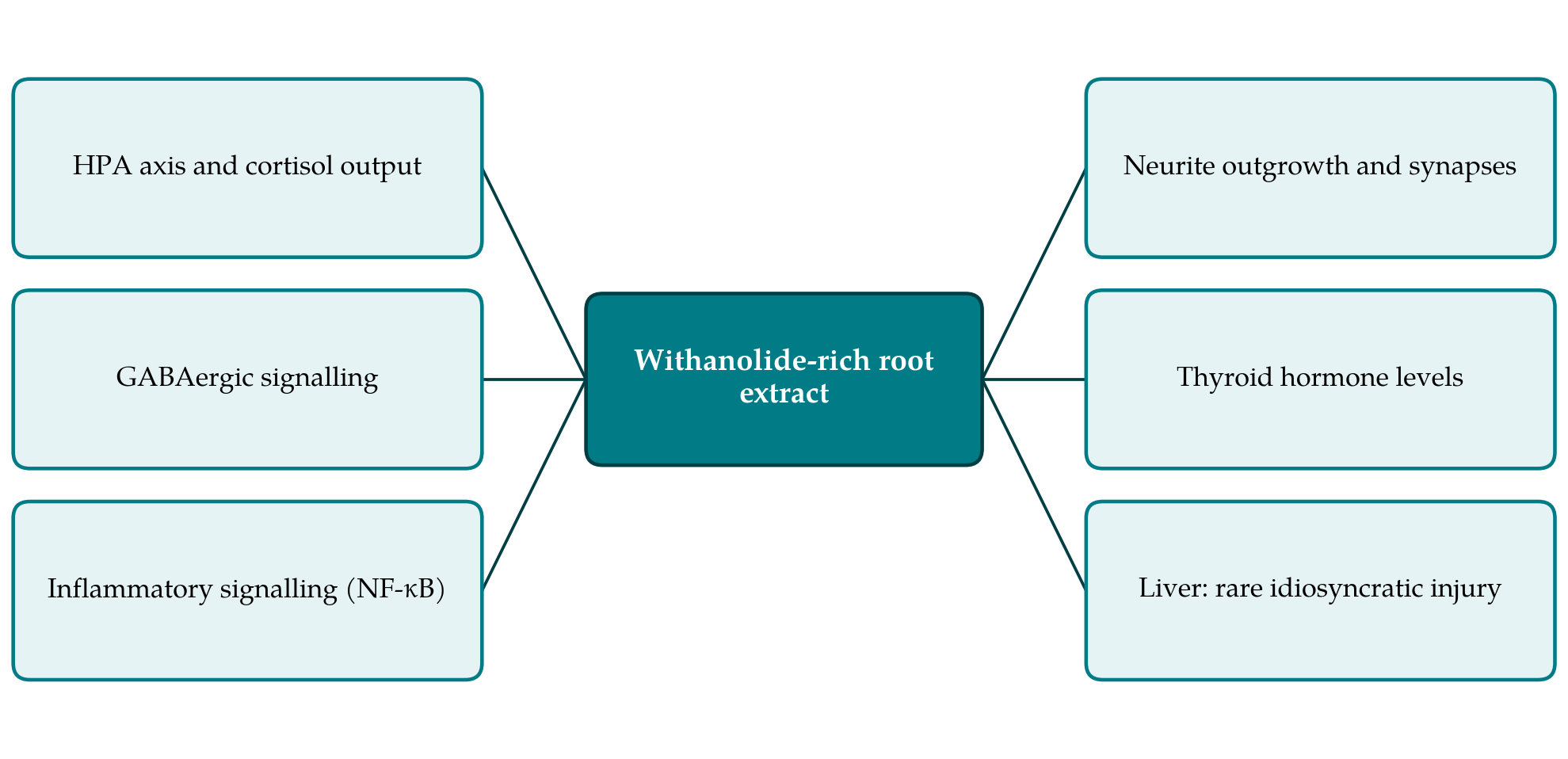
The term adaptogen was introduced in Soviet pharmacology for substances that raise non-specific resistance to stressors while having a normalizing action and little toxicity (Brekhman and Dardymov, 1969). Later work has tried to give the concept a molecular footing in stress-response signalling (Panossian and Wikman, 2010). For ashwagandha the mechanisms proposed fall into four groups, shown with the main safety signals in Figure 1.
4.1. The hypothalamic-pituitary-adrenal axis
In rats exposed to chronic unpredictable footshock, a standardized root extract attenuated a range of stress-induced changes, including raised plasma corticosterone, glucose intolerance, gastric ulceration and behavioural depression (Bhattacharya and Muruganandam, 2003). Human trials have used serum or salivary cortisol as a secondary outcome and have mostly reported reductions relative to placebo (Chandrasekhar et al., 2012; Lopresti et al., 2019). How withanolides would act on the axis is not established. A single morning cortisol value is also a crude index of axis function, since secretion is pulsatile and follows a marked circadian rhythm.
4.2. GABAergic activity
An anxiolytic and sleep-promoting herb invites comparison with benzodiazepines. Early binding studies suggested that root extract had GABA-mimetic activity at the GABAA receptor complex (Mehta et al., 1991). Electrophysiological work on receptors expressed in oocytes confirmed that an aqueous root extract activates GABAA and, more potently, GABAρ receptors, but found that withaferin A and withanolide A did not account for the effect (Candelario et al., 2015). In mice, the sleep-inducing activity of a leaf extract was traced to triethylene glycol and not to withanolides (Kaushik et al., 2017). These findings matter, because they imply that the constituents used to standardize products may not be the ones responsible for calming effects.
4.3. Inflammation and neuronal plasticity
Withaferin A inhibits activation of the transcription factor NF-κB by acting on IκB kinase β (Kaileh et al., 2007), and it is known to bind covalently to several other proteins. Anti-inflammatory activity is plausible on this basis, but the same reactivity underlies its cytotoxicity, which is why it is studied as an anticancer lead. Withanolide A, by contrast, promoted neurite regeneration and synaptic reconstruction in damaged cortical neurons and in a mouse model (Kuboyama et al., 2005). Glycowithanolide fractions showed anxiolytic and antidepressant-like effects in standard rodent tests (Bhattacharya et al., 2000). Whether concentrations reached in human brain after oral supplements are sufficient for any of these actions is unknown.
5. Pharmacokinetics
Knowledge of absorption and disposition is thin. In mice given an aqueous root extract by mouth, withaferin A and withanolide A appeared in plasma quickly and were cleared within hours (Patil et al., 2013). Published estimates of oral bioavailability for individual withanolides differ between laboratories and species, and the glycosides may be hydrolysed in the gut before absorption. Few studies have measured withanolides in human plasma after commercial products, and exposure has not been linked to effect in any trial. Without such data it is impossible to say whether two extracts deliver comparable amounts of the same compounds, or to anticipate interactions with medicines.
6. Clinical Evidence in Stress and Anxiety
Table 1 summarizes the kinds of clinical evidence available. The most cited trial randomized adults with a history of chronic stress to a concentrated root extract or placebo for about two months and reported lower scores on stress questionnaires and lower serum cortisol in the active group (Chandrasekhar et al., 2012). Later placebo-controlled trials with other root or root-and-leaf extracts reported similar directions of effect on perceived stress, anxiety ratings and sleep (Lopresti et al., 2019; Salve et al., 2019; Langade et al., 2019). Where ashwagandha has been tested as one element of a multi-component naturopathic programme, any benefit cannot be attributed to the herb.
| Evidence type | What it shows | Main limitation | Representative sources |
|---|---|---|---|
| Rodent stress models | Extract blunts endocrine and behavioural effects of chronic stress | Doses and extracts differ from human products | Bhattacharya and Muruganandam, 2003 |
| Receptor and cell studies | GABA receptor activation; NF-κB inhibition; neurite outgrowth | Active constituent often not a withanolide; concentrations uncertain | Candelario et al., 2015; Kaileh et al., 2007 |
| Placebo-controlled trials | Lower stress and anxiety scores, lower cortisol | Small, short, varied products, sponsor involvement | Chandrasekhar et al., 2012; Lopresti et al., 2019 |
| Systematic reviews | Consistent direction of benefit | Heterogeneity and risk of bias limit certainty | Pratte et al., 2014; Akhgarjand et al., 2022 |
| Case series of harm | Liver injury after supplement use | No denominator; product quality variable | Björnsson et al., 2020 |
Systematic reviews have reached cautious conclusions. Pratte et al. (2014) found that every trial they included favoured ashwagandha over the comparator, and judged the risk of bias to be unclear or high throughout. A later meta-analysis of randomized trials likewise reported reductions in anxiety and stress scores and rated the certainty of the evidence as low (Akhgarjand et al., 2022). A detailed narrative review of stress, anxiety, depression and insomnia reached a similar position (Speers et al., 2021).
Several weaknesses recur. Trials last weeks, whereas use by consumers may continue for years. Participants are mostly healthy adults with self-reported stress, recruited at a small number of sites, and few trials enrol patients with a diagnosed anxiety disorder. Outcomes are largely self-rated scales such as the Perceived Stress Scale (Cohen et al., 1983), which are sensitive to expectation. Many trials are funded by the manufacturer of the extract tested. Above all, the products differ, so that pooled estimates describe a category and not a defined medicine. The evidence supports the statement that some root extracts probably reduce perceived stress over the short term. It does not establish efficacy in clinical anxiety disorders, and it does not show that withanolides are the responsible constituents.
7. Safety
In trials, adverse events have been infrequent, mild and similar in frequency to placebo, with drowsiness and gastrointestinal discomfort the most often mentioned, and a review of the clinical literature judged root preparations to be reasonably safe over the periods studied (Tandon and Yadav, 2020). Trials of this size and length cannot detect uncommon or delayed harms, and spontaneous reports have filled part of that gap.
Product quality is a separate source of uncertainty. In most jurisdictions botanical supplements are not held to the manufacturing and labelling standards that apply to medicines. For ashwagandha the particular concerns are leaf material in products sold as root, which has been reported and which raises the content of withaferin A, and wide variation in withanolide levels between brands. An adverse event reported with one product cannot be assumed to apply to all, and a reassuring trial of one extract says little about another.
The clearest signal concerns the liver. A case series from Iceland and the United States described patients who developed cholestatic or mixed liver injury, with jaundice and itching, some weeks after starting ashwagandha supplements; the injury resolved after the product was stopped (Björnsson et al., 2020). The mechanism is unknown, the reaction appears to be rare and idiosyncratic, and contamination or adulteration cannot always be excluded. Even so, the consistency of the clinical picture across reports has led clinicians to regard ashwagandha as a credible cause of herb-induced liver injury.
Thyroid effects form a second signal. In a placebo-controlled trial in subclinical hypothyroidism, root extract raised serum thyroid hormone concentrations (Sharma et al., 2018), which is presented as a benefit in that population and implies a risk for people with hyperthyroidism or those taking thyroid hormone. Additive sedation with central nervous system depressants is plausible given the GABAergic findings. Safety in pregnancy and lactation has not been established, and traditional and regulatory sources advise against use. Regulators in some European countries have taken a restrictive position on ashwagandha in food supplements, citing these uncertainties.
8. Gaps and Directions for Research
The most basic gap is chemical. Trials should report a full chromatographic characterisation of the product, including individual withanolides and glycosides, so that results can be tied to composition. Human pharmacokinetic studies with validated assays are needed for the main commercial extracts. Comparative work should test whether withanolide-rich and withanolide-poor fractions differ in effect, since the receptor studies suggest that other constituents contribute.
Clinically, independent trials of adequate size in defined patient groups, with active comparators and follow-up of six months or more, would show whether early effects persist and how they compare with established treatments. Liver enzymes and thyroid function should be measured systematically, and cases of suspected injury should be reported with product analysis. Until such data exist, claims for withanolides in stress-related disorders run ahead of the evidence.
9. Conclusion
Ashwagandha root extracts have a plausible pharmacology and a body of small trials pointing toward short-term reductions in perceived stress and anxiety. The withanolides are the best characterised constituents and the usual basis of standardization, yet their role in the calming effects is unproven and for some mechanisms doubtful. Short-term tolerability is good, while rare liver injury and effects on thyroid hormones are documented. For clinicians and consumers the reasonable position is one of qualified interest: the herb is neither an established treatment for anxiety disorders nor free of risk.
Conflict of interest
To be declared by the author(s) before publication.
Funding
To be declared by the author(s) before publication.