1. Introduction
The Indian Ocean is the oldest of the long-distance maritime trading worlds, and its commerce has been studied for a long time as a history of high-value cargoes. Pepper, cinnamon, silk, gold and silver dominate the classic accounts, as do the merchant princes of Surat or Aden and the European companies that arrived after 1498. That emphasis reflects the sources. Customs registers and company ledgers record what was taxed and what was profitable, and a bale of fine muslin leaves more ink behind it than a crate of cooking pots.
A different question has gained ground since the 1980s: what did people in the port towns actually wear, eat from, cook in and live among, and how much of it came across the sea? The shift owes something to Chaudhuri (1985), who treated the ocean as a single field of exchange, and more to his later attempt to write a history of food, clothing and housing across the same space (Chaudhuri, 1990). It owes as much to archaeology, which recovers what was broken and thrown away, and to an anthropology of commodities that asks how things acquire value as they move between settings (Appadurai, 1986).
This article reviews what that literature says about everyday material culture in the port towns of the western and eastern Indian Ocean before 1800. The date is a convention. It marks the point after which steam, industrial cloth and colonial rule changed the terms of exchange, and it is the horizon at which most of the standard syntheses close.
2. Scope and Approach
The review is narrative. It draws on monographs, edited volumes and journal articles that are widely cited in Indian Ocean history and archaeology, read for what they establish about ordinary consumption. No claim is made to a complete or systematic search. The geographical frame follows the reach of the monsoon: the East African coast, the Red Sea and Gulf, western and southern India, and the ports of the Bay of Bengal and island Southeast Asia. The general synthesis by Pearson (2003) provides the framework. "Everyday" is used loosely, for goods met in the routine of a household, whether cheap or dear.
3. The Monsoon as a Structure of Exchange
The physical basis of the system is simple and has been understood since antiquity. Between about June and September the wind over the Arabian Sea and the Bay of Bengal blows from the southwest; from about November to March it reverses and blows from the northeast. A ship could cross open water in one season and return in the next. The Periplus Maris Erythraei, a Greek merchant's guide of the first century CE, already describes direct sailings from the mouth of the Red Sea to the ports of western India and lists what was bought and sold at each (Casson, 1989).
The reversal imposed a calendar on the towns. Vessels arrived together and left together, so that a port had a trading season and a dead season, and crews and merchants waited for months in places that were not their homes. Historians have drawn two consequences from this. One is that the towns became plural societies, with resident communities of foreigners, intermarriage and shared religious institutions (Sheriff, 2010; Ho, 2006). The other is that people on different shores often had more in common with one another than with their own hinterlands, an idea Pearson (2006) developed as "littoral society". Both bear on material culture, because goods followed people as well as markets.
Larger models place this seasonal traffic within chains of regional circuits that linked the Mediterranean to China well before the sixteenth century (Abu-Lughod, 1989). For the purposes of this review their main lesson is that few objects made the whole journey in one ship. Most passed through several hands and several ports, and were sorted, repacked and revalued at each.
4. Sources for the Everyday
Three kinds of evidence carry the subject, and each sees different things. Table 1 summarises them. Excavation supplies durable materials in quantity and in context: sherds of imported and local pottery, glass, beads, coins, and the plans of houses. Work at Shanga in the Lamu archipelago, where a sequence beginning in the eighth century was dug to its base, showed how a settlement of timber and thatch acquired stone buildings and a growing share of imported ceramics over several centuries (Horton, 1996). At the Egyptian Red Sea ports, Indian cooking wares found beside Roman amphorae point to resident sailors or merchants from the subcontinent and not only to their cargoes (Tomber, 2008). Shipwrecks add sealed cargoes: the ninth-century vessel found off Belitung in Indonesia carried Chinese ceramics packed in bulk for western Asian buyers (Flecker, 2001).
| Evidence | What it preserves | Main limits | Representative studies |
|---|---|---|---|
| Settlement excavation | Ceramics, glass, beads, house plans, food remains | Cloth, wood and foodstuffs rarely survive | Horton, 1996; Wynne-Jones, 2016 |
| Shipwreck cargoes | Goods in transit, packing, quantities | Few wrecks; one voyage each | Flecker, 2001 |
| Objects in collections | Textiles, porcelain and metalwork kept as heirlooms | Find context often lost; fine pieces favoured | Guy, 1998; Barnes, 1997 |
| Merchant letters | Personal orders, gifts, household needs | Survive for a few communities only | Goitein and Friedman, 2008 |
| Port and company records | Volumes, prices, named varieties of cloth | Record taxed and profitable trade | Das Gupta, 1979 |
| Travel and pilot texts | Descriptions of markets, dress and diet | Outsider observers; set-piece description | Casson, 1989 |
Surviving objects are the second source. Textiles almost never last in tropical soil, so the history of Indian cloth abroad depends heavily on pieces preserved elsewhere: block-printed cotton fragments recovered from dry Egyptian sites and now in museum collections (Barnes, 1997), and trade cloths kept for generations as heirlooms and ritual objects in Indonesia (Guy, 1998). Such pieces show designs, dyes and wear, though seldom who owned them.
Documents are the third. The letters of Jewish merchants trading between Egypt, Aden and the Malabar coast in the eleventh and twelfth centuries, preserved in the Cairo Geniza, are unusual in that they mix business with domestic matters: alongside consignments of pepper and iron they mention kitchenware, clothing, paper and foodstuffs sent as gifts or personal orders (Goitein and Friedman, 2008). The same archive underlies the reconstruction of Aden as a working port with its customs house, warehouses and provisioning trades (Margariti, 2007). For later centuries the Portuguese, Dutch and English records are abundant, and they have been used to follow Asian merchants and markets as well as European ones (Das Gupta, 1979; Subrahmanyam, 1990).
5. Things in Use
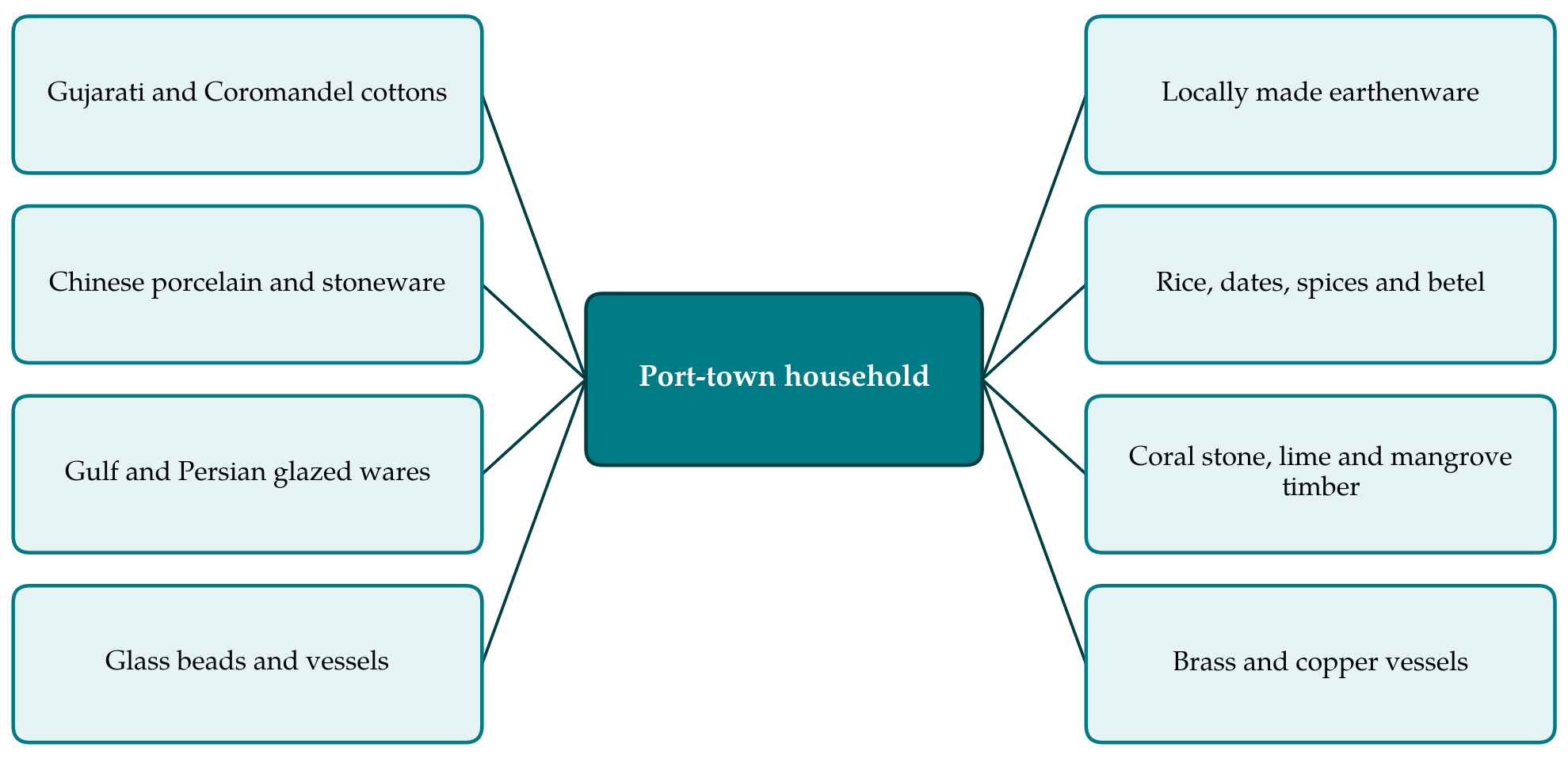
What the three sources reveal can be grouped by the part of domestic life it concerns. Figure 1 sketches the range of goods, imported and local, that the literature places in a port-town household; the subsections below take them in turn.
5.1. Cloth and dress
Cotton cloth from Gujarat, the Coromandel coast and Bengal was the most widely distributed manufactured good in the ocean. It served as clothing, as furnishing, as a store of wealth and in many places as a medium of payment. The scholarship stresses variety: producers supplied named types for named markets, in the colours, sizes and patterns each preferred (Riello and Roy, 2009; Riello, 2013). In Southeast Asia cloth was the leading import, and local dress combined it with regional weaving (Reid, 1988). On the Mozambique coast Gujarati merchants relayed African preferences back to weaving districts, so that consumer taste in one continent directed production in another (Machado, 2014). Cloth was thus shaped by its buyers as much as by its makers.
5.2. Ceramics, glass and the table
Pottery is the best-documented class of object because it survives. Assemblages from the Swahili coast are typically dominated by locally made earthenware used for cooking and storage, with a smaller share of glazed imports: wares from the Gulf and Iran in the earlier centuries, Chinese stonewares and porcelain in growing quantity later (Horton and Middleton, 2000). Chinese export ceramics reached every shore of the ocean, and blue-and-white porcelain in particular became a common possession of coastal elites. Imports were not simply tableware. Bowls were set into the walls of mosques and tombs and displayed in the plastered wall niches of stone houses, and open bowls suited communal eating from a shared dish. Fleisher (2010) links their adoption to feasting as a way of building standing in the towns. Glass beads, traded in very large numbers, were worn across all social ranks.
5.3. Food and the kitchen
Bulk foodstuffs moved by sea more than older accounts allowed. Rice was shipped from surplus regions to towns that could not feed themselves, dates travelled from the Gulf to India and Africa, and dried fish, salt, sugar and cooking fats filled the holds of small coasting craft (Chaudhuri, 1985). Betel and areca, chewed from East Africa to the Philippines, required their own sets of boxes and cutters (Reid, 1988). Large stoneware jars served as shipboard containers for water and provisions and then had long second lives in houses. The evidence here is weaker than for ceramics, since plant and animal remains are recovered only where excavators have sieved and floated deposits for them.
5.4. The house and its furnishings
Building itself drew on the trade. Coral stone and lime mortar characterise the grander houses of the East African coast, and mangrove poles cut there were exported to the timber-poor Gulf as roofing (Sheriff, 2010). Inside, furnishing was sparse by later standards and consisted largely of textiles: mats, carpets, cushions and hangings, with chests and metal vessels as the chief movable goods (Chaudhuri, 1990). Studies of Swahili towns read the stone house as a statement of creditworthiness and permanence directed at visiting merchants as much as at neighbours (Horton and Middleton, 2000).
6. Port-Town Society and the Meaning of Imports
The interpretive question running through this work is what imported things meant to those who used them. An older view treated them as markers of foreign influence, so that a town with Persian bowls and Indian cloth was taken to be a colony of Persians or Indians. Archaeologists of the Swahili coast have largely abandoned that reading. Wynne-Jones (2016) argues that objects were active in making coastal identities: imports were absorbed into local practices of hospitality, piety and display, and their value lay in what was done with them. The approach follows the proposal that commodities have social lives and change meaning as they change hands (Appadurai, 1986).
A related theme is the agency of consumers. The textile literature shows that Asian and African buyers were exacting, and that merchants who misjudged a market were left with unsaleable stock (Machado, 2014; Riello, 2013). This qualifies any picture of port towns as passive recipients of whatever the monsoon brought. It also complicates the place of Europeans before 1800, who for most of the period entered an established commerce as one group of carriers among many and bought and sold the same everyday goods as their competitors (Subrahmanyam, 1990).
7. Gaps and Future Work
Four weaknesses recur. The first is the imbalance between durable and perishable goods. Cloth and food were the largest trades by volume and are the least visible in the ground, so that ceramic evidence carries more interpretive weight than its economic importance warrants. The second is social coverage. Stone houses, fine porcelain and merchant correspondence all belong to the better-off, and the households of labourers, sailors, fishers and enslaved people, who made up much of any port's population, are thinly represented.
The third is geography. The East African coast and parts of the Gulf and Red Sea have been excavated with questions about consumption in mind; many South Asian and Southeast Asian ports lie under living cities and are known mainly from texts. The fourth is method. Historians and archaeologists still tend to write separately, and few studies set a documentary series beside an excavated sequence for the same town. Closer joint work, wider use of archaeobotanical and residue analysis, and attention to smaller and poorer settlements are the directions most often recommended in the literature reviewed here.
8. Conclusion
The scholarship of the past four decades has shown that the monsoon trade was a trade in ordinary things as much as in luxuries, and that port-town households from Kilwa to Java furnished, clothed and fed themselves partly from across the sea. It has also shown that those households chose, adapted and gave their own meanings to what they acquired. The picture remains clearest for durable goods and wealthier residents. Filling in the rest will depend on evidence that is harder to recover and on closer collaboration between the disciplines that study it.
Conflict of interest
To be declared by the author(s) before publication.
Funding
To be declared by the author(s) before publication.