1. Introduction
Disputes between separated parents over where a child will live and how time will be shared are poorly suited to adversarial trial. The parties must go on dealing with each other for years, the court's order governs conduct that no court can supervise, and the legal standard, the best interests of the child, leaves wide room for disagreement. Mnookin and Kornhauser (1979) observed long ago that most such disputes are settled by the parents themselves, bargaining in the shadow of the law. Mediation offers a structured setting for that bargaining, and courts have adopted it widely, often by way of a pilot attached to a single court centre.
Pilots are meant to produce evidence, and frequently they do not. A typical closing report gives the proportion of mediated cases that settled and the proportion of parents who said they were satisfied. Neither figure has a comparison, and both are taken at the moment when goodwill is highest. This article proposes a stronger design. It is addressed to court administrators, mediators and researchers planning a pilot, and it describes what should be decided before the first family is referred. Nothing here reports the results of an actual programme.
2. Background
The research base for custody mediation is more substantial than for most court reforms. Early longitudinal work in the United States compared mediating and litigating families over time (Pearson and Thoennes, 1984). The best known study assigned families at random to mediation or to the ordinary adversarial route and followed them for twelve years; it found that parents without primary residence who had mediated remained more involved with their children (Emery et al., 2001). Reviews of the field report that mediation settles a majority of cases, that parents tend to rate it more favourably than litigation, and that evidence for lasting effects on children's adjustment is thinner (Kelly, 2004; Emery et al., 2005). More recent trials have tested variants that bring the child's perspective into the sessions (McIntosh et al., 2008; Ballard et al., 2013).
The same literature carries a warning. Grillo (1991) argued that mediation, particularly when mandatory, can disadvantage the party with less power and can pressure a parent who has been abused into negotiating face to face with the abuser. That critique changed practice: screening for intimate partner violence is now treated as a precondition of responsible mediation, and structured instruments exist for the purpose (Holtzworth-Munroe et al., 2010). An evaluation that ignored safety would miss the outcome on which critics and supporters most sharply disagree. There is, finally, the reason the dispute matters at all. Continuing conflict between parents is among the more consistent correlates of poorer adjustment in children after separation (Amato, 2001), so a pilot that produced agreements without reducing conflict would have achieved little.
3. The Proposed Design
The design has six components: a statement of programme logic, a comparison strategy, a set of outcomes, a measurement schedule, an analysis plan and a process evaluation. They are described in turn. All of them should be fixed in a written protocol before referrals begin, and the protocol should be lodged somewhere public.
3.1. Programme logic
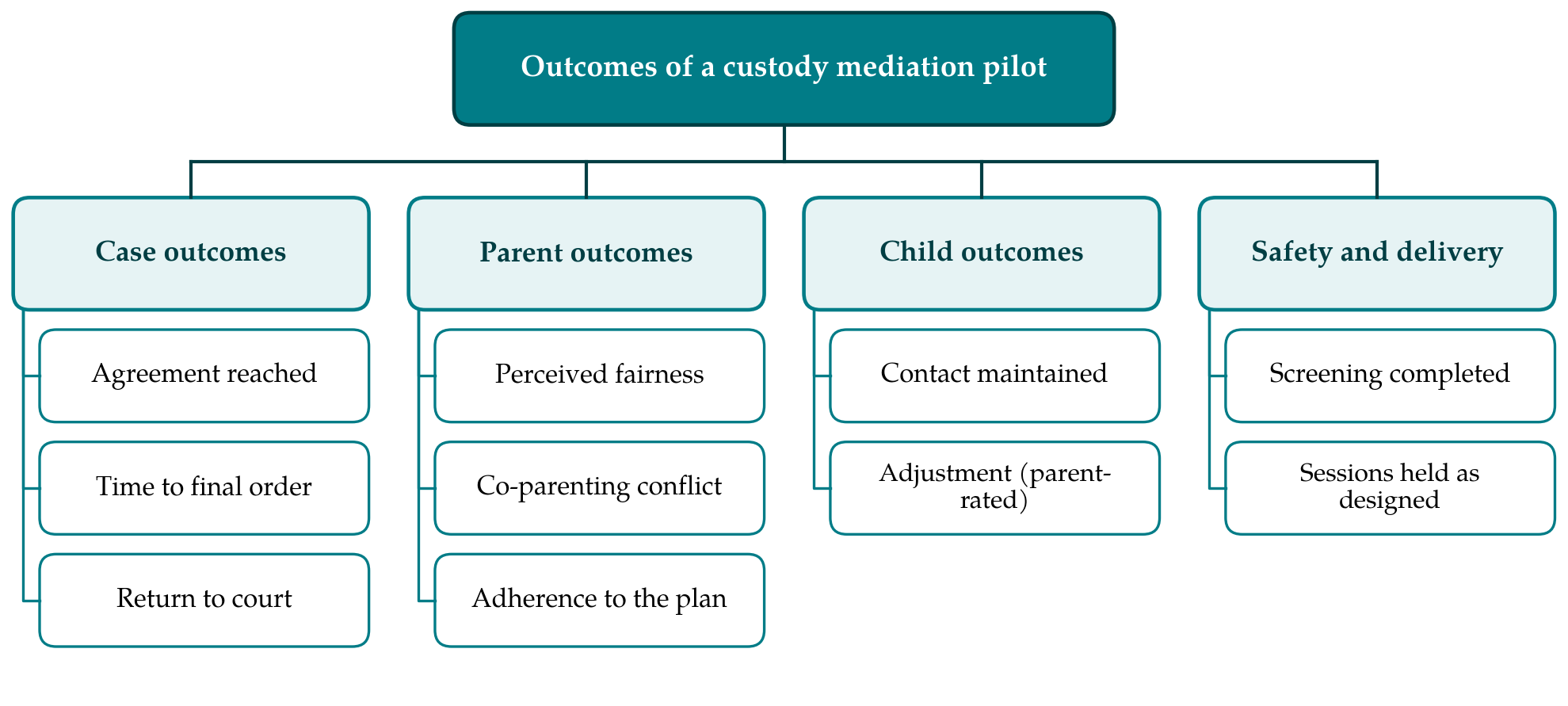
Evaluation starts from a clear account of what the programme is expected to do and by what route (Rossi et al., 2004). For custody mediation the usual reasoning runs as follows. Parents who work out their own arrangements with a neutral third party understand them better and feel more ownership of them; they therefore keep to them more faithfully and return to court less often; lower conflict and steadier contact follow, and children benefit. Each link is a hypothesis. Writing the chain down tells the evaluator what to measure and prevents a favourable result on an early link, such as the settlement rate, from being presented as proof of the whole. The outcome domains that follow from this logic are set out in Figure 1.
3.2. Comparison strategy
The central difficulty is selection. Parents who agree to mediate are likely to be less hostile to begin with, and they would settle more often under any procedure. The most credible answer is to randomise, and what can properly be randomised in a court is the offer. Eligible cases are assigned by lot either to receive an early invitation to mediation or to proceed in the usual way, with nobody compelled to mediate and nobody barred from arranging it privately. Greiner and Pattanayak (2012) used this structure to evaluate offers of legal representation and showed why the distinction between an offer and its use matters. Where the pilot has fewer places than eligible families, a lottery is also a fair way of allocating them.
Some courts will not be able to randomise. The fallback is a quasi-experimental comparison (Shadish et al., 2002). If the pilot is introduced at different court centres at different times, families filing just before and just after its introduction at each centre can be compared, with other centres serving as a check on general trends. Failing that, mediated cases may be matched to similar cases from a comparable court on characteristics recorded at filing, using the propensity score (Rosenbaum and Rubin, 1983). Matching adjusts only for what was recorded, and willingness to cooperate is rarely recorded. A report based on the fallback should say so prominently.
3.3. Outcomes and instruments
Four groups of outcome are proposed. Case outcomes come from the court file: whether a full or partial agreement was reached, the time from filing to final order, the number of hearings, and whether either parent later applied to vary or enforce the order. Parent outcomes come from short questionnaires: perceived fairness of the process, the level of conflict in co-parenting, and how closely the agreed arrangements are followed. Child outcomes are the hardest to obtain. The proposal is to record whether contact with both parents is continuing and to ask each parent to complete a brief validated screening measure of the child's adjustment, such as the Strengths and Difficulties Questionnaire (Goodman, 1997). Direct interviews with children are not proposed for a routine pilot, though the trials of child-inclusive practice show that they can be done with proper safeguards (McIntosh et al., 2008). The fourth group concerns safety and delivery and is discussed below.
3.4. Measurement schedule
Outcomes measured only at the close of mediation are of limited value, since the question is whether arrangements last. Table 1 sets out a schedule with five points. The baseline measures are taken before assignment so that the groups can be shown to be alike. Follow-up at about six and eighteen months after the final order is the minimum needed to observe returns to court, and the court file can be checked again later at almost no cost. Parents in both groups are approached in the same way and at the same intervals.
| Point | Source | What is recorded | Purpose |
|---|---|---|---|
| Filing (baseline) | Court file; intake form | Family circumstances, issues in dispute, prior orders | Check that groups are comparable |
| Intake screening | Trained screener | Structured violence and coercion screen; decision taken | Safety; eligibility |
| End of mediation or first hearing | Mediator log; parents | Sessions held, agreement, perceived fairness | Delivery and immediate outcomes |
| About six months after final order | Parents; court file | Conflict, adherence, contact, child adjustment | Short-term durability |
| About eighteen months after final order | Parents; court file | Same measures; applications to vary or enforce | Longer-term durability |
| Later file check | Court file only | Any further proceedings | Low-cost long follow-up |
3.5. Analysis plan
The primary analysis compares all families assigned to the offer with all families assigned to the usual route, whether or not they mediated. This intention-to-treat comparison answers the question a court service actually faces, which is what happens when mediation is made available. A secondary analysis estimates the effect on those who took up mediation because it was offered, using assignment as an instrument for participation (Angrist et al., 1996). The primary outcome should be named in advance; return to court within eighteen months is a reasonable choice, being objective and available for every case. The number of families needed should be worked out beforehand from the smallest difference the court would regard as worth having, and the flow of cases through assignment, participation and follow-up should be reported in full, as the reporting standards for trials require (Schulz et al., 2010).
3.6. Process evaluation
An outcome comparison shows whether the pilot made a difference and says nothing about why. A process evaluation running beside it records what was delivered: how many sessions took place, how long after filing, by mediators with what training, following what model, and how many parents declined or withdrew and at what point. Guidance on complex interventions recommends examining implementation, mechanisms and context together (Moore et al., 2015). A modest version is within reach of any pilot: a standard log completed by mediators after each session, and interviews with a small number of parents, mediators, lawyers and judges about how the scheme worked in practice.
4. Fitting the Design to an Ordinary Court
Most of what the design requires is administrative. The lottery can be run by the registry from a sealed list prepared by someone outside the court. The case outcomes are already held in the file and need only a field that marks which group a case belongs to. The questionnaires are short enough to be completed on a telephone, and reminders can be sent by the same staff who send hearing notices, provided the answers go to the evaluators and not to the registry. The work that calls for outside help is the writing of the protocol, the calculation of numbers, and the analysis; a university department or an independent researcher can supply these at modest cost, and an arm's-length analyst also protects the court from the suspicion that it has marked its own work. What the design does demand of the court is patience, since the outcome that matters most cannot be known until eighteen months after the last family has its order.
5. Safeguards and Ethics
Every case should be screened for violence, coercion and fear before any offer of mediation is made, using a structured instrument such as the one described by Holtzworth-Munroe et al. (2010) and administered to each parent separately. Cases screened out are excluded from assignment and proceed to the court with the screening information available to it. For cases screened in, safety is monitored as an outcome: any new protective order or reported incident during follow-up is recorded for both groups. Parents must be told that research is taking place, that declining to take part in questionnaires has no effect on their case, and that what they say to researchers will not reach the judge. Independent ethical review should be sought before the pilot starts. The child's right to have his or her views considered in proceedings, recognised in Article 12 of the United Nations Convention on the Rights of the Child, should be reflected in how the mediation model itself is chosen.
6. Limitations and What Remains to Be Shown
This design has not been put into practice or validated in the present article, and several things could defeat it. A single court centre may see too few eligible cases to detect any but a large effect, in which case centres should pool their pilots or the evaluation should be presented as a feasibility exercise. Follow-up questionnaires lose families over time, and those lost are seldom typical; the reliance on court-file outcomes is partly a defence against this. Parent-rated measures of child adjustment are coloured by the parent's own state. Judges and lawyers may resist random assignment, and persuading them requires early consultation. Finally, a result obtained in one court with one group of mediators does not automatically transfer to another, which is why the process record matters.
7. Conclusion
A custody mediation pilot can be evaluated credibly without a large research budget if the evaluation is designed before the programme opens. Assigning the offer by lot, measuring outcomes that the court file already holds, following families past the final order, screening every case and recording what was delivered are each manageable steps. Together they would let a court say whether mediation reduced repeat litigation and conflict among the families it served, and whether it did so safely.
Conflict of interest
To be declared by the author(s) before publication.
Funding
To be declared by the author(s) before publication.