1. Introduction
The modern history of mobile robots in warehouses is usually dated from the goods-to-person systems in which low robots carry shelving pods to stationary pickers, described for a technical audience by Wurman et al. (2008). Those systems required a fenced floor laid out for the robots. The autonomous mobile robot, or AMR, that followed makes a different offer. It localises against the building itself using laser scanners or cameras, plans its own path around obstacles, and shares aisles with people and trucks. In principle it can be introduced into a working warehouse without rebuilding it.
That offer suits the mid-sized operator: a regional distribution centre or third-party logistics site with a single building, a warehouse management system of modest sophistication, a small engineering staff and a building that was not designed for automation. Such sites have seldom been able to afford the automated storage and retrieval systems surveyed by Roodbergen and Vis (2009). They are also the sites least equipped to absorb a difficult start.
This review asks what the published literature leads one to expect in the early phase of an AMR deployment at such a site. It reports no deployment of its own and presents no data. Its aim is to assemble, from several fields that rarely cite one another, the foreseeable ways in which the first months go badly.
2. Scope and Approach
The article is a narrative review. It draws on the principal surveys of warehouse design and robotised warehousing, on the literature on automated guided vehicle systems that preceded AMRs, on core texts in mobile robot navigation, on current safety standards, and on the human factors literature concerning automation. No systematic search was performed, and no claim of completeness is made. Publications that describe the commissioning of particular sites are scarce, so much of the argument proceeds by inference: a mechanism established in one field is applied to the circumstances of a mid-sized warehouse. Where this is done, the text says so. Trade press accounts and vendor material were not used as evidence.
3. What the Research Literature Covers
Research on warehouse operations is extensive. The standard reviews cover layout, storage assignment, batching, routing and zoning in manual order picking (de Koster et al., 2007; Gu et al., 2007), and more recent ones cover the requirements of e-commerce fulfilment and the robotised systems built to meet them (Boysen et al., 2019; Azadeh et al., 2019). For vehicle-based systems there is a long line of work on fleet sizing, dispatching, routing, deadlock handling and battery management, first for guided vehicles (Vis, 2006; Le-Anh and De Koster, 2006) and then for AMRs, for which Fragapane et al. (2021) provide a review and research agenda.
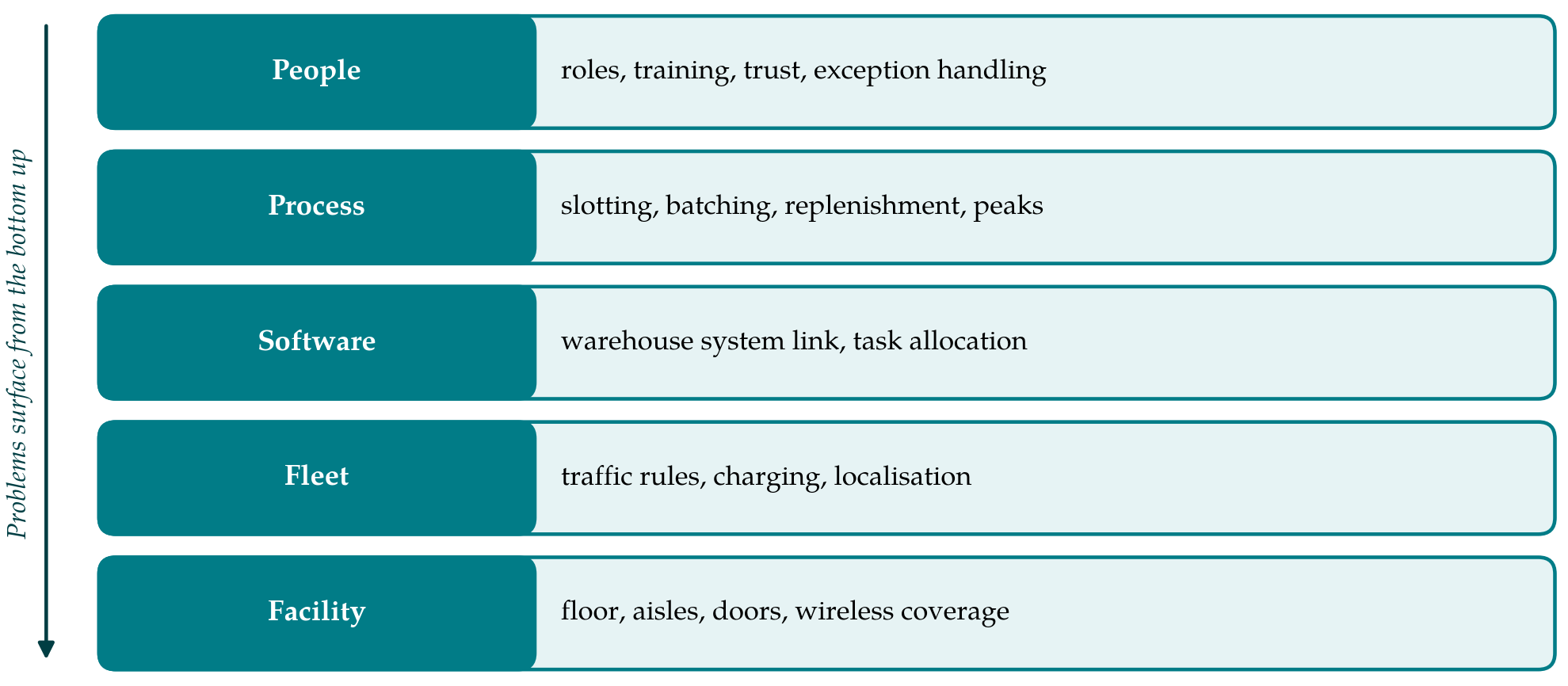
Two features of this literature limit its use for the present question. Most models describe a system in steady state, with stable demand, a known layout and a fleet that behaves as specified; performance estimates for robotic mobile fulfilment systems, for example, rest on queueing networks with such assumptions (Lamballais et al., 2017). And the systems modelled are mostly large and purpose-built. The ramp-up period, in which the layout is still being adjusted, staff are learning and the software interfaces are new, falls outside the frame. The sections below therefore read the literature for what it implies about that period. Figure 1 shows the five layers used to organise the discussion.
4. Early Problems by Layer
Problems in a lower layer tend to show themselves earlier and to mask those above. A fleet that keeps losing its position cannot reveal that the batching logic is poor. Table 1 summarises the typical early symptom and the underlying cause in each layer, with the sources on which the discussion relies.
| Layer | Typical early symptom | Underlying cause | Sources |
|---|---|---|---|
| Facility | Robots stop, slow or lose position in certain areas | Changing surroundings, poor floor, gaps in wireless coverage | Cadena et al., 2016 |
| Fleet | Queues and stand-offs at aisle ends and stations | Too many robots for the space; weak traffic rules | Le-Anh and De Koster, 2006; Sharon et al., 2015 |
| Fleet | Robots unavailable at peak hours | Charging policy not matched to the shift pattern | Fragapane et al., 2021 |
| Software | Tasks released late, duplicated or lost | Interface between warehouse system and fleet manager | VDA and VDMA, 2020 |
| Process | Throughput below the planning figure | Slotting, batching and replenishment left as for manual work | de Koster et al., 2007 |
| People | Staff work around or over-rely on the robots | Miscalibrated trust; unclear roles in exceptions | Lee and See, 2004 |
| Safety | Frequent protective stops in shared aisles | Safety fields meeting pedestrian and truck traffic | ISO, 2020 |
4.1. The facility
An AMR finds its position by matching what its sensors see against a stored map, using the probabilistic methods set out by Thrun et al. (2005). The method assumes that most of what the robot sees is permanent. A warehouse violates that assumption daily. Pallets staged on the floor, empty and full rack bays, parked trucks and stacked cartons change the scene between one pass and the next, and long aisles of uniform racking offer few distinctive features along their length. The survey of simultaneous localisation and mapping by Cadena et al. (2016) identifies robustness in dynamic and self-similar environments as an open problem, not a solved one. Glass partitions, stretch-wrapped pallets and polished floors add difficulties for optical sensors.
The building imposes more mundane limits as well. Floors in older warehouses have joints, slopes, drain covers and damaged patches that a forklift ignores and a small-wheeled robot does not. Fire doors, strip curtains and dock levellers interrupt routes. Wireless networks installed for handheld scanners may have dead spots between racks, and a robot that roams between access points can briefly lose contact with its fleet manager. None of this is exotic, and all of it can be surveyed before purchase, but a mid-sized operator is unlikely to have someone whose job that survey is.
4.2. The fleet
Local obstacle avoidance of the kind introduced by Fox et al. (1997) lets a single robot steer around a pallet. It does not coordinate many robots in a narrow aisle. The guided vehicle literature devoted much attention to deadlock, in which vehicles block one another so that none can proceed, and to the zoning and routing rules that prevent it (Vis, 2006; Le-Anh and De Koster, 2006). The formal version of the problem, multi-agent path finding, is computationally hard to solve optimally (Sharon et al., 2015), and practical fleet managers rely on heuristics and traffic rules that have to be configured for each site. In a warehouse with aisles wide enough for one robot and a person but not for two robots, the first weeks are apt to expose every gap in those rules.
Fleet size and charging interact with congestion. Adding robots raises throughput only until they begin to obstruct one another, a saturation effect that analytical models of robotic systems reproduce (Lamballais et al., 2017). Charging policy matters because a fleet dimensioned on average demand may find a large share of its robots at the chargers when the afternoon peak arrives. Fragapane et al. (2021) list battery management among the planning decisions that have received less attention than routing and dispatching.
4.3. The software integration
The robots take their work from a fleet manager, which in turn takes orders from the warehouse management system. The connection between the two is custom work in most projects. Tasks must be released in a form the fleet manager accepts, confirmations must flow back, and both systems must agree on what happens when a pick is short, a tote is full or a location is blocked. Interface standards such as VDA 5050, which defines the communication between vehicles and a master control, exist partly because of how much effort this otherwise consumes (VDA and VDMA, 2020). Open robotics middleware has lowered the cost of building robots (Macenski et al., 2022) without removing the integration burden at the business-system end. An operator whose warehouse system is old or heavily customised should expect this layer to take longer than the robots themselves.
4.4. The process
A manual warehouse embodies years of adaptation to human pickers: fast-moving items near the dispatch area, batch sizes that fit a trolley, replenishment timed to quiet periods. Robots change the economics of travel, which is the quantity these practices were tuned to minimise (de Koster et al., 2007; Bartholdi and Hackman, 2019). If slotting and batching are left unchanged, pickers may wait for robots in the densest zone while robots wait for pickers elsewhere. Planning figures supplied before purchase generally assume a tuned process, and the shortfall against them in the early weeks is often a process matter and not a robot fault. Seasonal peaks deserve separate thought, since Boysen et al. (2019) stress that e-commerce demand is volatile and a system commissioned in a quiet month has not been tested.
4.5. The people
Human factors research anticipated much of what warehouse staff experience with robots. Bainbridge (1983) observed that automation leaves the human with the tasks the designer could not automate, which are the irregular and difficult ones: here, the damaged carton, the mislabelled location, the robot stranded behind a pallet. Parasuraman and Riley (1997) distinguished misuse of automation through over-reliance from disuse through under-reliance, and Lee and See (2004) showed how both follow from trust that is poorly matched to the system's actual capability. A fleet that stops unpredictably in its first weeks teaches staff to distrust it, and that lesson can outlast the faults that caused it.
Acceptance also depends on whether staff see the system as useful and easy to work with, the two perceptions at the centre of the technology acceptance model (Davis, 1989), and on how the change is introduced among them (Rogers, 2003). In a mid-sized site there is rarely a dedicated robot technician. Someone from the existing team becomes the person who recovers stuck robots and adjusts maps, usually without formal time for it, and the quality of that arrangement shapes the ramp-up as much as any technical parameter.
4.6. Safety in shared aisles
Driverless trucks and mobile robots are subject to safety standards that require personnel detection and define the zones in which reduced clearances are permitted (ISO, 2020; RIA, 2020). The standards place duties on the integrator and the user as well as the manufacturer, including a risk assessment of the specific site. In practice a safety scanner cannot tell a careless colleague from a pallet corner, so busy shared aisles produce frequent protective stops, each costing a few seconds and collectively a good deal of throughput. Mixed traffic with manually driven forklifts is the hardest case, because the truck driver's view of a low robot is poor.
5. Why Mid-Sized Operators Are More Exposed
Three structural reasons emerge. Scale is the first: a large site can dedicate a zone, a shift and an engineering team to commissioning, while a mid-sized one must keep shipping from the same floor. Buildings are the second: the large installations in the research literature are designed around their robots, and the mid-sized deployment is fitted into what exists. Knowledge is the third. A small fleet generates little data, vendor support is remote, and the operator has no earlier project to learn from. Each of these makes the foreseeable problems above more likely to be met without preparation.
6. Gaps and Future Work
The clearest gap is empirical. Structured, independent accounts of AMR commissioning, recording what was planned, what occurred and how long recovery took, are almost absent from the scholarly literature, and without them the ordering of problems proposed here remains an inference. Models of the transient phase, in which fleet size, layout and staff proficiency all change together, would complement the steady-state models now available. Research on how localisation degrades in real warehouse clutter, on interoperability between fleets from different vendors, and on the work of the staff who supervise robots would also address needs that the surveyed literature identifies but does not meet.
7. Conclusion
Little about a troubled AMR start is mysterious. Navigation research predicts localisation trouble in changing, repetitive surroundings; vehicle-system research predicts congestion and deadlock; warehouse research predicts that an unchanged process will waste the robots; and human factors research predicts both distrust and over-reliance. What mid-sized operators lack is not the knowledge but its assembly in one place and the staff to act on it before the robots arrive. A site survey, a realistic integration schedule, a redesigned process and a named owner for exceptions follow directly from the literature reviewed here.
Conflict of interest
To be declared by the author(s) before publication.
Funding
To be declared by the author(s) before publication.