1. Introduction
Rice is eaten as a whole grain, and the texture of the cooked grain carries most of the weight in how a variety is judged. Consumers in different regions want different things: a soft, sticky japonica grain in north-east Asia, a firm and separate indica grain in much of South Asia, an intermediate texture in parts of South East Asia. The traits used to describe these preferences are apparent amylose content, gelatinisation temperature and gel consistency, and all three are physical consequences of how starch is assembled in the developing endosperm (Juliano, 1971; Nakamura, 2002).
The pathway behind them is well mapped. Granule-bound starch synthase I, encoded by the waxy locus, makes amylose. The soluble starch synthases, the branching enzymes and the debranching enzymes together determine the chain-length distribution of amylopectin, which sets the temperature at which the granule swells. Natural alleles at two loci do most of the work in breeding practice: the waxy locus for amylose and the starch synthase IIa locus, also called ALK, for gelatinisation temperature (Wang et al., 1995; Umemoto et al., 2002; Tian et al., 2009).
Working with those alleles by crossing is slow and imprecise. A desirable waxy allele sits in a donor background that also carries traits a breeder does not want, and several backcross generations are needed before the segment around the locus is small enough to ignore. Targeted mutagenesis offered a way around this, and the nuclease platforms were applied to rice soon after they became available (Shan et al., 2013). Nucleases, however, produce insertions and deletions, which are well suited to knocking a gene out and poorly suited to tuning it.
Base editors changed the calculation. A cytosine base editor fuses a cytidine deaminase to a Cas9 nickase and converts a C to a T within a narrow window of the protospacer without cutting both strands (Komor et al., 2016); an adenine base editor performs the A to G conversion using an evolved deoxyadenosine deaminase (Gaudelli et al., 2017). Both were shown to work in rice within a year of their description (Zong et al., 2017; Li et al., 2017). The prospect is a tool that writes defined point changes into quality genes in an elite background. This article reviews what the published work has shown so far, and what it has not.
2. Scope and Approach
This is a narrative review of the published literature rather than a systematic one. No count of records screened is reported and no formal inclusion criteria were applied. The aim is to draw together three bodies of work that are usually read separately: the genetics of rice starch quality, the behaviour of base editors in cereal cells, and the reported attempts to combine them. Primary research papers are cited where a specific claim rests on them, and standard reviews and textbook accounts are cited where the point is settled background. Work on rice is the focus, with results from wheat and maize mentioned only where they bear directly on how an editor behaves in a cereal endosperm or callus.
3. The Genetic Basis of Cooking Quality
Amylose is a largely linear glucan, amylopectin a branched one, and the ratio between them governs how a cooked grain behaves. High-amylose grains cook firm and dry and retrograde readily on cooling; low-amylose grains stay soft and cohesive. Apparent amylose content, measured by iodine binding in the classical assay, remains the routine screening trait in quality programmes (Juliano, 1971), although the figure it returns includes long amylopectin chains and therefore overstates true amylose.
The waxy locus explains most of the variation in that trait. Glutinous rice carries loss-of-function waxy alleles and accumulates almost no amylose (Sano, 1984). Among non-glutinous varieties the principal distinction is between the allele common in indica rice and the allele common in temperate japonica rice, which differ at the 5 prime splice site of the first intron. The japonica allele carries a G to T change at that position, splicing of the leader intron becomes inefficient, less mature transcript accumulates and amylose content falls (Wang et al., 1995). That single base is the reason a molecular change of the smallest possible size can shift a quality class.
Gelatinisation temperature is controlled chiefly by starch synthase IIa, which extends the short A chains of amylopectin into intermediate B1 chains. Varieties carrying the active enzyme build longer chains and gelatinise at a higher temperature; varieties carrying the weak alleles found in many japonica lines gelatinise lower (Umemoto et al., 2002). Combinations of waxy and starch synthase IIa alleles account for a large share of the eating quality differences among cultivated rices (Tian et al., 2009). Starch branching enzyme IIb acts on a different part of the problem: suppressing it lengthens amylopectin chains, raises resistant starch and changes the grain in ways relevant to nutrition rather than to texture alone (Butardo et al., 2011). Table 1 gathers these targets with the trait each affects.
| Locus | Gene product | Trait affected | Key source |
|---|---|---|---|
| Wx (waxy) | Granule-bound starch synthase I | Apparent amylose content, grain translucency | Sano, 1984 |
| Wx intron 1 | 5 prime splice site of the leader intron | Amount of mature transcript, hence amylose | Wang et al., 1995 |
| SSIIa / ALK | Soluble starch synthase IIa | Gelatinisation temperature, chain length | Umemoto et al., 2002 |
| SBEIIb | Starch branching enzyme IIb | Amylopectin branching, resistant starch | Butardo et al., 2011 |
| Combined Wx and SSIIa | Two enzymes acting in series | Most of the eating quality variation among cultivars | Tian et al., 2009 |
| Pathway as a whole | Synthases, branching and debranching enzymes | Granule architecture and cooking behaviour | Nakamura, 2002 |
4. How Base Editors Behave in Rice
A base editor is a Cas9 nickase carrying a deaminase domain and, in the cytosine editors, a uracil glycosylase inhibitor. The guide RNA positions the complex, the deaminase acts on single-stranded DNA in the displaced R-loop, and the nick on the opposite strand biases repair towards the edited base (Komor et al., 2016). Activity is confined to a window of a few nucleotides near the far end of the protospacer from the protospacer-adjacent motif. The adenine editors work on the same principle with an evolved tRNA adenosine deaminase (Gaudelli et al., 2017). Neither chemistry produces a double-strand break, so indels are rare and no donor template is needed.
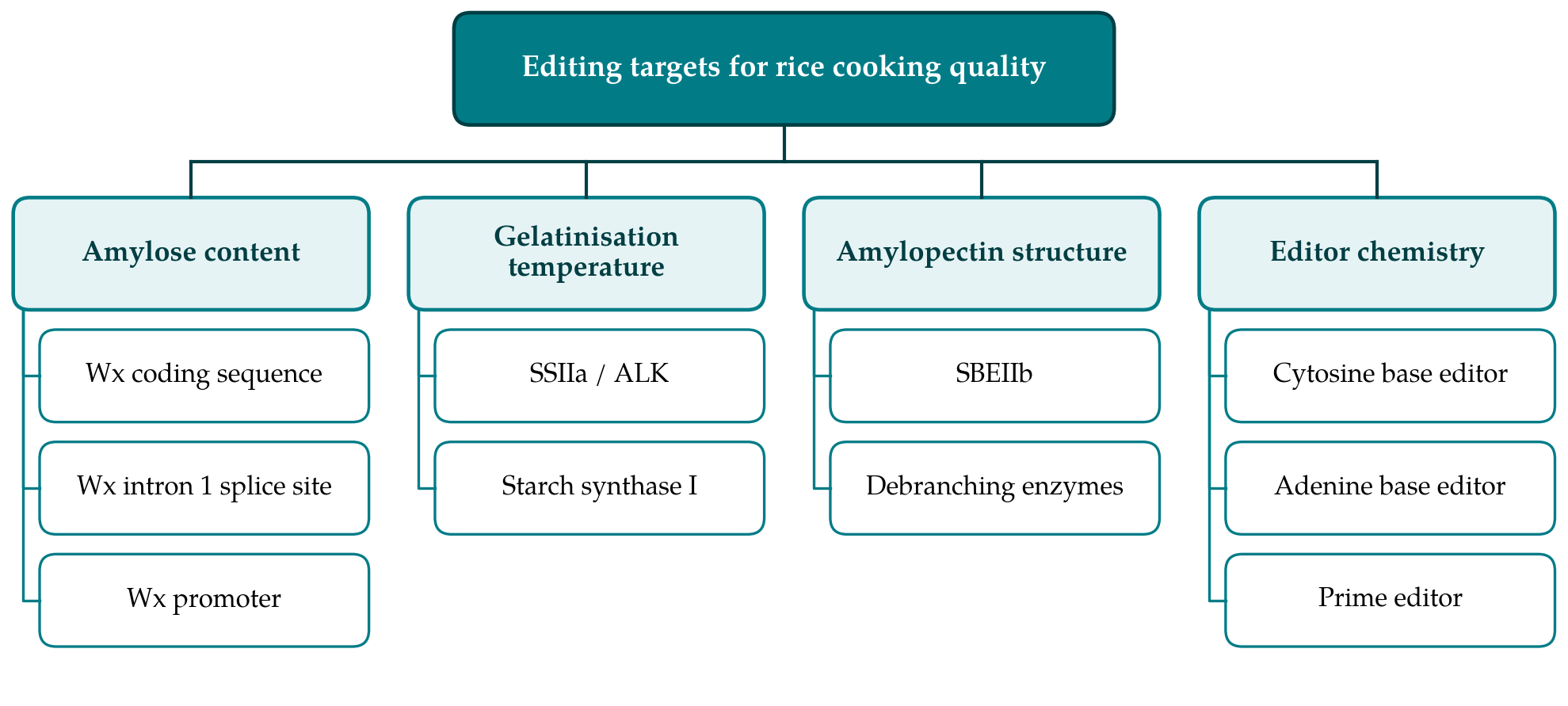
In rice, the first cytidine deaminase fusions produced heritable C to T substitutions in protoplasts and in regenerated plants (Zong et al., 2017; Li et al., 2017). Two practical constraints emerged quickly. The first is targeting: the editing window has to be placed over the intended base, and a canonical Cas9 motif is not always available at the right distance. Engineered Cas9 variants with relaxed motif requirements widened the accessible sequence space in rice (Hua et al., 2019). The second is bystander editing. When more than one cytosine falls inside the window, several may be converted, which in a coding sequence yields a set of alleles rather than the single intended one. For a quality gene this is less damaging than it sounds, since a graded allelic series is often what a breeder wants, but it means each regenerated line must be sequenced across the window and characterised on its own terms. Figure 1 sets out the targets and the editor chemistries together.
Transversions remain the hard case. Neither editor class can convert a C to a G or an A to a T, and several informative changes in starch genes are of that kind. Prime editing, which uses a reverse transcriptase and an extended guide to copy a template sequence into the nicked strand, removes that restriction in principle (Anzalone et al., 2019) and has been demonstrated in rice and wheat (Lin et al., 2020). Reported efficiencies in cereals have been lower than those of base editors, which is why most quality work so far has stayed with transitions.
Specificity deserves a separate word. The sequence-dependent off-target activity of Cas9 has been studied since the platform was introduced (Jinek et al., 2012; Hsu et al., 2014), and guide design tools address it. Cytosine base editors also show guide-independent deamination arising from the deaminase acting on transiently exposed DNA and on RNA, which guide design cannot prevent. In a crop this matters less than in a clinical setting, because segregation and backcrossing remove unlinked changes, but it is a reason to sequence candidate lines and not to rely on the predicted specificity of the guide alone. The habit followed in most cereal laboratories is to sequence the target region of the chosen variety before the guide is designed, and to carry forward more than one independently edited line so that a change nobody looked for does not become the basis of a conclusion about the gene.
5. Reported Edits at Quality Loci
The clearest demonstrations concern the waxy locus. Because the difference between the two common non-glutinous alleles is a single base at a splice site, the locus is an obvious candidate for an editor that installs transitions, and it has the further advantage that the resulting phenotype is measurable in the first generation of seed. Work using nuclease-based editing of the waxy promoter showed that varying the extent of disruption in the regulatory region produces a graded set of amylose levels rather than the all-or-nothing result obtained by knocking out the coding sequence (Huang et al., 2020). That finding matters for base editing too, since it establishes that intermediate expression of granule-bound starch synthase gives intermediate and agronomically useful amylose values.
Editing the coding sequence is a blunter instrument but still informative. Converting a codon in a conserved catalytic region lowers enzyme activity without removing the protein, and the amylose content of the resulting grain falls accordingly. Editing at the intron 1 splice site is the most attractive target of all, because the natural japonica allele shows what the phenotype of that change is: this is one of the few cases in crop improvement where the intended edit has an existing natural counterpart whose field performance is documented. Work on starch synthase IIa has followed the same logic, with the natural weak alleles indicating which residues to target.
Two cautions apply when reading this literature. Published amylose figures are not always comparable, because the iodine assay is sensitive to method and to growing environment, and because some reports use apparent amylose and others a chromatographic estimate of true amylose. And the number of genetic backgrounds examined is small. A change that lowers amylose in one japonica variety need not produce the same cooked texture in an indica background with a different starch synthase IIa allele and a different grain shape.
6. What the Evidence Supports
Three claims are reasonably well supported. Base editors function in rice and transmit their edits through meiosis. The genes that control cooking quality are known well enough that a target can be chosen on mechanistic grounds rather than by screening. And graded phenotypes can be obtained, whether through bystander variation within the editing window or through deliberate editing of regulatory sequence, which is what a quality programme needs.
Three claims are not yet supported. There is little published evidence on how edited quality lines behave across environments and seasons, and starch traits are known to respond to temperature during grain filling. There is almost no sensory evaluation: amylose content is a proxy for texture, not a measure of acceptability, and a trained panel or a consumer study is the only way to settle whether an edited grain eats as intended. And the yield consequences of altering carbon partitioning in the endosperm have not been examined in the depth that a breeder would want before committing to a line.
7. Gaps and Future Work
The most useful next step is probably combinatorial. Since waxy and starch synthase IIa act in series, editing both in one background would let a programme place a variety deliberately in a texture class instead of accepting whatever the available alleles offer. Multiplexed base editing makes that technically straightforward; the work that remains is phenotypic.
A second gap is delivery. Most rice editing still proceeds through tissue culture and Agrobacterium-mediated transformation, which is genotype dependent and excludes many locally preferred varieties, exactly the varieties whose quality a farmer would least want to change. Transgene-free approaches and improved regeneration would broaden the set of backgrounds that can be addressed directly.
A third concerns the regulatory and commercial setting. Jurisdictions differ in whether a plant carrying a single transition mutation and no foreign DNA is treated as a conventional variety or as a genetically modified organism, and that difference, rather than any technical barrier, is what decides whether an edited quality trait reaches a farmer (Waltz, 2016). The scientific case for base editing starch genes is not in doubt; the path to the field runs through policy as much as through the laboratory.
8. Conclusion
Rice cooking quality is one of the few complex consumer traits with a simple and well understood genetic basis, and that makes it an unusually good match for base editing. The waxy locus in particular offers a target where a single transition has a known phenotype, documented in natural germplasm, and where graded alleles are more valuable than a clean knockout. The published work establishes that the chemistry functions in rice and that useful allelic variation can be created. What it has not yet established is how the resulting grain performs in the field and on the plate. Multi-environment trials, sensory panels and work in a wider set of backgrounds are the obvious priorities, and they are within reach of ordinary breeding programmes rather than requiring new technology.
Conflict of interest
To be declared by the author(s) before publication.
Funding
To be declared by the author(s) before publication.