1. Introduction
Moringa oleifera Lam. (Moringaceae) is a fast-growing tree native to the sub-Himalayan tracts of northern India and now cultivated throughout the tropics. Almost every part of it is used, but the leaves carry most of its present commercial weight: they are eaten fresh as a vegetable, dried and milled into powder, and extracted for capsules and teas (Anwar et al., 2007). Their nutritional value was documented in detail well before the current interest in supplements (Leone et al., 2015), and reviews of human and animal studies have found the leaf to be well tolerated at the intakes examined, while noting that the clinical evidence for specific health effects remains limited (Stohs and Hartman, 2015).
Much of the marketing of moringa leaf rests on two linked claims, that it is rich in flavonoids and that it has high antioxidant capacity. Both are properties of a particular batch and not of the species. A moringa tree in a managed plot is cut back repeatedly, and regrowth is harvested at intervals of some weeks across wet, dry, hot and cool periods. Secondary metabolism in leaves responds to exactly the variables that change between those periods. A processor who buys leaf all year therefore receives material whose phenolic content may shift from one consignment to the next, and a specification written around a single harvest may not hold for the following one.
This article reviews what is known about that shift. It asks which flavonoids are at issue, how antioxidant capacity has been measured, why harvest season would be expected to matter, what the studies that compared seasons actually report, and how far their findings can be separated from other sources of variation.
2. Scope and Approach
The article is a narrative review of the published literature on M. oleifera leaf phenolics. It draws on phytochemical profiling studies, on work that compared leaves by season, location, maturity or genotype, on the methodological literature on antioxidant assays, and on general plant physiology where it explains a pattern. No formal search protocol was applied and no pooled estimate is attempted, because the studies differ too much in material and method for their numbers to be combined. Quantitative values from individual papers are deliberately not reproduced here, for the reason developed below: they are expressed in units and against standards that are not interchangeable.
3. Flavonoids of the Moringa Leaf
The leaf flavonoids of moringa are flavonol glycosides. Profiling by liquid chromatography with mass spectrometric detection identified quercetin 3-O-glucoside and its malonylated form as the dominant compounds, with smaller amounts of the corresponding kaempferol glycosides, together with 3- and 5-caffeoylquinic acids (Bennett et al., 2003). Later work on trees grown in Ghana found the same families of compounds in the leaf and showed that they are distributed unevenly between tissues, which matters when stalks and petioles are milled along with the leaflets (Amaglo et al., 2010). Rutin and isorhamnetin glycosides are also reported, and a validated LC-MS method has been used to quantify a dozen flavonoids across accessions of different origin (Coppin et al., 2013).
Two features of this chemistry bear on seasonal comparisons. The first is that the flavonoids occur as glycosides and acylated glycosides, not as free aglycones. Malonyl esters are labile, and harsh drying or hot extraction can convert them to the simple glucosides, so that a change in profile may be produced in the laboratory and mistaken for a change in the plant. The second is that flavonoids are not the only reducing compounds present. The leaf also contains ascorbic acid, carotenoids, tocopherols and the glucosinolate glucomoringin, and some of these respond in the colorimetric assays that are often read as measures of phenolics (Leone et al., 2015).
4. How Antioxidant Capacity Is Measured
Antioxidant capacity is not a single quantity. The assays in common use differ in the oxidant or radical they employ, in the reaction mechanism they favour and in the solvent in which they run, and they rank the same samples differently. A widely used classification separates assays based on hydrogen atom transfer, such as the oxygen radical absorbance capacity method, from those based on single electron transfer, such as the ferric reducing and Folin-Ciocalteu methods, with the DPPH and ABTS radical assays able to proceed by either route (Huang et al., 2005). The principal methods applied to moringa leaf are compared in Table 1.
| Assay | Principle | Caution when comparing seasons |
|---|---|---|
| Folin-Ciocalteu total phenolics (Singleton and Rossi, 1965) | Reduction of a phosphomolybdic-phosphotungstic reagent in alkali | Also responds to ascorbic acid and other reductants that vary with season |
| Aluminium chloride total flavonoids | Coloured complex of aluminium with flavonoid hydroxyl and carbonyl groups | Result depends on the standard chosen: quercetin, rutin or catechin |
| DPPH (Brand-Williams et al., 1995) | Decolorisation of a stable nitrogen radical in alcohol | Leaf pigments absorb near the reading wavelength; reaction time matters |
| ABTS (Re et al., 1999) | Decolorisation of a preformed radical cation | Works in aqueous and organic media; values are not comparable with DPPH |
| FRAP (Benzie and Strain, 1996) | Reduction of a ferric complex at acid pH | Measures reducing power only; blind to radical quenching by hydrogen transfer |
| HPLC or LC-MS profiling (Coppin et al., 2013) | Separation and quantification of named compounds | Needs authentic standards; acyl glycosides may degrade during preparation |
The total phenolics assay descends from a method devised for wine (Singleton and Rossi, 1965). It measures reducing capacity under alkaline conditions and is not specific to phenols. In a leaf whose ascorbic acid content is itself seasonal, a rise in the reading cannot be assigned to flavonoids without a chromatographic check. The aluminium chloride method for total flavonoids has a different weakness: results are expressed as equivalents of whichever standard the laboratory chose, and a figure in rutin equivalents cannot be set beside one in quercetin or catechin equivalents.
The radical assays have their own conventions. The DPPH method was characterised kinetically by Brand-Williams et al. (1995), who showed that different antioxidants reach their end point at very different rates, so that a fixed reading time favours fast reactors. The ABTS method in its improved form uses a radical cation generated beforehand with persulfate (Re et al., 1999), and the ferric reducing assay was first described for plasma and only later adopted for plant extracts (Benzie and Strain, 1996). A review prepared for the purpose of standardisation concluded that no one assay is sufficient and recommended that a small set with different mechanisms be reported together (Prior et al., 2005). Seasonal studies of moringa that rely on a single colorimetric method should be read with that advice in mind.
5. Why Harvest Season Would Be Expected to Matter
Flavonoids are made by the phenylpropanoid pathway, and the genes that encode its early enzymes are among the most strongly regulated by environment in the plant. High irradiance, ultraviolet-B radiation, low temperature, nitrogen shortage and wounding all increase flavonoid synthesis in a wide range of species (Winkel-Shirley, 2002). The response is usually interpreted as protective. Flavonols accumulate in the epidermis, where they screen ultraviolet light, and in the mesophyll, where dihydroxylated forms such as the quercetin glycosides are thought to quench reactive oxygen species formed when the leaf absorbs more light than it can use (Agati et al., 2012). They also contribute to defence against pathogens and herbivores, whose pressure varies through the year (Treutter, 2006).
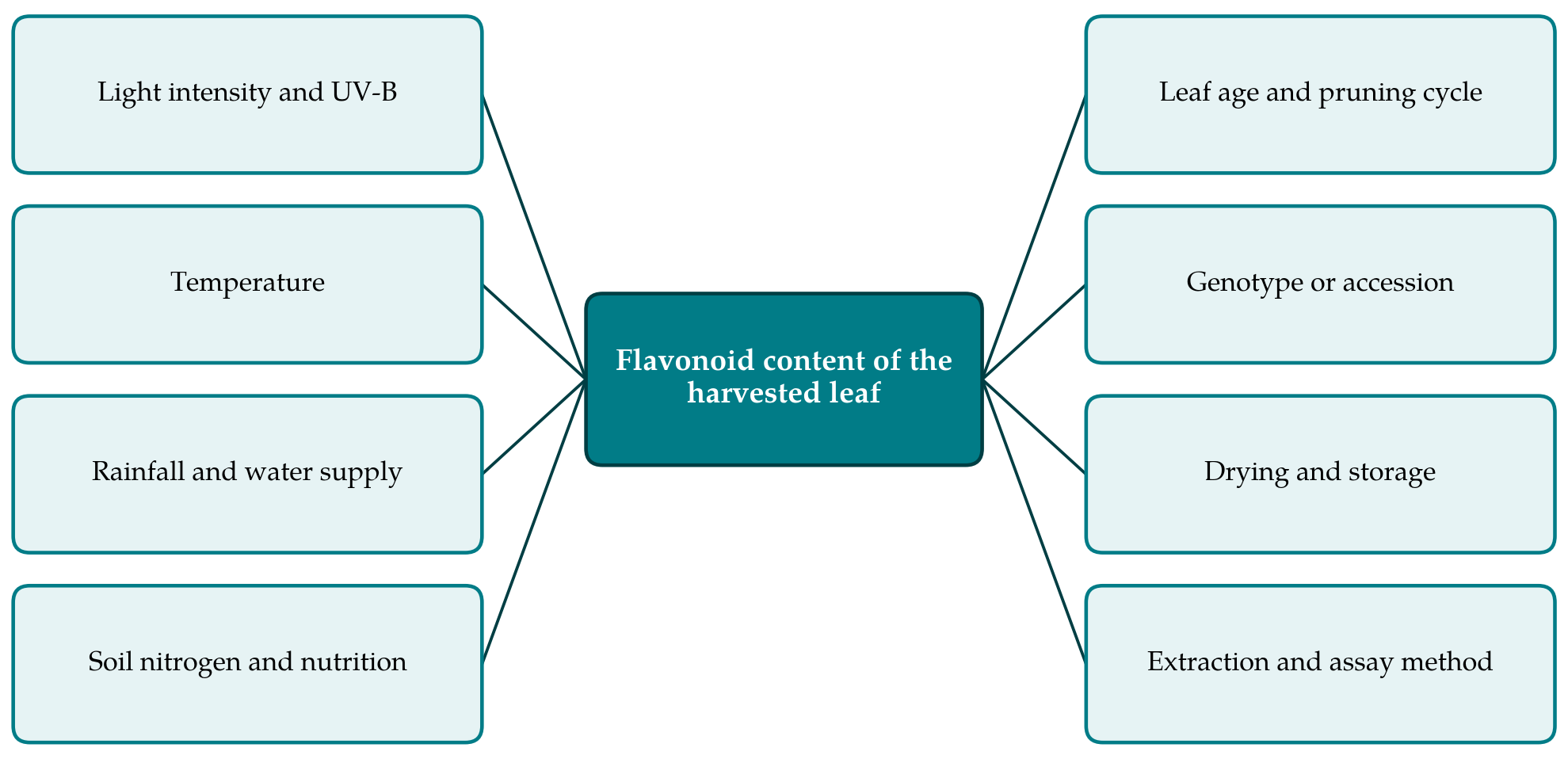
Season in a tropical or subtropical plantation is a bundle of these signals. The monsoon brings cloud, water and rapid growth; the dry season brings clear skies, high irradiance and water deficit; winter at higher latitudes or altitudes brings cool nights. Day length and solar angle change the ultraviolet dose, and work on other species grown along latitudinal gradients has shown that light quality and temperature alter not only the total amount of flavonoid but the ratio of quercetin to kaempferol derivatives (Jaakola and Hohtola, 2010). On physiological grounds, then, one would predict more flavonol, and a profile shifted towards quercetin glycosides, in moringa leaves grown under bright, cool or dry conditions than in soft leaves formed during rapid growth in the rains. Figure 1 sets out the factors that act on the content of the harvested leaf, including those that have nothing to do with weather.
6. What Studies Comparing Seasons Report
Direct seasonal comparisons of moringa leaf are few. The most cited is that of Iqbal and Bhanger (2006), who collected leaves at different times of year from several production locations in Pakistan and found that both the month of collection and the place of growth affected antioxidant activity and phenolic content. Their design is valuable because it varied season and site together, and it showed that the two interact: the seasonal pattern was not the same at every location. In Taiwan, Shih et al. (2011) compared summer and winter harvests of leaf, stem and stalk and reported that composition and antioxidant activity differed between the two seasons as well as between plant parts.
Other studies address season indirectly. Siddhuraju and Becker (2003) examined leaves from three agroclimatic origins and found that antioxidant properties and extractable phenolics differed with origin and, to a marked degree, with the extraction solvent. Because climate differs between origins much as it differs between seasons at one site, such comparisons support the general proposition that growing conditions shape leaf phenolics, but they cannot say what a given grower should expect from one harvest to the next. A comparison of thirteen cultivars raised together in South Africa likewise found considerable variation in phenolic content and antioxidant activity that could only be genetic in origin, since the environment was shared (Ndhlala et al., 2014).
Read together, these reports agree on the existence of a seasonal effect and disagree on its shape. Some point to higher antioxidant readings in cooler months, in line with the physiological prediction; in others the pattern depends on the location or the assay. None followed individually identified trees through several years, so the repeatability of any seasonal pattern from year to year is unknown. Very few reported compound-level profiles by season, which means that the title question, whether the flavonoid profile changes and not merely a colorimetric total, has been answered only in part.
7. Factors Confounded With Season
A harvest date fixes more than the weather. Several other variables move with it, and unless a study controls them its seasonal contrast is a mixture.
7.1. Leaf age and harvest practice
Moringa is managed by pruning, and the age of the regrowth at cutting depends on how fast it grew. Leaves harvested after a fixed number of weeks are physiologically younger in a slow season than in a fast one. Maturity has an effect of its own: Sreelatha and Padma (2009) compared tender and mature leaves and found differences in phenolic content and antioxidant activity between the two stages. A seasonal study that samples by calendar interval therefore compares leaves of different developmental age, and one that samples by leaf position compares leaves formed over different lengths of time.
7.2. Genotype and site
Most plantations are raised from seed, and moringa is largely outcrossing, so a field is a population of genotypes. The cultivar comparison cited above shows how wide the genetic component can be (Ndhlala et al., 2014), and accessions of different geographical origin differ in their flavonoid profiles when analysed by the same method (Coppin et al., 2013). If different trees are sampled at each date, tree-to-tree variation is added to the seasonal contrast. Soil fertility and irrigation add a further layer, since nitrogen supply and water deficit both act on phenylpropanoid metabolism (Winkel-Shirley, 2002).
7.3. Drying, storage and extraction
Leaves are seldom analysed fresh. They are shade dried, sun dried, oven dried or freeze dried, and the ambient conditions for the first two change with season: drying is slow and mould-prone in humid months and fast in dry ones. Extraction then introduces the largest single source of disagreement in the literature. Aqueous methanol and aqueous ethanol recover far more phenolic material from moringa leaf than water alone (Siddhuraju and Becker, 2003), and a systematic comparison of extraction procedures found that the choice of method and solvent strength changed total phenolics, total flavonoids and antioxidant activity substantially (Vongsak et al., 2013). Two laboratories studying the same seasonal material with different extraction protocols could reach different conclusions.
8. Gaps and Directions for Future Work
The study that would settle the matter is easy to describe. It would follow tagged trees of known origin, ideally clonal or at least from a single seed lot, at two or more contrasting sites for at least two years. Leaves of defined position and age would be taken at each harvest, stabilised at once by freezing or freeze-drying, and extracted by a fixed protocol. Individual flavonol glycosides and caffeoylquinic acids would be quantified by chromatography against authentic standards, alongside two or three antioxidant assays of differing mechanism. Temperature, rainfall, irradiance and soil nitrogen would be logged so that season could be replaced in the analysis by the variables it stands for.
Two wider questions lie beyond phytochemistry. One is whether seasonal differences of the size observed matter to the consumer. Flavonol glycosides are absorbed to a limited and variable extent and circulate mainly as conjugated metabolites, so capacity measured in a test tube is a poor guide to effect in the body (Manach et al., 2004). The other is regulatory. If the content of marker compounds varies systematically through the year, a quality specification for moringa leaf should either set limits wide enough to cover it or require that batches be blended or standardised to a declared content of named flavonoids.
9. Conclusion
The flavonoids of moringa leaf are well characterised, the environmental control of their synthesis is understood in outline, and the studies that have compared harvest seasons agree that season makes a difference. They do not yet agree on which season is best, and they could not be expected to, given that they differ in site, genotype, leaf age, drying, solvent and assay. Until seasonal work is done on fixed trees with compound-specific analysis, the prudent position for producers and analysts is to treat every harvest as a separate batch, to test it by chromatography and not by a colorimetric total alone, and to avoid general claims about the antioxidant capacity of moringa leaf that no single batch can guarantee.
Conflict of interest
To be declared by the author(s) before publication.
Funding
To be declared by the author(s) before publication.