1. Introduction
A prescriptive fire code tells the designer what to build. A performance-based code tells the designer what the building must achieve and leaves the means open, subject to demonstration (Meacham and Custer, 1995). Over the last four decades many industrialised countries have moved towards the second model. England and Wales adopted functional requirements in the 1980s, New Zealand and Australia introduced performance-based building codes in the 1990s, and Japan revised its Building Standard Law on similar lines in 2000 (Hadjisophocleous et al., 1998; Meacham et al., 2005). Engineering guidance, national and international standards and a model performance code now support the approach (SFPE, 2007; BSI, 2019; ISO, 2018; ICC, 2021).
In low- and middle-income countries the picture is different. Codes are for the most part prescriptive, and the performance route, where it is mentioned, is seldom supported by procedures for using it. The common view among regulators is that this is as it should be: performance-based design is a refinement for countries with many qualified engineers and strong institutions, and a country that struggles to enforce simple rules should not introduce complicated ones.
This article takes the opposite position. It argues that the case for performance-based fire design is in some respects stronger in developing countries than in rich ones, because the gap between what prescriptive rules assume and what exists on the ground is wider. It also argues that the real choice is not between simple rules and engineering, but between engineering that is recognised and controlled and engineering that happens through exemptions.
2. What Borrowed Rules Assume
Prescriptive fire provisions are the residue of experience. Each travel distance and each fire resistance period was arrived at in a particular place, in response to particular fires, for the construction methods and emergency services of the time. Law and Bisby (2020) trace how the concept of fire resistance, and the standard furnace test that defines it, grew out of specific historical circumstances and then hardened into a universal measure. When such provisions are transplanted, the numbers travel and the reasoning stays behind.
The reasoning matters because it contains assumptions. A rule that allows a given building height with a single stair may assume a fire service that arrives within minutes with aerial appliances and a reliable hydrant supply. A fire resistance rating assumes that the element is built as tested. A limit on compartment size assumes fire loads typical of the country of origin. Reviews of building regulation in developing countries have observed that codes adopted from elsewhere frequently fit local materials, practices and incomes poorly, and that much construction takes place outside the regulated system as a result (World Bank, 2015).
The extreme case is the informal settlement, where the prescriptive code has no purchase at all. Work on fire risk in such settlements has had to start from first principles, measuring how dwellings of sheet metal and timber burn and how fire spreads between them (Walls et al., 2017), and asking how risk can be assessed where conventional data are missing (Twigg et al., 2017). That is performance-based thinking in everything but name: define the objective, understand the fire, and judge measures by their effect.
3. Three Reasons for a Stronger Place
The first reason is transparency of purpose. A performance-based code must state its objectives: that occupants can reach a place of safety, that the structure remains stable for long enough, that fire does not spread to neighbours, that firefighters can work (Meacham and Custer, 1995). Once the objectives are written down, even prescriptive provisions can be read against them. An official who knows that a rule exists to keep an escape route free of smoke is better placed to judge a non-standard building, or to refuse a harmful shortcut, than one who knows only the number.
The second reason is the nature of what is now being built. Urban growth in Asia, Africa and Latin America is producing very tall residential buildings, deep-plan shopping centres, transport interchanges and multi-storey factories at great speed. These are the building types for which prescriptive rules are least adequate anywhere, and for which engineered analysis of smoke movement, evacuation and structural response was developed (Buchanan and Abu, 2017). The National Building Code of India, to take one example, devotes a long part to fire and life safety organised by occupancy and height (BIS, 2016). No such document, however detailed, can anticipate every combination of height, use and layout that a fast-growing city produces.
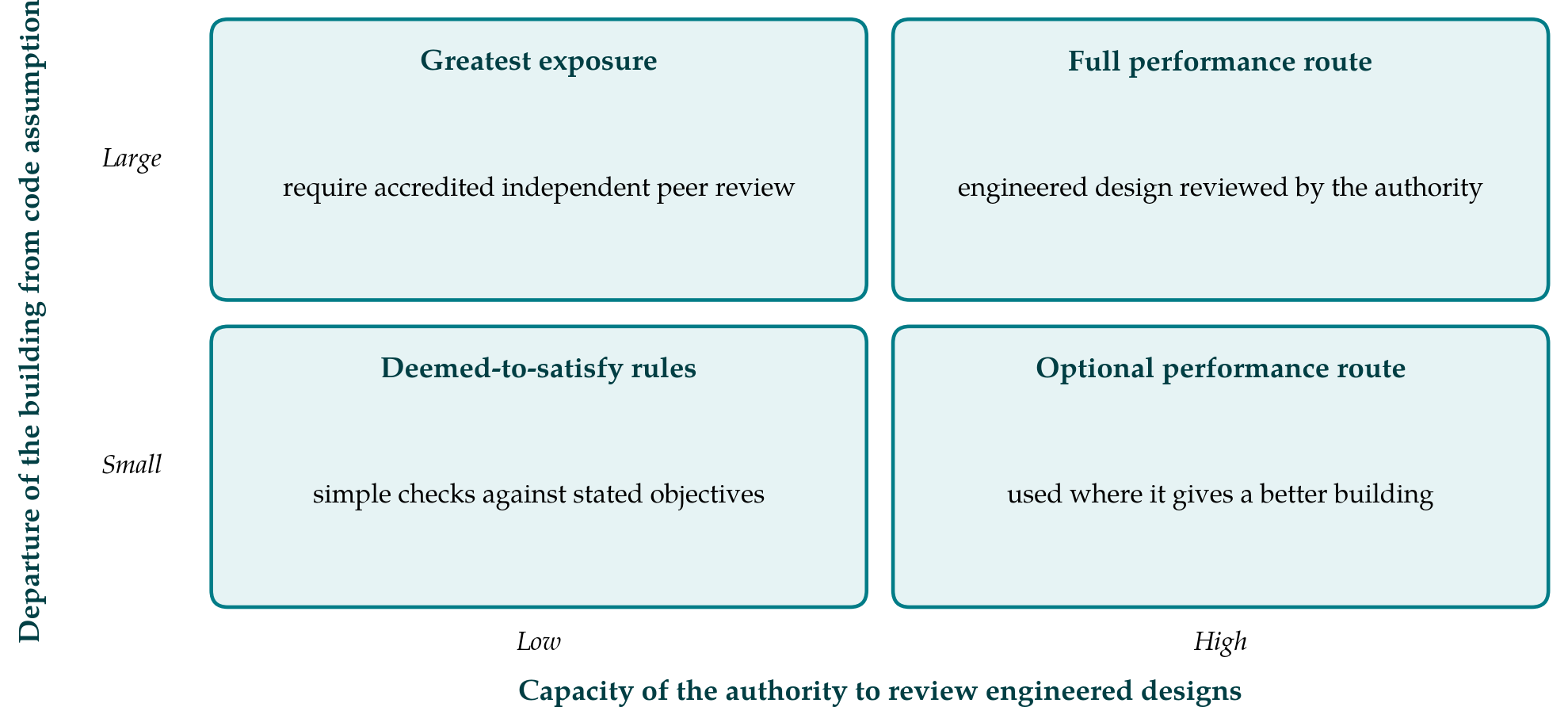
The third reason is that the alternative to a formal performance route is not strict prescription. It is the informal waiver. Where a project cannot comply with the letter of the code, approval is negotiated, and the negotiation takes place without stated objectives, without defined methods and without any record that others can examine. Formal recognition would bring these decisions into the open, and Figure 1 suggests how the degree of control might be matched to the circumstances.
4. The Objections
The case against is substantial, and it comes from experience in countries that adopted performance-based design early. Table 1 sets out the main objections with the response this article offers to each. They are discussed below.
| Objection | Substance | Response proposed |
|---|---|---|
| Review capacity | Authorities cannot check engineering analyses | Accredited third-party peer review, paid for by the applicant |
| Scarcity of engineers | Few practitioners are educated in fire safety engineering | Registration by competence; regional education programmes |
| Weak data | Fire statistics, fire loads and occupant data are lacking | Conservative default inputs published with the code |
| Misuse | Flexibility is used to reduce cost and safety | Stated objectives, mandatory documentation, limits on scope |
| Construction quality | The built work departs from the design | Inspection duties and commissioning tied to the fire strategy |
| Method uncertainty | Design calculations rest on contested simplifications | Explicit safety margins and sensitivity analysis |
Capacity is the objection most often raised, and it is real. A review of two decades of performance-based practice found recurring difficulties even in well-resourced jurisdictions: inconsistent acceptance criteria, uneven competence among both designers and reviewers, and weak links between the design assumptions and the way the building is later managed (Alvarez et al., 2013). The independent review that followed the Grenfell Tower fire described a regulatory system in England in which responsibility was unclear and competence was not assured (Hackitt, 2018). If mature systems fail in these ways, a regulator with a handful of plan checkers has reason to be cautious.
The methods themselves are open to criticism. The comparison of available and required safe escape time, which lies at the centre of most life safety analyses, has been challenged as giving a false sense of precision and neglecting occupants who cannot move at the assumed speed (Babrauskas et al., 2010). Sociological study of fire safety regulation has shown how engineering judgement can be shaped by commercial interest when the client pays the engineer and the regulator lacks the expertise to disagree (Spinardi et al., 2017). And fire safety engineering is a young discipline whose educational base is narrow even in rich countries (Woodrow et al., 2013).
These objections do not, however, favour the present arrangement. Prescriptive codes need competent enforcement too, and where enforcement is weak they fail just as surely. Their failure is merely less visible, since a building that complies on paper attracts no scrutiny. Nor does prescription escape the problem of interested judgement: the decision to grant a waiver is as exposed to pressure as the decision to accept an analysis, and it leaves less of a trail. The objections argue for adopting performance-based design with safeguards. They do not argue for excluding it.
5. A Staged Adoption
A stronger place can be given in three stages, and the first costs little. The code is revised so that every group of fire provisions is preceded by a statement of its objective and of the main assumptions behind it, including assumptions about fire service intervention and water supply. The existing prescriptive provisions are retained as deemed-to-satisfy solutions. Nothing changes for the ordinary building, but officials and designers acquire a common language for discussing the exceptional one.
The second stage opens an engineered route for defined classes of building, initially those that the prescriptive provisions serve worst. Use of the route is conditional. The designer must hold a recognised qualification. The design must follow a published process, with a fire strategy report that records objectives, design fires, acceptance criteria and assumptions about management (SFPE, 2007; ISO, 2018). And the design must be reviewed by an independent party accredited for the purpose, at the applicant's expense, so that the authority's own staff are not asked to do what they have not been trained to do.
The third stage builds the supporting system: default design fires and occupant characteristics published for local conditions, so that inputs are not chosen to suit the answer; inspection during construction against the fire strategy; and a duty on the owner to maintain the measures on which the design depends. Education has to proceed alongside. Regional postgraduate programmes, shared between universities and supported by professional bodies, are a more realistic means of producing reviewers and designers than reliance on visiting consultants.
None of this requires a country to abandon prescription. Most buildings in most countries, rich or poor, are designed to deemed-to-satisfy rules and will continue to be. The proposal is that those rules should sit inside a framework of stated objectives, and that the engineered alternative should be a regulated route with entry conditions.
6. Implications
For code-writing bodies the immediate task is the modest one of making objectives explicit. It can be done at the next revision cycle without new institutions. For governments and development agencies the implication is that support for building regulation should include the fire engineering profession, through education, accreditation and peer review schemes, and not only the drafting of documents. For the international fire engineering community there is a need for guidance and default data suited to conditions that the existing handbooks, written largely from North American and European experience, do not cover. For researchers, the fire loads, occupant characteristics and fire service performance of cities in the global South are almost unmeasured, and work on them would have direct regulatory use.
7. Conclusion
Prescriptive fire codes borrowed from elsewhere carry assumptions that are often untrue in the places that have adopted them, and the fastest-growing cities are building precisely the structures that such codes handle least well. Performance-based design addresses both problems by making objectives explicit and by allowing solutions to be fitted to local conditions. Its dangers are well documented, and they are dangers of weak control, which afflict prescriptive regulation equally. A staged adoption, with stated objectives first, a restricted engineered route second and supporting data and education third, would give developing countries the benefits of the approach while keeping its risks in view. The alternative is to leave engineering judgement where it already operates, in unrecorded exemptions.
Conflict of interest
To be declared by the author(s) before publication.
Funding
To be declared by the author(s) before publication.