1. Introduction
Preeclampsia is defined by new hypertension after twenty weeks of gestation together with proteinuria or other evidence of maternal organ or uteroplacental dysfunction (Brown et al., 2018). It remains a leading cause of maternal and perinatal harm, and no treatment other than delivery stops the disease once it is established. Prevention therefore carries much of the clinical weight, and the one preventive drug supported by a large body of randomised evidence is aspirin at low dose.
The evidence accumulated over three decades. The CLASP trial, which enrolled more than nine thousand women, found a smaller effect than earlier small trials had promised (CLASP Collaborative Group, 1994). Pooled analyses later confirmed a modest but consistent reduction in preeclampsia with antiplatelet agents, and the current Cochrane review reaches that conclusion (Duley et al., 2019). A later meta-analysis that separated trials by timing and dose reported larger effects when aspirin was started before sixteen weeks and given at higher doses (Roberge et al., 2017). The ASPRE trial then tested that proposition directly, giving 150 mg at night from 11 to 14 weeks until 36 weeks to women screened as high risk, and showed a substantial fall in preterm preeclampsia (Rolnik et al., 2017).
Guidelines now recommend low dose aspirin for women at increased risk, although they differ on dose and on how risk is assessed (ACOG, 2018; NICE, 2019; US Preventive Services Task Force, 2021). What none of them can ensure is that the drug is taken. This article proposes a study design for measuring aspirin adherence in high risk pregnancy within ordinary antenatal care. It reports no data. The design is offered so that units can produce adherence figures that mean the same thing from one service to the next.
2. Why Adherence Needs Its Own Measurement
A secondary analysis of ASPRE examined the effect of aspirin according to how much of the allocated medication each woman took, judged by tablet counts. The reduction in preterm preeclampsia was considerably greater among women who took at least ninety per cent of their tablets than among those who took fewer (Wright et al., 2017). The comparison is not randomised, since women who adhere differ from those who do not, but it agrees with pharmacology and with an Australian cohort in which women with poor adherence, assessed by several methods including a biochemical one, had worse outcomes than adherent women at similar baseline risk (Shanmugalingam et al., 2020).
Adherence to long-term preventive medicine is poor across medicine, and the reasons are well described: the condition being prevented is silent, the benefit is invisible to the person taking the drug, and the regimen lasts for months (Sabaté, 2003; Osterberg and Blaschke, 2005). Pregnancy adds its own features. Women are often cautious about any medicine during pregnancy, aspirin is sold over the counter in many countries so that no dispensing record may exist, nausea in the first trimester coincides with the time the drug should start, and advice from different clinicians can conflict. A service that wants to improve uptake needs to know at which point women are lost, and a single question at one visit does not show that.
3. Concepts and Definitions
The proposed design adopts the taxonomy published by Vrijens et al. (2012), which divides adherence into three phases. Initiation is the taking of the first dose. Implementation is the extent to which actual dosing matches the prescribed regimen from first dose to last. Persistence is the length of time from initiation until the patient stops. Each phase fails for different reasons and needs a different remedy, so a study that reports one summary percentage discards most of what is useful. Figure 1 sets the phases beside the record that captures each one in this design.
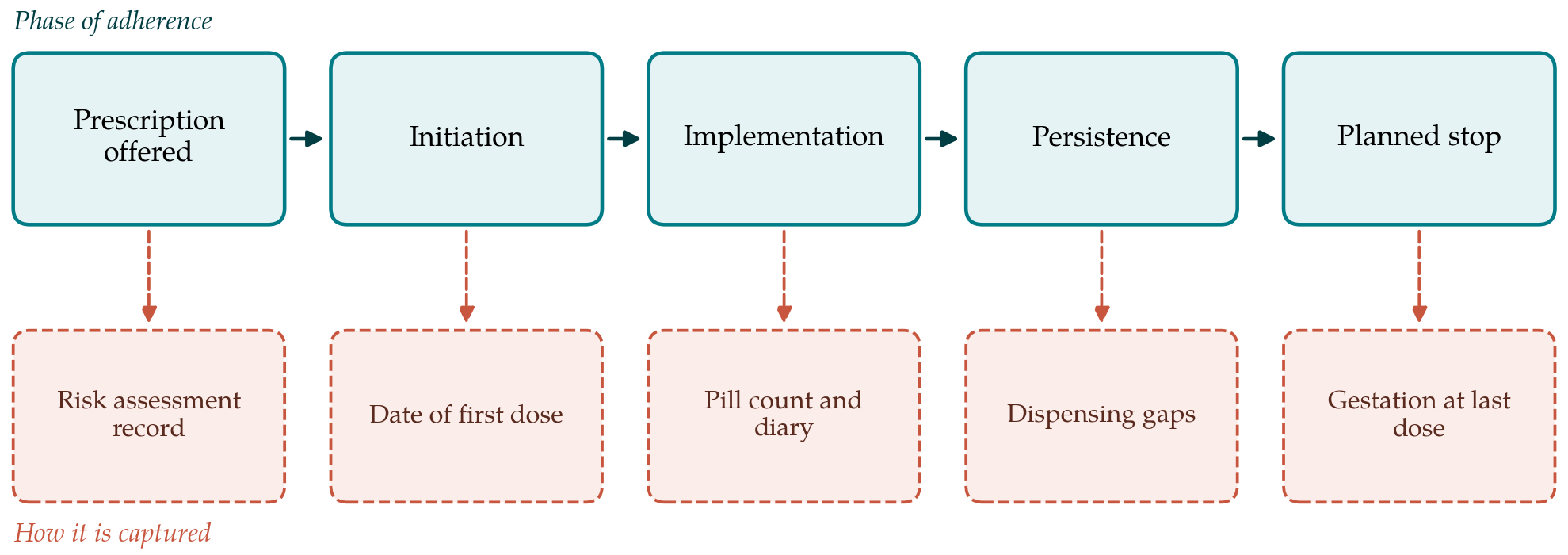
Two further definitions should be fixed before any data are collected. The first is the denominator: the women who were assessed as high risk under the local guideline and offered aspirin, including those who declined. The second is the threshold for adequate implementation. Ninety per cent of prescribed doses is the value used in the ASPRE analysis and is the natural primary definition (Wright et al., 2017); the conventional eighty per cent used in much adherence research can be reported alongside it so that findings can be compared with studies of other drugs.
4. The Proposed Design
The design is a prospective observational cohort embedded in routine antenatal care. Its elements are described below in the order in which a unit would set them up.
4.1. Setting and eligibility
All women booking for antenatal care at the participating unit who meet the local criteria for aspirin prophylaxis are eligible, whether risk is assigned from clinical risk factors or from a combined first-trimester screening algorithm. The method of risk assessment and the dose and timing advised should be recorded exactly as the unit applies them, because adherence can only be judged against the regimen that was prescribed. Women with a contraindication to aspirin are counted and described but not followed.
4.2. Measures of adherence
No single measure of adherence is accurate, cheap and unobtrusive at once, and standard texts advise combining methods whose errors point in different directions (Osterberg and Blaschke, 2005). Table 1 lists the measures proposed, the phase each informs and the weakness of each.
| Measure | Phase informed | How it is obtained | Main weakness |
|---|---|---|---|
| Dispensing record | Initiation, persistence | Dates and quantities supplied by the pharmacy Steiner and Prochazka, 1997 | Misses tablets bought without prescription |
| Pill count | Implementation | Tablets returned at each visit set against tablets issued | Tablets may be discarded before the visit |
| Self-report scale | Implementation | Short validated questionnaire Morisky et al., 1986 | Tends to overstate adherence |
| Dosing diary | Initiation, implementation | Date of first dose and missed days noted by the woman | Incomplete entries; recall when filled late |
| Biochemical check | Recent dosing only | Laboratory assay of aspirin exposure in a subsample | Cost; reflects the last few days only |
| Beliefs questionnaire | Explains non-adherence | Necessity and concerns scales Horne et al., 1999 | Not a measure of dosing itself |
Dispensing data yield the proportion of days covered, a standard quantity whose properties are understood (Steiner and Prochazka, 1997). Pill counts were the basis of the ASPRE adherence analysis and are simple to add to visits that already take place. Self-report is quick, and the four-item scale of Morisky et al. (1986) is among the most widely used instruments, although any self-report scale should be checked for licensing terms and for a validated translation before it is adopted. A biochemical measure in a subsample guards against the shared optimism of the other three. It should be presented to participants openly as a check on the measurement methods, not as a test of the individual.
4.3. Covariates and outcomes
The covariates are those that plausibly influence both adherence and outcome: age, parity, body mass index, chronic hypertension, diabetes, previous preeclampsia, gestation at first prescription, nausea and vomiting, language of consultation and socioeconomic position. Beliefs about medicines are measured once, soon after prescription, with the necessity and concerns scales developed by Horne et al. (1999). Pregnancy outcomes, classified by the criteria of the International Society for the Study of Hypertension in Pregnancy (Brown et al., 2018), are taken from the clinical record. They are recorded as secondary outcomes; the primary purpose of the study is to describe adherence, and the design does not pretend to estimate the efficacy of aspirin.
4.4. Analysis plan
The primary analysis is descriptive: the proportion of eligible women who initiate, the distribution of implementation among initiators by each measure, and the time to discontinuation. Agreement between measures is reported, because disagreement is itself a finding about which instrument a service can trust. Associations between baseline characteristics and adherence are examined by regression with the covariates specified in advance. Any comparison of outcomes between adherent and non-adherent women must be labelled as observational and interpreted with the caution that applies to all analyses conditioned on behaviour after enrolment. Women who adhere to one recommendation tend to follow others, and that healthy adherer effect cannot be removed by adjustment alone.
4.5. Reporting
The study should be reported in line with the STROBE statement for observational studies (von Elm et al., 2007) and the EMERGE guideline for adherence research, which asks authors to state the phase studied, the operational definition and the measurement method for each estimate (De Geest et al., 2018). Following both makes the results usable in later pooled analyses.
5. Fitting the Design to a Maternity Service
The design was shaped by what an ordinary unit can sustain. Pill counts and the self-report scale add a few minutes to existing visits and can be done by the midwife or pharmacist already seeing the woman. Dispensing data depend on local arrangements. Where aspirin is supplied on prescription from a hospital or linked community pharmacy the record is complete; where women are told to buy it themselves the measure is lost, and the study should say so plainly instead of reporting a figure that covers only part of the cohort. Ethical review and written consent are required, and participants should be told at the outset that tablets will be counted. Measurement of this kind is known to raise adherence for a time, which makes the study a conservative guide to what happens in unobserved care.
Units that advise different doses or stopping points can still use the design, provided each reports adherence against its own regimen and states that regimen. The design takes no position on which dose is preferable. That question belongs to the randomised evidence and to guideline bodies, and nothing in an adherence study should be read as advice to change what women are prescribed.
6. Limitations and What Remains to Be Shown
The procedure described here is proposed and has not been validated. A first application would need to show three things. One is feasibility: whether pill counts are completed at enough visits to be analysed and whether women accept them. A second is agreement: how closely the inexpensive measures track the biochemical one in the subsample, since a scale that classifies nearly everyone as adherent is of little use. The third is whether the three-phase description identifies a point of loss that a service could act on, for instance a large share of women who never start.
Some weaknesses are built in. Every measure other than the biochemical one can be influenced by the woman, and the biochemical one sees only recent doses. Observation changes behaviour. Results from one unit reflect its population, its prescribing arrangements and its way of explaining risk, and should not be generalised without replication. Finally, the study describes adherence and its correlates; it cannot show that improving adherence improves outcomes, which would require a trial of an adherence intervention.
7. Conclusion
Aspirin prophylaxis is among the few antenatal interventions with strong trial support, and its benefit appears to depend on adherence that services seldom measure. The design proposed here separates initiation, implementation and persistence, pairs several imperfect measures so that their errors can be compared, and fixes definitions in advance so that results from different units can be set side by side. Whether it works as intended is for a first application to show.
Conflict of interest
To be declared by the author(s) before publication.
Funding
To be declared by the author(s) before publication.