1. Introduction
Carboxylic acids are among the most widely available functional groups in organic chemistry, and α-amino acids are the most widely available chiral ones. Using the carboxyl group as a leaving group, with carbon dioxide as the only by-product from the substrate, is an old idea that reaches back to Kolbe electrolysis and the Hunsdiecker and Barton reactions. What visible-light photoredox catalysis added was a way to do it at room temperature, with household light sources and with functional group tolerance good enough for late-stage use (Prier et al., 2013).
Amino acid derivatives were at the centre of that development. The nitrogen lone pair stabilises the radical left behind after decarboxylation, so carbamate-protected amino acids are oxidised more easily than simple aliphatic acids and fragment quickly. The decarboxylative arylation reported by Zuo and MacMillan (2014), the conjugate addition of Chu et al. (2014) and the nickel-photoredox cross-coupling of Zuo et al. (2014) all used proline and its relatives as model substrates, and all depended on iridium photocatalysts.
Iridium and ruthenium are scarce, their complexes are costly, and residual heavy metal is a regulated impurity in pharmaceutical products. These facts have motivated a steady shift towards organic photocatalysts and towards catalyst-free photochemistry (Romero and Nicewicz, 2016). This review covers that shift for one substrate class, the α-amino acids and short peptides, and for one elementary step, the loss of carbon dioxide to give a carbon-centred radical.
2. Scope and Approach
This is a narrative review of the published literature. It draws on the primary reports that introduced each catalyst class or reaction type and on the general reviews of decarboxylative photochemistry (Xuan et al., 2015; Schwarz and König, 2018). No claim of exhaustive coverage is made, and no attempt is made to tabulate yields, which depend heavily on substrate and set-up. The aim is to explain how the reactions work, which organic catalysts suit which activation mode, and what a chemist choosing among them should weigh.
A word on terminology is needed first. In this literature, metal-free normally means that no transition metal complex is added as photocatalyst or co-catalyst. It does not exclude the caesium or potassium carbonate commonly used to deprotonate the acid, and it says nothing about trace metals in reagents. Some authors also apply the term loosely to reactions that pair an organic photocatalyst with a nickel cross-coupling catalyst. Such dual systems are noted here where they are instructive, but they are not metal-free in any strict sense.
3. Two Ways to Activate the Carboxyl Group
Decarboxylation under photoredox conditions starts from one of two species, and the choice determines almost everything else about the reaction: the catalyst required, the additives, and the side products.
3.1. Oxidation of the free carboxylate
In the first mode the acid is deprotonated and the carboxylate gives up one electron to the excited photocatalyst. The resulting carboxyl radical loses carbon dioxide and leaves an α-amino radical, which is nucleophilic and adds readily to electron-poor partners. Carbamate-protected α-amino carboxylates have oxidation potentials close to +1 V against the saturated calomel electrode, well below those of unactivated aliphatic carboxylates (Zuo and MacMillan, 2014). The excited catalyst must therefore be a reasonably strong oxidant, and its reduced form must later be able to hand the electron back to an intermediate so that the cycle closes without a sacrificial reagent. Figure 1 shows this redox-neutral sequence for a conjugate addition.
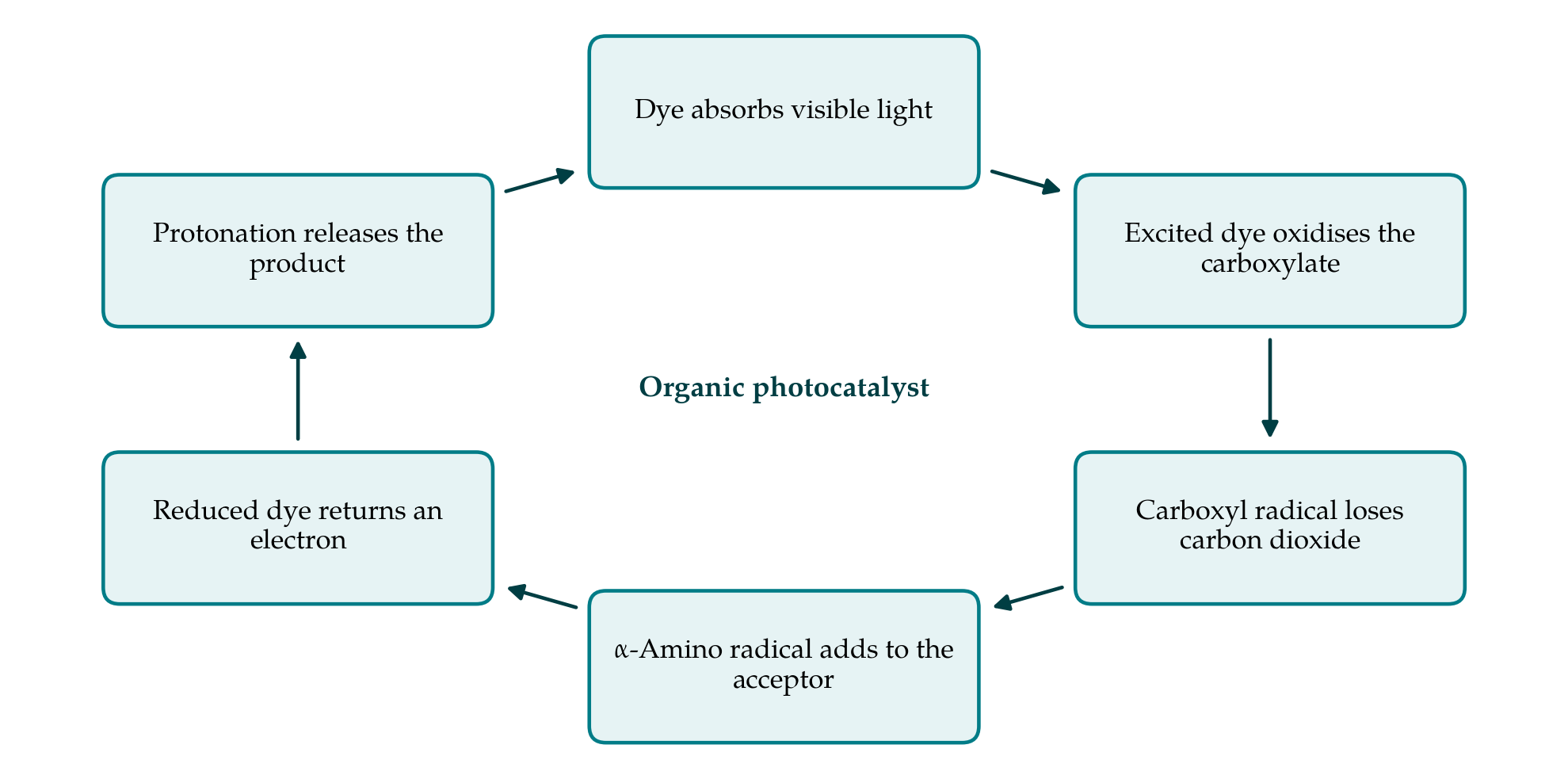
The attraction of this mode is economy. The amino acid is used as purchased, only a base is added, and the by-products are carbon dioxide and a protonated base. Its limitation is the need for a strongly oxidising excited state, which narrows the choice of organic dyes and can expose electron-rich groups elsewhere in the molecule, such as indoles, phenols and thioethers, to unwanted oxidation.
3.2. Reduction of redox-active esters
In the second mode the acid is first converted into an ester that accepts an electron easily. The N-(acyloxy)phthalimides, introduced as radical precursors by Okada et al. (1991), are by far the most common. One-electron reduction gives a radical anion that fragments into phthalimide anion, carbon dioxide and the same α-amino radical. Because the ester is reduced at mild potentials, weakly reducing organic dyes suffice, and the oxidation-sensitive side chains that trouble the first mode are left alone.
The cost is an extra synthetic step and a stoichiometric phthalimide by-product. A terminal reductant is also needed unless the coupling partner itself returns an electron. Hantzsch esters and tertiary amines are the usual choices, and each brings its own radical chemistry: the oxidised Hantzsch ester is a good hydrogen atom donor, which is helpful in reductive couplings and a source of simple reduction products when it is not wanted.
4. Organic Photocatalysts and Catalyst-Free Systems
Four families of organic dye account for most of the published metal-free decarboxylations, and a fifth approach needs no dye at all. Table 1 summarises them. The general photophysics and redox properties of these dyes are treated in depth by Romero and Nicewicz (2016).
| System | Usual activation mode | Strength | Main limitation |
|---|---|---|---|
| Acridinium salts | Oxidation of the carboxylate | Very strongly oxidising excited state (Fukuzumi et al., 2004) | Attack by nucleophiles on the dye; weak reductant after electron transfer |
| Donor-acceptor cyanoarenes | Either mode | Balanced redox window, tunable by substitution (Speckmeier et al., 2018) | Photosubstitution of the dye under some conditions |
| Xanthene dyes such as eosin Y | Reduction of redox-active esters | Cheap, absorbs green light (Hari and König, 2014) | Too weak an oxidant for most free carboxylates; bleaching |
| Flavins | Oxidation of the carboxylate | Water-soluble, biocompatible (Bloom et al., 2018) | Short catalyst lifetime under irradiation |
| Donor-acceptor complexes, no catalyst | Reduction of redox-active esters | No dye to buy or remove (Crisenza et al., 2020) | Needs a suitable donor in stoichiometric amount |
| Organic dye with nickel | Oxidation of the carboxylate | Opens aryl halide coupling (Luo and Zhang, 2016) | Not metal-free in the strict sense |
4.1. Acridinium salts
The 9-mesityl-10-methylacridinium ion described by Fukuzumi et al. (2004) is among the most strongly oxidising photocatalysts in common use, with an excited-state reduction potential near +2 V against the saturated calomel electrode (Romero and Nicewicz, 2016). It oxidises carboxylates of every kind, including those that iridium complexes cannot touch. Griffin et al. (2015) used an N-phenyl analogue together with a disulfide co-catalyst to replace carboxyl groups with hydrogen, and their mechanistic work showed that a thiol formed in situ transfers a hydrogen atom to the alkyl radical while the thiyl radical regenerates the dye. Ramirez and Gonzalez-Gomez (2017) applied the parent acridinium salt to Giese-type additions of carboxylic acids, amino acids among them, to electron-poor alkenes.
The weakness of the acridinium core is its electrophilicity. Carboxylates, amines and other nucleophiles can add to the ring and bleach the catalyst, which is why later designs carry bulky substituents at nitrogen and on the acridine skeleton. The reduced acridine radical is also only a modest reductant in its ground state, so closing a redox-neutral cycle depends on the radical adduct being easy to reduce.
4.2. Donor-acceptor cyanoarenes
The carbazolyl dicyanobenzene known as 4CzIPN was designed as an emitter for organic light-emitting diodes, where its small singlet-triplet gap allows thermally activated delayed fluorescence (Uoyama et al., 2012). Luo and Zhang (2016) recognised that the same property gives a long-lived excited state with redox potentials close to those of the iridium complex used in the original decarboxylative couplings, and showed that it could replace that complex in the nickel-mediated arylation of protected amino acids. Since then 4CzIPN has become the default organic catalyst for oxidation of α-amino carboxylates.
Its appeal lies in balance. The excited state is oxidising enough for carbamate-protected amino acids, and the radical anion formed afterwards is reducing enough to turn over most acceptors. The modular synthesis from fluorinated dicyanobenzenes and carbazoles or diarylamines also lets the potentials be shifted in either direction, as the systematic study of Speckmeier et al. (2018) demonstrates. The same compounds reduce N-(acyloxy)phthalimides in the presence of a sacrificial donor, so a single catalyst can serve both activation modes.
4.3. Xanthene dyes and flavins
Eosin Y, rose bengal and related xanthenes are inexpensive, absorb in the green region and have long been used as photosensitisers. Their excited states are milder oxidants than those of acridinium salts or cyanoarenes, which makes them poorly suited to free carboxylates but adequate for redox-active esters in combination with an amine or Hantzsch ester reductant (Hari and König, 2014). Their acid-base equilibria matter: the neutral form of eosin Y absorbs visible light only weakly, so the reaction pH and the choice of the neutral or disodium form affect the outcome. Flavins occupy a niche of their own. They are natural cofactors, soluble in water and tolerated by biomolecules, and their excited states oxidise C-terminal carboxylates in buffer, as discussed below.
4.4. Electron donor-acceptor complexes
Some reactions need no photocatalyst. An electron-poor phthalimide ester and an electron-rich partner can associate in the ground state to form a coloured complex whose excitation transfers an electron directly from donor to acceptor (Crisenza et al., 2020). The decarboxylative borylation of Fawcett et al. (2017) is the best-known example: N-(acyloxy)phthalimides, bis(catecholato)diboron and an amide solvent are irradiated with blue light and give boronic esters, protected α-amino boronates included, with no added catalyst. Hantzsch esters form comparable complexes with redox-active esters. These systems are simple to run and leave no dye to remove, but each depends on a specific donor, and the scope follows the donor more than the acid.
5. Bond-Forming Reactions of the α-Amino Radical
Once formed, the α-amino radical behaves as a nucleophilic carbon radical, and the reactions developed with organic catalysts follow from that character.
5.1. Conjugate addition
Addition to acrylates, enones, vinyl sulfones and related acceptors is the most forgiving decarboxylative coupling and usually the first reaction tried with a new catalyst. Starting from the free acid it is redox-neutral: the radical adduct accepts an electron from the reduced dye and the resulting carbanion is protonated (Chu et al., 2014; Ramirez and Gonzalez-Gomez, 2017). Dehydroalanine derivatives are especially useful acceptors, because the product is a new unnatural amino acid in which two amino acid fragments are joined through carbon.
5.2. Minisci-type heteroarylation
Protonated pyridines, quinolines and other azines trap nucleophilic radicals at their electron-poor positions, and amino acid derived radicals give the aminoalkylated heterocycles that are prized in medicinal chemistry (Proctor and Phipps, 2019). The redox-active esters of amino acids are convenient radical sources for this purpose, and a Brønsted acid is added to activate the heterocycle. Sherwood et al. (2018) showed that an organic photocatalyst supports a one-pot variant in which the phthalimide ester is formed from the carboxylic acid and consumed without isolation. Regioselectivity between the 2- and 4-positions of the heterocycle is still the recurring difficulty.
5.3. Alkynylation, borylation and peptide modification
Radical traps other than alkenes and heteroarenes extend the product range. Hypervalent iodine alkyne-transfer reagents convert the α-amino radical into a propargylic amine, and Garreau et al. (2019) used organic cyanoarene dyes to alkynylate the C-terminus of unprotected peptides in this way. Borylation through donor-acceptor complexes gives α-amino boronic esters (Fawcett et al., 2017). The peptide work rests on a useful selectivity: the C-terminal carboxylate, which leads to a nitrogen-stabilised radical, is oxidised in preference to the side-chain carboxylates of aspartate and glutamate. Bloom et al. (2018) exploited that difference with a flavin photocatalyst in aqueous buffer to alkylate native peptides and proteins at the C-terminus alone.
6. Mechanistic Questions and How to Test Them
Published mechanisms in this field are often drawn as closed cycles on limited evidence. Three checks deserve to be routine. Luminescence quenching identifies which component reacts with the excited dye, and the thermodynamic feasibility of that step can be estimated from the ground-state potentials and the excitation energy of the dye. Quantum yield measurement distinguishes a closed cycle from a radical chain, since a value above one cannot be explained without propagation (Cismesia and Yoon, 2015). Control experiments without light, without dye and under air show whether a donor-acceptor complex or adventitious oxygen is doing the work. A fuller catalogue of methods is given by Buzzetti et al. (2019).
Chains are a real possibility with redox-active esters, because the radical adduct or the oxidised Hantzsch ester may itself reduce the next molecule of ester. Whether a reaction is chain or closed-cycle is of practical interest: chain reactions respond to initiator and inhibitor impurities and to light intensity quite differently, and they scale differently.
7. Gaps and Future Work
Stereochemistry is the largest open problem. Decarboxylation destroys the stereocentre of the amino acid, so enantiopure starting materials give racemic products unless a later step is controlled. The enantioselective Minisci reaction of Proctor et al. (2018), in which a chiral phosphoric acid organises the radical addition and the deprotonation that follows it, shows that such control is possible. That work used an iridium photocatalyst, and general, fully organocatalytic solutions for other reaction classes are still scarce. Diastereoselective additions to chiral acceptors are better developed and are often the pragmatic choice.
Sustainability claims also need care. An organic dye removes the precious metal but not the stoichiometric waste: a redox-active ester route discards phthalimide and an oxidised reductant for every bond formed, and the dipolar aprotic solvents that dominate the literature are themselves under regulatory pressure. Direct use of the free acid in benign solvents is the more defensible route where the substrate tolerates an oxidising catalyst.
Finally, light does not penetrate far into an absorbing solution, so batch photoreactions are hard to enlarge. Continuous-flow reactors with short optical paths address this and are now standard for photochemical scale-up (Cambié et al., 2016). Reports that combine organic photocatalysts, amino acid substrates and flow at meaningful scale are still few, and catalyst photostability over long irradiation is rarely documented. Both would be valuable additions to the literature.
8. Conclusion
Decarboxylative coupling of amino acid derivatives no longer requires iridium or ruthenium. Acridinium salts and donor-acceptor cyanoarenes oxidise the free carboxylate directly, xanthene dyes and donor-acceptor complexes reduce phthalimide esters, and flavins carry the chemistry into water and onto peptides. The choice among them follows from the activation mode, the other functional groups in the substrate and the tolerance for stoichiometric by-products. Control of the new stereocentre, honest accounting of waste and demonstration at scale are the matters on which the field has most still to show.
Conflict of interest
To be declared by the author(s) before publication.
Funding
To be declared by the author(s) before publication.