1. Introduction
Synthetic fibres account for a large share of all the polymer ever manufactured, and most of that fibre is polyester (Geyer et al., 2017). The industry has responded to pressure on virgin feedstock in two ways. One is recycling: post-consumer bottles are washed, flaked and remelted, and the greater part of this material has historically gone into staple fibre and filament and not back into bottles (Shen et al., 2010; Welle, 2011). The other is substitution by polymers made from renewable carbon, of which polylactic acid (PLA), produced from fermented plant sugars, is the most developed (Vink et al., 2003).
A filament spun from a blend of recycled poly(ethylene terephthalate) (rPET) and PLA would combine both responses in one product, and the idea recurs in the literature on sustainable textiles. There is also a less voluntary reason to study the blend. PLA packaging is hard to distinguish from PET by eye, and when it reaches a PET recycling line it becomes a contaminant whose effect on the melt has to be understood (La Mantia et al., 2012). In both situations the practical question is the same: what happens when two polyesters with very different thermal behaviour are forced through one spinneret.
This review assembles the published knowledge that bears on that question. It does not report new spinning trials. Its purpose is to set out, in the order in which a spinning technologist meets them, the phenomena that govern whether an rPET and PLA blend can be spun at all, what the filament is likely to look like, and where the evidence is thin.
2. Scope and Approach
The article is a narrative review of the published literature. It draws on standard texts on fibre formation and polymer blends, on established reviews of PET recycling and of PLA processing, and on primary papers that deal with the two polymers together. No formal search protocol was applied, and the selection reflects a judgement about which sources are well established. Much of what can be said about the blend is inferred from the separate behaviour of its components and from the general theory of immiscible melts, and the text indicates where a statement rests on such inference and not on direct observation of rPET and PLA filaments.
3. The Two Polymers as Spinning Materials
Melt spinning asks three things of a polymer: a melt that is stable for the minutes it spends in the extruder and pack, a viscosity that allows steady flow through fine capillaries, and enough melt strength and crystallisability for the thread to survive attenuation and take up an oriented structure (Ziabicki, 1976). PET and PLA meet these requirements under different conditions. Table 1 sets the properties that matter for spinning side by side.
| Aspect | Recycled PET | PLA | Consequence for the blend |
|---|---|---|---|
| Melting range | About 250 to 260 °C | About 150 to 180 °C, lower with more D-isomer | Melt must be held above the PET melting point |
| Glass transition | About 70 to 80 °C | About 55 to 65 °C | Two transitions; drawing temperature is a compromise |
| Melt stability | Hydrolysis if moist; chain scission on repeated processing | Hydrolysis, lactide formation and chain scission well below PET spinning temperatures | PLA phase loses molecular weight during mixing |
| Crystallisation | Slow from the quiescent melt, rapid under stress | Slow; governed by optical purity | Components may solidify at different points on the spinline |
| Feedstock variability | Intrinsic viscosity and contaminants vary by lot | Grade-dependent but consistent | Viscosity ratio shifts from lot to lot |
| Fibre in use | High modulus, good hydrolysis resistance | Lower melting, sensitive to hot alkaline treatment | Dyeing and finishing must respect the weaker component |
3.1. Recycled poly(ethylene terephthalate)
The chemistry and processing of PET are documented in depth (Scheirs and Long, 2003). What distinguishes recycled material is its history. Each pass through the melt in the presence of residual moisture shortens the chains by hydrolysis, and thermal and thermo-oxidative reactions add carboxyl end groups and colour. Bottle flake also carries traces of other polymers, adhesives and label residues, of which poly(vinyl chloride) is the most damaging because it releases acid that catalyses further chain scission (Awaja and Pavel, 2005). The consequences for spinning are a lower and less uniform intrinsic viscosity, more gel and particle contamination at the filter pack, and a tendency to filament breaks at high take-up speeds.
Recyclers have several remedies. Thorough drying limits hydrolysis, melt filtration removes solid contaminants, and molecular weight can be rebuilt by solid-state polycondensation or by reactive chain extenders added in the extruder (Awaja and Pavel, 2005; Ragaert et al., 2017). Mechanical recycling of this kind remains the dominant route for PET, with chemical depolymerisation reserved for streams that are too mixed or too degraded to remelt. Any blend study therefore starts from a base polymer whose viscosity depends on the lot and on the reprocessing it has received.
3.2. Polylactic acid
PLA is an aliphatic polyester made by ring-opening polymerisation of lactide. Its properties are controlled to an unusual degree by stereochemistry: the proportion of D-lactic units in a predominantly L chain lowers the melting point and slows crystallisation, to the point where grades with a high D content do not crystallise at all (Kolstad, 1996; Garlotta, 2001). Even optically pure grades crystallise slowly from the quiescent melt, and much of the PLA processing literature concerns nucleation and the use of orientation to speed it up (Saeidlou et al., 2012).
Thermal stability is the property that matters most here. PLA degrades in the melt by hydrolysis, by intramolecular transesterification that releases lactide and cyclic oligomers, and by random chain scission, and residual polymerisation catalyst accelerates these reactions (Kopinke et al., 1996). The polymer must be dried carefully before processing, and residence time at temperature has to be kept short (Lim et al., 2008). On its own PLA spins well. High-speed spinning and spin-drawing produce oriented, crystalline filaments whose structure develops with take-up speed in much the way familiar from PET (Mezghani and Spruiell, 1998; Schmack et al., 1999), and the resulting fibres have been reviewed in detail (Gupta et al., 2007).
4. Miscibility, Morphology and Compatibilisation
Most pairs of high polymers are immiscible, because the entropy gained on mixing long chains is too small to offset even a weakly unfavourable interaction (Paul and Bucknall, 2000). PET and PLA follow the rule. Studies of melt-mixed blends treat the pair as a two-phase system in which each component keeps its own glass transition and melting behaviour (McLauchlin and Ghita, 2016). The minor component is dispersed as droplets in the major one, and the properties of the product depend on the size of those droplets and on the strength of the interface.
Droplet size in an immiscible melt is set by the balance between the viscous stress that deforms a drop and the interfacial tension that resists it, an analysis that goes back to Taylor (1934). For extruded polymer blends, Wu (1987) showed that the dispersed phase is finest when the viscosities of the two components are close and coarsens as their ratio departs from unity in either direction. This result has an awkward implication for rPET and PLA. At a temperature high enough to melt PET, PLA is far above its own melting point and is losing molecular weight, so its viscosity is low and falling, while the viscosity of the rPET depends on the lot. The viscosity ratio is therefore neither close to one nor constant.
Compatibilisation is the usual answer to coarse morphology and weak interfaces. A block or graft copolymer located at the interface lowers interfacial tension, suppresses coalescence and transmits stress between the phases, and it can be added ready made or formed during mixing by reaction between functional groups (Utracki, 2002). Polyesters offer a further possibility, because ester groups on different chains can exchange in the melt and so generate copolymer at the phase boundary without any additive (Scheirs and Long, 2003). Whether such interchange proceeds far enough between PET and PLA within a spinning residence time, before degradation of the PLA dominates, is not settled by the sources reviewed here. Epoxy-functional chain extenders of the kind used to upgrade rPET react with the end groups of both polymers and are an obvious candidate for a combined role, but their effect on spinnability, as distinct from the properties of moulded specimens, is poorly documented.
5. Behaviour Along the Spinline
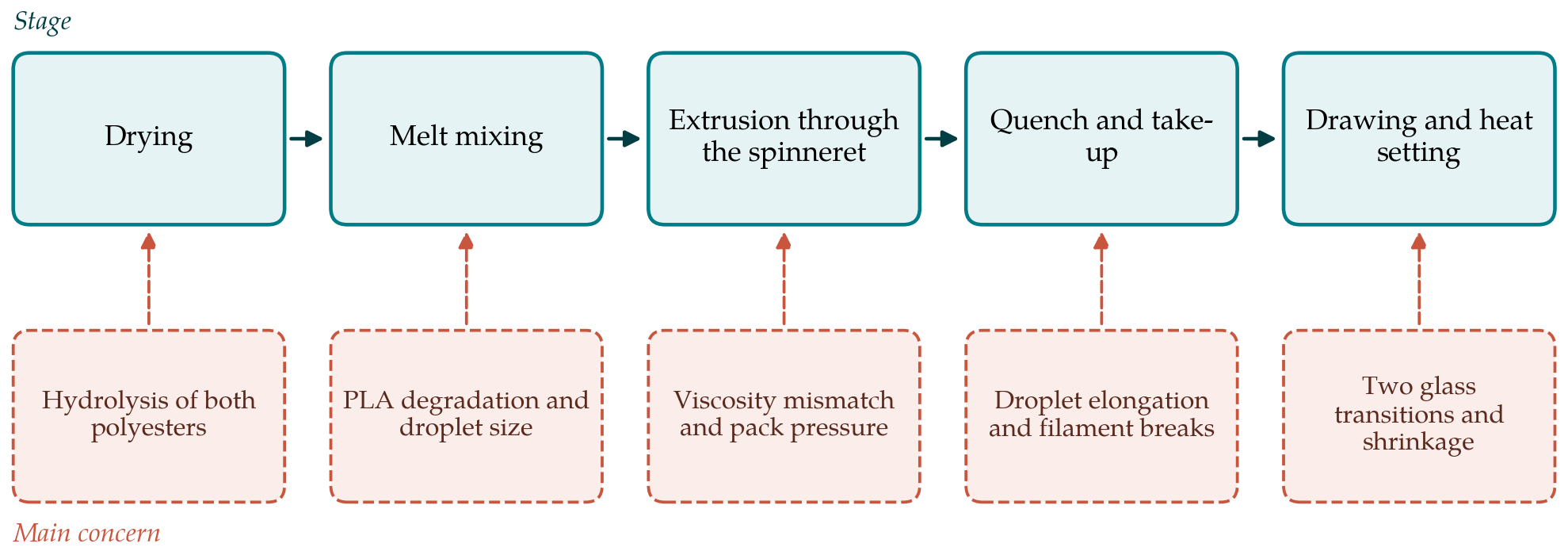
A spinning line imposes a sequence of operations, and the blend raises a different difficulty at each one. Figure 1 pairs the stages with the concern that dominates there. The subsections that follow take them in order.
5.1. Drying and melt preparation
Both polymers are condensation polyesters and both hydrolyse in the melt, so both must be dried to very low moisture content before extrusion. Their drying conditions differ. PET flake is normally crystallised and dried well above the temperature at which amorphous PLA softens and sticks, which means that the components have to be dried separately and combined at the extruder throat, or dried together under the milder conditions that PLA tolerates and for a correspondingly longer time (Lim et al., 2008). Moisture that survives drying affects both phases, but its consequences are worse for PLA, whose chains are already under thermal attack.
5.2. Extrusion and melt rheology
The melt must be brought above the melting point of PET, and it is at this step that the processing windows of the two polymers fail to overlap. The practical levers are those that shorten the exposure of PLA: a low melt temperature for PET, a short screw and transfer line, and late addition of the PLA through a side feeder. La Mantia et al. (2012) examined PET bottle material containing small proportions of PLA and concluded that even minor contamination altered the rheological response of the melt, with a less marked effect on the mechanical properties of the solid. For spinning, the rheological change is the one that counts. A two-phase melt with a low-viscosity dispersed phase tends to lower pack pressure and to show less elasticity than the matrix polymer alone, and volatile degradation products can form bubbles that break filaments below the spinneret.
5.3. Attenuation and structure formation
Between the spinneret and the take-up roll the thread is stretched many times over while it cools, and the flow is almost purely elongational (Ziabicki, 1976). Elongational flow deforms dispersed droplets far more effectively than shear, so the minor phase of an immiscible blend is drawn into long fibrils aligned with the filament axis. This is the principle behind microfibrillar composites, in which a blend of two polymers with different melting points is drawn and then processed at a temperature between them (Fakirov et al., 1993), and behind the islands-in-the-sea and other bicomponent constructions used commercially (Hufenus et al., 2020). In an rPET matrix with PLA as the minor phase, the PET solidifies first on cooling and the PLA fibrils remain molten inside a setting matrix. In the reverse case, PET domains freeze while the surrounding PLA is still fluid and act as rigid inclusions.
Either arrangement affects spinning stability. The instabilities of the spinline, among them draw resonance and cohesive fracture of the thread, are sensitive to the elongational viscosity of the melt and to how fast it rises on cooling (Ziabicki, 1976), and a coarse or weakly bonded dispersed phase supplies defects at which a filament can break. High-speed spinning of the separate polymers relies on stress-induced crystallisation to stabilise the thread, and the published work on PLA shows that this mechanism operates over a narrower range of conditions than in PET (Mezghani and Spruiell, 1998). How the two crystallisation processes interact in one filament has received little direct study.
5.4. Drawing and heat setting
Drawing is carried out a little above the glass transition, and heat setting well above it. A blend has two glass transitions some way apart, so a draw temperature suited to PET finds the PLA phase soft and unable to carry load, while one suited to PLA leaves PET too stiff to draw uniformly. Heat setting meets a harder limit, since the temperatures normally used to stabilise PET yarn approach or exceed the melting range of PLA. The expected outcome is a filament in which one phase is less oriented than it would be alone, and whose shrinkage reflects the less stable component (Farrington et al., 2005).
6. Fibre Properties and End of Life
The properties of PLA fibre that differ most from PET are its lower melting point, its lower modulus and its sensitivity to hydrolysis under hot, alkaline conditions, which is why PLA fabrics are dyed at lower temperatures and scoured more gently than polyester (Farrington et al., 2005; Gupta et al., 2007). A blended filament inherits the constraints of its weaker phase: ironing and heat-setting temperatures, dyeing conditions and alkaline finishing all have to be chosen with PLA in mind. Disperse dyes take up differently in the two polymers, so shade and fastness will depend on blend ratio and morphology.
The environmental case needs equal care. Life cycle studies support both the recycling of bottles into fibre and the production of PLA from renewable feedstock when each is taken separately (Shen et al., 2010; Vink et al., 2003). A fibre that mixes the two intimately is harder to place. PLA is unwelcome in PET recycling for exactly the reasons described above, and PET does not biodegrade under the composting conditions for which PLA is designed, so the blend may fit neither recovery route (Ragaert et al., 2017). A claim that the blended yarn is more sustainable than its components would have to be supported by an assessment that includes its own end of life.
7. Gaps and Future Work
Four gaps stand out. The first is the scarcity of spinning studies as opposed to studies of moulded or extruded blends: most of what is known about the pair comes from specimens that never experienced elongational flow. The second is the effect of real feedstock variability, since work with a single well-characterised lot says little about a recycler's month-to-month experience. The third is compatibilisation under spinning conditions, where reactive additives, interchange reactions and degradation compete on a timescale of minutes. The fourth is the fate of the blended fibre in laundering, in recycling and in the environment.
There is also a design question that the literature has not confronted directly. If the aim is a filament that contains both polymers, a bicomponent construction, in which each melt is prepared at its own temperature and the two meet only in the spin pack, avoids most of the thermal conflict that an intimate blend creates (Hufenus et al., 2020). Comparative work on blended and bicomponent routes at equal composition would show whether the blend offers anything that the bicomponent filament does not.
8. Conclusion
The published record supports a cautious view of rPET and PLA as a spinning blend. The two polymers are immiscible, their viscosities diverge at any common melt temperature, and the temperature required to melt the polyester degrades the polylactic acid. Each stage of the spinning line adds a compromise, from drying through to heat setting. None of these obstacles is unique to this pair, and the tools for dealing with them, including chain extension, reactive compatibilisation, short residence times and bicomponent spinning, are established. What is missing is direct evidence from spinning lines, on realistic recycled feedstock, that the resulting filament is good enough to justify the complication it introduces at the end of its life.
Conflict of interest
To be declared by the author(s) before publication.
Funding
To be declared by the author(s) before publication.