1. Introduction
The international agenda for disaster risk reduction now has a clear target for warning. The Sendai Framework calls for a substantial increase in the availability of, and access to, multi-hazard early warning systems and disaster risk information by 2030 (UNISDR, 2015), and the Early Warnings for All initiative led by the World Meteorological Organization set the aim of protecting every person by such systems by the end of 2027 (WMO, 2022). Much of the effort to meet these aims is directed at mobile technology: cell broadcast, location-based text messages and applications.
The emphasis is understandable, since mobile phones are the most widely held communication device in history. It also carries a risk. The places where disasters kill most readily, remote uplands, river deltas, small islands and the informal edges of cities, overlap heavily with the places where coverage is weakest, handsets are shared, charging is uncertain and the language of official messages is not the language spoken at home. The International Telecommunication Union estimated that roughly a third of the world's population was still offline in 2023 (ITU, 2023).
This article argues that community radio, meaning small non-profit stations run by and for a defined locality, remains necessary to disaster communication in such regions. The claim is not nostalgic and it is not that radio should be preferred to mobile alerts. It is that a warning system designed without local radio will fail a predictable set of people, and that the cost of including it is small.
2. Why Radio Fits the Problem
Some of the case is technical. A broadcast signal is received by any number of sets at once, so a transmitter cannot be overloaded by demand in the way a mobile cell is when everyone calls at the same moment. Receivers are inexpensive, last for years, run for long periods on dry batteries or a hand crank, and need no account, credit or literacy. A low-power FM station consists of equipment that fits in a vehicle and can be put back on air from a generator or a solar panel. Community radio handbooks have described this simplicity for decades as the reason the medium took root in poor and remote areas (Fraser and Restrepo Estrada, 2001).
The stronger part of the case is social. Community stations broadcast in local languages and dialects, are staffed by people known to their listeners and are accustomed to taking calls, messages and visitors. Myers (2011) reviewed the spread of such stations and their importance to rural audiences in developing countries. In India, where licences were at first restricted to educational institutions, the opening of the sector to community organisations followed a long campaign that Pavarala and Malik (2007) document. What these stations have in ordinary times, a trusted voice and a habit of two-way contact, is what emergency communication needs and cannot improvise.
3. Warning Is a Social Process
Research on public warnings has been consistent on one point since it was synthesised by Mileti and Sorensen (1990): people do not act on a warning simply because it has been issued. They hear it, try to understand it, decide whether to believe it, work out whether it applies to them, and look for confirmation from other sources and other people before they move. The Protective Action Decision Model formalises these stages and identifies the source of the message, the channel and social cues as influences at each (Lindell and Perry, 2012). Quarantelli (1988) made a related observation about emergency organisations: the recurrent failures lie in communication between agencies and with the public, far more often than in the technology.
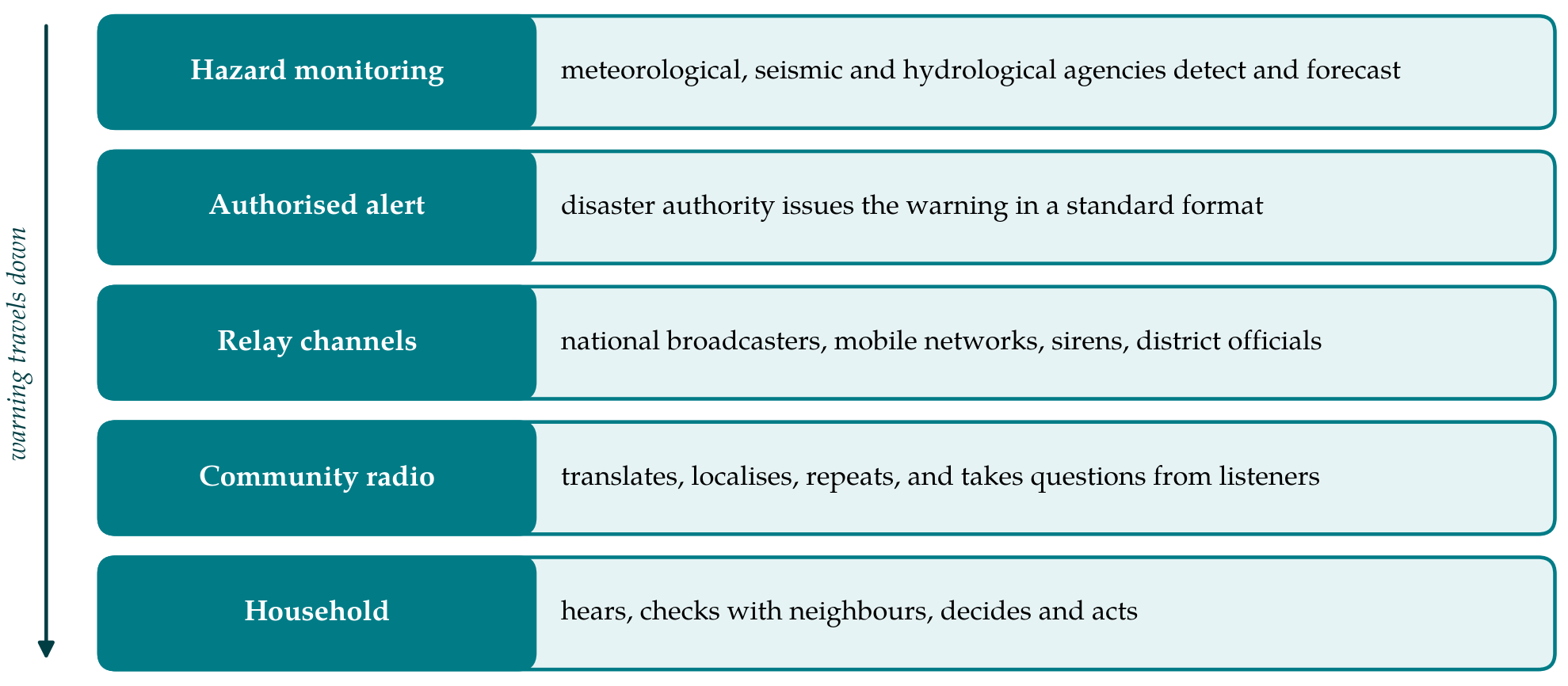
Seen in this light, a text alert and a local broadcast do different work. The alert is fast and uniform. The broadcast can say which villages lie below the embankment, which road is cut, where the shelter is and who has the key, and it can say so repeatedly in words the audience uses. It can also answer back. A presenter who takes questions on air is providing the confirmation that warning research says people will seek anyway. Consensus statements on crisis communication recommend partnership with the public, attention to its concerns and collaboration with credible sources (Seeger, 2006). A community station is such a source where it exists. Figure 1 places it in the chain from hazard detection to household action.
4. What Connectivity Promises and Where It Stops
Mobile and internet channels have changed disaster communication for the better. People affected by disasters use them to report, to find relatives and to organise help, a development reviewed after fifteen years of experience by Reuter and Kaufhold (2018). Standard message formats such as the Common Alerting Protocol allow one authorised alert to be sent over many channels at once (OASIS, 2010). None of this is in dispute.
The limits are equally well established. Mobile networks depend on towers, backhaul links and grid or generator power, all of which are exposed to wind, flood and ground shaking, and networks that survive are often congested. Handsets need charging. Social media reaches those who are connected, literate in a major language and already inclined to look. The humanitarian sector's own review of technology in disasters warned that digital tools can widen the gap between those who are reached and those who are not (IFRC, 2013). Table 1 compares the main channels on the properties that matter in a low-connectivity setting. The comparison is qualitative and general; particular places will differ.
| Channel | Works without mobile network or grid power | Local language and detail | Two-way exchange |
|---|---|---|---|
| Community radio | Yes, with battery sets and station backup power | Strong; normal practice | Call-ins, visits, messages on air |
| National or regional radio | Yes for listeners; studio distant | Limited to major languages | Rare during emergencies |
| Cell broadcast and SMS alerts | No; needs towers and charged handsets | Short text; few languages | None by design |
| Social media and messaging apps | No; needs data coverage | Depends on who posts | Strong where connected |
| Sirens and loudspeakers | Often, if independently powered | Signal only, or brief speech | None |
5. What Experience Records
The published record of community radio in disasters is made up largely of case accounts, and it should be read as such. It is nevertheless consistent. In Indonesia, community stations around Mount Merapi and in areas struck by earthquakes relayed hazard information and coordinated local response (Birowo, 2010), and research in Aceh after the 2004 Indian Ocean tsunami examined how local radio could be used to build preparedness (Romo-Murphy et al., 2011). In Japan, temporary emergency FM stations were licensed in municipalities affected by the 2011 Great East Japan Earthquake and tsunami, some growing out of existing community stations, and they carried information on water, food distribution, missing persons and reconstruction for long periods afterwards (Hibino and Shaw, 2014).
Two features recur in these accounts. The stations mattered most after the first hours, when the information people needed was no longer the warning itself but where to find supplies, services and one another. And their value depended on relationships formed before the event. Studies of recovery reach the same conclusion by another route: communities with dense social ties recover faster (Aldrich, 2012), and resilience is better understood as a set of networked capacities, including trusted sources of information, than as a stock of equipment (Norris et al., 2008). Capacity of that kind has to be built deliberately and in advance.
The limits of this evidence should be acknowledged. Accounts written after a disaster tend to come from places where a station was present and performed well, and stations that fell silent leave little trace in the literature. Comparative evaluation of how well warnings were received with and without local radio is scarce, and would be difficult to carry out. The argument made here therefore rests on the convergence of three kinds of knowledge, technical, behavioural and descriptive, and not on a measured effect.
6. Objections
Four objections deserve an answer. The first is reach. A low-power station covers a few kilometres and many localities have none. This is true and is an argument for licensing more stations and for treating them as one layer among several, not for leaving them out. The second is fragility. Community stations run on volunteers and small grants, and a station can itself be destroyed. Experience in Japan suggests that portable equipment and a legal route to emergency licences allow broadcasting to resume quickly (Hibino and Shaw, 2014), but only where both have been arranged in advance.
The third objection is accuracy. Volunteers under pressure may broadcast rumour, and an unofficial warning that proves wrong can damage trust in the next one. The remedy is a direct, tested connection between the station and the authorised alerting agency, together with training in what may and may not be said on the station's own authority. The fourth is that radio listening is declining as phones spread. Where that is so, the case weakens accordingly. It does not disappear, because the households that keep a radio and lack a reliable phone are disproportionately the older, poorer and more remote ones a warning system finds hardest to reach.
A further difficulty is political and should be stated plainly. Governments have often been reluctant to license broadcasters they do not control, and community radio has been restricted in many countries for reasons unrelated to spectrum. The long delay before community organisations in India could hold licences is one documented instance (Pavarala and Malik, 2007). Where that reluctance persists, the disaster case offers regulators a limited and practical reason to open the sector: a station that is licensed, known to the authorities and connected to the official alert feed is easier to work with in an emergency than an informal one that appears after the event.
7. Implications for Policy and Practice
If the argument is accepted, several modest measures follow. Regulators can license community broadcasting on terms that small organisations can meet, and can provide in advance for temporary emergency stations. Disaster management authorities can name local stations in district warning plans, include them in drills and supply them with authorised alerts in a standard format such as the Common Alerting Protocol, so that a station is relaying an official message and not interpreting a rumour (OASIS, 2010). Funders can pay for the unglamorous items that decide whether a station is on air when it is needed: a generator or solar supply, a spare transmitter, a mast built to withstand local hazards, and a stock of receivers for shelters.
Stations have obligations in return. They need a written emergency procedure, agreed contacts in the relevant agencies, presenters trained in the language of warnings and a habit of saying on air what is confirmed and what is not. Programmes on preparedness in ordinary times, of the kind studied in Aceh (Romo-Murphy et al., 2011), build the audience and the credibility on which an emergency broadcast depends. None of this competes with investment in mobile alerting. It completes it at the pillar of the Early Warnings for All plan concerned with warning dissemination and communication, where the distance between an issued alert and an informed household is greatest (WMO, 2022).
8. Conclusion
The reasons community radio serves disaster communication well are not new, and that is the point. They are properties of broadcast physics and of local social life that the spread of mobile networks has not altered: a signal that does not congest, a receiver that needs little, a voice that listeners know and can question, a language they speak. In well-connected regions these may now be reserve capacities. In low-connectivity regions they remain the difference between a warning that has been issued and one that has been heard, understood and believed. Planning should treat local stations as part of the warning system and equip them accordingly, before the next event tests the arrangement.
Conflict of interest
To be declared by the author(s) before publication.
Funding
To be declared by the author(s) before publication.