1. Introduction
Psoriasis is common, visible and lifelong. Estimates of its prevalence differ considerably between countries and populations (Parisi et al., 2013), and the World Health Organization has recognised it as a serious noncommunicable disease with a heavy burden of stigma and impaired quality of life (World Health Organization, 2016). Chronic plaque psoriasis, the usual form, follows a course of exacerbation and partial remission over decades. Conventional treatment can control it and, with modern biologic agents, often clear it, but treatment is continuous, costly, and not without risk (Armstrong and Read, 2020).
It is unsurprising that many people with psoriasis turn to other systems of medicine. In India, Ayurveda is a recognised part of the health system, and its physicians treat skin disease routinely (Sharma et al., 2007). The distinctive Ayurvedic offering for a chronic condition of this kind is Panchakarma, a programme of bodily purification followed by palliative medicines and a prescribed regimen. Accounts of psoriasis clearing after Panchakarma circulate widely in clinics, in journals of Ayurveda and among patients.
This article reviews what is known. It was prompted by a simple observation about the form in which such accounts usually appear: a description of one treated person, with photographs before and after a course of therapy. The review asks what evidence of that kind can show, how it relates to the other evidence available, and why the duration of follow-up, taken here as at least twelve months, is central to interpreting any claim of benefit in a disease that waxes and wanes without intervention.
2. Scope and Approach
The review is narrative. It draws on standard dermatological sources for the nature and measurement of psoriasis, on the classical Ayurvedic account of skin disease, on published reviews of complementary medicine in psoriasis, and on methodological guidance for case reports and for trials of traditional medicine. It does not present a systematic search, and it does not pool results. The Ayurvedic clinical literature on psoriasis is scattered across journals of uneven indexing, so the characterisation of it given here is general and should be read as such. No new clinical observations are reported.
3. Two Accounts of the Disease
Any assessment of Ayurvedic treatment for a biomedically defined disease has to begin by noting that the two systems describe the condition differently. The accounts are summarised briefly here.
3.1. Plaque psoriasis in biomedicine
Plaque psoriasis presents as sharply demarcated, red, scaling plaques, typically on the extensor surfaces, scalp and lower back. Histologically the epidermis is thickened by accelerated keratinocyte turnover, with dilated dermal vessels and an inflammatory infiltrate (Griffiths and Barker, 2007). The disease is now understood as immune-mediated, driven by interaction between dendritic cells, T cells and keratinocytes in genetically predisposed individuals, with the interleukin-23 and interleukin-17 pathway and tumour necrosis factor as the main effector signals (Nestle et al., 2009). It is associated with psoriatic arthritis and with cardiometabolic comorbidity, and it is provoked by trauma to the skin, infection, certain drugs and psychological stress (Boehncke and Schön, 2015). Its natural course is variable. Plaques may persist unchanged for years, flare, or recede for a time without any treatment, and many patients improve in summer.
3.2. Kushtha in Ayurveda
The classical texts treat skin disease under the heading of kushtha, of which the Caraka Samhita describes eighteen varieties, seven major and eleven minor (Sharma, 1981). No single variety corresponds exactly to psoriasis. Authors most often equate plaque psoriasis with ekakushtha, characterised in the text by absence of sweating, extensive lesions and scaling likened to the scales of a fish, or with kitibha, described as dark, rough and hard to the touch, and sometimes with sidhma. All forms of kushtha are held to arise from derangement of the three dosha acting on skin, blood, muscle tissue and body fluid, and the disease is regarded as deep-seated and prone to recur.
Two features of this account bear on the present question. The first is that treatment is directed at the underlying derangement and not at the lesion, which is the rationale for systemic purification. The second is that the text does not envisage a single curative course. It instructs that emesis, purgation, bloodletting and nasal therapy be repeated at stated intervals over the long term in a person with kushtha (Sharma, 1981). The classical expectation, in other words, is of a chronic condition managed by periodic intervention, and that expectation is compatible with the dermatological one.
4. Panchakarma Procedures Used in Psoriasis
Panchakarma means five procedures, though in practice it denotes a structured sequence in three phases, shown in Figure 1. The preparatory phase aims to mobilise the morbid dosha. It begins with medicines to improve digestion, followed by internal oleation, in which medicated ghee is drunk in increasing amounts over several days, and then by external oil massage and sudation. Bitter medicated ghees are the customary choice in skin disease.
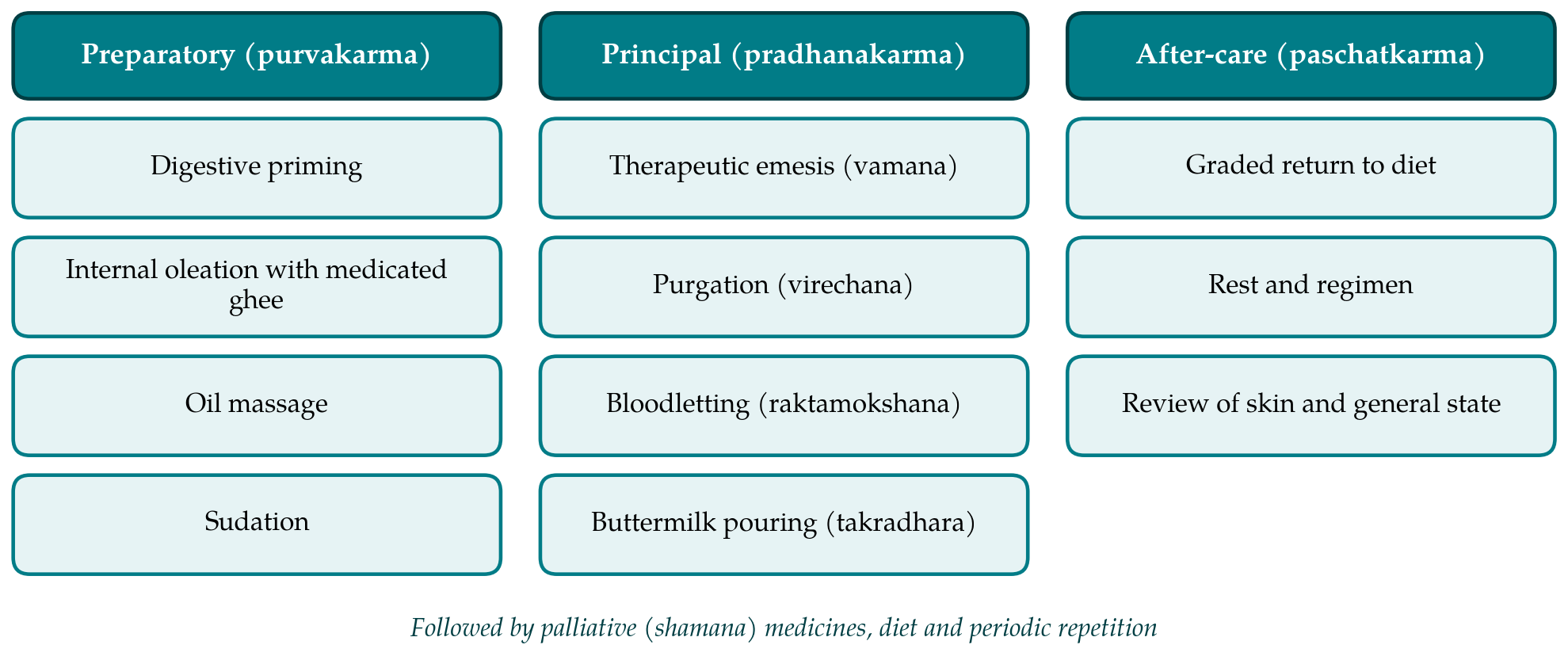
The principal phase is eliminative. Therapeutic emesis (vamana) and purgation (virechana) are the procedures most often used in psoriasis, chosen according to the predominant dosha and the strength of the patient, and bloodletting (raktamokshana) has classical sanction in kushtha. In Kerala practice, pouring of medicated buttermilk over the head or body (takradhara) is widely employed. The after-care phase restores the diet in graded steps. Palliative treatment then continues with oral compound medicines and external oils, together with advice on diet and conduct (Conboy et al., 2009). A course is thus a package of many components delivered over weeks, individualised to the patient, and followed by months of medication. Any claim about "Panchakarma" is a claim about this whole package.
5. What the Published Literature Contains
The evidence bearing on Panchakarma in psoriasis is of several kinds, and they differ sharply in what they can support. Table 1 sets them side by side.
| Kind of evidence | What it can show | Main limitation |
|---|---|---|
| Single case report | That a course was feasible and was followed by improvement in one person | Cannot separate treatment effect from natural fluctuation |
| Case series | A pattern of response across several treated people | Selection of favourable cases; no comparator |
| Uncontrolled before-and-after study | Average change in a severity score over a course | Regression to the mean; seasonal change; short follow-up |
| Trial of a single botanical | Effect of one defined product against placebo or standard care | Does not test the individualised whole regimen |
| Randomised trial of the whole regimen | Comparative effectiveness of the package | Blinding is difficult; such trials are scarce in psoriasis |
| Safety and product-quality reports | Hazards of procedures and of contaminated products | Denominators are usually unknown |
5.1. Case reports and uncontrolled studies
Most of what has been published on Panchakarma for psoriasis consists of individual case reports, small series and uncontrolled studies from teaching hospitals of Ayurveda. They typically describe a course of oleation followed by emesis or purgation, then oral medicines, and report a fall in a severity score or clearance of plaques on photographs at the end of treatment. Such reports have real uses. As Vandenbroucke (2001) argued, case reports are where unexpected effects, new approaches and hypotheses first enter the literature. They can document exactly what was done, which matters for a therapy as variable as this one.
Their limits are just as clear. A report of success is more likely to be written and published than a report of failure. A person usually seeks treatment during a flare, when subsequent improvement is probable whatever is done. A residential course removes the patient from work, alcohol and other triggers, supplies rest and daily attention, and applies oils that are emollient in their own right. Conventional medicines may have been stopped recently or continued alongside. None of these alternative explanations can be excluded from within a single case.
5.2. Controlled evidence
Reviews of complementary and alternative medicine in psoriasis have found the controlled trial evidence limited and concentrated on individual agents, with little on traditional whole systems (Smith et al., 2009; Talbott and Duffy, 2015). The single-agent trials give mixed results. An open-label trial of oral curcumin recorded a low response rate (Kurd et al., 2008). Topical Aloe vera was superior to placebo in one double-blind study (Syed et al., 1996) and no better than placebo in another (Paulsen et al., 2005). These studies are informative about the products tested, but they say little about a multi-component, individualised regimen.
Trials of whole Ayurvedic regimens are feasible, as work in other conditions has shown. A double-blind pilot trial compared classical Ayurvedic treatment, methotrexate and their combination in rheumatoid arthritis (Furst et al., 2011), and a randomised trial compared a complex Ayurvedic programme with conventional care in osteoarthritis of the knee, with follow-up to twelve months (Kessler et al., 2018). Comparable work in psoriasis has yet to appear in the mainstream dermatological literature.
6. Outcome Measurement and the Twelve-Month Horizon
Whether a report can be compared with others depends on what was measured and for how long. Dermatology has standard instruments. The Psoriasis Area and Severity Index combines the extent of involvement with the redness, thickness and scaling of plaques in four body regions into a single score (Fredriksson and Pettersson, 1978), and the proportion of patients reaching a seventy-five per cent reduction is the conventional benchmark of response. The Dermatology Life Quality Index records the effect of skin disease on daily life from the patient's side (Finlay and Khan, 1994). A European consensus has defined treatment goals in terms of both (Mrowietz et al., 2011). Ayurvedic reports that use these instruments, scored by an assessor who did not deliver the treatment and supported by standardised photographs, can be read alongside the dermatological literature. Reports that rely on symptom grades devised for the occasion cannot.
Duration is the more neglected issue. An assessment at the end of a four- or six-week course captures the point at which emollient, rest and expectation effects are at their height. Psoriasis is defined by relapse, so the informative questions are how long improvement lasts, how severe the recurrence is, and what maintenance was needed. Twelve months is a reasonable minimum horizon for three reasons. It spans a full cycle of seasons, which removes the confounding effect of summer improvement. It is long enough for a relapse to declare itself after any plausible carry-over of treatment. And it matches the classical instruction that purification be repeated periodically, so that the regimen is observed as the texts intend it to be used.
Follow-up of that length raises its own reporting demands. The account should state every intervention received during the year, including conventional topical or systemic drugs, phototherapy and further Ayurvedic courses, with dates. Severity and quality-of-life scores should be recorded at fixed intervals and not only when the skin looks well. A relapse criterion should be defined in advance. The CARE guidelines for case reports provide a suitable structure, including a timeline and the patient's own perspective (Gagnier et al., 2014).
7. Safety
Panchakarma is an intervention with physiological cost. Induced vomiting and purgation can cause dehydration and electrolyte disturbance, and the classical texts themselves list the persons in whom they are contraindicated and the complications of faulty administration. Large oral doses of ghee are a consideration in a population already prone to cardiometabolic disease. Psoriasis can also be worsened by skin injury, which is relevant to bloodletting and to vigorous massage. Published accounts seldom report adverse events systematically, and absence of mention is not evidence of absence.
The medicines given after purification raise a separate issue. Surveys of Ayurvedic products sold in the United States and over the Internet found that a substantial minority contained detectable lead, mercury or arsenic (Saper et al., 2004; Saper et al., 2008). Some classical formulations used in skin disease include processed metals and minerals by design. Reports should therefore identify each product, its manufacturer and batch, in the manner recommended for trials of herbal interventions (Gagnier et al., 2006). A further hazard is indirect: abrupt withdrawal of systemic conventional therapy in order to begin Ayurvedic treatment can precipitate a severe flare.
8. Gaps and Future Work
Three steps would move the field forward. The first is better case reporting: CARE-compliant accounts with validated scores, independent assessment, complete disclosure of concurrent treatment and follow-up to twelve months or beyond, including cases that relapsed. The second is prospective registries in Ayurvedic hospitals that enrol consecutive patients with plaque psoriasis, so that the denominator is known and favourable cases are not selected. The third is a pragmatic randomised comparison of an individualised Panchakarma-based programme with guideline-based dermatological care, using shared outcome measures and blinded assessment, on the model already applied in joint disease. Product quality testing should accompany all three.
9. Conclusion
The belief that Panchakarma benefits chronic plaque psoriasis rests on classical authority, clinical experience and a body of case reports and uncontrolled studies. That body of work shows that the treatment is practised, is acceptable to patients, and is often followed by improvement. It does not yet show that the improvement is caused by the treatment or that it lasts. Because the disease remits and relapses of its own accord, observation over at least twelve months, with standard measures and full disclosure of other treatment, is the least that a credible report requires. Patients considering this route are best served by physicians of both systems who share information and keep conventional options open.
Conflict of interest
To be declared by the author(s) before publication.
Funding
To be declared by the author(s) before publication.