1. Introduction
Pharmaceutical manufacturing has been moving, slowly, from batch to continuous operation. The case was made on quality and agility grounds by authors from the United States Food and Drug Administration (Lee et al., 2015) and on cost grounds by comparative economic analysis (Schaber et al., 2011). An end-to-end pilot plant that carried a drug from chemical intermediates to finished tablets in one continuous train showed that the idea was technically feasible (Mascia et al., 2013). Regulatory guidance has followed, most recently in the form of the ICH Q13 guideline on continuous manufacturing (ICH, 2022).
A continuous line has no natural pause at which material is held and tested. Assurance of quality has to come from measurement and from models that connect what is measured to what matters. This is why the language of the digital twin has been taken up so readily in the sector. A virtual counterpart of the line that is kept current by plant data promises real-time knowledge of where every portion of material is and what state it is in.
The promise and the practice are not the same. This review asks three questions of the published literature. What counts as a digital twin, and how mature are the examples reported for continuous pharmaceutical processes? How should such a twin be validated when it bears on product quality? And what stands in the way of wider use?
2. Approach of the Review
The article is a narrative review of the published literature. It draws on review articles and perspectives in pharmaceutical engineering and process systems engineering, on the general literature on digital twins in manufacturing, on textbooks and papers on the verification and validation of simulation models, and on regulatory guidelines. Sources were chosen for their standing and relevance. No systematic search was performed, and the review does not attempt to count or classify every publication. It reports no new data and no case from any particular company.
3. What a Digital Twin Is and Is Not
The concept is usually traced to Grieves, who described a physical product, its virtual counterpart and the flows of data and information that tie them together (Grieves and Vickers, 2017). The aerospace community gave it a demanding form: a simulation of an individual as-built vehicle that uses the best physical models, sensor updates and service history to mirror the life of that vehicle (Glaessgen and Stargel, 2012). Later reviews found that the term had spread across manufacturing with very uneven meaning (Jones et al., 2020).
The most useful clarification is that of Kritzinger et al. (2018), who classify by the direction of automatic data flow. In a digital model, data pass between the physical and virtual objects only by hand. In a digital shadow, data flow automatically from the physical object to the virtual one, so that the model follows the plant. Only when the flow is automatic in both directions, and a change in the virtual object can alter the physical one, do they speak of a digital twin. Wright and Davidson (2020) make a related point: a twin is a model of a specific object that is updated by measurements of that object and is useful only so long as it is accurate enough for its purpose. By these tests a flowsheet simulation run in the development laboratory is a model, however detailed it may be.
4. Building Blocks for Continuous Lines
The components from which a twin of a continuous line might be assembled are well developed individually. They fall into process models, measurement, and control.
4.1. Process models
For solid oral dosage lines, the route of feeders, blenders, granulators or roller compactors, and tablet presses, the central description is the residence time distribution of each unit and of the line. It shows how a disturbance at a feeder is spread and delayed before it reaches the tablet press, and it is the basis for tracing raw material lots and for deciding which product to divert (Engisch and Muzzio, 2016). Flowsheet models connect unit models into a dynamic simulation of the whole line and allow sensitivity analysis across units (Boukouvala et al., 2012). Population balance and discrete element models describe particle-level phenomena in more detail, at a computational cost that usually rules out real-time use. Ierapetritou et al. (2016) give an overview of these methods for powder-based processes and of what limits them.
Where mechanistic knowledge is partial, as it often is for powders, hybrid models combine balance equations with data-driven submodels for the parts that are poorly understood. The review by von Stosch et al. (2014) sets out the structures available and their advantages in extrapolation over purely empirical models. For a twin, the attraction of the hybrid form is that the data-driven part can be re-estimated as plant data accumulate while the conservation laws stay fixed.
4.2. Measurement and control
The data link from plant to model rests on process analytical technology, a framework that the FDA set out two decades ago (FDA, 2004) and that has since supplied near-infrared and Raman spectroscopy, among other tools, for in-line measurement of blend and tablet composition. The link back from model to plant rests on the control system. Myerson et al. (2015) describe the control engineering required for continuous lines, and Su et al. (2019) argue for a shift from quality by design towards what they call quality by control, in which active process control, built on models, is the primary means of assuring quality. A closed-loop twin in the sense of Kritzinger and colleagues would be one implementation of that idea.
5. Maturity of Reported Work
If the published work is ordered by the degree of coupling between model and plant, four stages can be distinguished, as in Figure 1. The ordering is this review's own arrangement of the categories of Kritzinger et al. (2018), with the twin divided into advisory and closed-loop forms because the two carry very different validation burdens in a regulated plant.
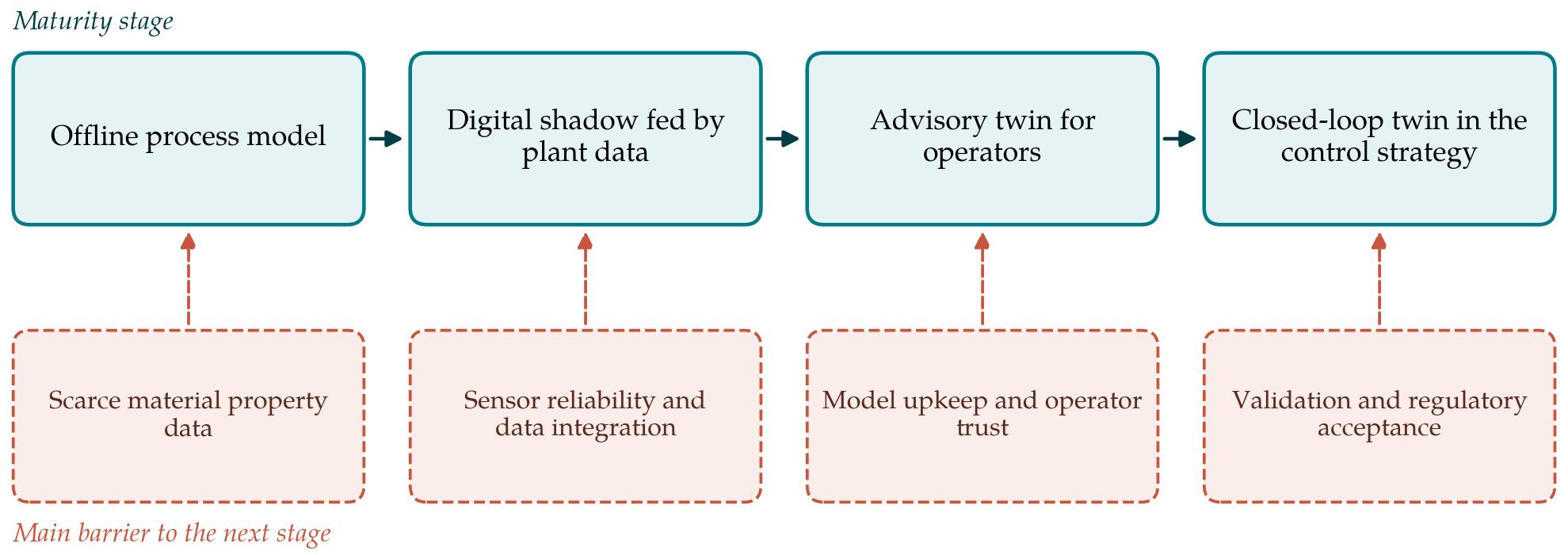
The review of Chen et al. (2020), which covers both small-molecule and biopharmaceutical manufacturing, concluded that the pieces of a twin, the models, the sensors and the data platforms, had each advanced, but that their full integration into a twin with automatic two-way exchange was at an early stage. That assessment matches the picture given by earlier perspectives on the field (Ierapetritou et al., 2016; Rantanen and Khinast, 2015). Most published examples sit at the first two stages: models built and exercised offline, and models that receive plant data for monitoring, material tracking or soft sensing. Demonstrations of model-based control on pilot lines exist and are important, but they are generally presented as control studies and not as twins maintained over a product's commercial life. Table 1 summarises the stages with the typical use of each and what its validation must cover, and adds as a final row the special case of a twin that supports real-time release.
| Stage | Data link with the plant | Typical use | What validation must cover |
|---|---|---|---|
| Offline model | Manual, in both directions | Process design, sensitivity analysis, design space studies | Fit to development data for the stated purpose |
| Digital shadow | Automatic from plant to model | Monitoring, material tracking, soft sensing | Model accuracy plus integrity of the incoming data |
| Advisory twin | Automatic to model; a person acts on the output | Decision support, diversion advice, what-if studies | Accuracy, uncertainty statement, human use of advice |
| Closed-loop twin | Automatic in both directions | Model-based control, automated diversion | All of the above plus controller and failure behaviour |
| Twin supporting release | Automatic, within the quality system | Real-time release testing | High-impact model expectations (ICH, 2011) |
6. Validation and Credibility
Validation is where the digital twin meets the particular demands of a regulated industry. Three bodies of guidance bear on it, and none was written for twins as such.
6.1. Pharmaceutical guidance on models
The quality by design framework of ICH Q8 allows a manufacturer to use enhanced process understanding, including models, to justify a design space and a control strategy (ICH, 2009). The implementation working group for ICH Q8, Q9 and Q10 later classified models as of low, medium or high impact according to their contribution to assuring product quality, and tied the extent of validation and documentation to that classification (ICH, 2011). A model used only in development is low impact. A model that is the sole predictor of a quality attribute for release is high impact. ICH Q13 carries this thinking into continuous manufacturing and discusses process models, residence time distributions and material diversion as elements of the control strategy (ICH, 2022). The implication for twins is direct: the same underlying model moves up the impact scale as it moves along the maturity scale of Table 1.
6.2. General principles of verification and validation
The simulation literature distinguishes verification, which asks whether the equations are solved correctly, from validation, which asks whether they are the right equations for the intended use (Oberkampf and Roy, 2010). Sargent (2013) stresses that a model is validated for a purpose and over a domain, never in general, and lists techniques from comparison with historical data to extreme-condition tests. The ASME V&V 40 standard, written for medical devices, turns this into a risk-informed procedure: state the question of interest and the context of use, assess model risk from the influence of the model on the decision and the consequence of a wrong decision, and set credibility goals in proportion (ASME, 2018). Its logic resembles that of the ICH impact classification and could be borrowed for process twins, although it has no formal status in drug manufacturing.
6.3. What is different for a twin
A twin adds two things that conventional model validation does not address well. The first is change over time. A model that is re-estimated from plant data is not the model that was validated, and the manufacturer needs a rule for when an update is a routine recalibration and when it is a change requiring fresh validation. Guidance on computerised systems, such as Annex 11 of the European good manufacturing practice rules and the GAMP 5 guide, covers software lifecycle, data integrity and change control (European Commission, 2011; ISPE, 2022), but says little about models that learn. The second is the data link itself. A twin can be wrong because a sensor has drifted, a spectroscopic calibration no longer suits a new raw material lot, or a time stamp is misaligned. Validation therefore has to extend to the detection of such faults and to the behaviour of the twin when its inputs are unreliable.
7. Barriers
The barriers named in the literature are consistent across sources. Material properties come first. Powder flow, cohesion and compaction behaviour are hard to measure, vary between lots, and enter the unit models as parameters that are often fitted and not predicted (Ierapetritou et al., 2016). A twin inherits that weakness and is tested by it whenever a new lot or supplier is introduced. Measurement is the second barrier: in-line spectroscopic probes foul, sample a small volume of a moving powder stream, and depend on multivariate calibrations that must themselves be maintained.
Integration and upkeep form the third group. Plant data sit in control systems, historians, laboratory systems and batch records that were not designed to feed a common model, and the engineering needed to join them is substantial (Chen et al., 2020). Once built, the twin needs people who understand both the process and the model for as long as the product is made, a commitment of skills that Rantanen and Khinast (2015) identified as a general constraint on the manufacturing sciences. The fourth barrier is uncertainty about regulatory expectations for adaptive models, which makes the conservative choice, a fixed model with a narrow role, the rational one for many firms. Finally, the economic argument is harder to make for a twin than for continuous manufacturing itself, because the benefits, fewer deviations and faster investigations, are diffuse and difficult to attribute.
Two structural obstacles complete the list. A twin with a path back to the plant is a new route by which a fault or an intrusion can reach the process, and it has to be protected and qualified with that in mind. The data integrity principles that regulators summarise as attributable, legible, contemporaneous, original and accurate apply to the inputs and outputs of a model as they do to any other record. In addition, equipment suppliers, control system vendors and modelling tools each bring their own formats and interfaces. A twin built for one line is therefore hard to move to another, and each implementation remains close to bespoke, which keeps the cost high and the pool of shared experience small.
8. Gaps and Future Work
Several needs follow. Published accounts that follow a twin through technology transfer, routine production and post-approval change would be more informative than further demonstrations of individual models. A credibility framework written for process twins, combining the ICH impact levels with the context-of-use reasoning of V&V 40, would give developers and assessors a common language. Methods for quantifying and displaying the uncertainty of twin predictions to operators deserve attention, since an advisory twin is only as good as the use people make of it. And open benchmark problems for continuous lines, with shared models and data, would let competing approaches be compared on equal terms, which is not possible at present.
The coverage of the literature is also uneven. Solid oral dosage lines, with their feeders, blenders and tablet presses, appear to have received the most attention, and continuous synthesis and crystallisation of the drug substance rather less under the heading of the digital twin, although both fall within the scope of ICH Q13 (ICH, 2022). Work that carries a single twin architecture across drug substance and drug product, where a disturbance in the first arrives as raw material variation in the second, would test whether the concept scales beyond one unit train. It would also show how residence time models of separate sections should be joined for the purpose of tracing material.
9. Conclusion
Measured against a strict definition, digital twins of continuous pharmaceutical lines are still uncommon in the published record. The components exist: residence time and flowsheet models, hybrid modelling methods, in-line analysers and model-based control. What is mostly missing is their sustained integration and a settled view of how a model that changes with the plant should be validated. Progress is likely to be stepwise, from shadow to advisory twin to closed loop, with the validation burden rising at each step. Treating maturity and model impact as two sides of one question would help manufacturers decide how far along that path a given product justifies going.
Conflict of interest
To be declared by the author(s) before publication.
Funding
To be declared by the author(s) before publication.