1. Introduction
For roughly two decades the only drugs shown to slow the progression of chronic kidney disease were blockers of the renin-angiotensin system. That changed in an unexpected way. Inhibitors of sodium-glucose cotransporter 2 (SGLT2), licensed as glucose-lowering agents, were found in the cardiovascular outcome trial EMPA-REG OUTCOME to reduce cardiovascular death (Zinman et al., 2015), and a secondary analysis of the same trial reported fewer kidney events in the treated group (Wanner et al., 2016). The CANVAS programme pointed the same way (Neal et al., 2017). These were trials in people with type 2 diabetes and, for the most part, well-preserved kidney function, so the kidney findings were suggestive and no more.
Dedicated kidney trials followed. CREDENCE confirmed the benefit in diabetic kidney disease with heavy albuminuria (Perkovic et al., 2019). The question that mattered for nephrology as a whole was whether the effect belonged to diabetes or to the kidney. Since the glucose-lowering action of these drugs weakens as filtration falls, while the kidney benefit in CREDENCE did not, there was reason to think that hyperglycaemia was not required. This review examines the evidence that has since accumulated in people with chronic kidney disease who do not have diabetes.
2. Scope and Approach
This is a narrative review of the published literature. It concentrates on the randomised outcome trials that enrolled participants without diabetes, their prespecified secondary analyses, the main collaborative meta-analysis, mechanistic studies that bear on a glucose-independent effect, and current international guidelines. It does not attempt a systematic search or a new quantitative synthesis. Findings are described in words where possible, and readers are referred to the primary reports for effect estimates and their confidence intervals.
3. Why a Glucose-Lowering Drug Might Protect a Non-Diabetic Kidney
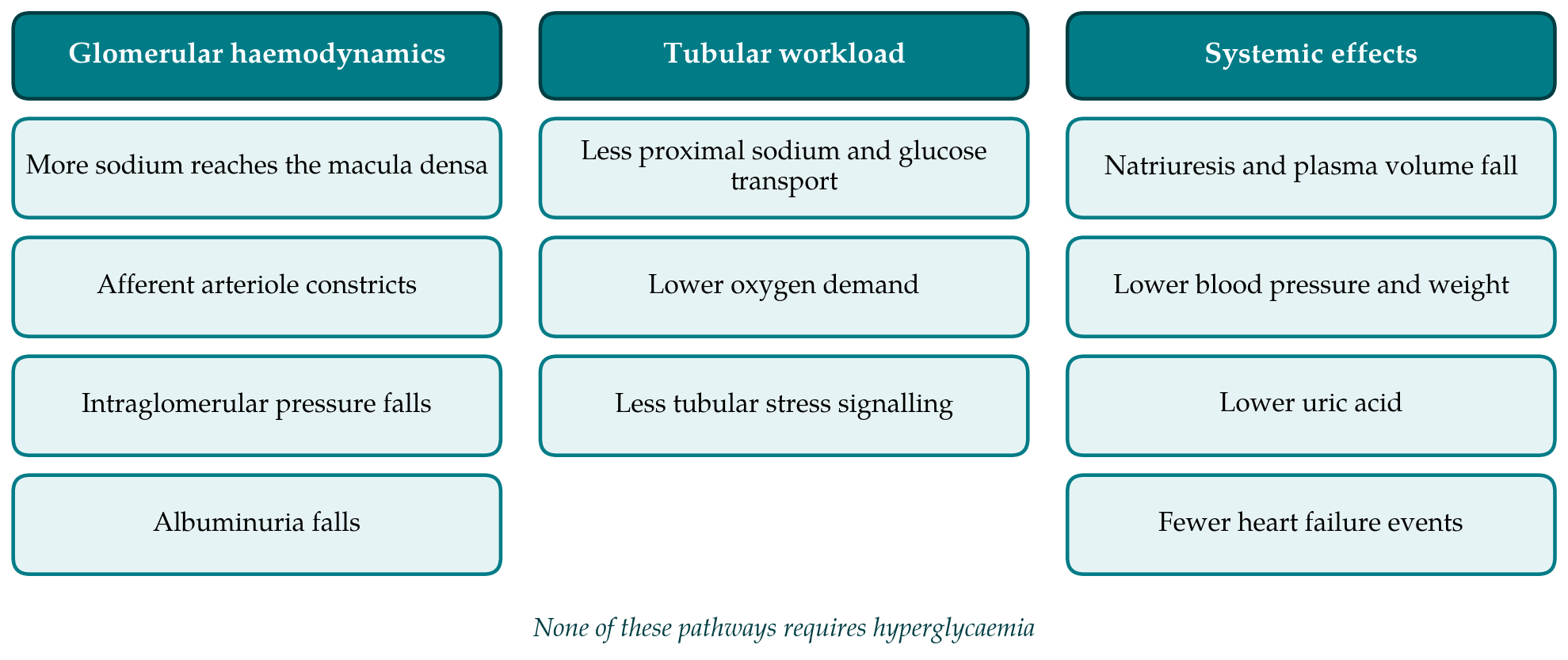
SGLT2 sits in the early proximal tubule and reabsorbs most of the filtered glucose together with sodium. Blocking it sends more sodium and chloride downstream to the macula densa. The macula densa reads this as a sign of excessive filtration and, through tubuloglomerular feedback, signals the afferent arteriole to constrict. Glomerular capillary pressure falls. Cherney et al. (2014) demonstrated this haemodynamic response directly in people with type 1 diabetes and hyperfiltration, and it provides the most widely accepted account of the early, reversible dip in estimated filtration rate seen when the drugs are started (Heerspink et al., 2016).
The relevance to non-diabetic disease follows from the hyperfiltration theory. Brenner and colleagues argued that when nephrons are lost for any reason the survivors take on a greater share of filtration, and that the raised pressure within them causes further sclerosis and further loss (Brenner et al., 1996). On this view glomerular hypertension is a shared final pathway of progressive kidney disease, and a drug that relieves it should help whatever the original insult. Renin-angiotensin blockade lowers glomerular pressure by dilating the efferent arteriole; SGLT2 inhibition does so from the afferent side, which may explain why the two appear to act additively.
Other mechanisms have been proposed, and Figure 1 groups them. Proximal tubular cells spend much of their energy on sodium transport, and reducing that work may lower oxygen demand in a region of the kidney that operates close to hypoxia (Vallon and Thomson, 2017). Systemically the drugs cause a modest natriuresis, with small falls in blood pressure, body weight and uric acid. Experimental work suggests effects on inflammation and fibrosis, though how much these contribute in patients is not established. In people without diabetes the filtered glucose load is smaller, so glycosuria is less, yet the sodium-linked effects persist.
4. Outcome Trials That Enrolled People Without Diabetes
Three groups of trials supply the clinical evidence: two dedicated kidney outcome trials, a set of heart failure trials in which many participants had reduced kidney function, and one small mechanistic crossover trial. Table 1 lists them with the features most relevant to non-diabetic disease.
| Trial | Population | Participants without diabetes | Relevance to kidney outcomes |
|---|---|---|---|
| DAPA-CKD (Heerspink et al., 2020) | Chronic kidney disease with albuminuria | About one third | Primary kidney outcome reduced; consistent by diabetes status |
| EMPA-KIDNEY (EMPA-KIDNEY, 2023) | Chronic kidney disease, wide range of albuminuria | More than half | Progression or cardiovascular death reduced |
| DIAMOND (Cherney et al., 2020) | Proteinuric kidney disease, short crossover | All | Reversible fall in measured filtration; proteinuria unchanged |
| DAPA-HF (McMurray et al., 2019) | Heart failure, reduced ejection fraction | More than half | Kidney outcomes secondary |
| EMPEROR-Reduc ed (Packer et al., 2020) | Heart failure, reduced ejection fraction | About half | Slower decline in filtration rate |
| EMPEROR-Preser ved (Anker et al., 2021) | Heart failure, preserved ejection fraction | About half | Kidney outcomes secondary |
| DELIVER (Solomon et al., 2022) | Heart failure, mildly reduced or preserved ejection fraction | More than half | Kidney outcomes secondary |
4.1. DAPA-CKD
DAPA-CKD randomised adults with reduced filtration rate and raised urinary albumin to dapagliflozin or placebo on top of renin-angiotensin blockade, with or without type 2 diabetes (Heerspink et al., 2020). The trial was stopped early on the advice of its monitoring committee because of clear efficacy. The primary outcome, a composite of a sustained halving of estimated filtration rate, kidney failure, or death from kidney or cardiovascular causes, occurred substantially less often with dapagliflozin, and death from any cause was also reduced. A prespecified analysis found the relative benefit to be similar in participants with and without diabetes (Wheeler et al., 2021a). Among those without diabetes the commonest diagnoses were ischaemic or hypertensive nephropathy and chronic glomerulonephritis.
4.2. EMPA-KIDNEY
EMPA-KIDNEY was designed to widen the tested population (EMPA-KIDNEY, 2023). Participants could enter with a low filtration rate regardless of albuminuria, or with better filtration and albuminuria above a set level, so that people with little or no albuminuria were deliberately included. More than half had no diabetes. This trial too was stopped early for efficacy. Empagliflozin lowered the risk of the primary composite of kidney disease progression or cardiovascular death, and the result did not differ by diabetes status. The relative effect on the primary outcome appeared smaller in those with low albuminuria, in whom few events occurred during a short follow-up, although the long-term slope of filtration rate was slower with treatment across the albuminuria range. That subgroup pattern is the main point of uncertainty the trial leaves.
4.3. Heart failure trials and pooled evidence
The heart failure trials were not designed around kidney endpoints, but they enrolled many people without diabetes and with moderately reduced kidney function, and they recorded kidney outcomes (McMurray et al., 2019; Packer et al., 2020; Anker et al., 2021; Solomon et al., 2022). A collaborative meta-analysis combined the large placebo-controlled trials across diabetes, heart failure and kidney disease populations and compared effects by diabetes status (Nuffield Group, 2022). It found that the proportional reduction in kidney disease progression was closely similar in people with and without diabetes, as was the reduction in acute kidney injury and in the composite of cardiovascular death or hospitalisation for heart failure. This pooled result is the firmest basis for treating the kidney benefit as a property of the drug class in chronic kidney disease generally.
4.4. What a mechanistic trial adds
DIAMOND was a small crossover trial of dapagliflozin given for several weeks to people with proteinuric kidney disease and no diabetes (Cherney et al., 2020). Measured filtration rate fell during treatment and recovered after it, as the haemodynamic account predicts, but proteinuria did not change significantly. The finding is a reminder that the long-term benefit seen in the outcome trials cannot be read off from short-term changes in urinary protein, and that surrogate responses in individual patients should be interpreted cautiously.
5. Evidence by Cause of Kidney Disease
Chronic kidney disease without diabetes is a collection of conditions, and clinicians reasonably ask whether the trial results apply to each. The best data concern IgA nephropathy. In a prespecified analysis of DAPA-CKD restricted to participants with that diagnosis, most of it biopsy-proven, dapagliflozin reduced the primary outcome markedly (Wheeler et al., 2021b). The number of events was small and the placebo group progressed faster than expected, so the size of the effect is uncertain, but the direction is clear and EMPA-KIDNEY, which enrolled more participants with glomerular disease, found no sign of a different effect by primary diagnosis.
For focal segmental glomerulosclerosis the corresponding DAPA-CKD analysis included few participants and too few events to draw a conclusion, although the decline in filtration rate was numerically slower with treatment (Wheeler et al., 2022). For other glomerular diseases there is essentially no direct evidence. Both outcome trials excluded people with polycystic kidney disease and kidney transplant recipients, and both restricted entry of people who had recently received intensive immunosuppression. The KDIGO guideline on glomerular diseases accordingly treats SGLT2 inhibition as part of general supportive care for proteinuric disease and not as a substitute for disease-specific immunotherapy (KDIGO, 2021).
6. Safety in People Without Diabetes
The adverse effects of the class were characterised in diabetes, and several of them depend on glucose. Hypoglycaemia is not expected in people without diabetes because the drugs do not stimulate insulin, and the outcome trials did not find an excess. Diabetic ketoacidosis, the most feared metabolic complication, was very rare overall in the pooled analysis and occurred essentially only in people with diabetes (Nuffield Group, 2022). Genital mycotic infections are linked to glycosuria and are less frequent when less glucose is excreted. Symptoms of volume depletion can occur, particularly alongside diuretics, and patients are commonly advised to pause treatment during acute illness with reduced intake. The initial fall in estimated filtration rate is haemodynamic and was not associated with harm in trial analyses; in fact acute kidney injury was less frequent with active treatment.
7. What Guidelines Now Recommend
The 2024 KDIGO guideline for chronic kidney disease gives a strong recommendation to treat adults who have chronic kidney disease with a filtration rate above the lower limit studied in the trials and either albuminuria above a moderate threshold or heart failure, irrespective of diabetes. It adds a weaker suggestion to treat those with moderately to severely reduced filtration and lower albuminuria (KDIGO, 2024). The difference in strength reflects the EMPA-KIDNEY subgroup findings described above. The guideline also advises that treatment, once started, can be continued as filtration declines below the starting threshold until kidney replacement therapy begins.
8. Gaps and Future Work
Several groups seen daily in nephrology clinics fall outside the evidence. People with chronic kidney disease and normal albumin excretion, many of them older with vascular disease, progress slowly, and a trial would need long follow-up to detect an effect on hard kidney endpoints. Whether the slower decline in filtration seen in this subgroup translates into fewer cases of kidney failure is not known. Autosomal dominant polycystic kidney disease was excluded from the outcome trials, and the mechanism of cyst growth gives no strong reason to predict benefit or harm. Kidney transplant recipients were excluded as well; in them the balance may be altered by immunosuppression and a higher background risk of urinary and genital infection.
Other open questions concern timing and combination. Evidence for starting treatment at very low filtration rates or during dialysis is lacking. Type 1 diabetes was excluded from the kidney trials because of ketoacidosis risk. In active glomerular disease the interaction with immunosuppression has not been studied. Finally, the non-steroidal mineralocorticoid receptor antagonist finerenone has outcome data only in diabetic kidney disease (Bakris et al., 2020), so the value of layering newer agents on SGLT2 inhibition in non-diabetic disease rests on extrapolation for now.
9. Conclusion
The evidence that SGLT2 inhibitors slow progression of chronic kidney disease in people without diabetes is consistent across two large outcome trials and a collaborative meta-analysis, and it is supported by a coherent haemodynamic mechanism. It is strongest for proteinuric disease, including IgA nephropathy. It is weaker for disease without albuminuria and absent for polycystic kidney disease, transplant recipients and several other groups. Clinicians can apply the trial results with confidence to patients who resemble the trial participants, and should recognise when a patient does not.
Conflict of interest
To be declared by the author(s) before publication.
Funding
To be declared by the author(s) before publication.