1. Introduction
Since Darwin described the mechanisms by which orchid flowers place their pollen on insects (Darwin, 1862), the family has served as a test case for ideas about pollination. One observation recurs across that long record: most orchid flowers are never pollinated. Surveys of natural fruit set across the family find that the majority of flowers in most species fail to produce a capsule, and that the shortfall is greatest in species that offer no nectar (Neiland and Wilcock, 1998; Tremblay et al., 2005). Low fruit set is therefore the normal condition of an orchid population, and not in itself a sign of trouble.
The difficulty for conservation is that this normal condition leaves little margin. Orchids make up a large part of the flora assessed as threatened, and habitat loss is the cause most often named (Swarts and Dixon, 2009; Fay, 2018). What remains of a species is frequently a handful of small stands in a transformed landscape. If pollinators visit such stands less often than they visited the continuous population, a reproductive rate that was already low may fall further.
This review asks how far the published evidence supports that concern. It follows the reproductive pathway in order: whether pollinators reach the plants, whether pollen is removed and delivered, whether capsules and viable seeds result, and whether seed output matters for the persistence of the population. Throughout, it separates what has been shown for orchids from what is inferred from other plant families.
2. Scope and Approach
The article is a narrative review of the published literature. It relies on the major syntheses of pollen limitation and of fragmentation effects on plant reproduction, on the standard works of orchid biology, and on field studies of individual orchid species that are widely cited in those sources. No systematic search was carried out, and no quantitative pooling of results is attempted. Where a statement rests on one study, the species and setting are named so that the reader can judge how far it may be generalised. The emphasis is on terrestrial and epiphytic orchids pollinated by insects, since these account for nearly all of the available evidence.
3. Why Orchids Are Exposed to Pollination Failure
Three traits of the family shape its response to any reduction in pollinator service. They are considered here because they determine which of the general findings on fragmentation can be carried over to orchids and which cannot.
3.1. Pollen packaged in pollinia
In most orchids the pollen of a flower is aggregated into a small number of pollinia, which are removed as a unit with an adhesive viscidium attached (Johnson and Edwards, 2000). A single successful visit can fertilise the very large number of ovules in an ovary, which is how one capsule comes to hold thousands of dust-like seeds (Arditti and Ghani, 2000). The reverse also holds. A flower that receives no pollinium sets no seed at all, and there is no partial success of the kind that occurs when a bee deposits a few loose grains on the stigma of a daisy or a legume. Female success in an orchid population is thus spread very unevenly among flowers, and it depends on a small number of events.
3.2. Deception and rarity of visits
Roughly a third of orchid species are thought to offer their pollinators nothing. Some imitate the general appearance of rewarding flowers, and others imitate the scent and form of female insects and are pollinated by males attempting to mate (Jersáková et al., 2006). Insects learn to avoid unrewarding flowers, so visits are infrequent and are often made by inexperienced individuals. One proposed advantage is that deceived pollinators leave the plant quickly and travel farther, which favours outcrossing; pollen movement over long distances has been documented in the sexually deceptive Caladenia tentaculata (Peakall and Beattie, 1996). For present purposes the point is practical: a deceptive orchid in intact habitat already receives few visits.
3.3. Narrow pollinator relationships
Many orchids are pollinated by one species or one functional group of insects, a pattern that floral morphology enforces because the pollinarium must attach to a particular part of a particular body (Dressler, 1981). Specialisation of this kind means that the orchid has no substitute if its pollinator disappears from a fragment. It also means that the needs of the pollinator, such as larval host plants, nesting substrate or, for sexually deceived wasps, the female insects themselves, become part of the habitat requirement of the plant. These needs are often met outside the patch in which the orchid grows.
4. How Fragmentation Alters Visitation
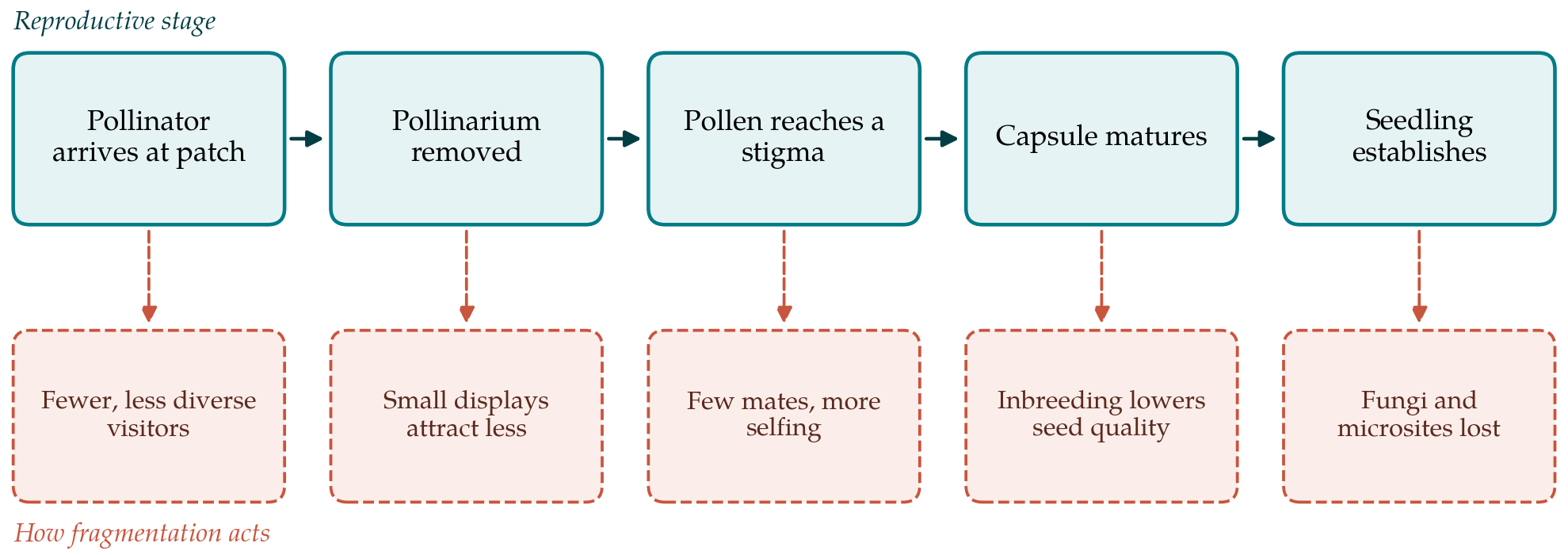
Fragmentation changes several things at once: the area of habitat, the number and density of plants within each remnant, the distance between remnants and the nature of the land between them (Rathcke and Jules, 1993). Each can affect pollinators separately. Small or sparse floral displays attract fewer foragers, and plants in them may receive fewer visits per flower, an instance of the Allee effect in which individual fitness declines at low density (Stephens et al., 1999). The classic demonstration in a non-orchid is the work of Ågren (1996) on the self-incompatible herb Lythrum salicaria, in which seed production per flower rose with population size and the difference was removed by adding pollen by hand.
Pollinator communities themselves are altered. Declines in the abundance and diversity of wild pollinators have been reported from several regions, with habitat loss, pesticides, pathogens and climate change among the drivers (Potts et al., 2010). Figure 1 places these influences against the stages of orchid reproduction at which each acts. The most direct orchid evidence comes from Murren (2002), who studied the epiphyte Catasetum viridiflavum, pollinated by male euglossine bees, on forested islands created by the flooding of Lake Gatún in Panama and at mainland sites. That study measured pollinator activity, pollinarium viability and reproductive success together, which is the design needed to locate where along the pathway a deficit arises.
The broadest synthesis is the meta-analysis of Aguilar et al. (2006), which pooled studies of many plant families and found a consistent negative effect of fragmentation on pollination and on reproductive output. Self-incompatible species were more strongly affected than self-compatible ones. Against expectation, plants with specialised pollination were not clearly more susceptible than generalists. The authors suggested that generalist plants may lose their most effective visitors while retaining poor ones. The result is a caution against assuming that a specialised orchid must suffer more than its neighbours; the outcome depends on whether its particular pollinator persists in the altered landscape.
5. From Visits to Capsules and Seeds
Pollen limitation, the condition in which seed production is constrained by the quantity or quality of pollen received, is widespread among flowering plants (Burd, 1994; Ashman et al., 2004; Knight et al., 2005). Orchids are among the families in which hand pollination most reliably raises fruit set (Tremblay et al., 2005). The inference that fewer visits in fragments mean fewer capsules is therefore secure in outline. Two qualifications matter when the question is seed set and not fruit set.
The first concerns pollen quality. In a small stand a pollinator moving between neighbouring flowers is likely to transfer pollinia within a plant or between close relatives. Many orchids are self-compatible, so capsules still form, yet the seeds inside may carry the costs of inbreeding. Small populations also lose genetic variation by drift, and reduced gene flow between remnants prevents its replacement (Ellstrand and Elam, 1993). A count of capsules can therefore conceal a decline in the proportion of seeds that contain a viable embryo. Studies that stop at fruit set cannot detect this.
The second concerns resources. Maturing a capsule is costly, and plants compelled to do so by supplemental pollination may grow or flower less in later seasons. Ackerman and Montalvo (1990) showed this in the tropical epiphyte Epidendrum ciliare: hand pollination increased fruit production at once, and the plants paid for it afterwards. A single season of pollen supplementation thus tends to overstate lifetime pollen limitation, a point made for plants in general by Ashman et al. (2004). Table 1 summarises the field measures in common use, the step of the pathway each addresses and its principal weakness.
| Measure | What it shows | Main limitation |
|---|---|---|
| Timed observation of visitors | Identity and frequency of flower visitors | Visits are rare; a visitor is not always a pollinator |
| Pollinarium removal counts | Male function; that a visitor of the right size came | Removed pollinia may be lost and never reach a stigma |
| Pollinium deposition on stigmas | Female success per flower | Does not reveal the pollen donor or its relatedness |
| Natural fruit set | Realised capsule production | Says nothing of seed number or embryo viability |
| Supplemental hand pollination | Degree of pollen limitation (Knight et al., 2005) | One season overstates the lifetime effect |
| Seed viability staining | Proportion of seeds with a living embryo | Laborious; viability is not germination in the field |
| Buried seed packets | Germination in situ with native fungi (Rasmussen and Whigham, 1993) | Slow, and outcomes vary strongly between microsites |
Methods for the first rows of the table are described in the standard manual of Kearns and Inouye (1993). Counts of removed and deposited pollinia are a particular strength of orchid work, because they give a record of pollinator activity that accumulates over the life of the flower and does not require an observer to be present during the rare visit.
6. Whether Seed Output Limits the Population
A decline in seed set matters for conservation only if the population is limited by seed. For orchids this cannot be assumed. Their seeds lack endosperm and depend on infection by a compatible mycorrhizal fungus to germinate and to pass through the protocorm stage (Rasmussen, 1995). Each capsule releases so many seeds that a population may be saturated with them while very few land where the fungus and the right conditions coincide. The seed packet technique of Rasmussen and Whigham (1993) made it possible to test this directly by burying seeds in mesh and recovering them later, and it has shown that germination is patchy at fine scales.
Demographic analysis points the same way. Calvo and Horvitz (1990) used transition matrix models of orchid demography to ask how fitness would respond to higher pollination once the cost of fruiting was included. Their analysis showed that the gain depends heavily on that cost and can be small, so that a rise in fruit set does not translate directly into population growth. In long-lived perennials the survival of established plants usually has more influence on population growth than fecundity does. Short-lived orchids, and those whose adult plants are being lost to grazing or collection, are the cases in which recruitment from seed is most likely to be decisive.
7. Implications and Open Questions
For managers the literature supports a few working rules. Fruit set should be compared with values from large populations of the same or a closely related species, since a low figure alone is uninformative. Hand pollination is a reasonable emergency measure where capsules have ceased to form, provided that pollen is moved between unrelated plants and that the plants are not exhausted by repeated fruiting. Protection of the pollinator's own resources, which often lie outside the reserve boundary, deserves as much attention as protection of the orchid (Swarts and Dixon, 2009).
Several questions remain poorly answered. Few studies of threatened orchids follow the whole pathway from visit to seedling in the same populations, so the stage at which fragmentation bites hardest is usually unknown. Seed quality, as distinct from capsule number, is seldom reported. Tropical epiphytes, which make up most of the family, are represented by a handful of studies. Long records are scarce, yet fruit set in orchids varies so much between years that one or two seasons can mislead. Finally, the interaction between pollinator loss and loss of mycorrhizal fungi in degraded remnants has hardly been examined, although both are plausible consequences of the same disturbance.
8. Conclusion
The evidence that fragmentation reduces pollinator visitation and fruit production in plants is strong, and the biology of orchids gives every reason to expect that they share in it. Evidence that reduced seed set drives the decline of threatened orchid populations is thinner and depends on the life history of the species and on what else limits recruitment. Studies that measure visitation, pollinium transfer, seed viability and seedling establishment together, over several years, would do most to tell managers when pollination is the problem to solve and when effort is better spent elsewhere.
Conflict of interest
To be declared by the author(s) before publication.
Funding
To be declared by the author(s) before publication.