1. Introduction
Wheat is a crop of cool seasons grown, across a large part of its area, in places where the cool season ends abruptly. On the Indo-Gangetic Plain the crop is sown as the monsoon heat fades and harvested in a spring that warms by the week. The same pattern holds, with local variations, in the Yaqui Valley of Mexico, the Nile valley, the Mediterranean rim and the Australian wheatbelt. Heat that arrives during flowering and grain filling is called terminal heat stress because it comes at the end of the crop's life and usually ends it early.
Global analyses leave little doubt about the scale of the problem. A multi-model assessment concluded that world wheat production falls by about six per cent for each further degree Celsius of warming (Asseng et al., 2015), and simulation work for Australia showed that the damage is driven less by changes in the seasonal mean than by hot days during grain filling (Asseng et al., 2011). A general review of the physiology of heat in the reproductive and grain-filling phases is given by Farooq et al. (2011).
Plant scientists distinguish tolerance, the capacity to keep functioning at high tissue temperature, from escape, in which the sensitive stages simply occur before the heat arrives. Escape is the less glamorous route and the more accessible one. It is controlled by two choices made before the seed is in the ground. This review asks what the literature shows about those choices: how far earlier sowing and better-matched cultivars can move the crop out of harm's way, and what stops them moving it further.
2. Approach of the Review
The review is narrative. It draws on the physiological literature on high temperature in wheat, on field studies of sowing date and cultivar duration from South Asia, Mexico and Australia, and on the genetic literature on flowering time, and it does not claim to have covered these systematically. Growth stages are named in the terms of the decimal code of Zadoks et al. (1974). Quality effects of heat on grain protein and dough properties are outside the scope, as is drought, although in rainfed systems the two stresses seldom arrive separately.
3. How Late-Season Heat Reduces Yield
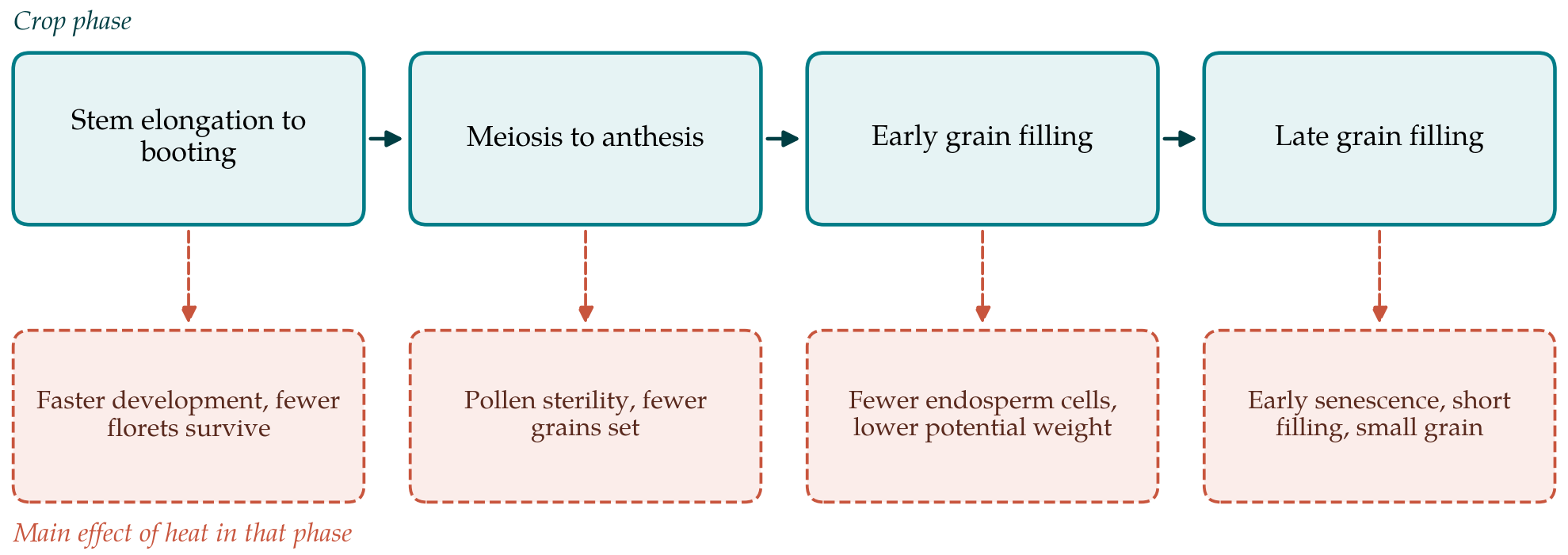
Yield in wheat is the product of grains per unit area and weight per grain, and heat acts on each at a different time. Figure 1 sets the phases of the crop against the principal effect of high temperature in each. The distinction matters for escape, because a sowing date that protects grain filling may still leave anthesis exposed, and the reverse.
3.1. Grain number
Grain number is largely settled in the few weeks before anthesis, when the spike is growing rapidly inside the stem. Fischer (1985) showed that kernel number per square metre depends on the ratio of solar radiation to temperature in that window: warmth hastens development, shortens the period of spike growth and leaves fewer fertile florets. A second, sharper mechanism operates at meiosis. Short episodes of high temperature at that stage disrupt pollen formation and can leave florets sterile (Saini and Aspinall, 1982), and later controlled-environment work identified two periods of particular sensitivity, one around meiosis and one close to anthesis itself (Prasad and Djanaguiraman, 2014).
3.2. Grain weight
After anthesis, the rate of grain growth rises with temperature but the duration falls faster, so final grain weight declines once mean temperatures move above the mid-teens Celsius (Wardlaw and Wrigley, 1994). The synthesis of cardinal temperatures by Porter and Gawith (1999) places the optimum for grain filling near 20 °C, well below the temperatures common in April on the Gangetic plain. Very hot days add damage of a different kind. A few days of very high temperature after anthesis can cut grain weight to a degree that differs widely among cultivars (Stone and Nicolas, 1994), and satellite observations over northern India indicate that days above 34 °C hasten canopy senescence more than crop models had assumed (Lobell et al., 2012).
4. Sowing Date as an Escape
If heat is a matter of the calendar, the first remedy is to change the calendar. Sowing-date experiments at Ludhiana in the Indian Punjab showed grain yield falling steadily as sowing was delayed past the optimum in November, with the loss traceable to higher temperatures and a shorter grain-filling period (Ortiz-Monasterio et al., 1994). Similar responses have been described wherever irrigated spring wheat is grown through a warming spring. The agronomic rule that follows, sow on time, is among the oldest in the extension literature. The harder question is why so much wheat is still sown late.
Late sowing is penalised twice. The crop meets warmer weather during grain filling, which is the effect usually emphasised, and it also passes through its vegetative and spike-growth phases under lengthening days and rising temperatures, so that it reaches anthesis with less biomass and fewer florets, the photothermal effect described by Fischer (1985). A late crop is therefore smaller before the heat arrives as well as shorter-lived after it. This is why extra seed and fertiliser, the customary compensation for late sowing, recover only part of the loss, and why the date itself is the variable to manage.
4.1. The preceding crop in rice-wheat systems
In the rice-wheat rotation the answer lies with the rice. Long-duration and late-transplanted rice is harvested in November, and the conventional sequence of residue removal, repeated tillage and pre-sowing irrigation takes further weeks, a delay that is most severe in the eastern plains (Joshi et al., 2007). Zero tillage attacks this delay directly. By drilling wheat into the undisturbed rice field, farmers gain days to weeks, and the review by Erenstein and Laxmi (2008) attributes a good part of the yield advantage of zero-tilled wheat to earlier sowing. Machines such as the Happy Seeder, which sows through standing rice stubble (Sidhu et al., 2007), remove the need to clear residue first. Satellite records suggest that sowing has in fact moved earlier across much of north-west India, with a measurable benefit to yield trends (Lobell et al., 2013).
4.2. Frost and the optimal flowering period
Earlier is not always better. In southern Australia a crop that flowers too soon meets frost, and one that flowers too late meets heat and terminal drought. Flohr et al. (2017) used simulation to define, site by site, the optimal flowering period in which the combined risk is least, and the target for growers is to land anthesis inside it. Projections indicate that this window shifts as the climate warms, although frost risk does not disappear as fast as intuition would suggest (Zheng et al., 2012). Sowing date therefore cannot be considered apart from the rate at which the cultivar develops. A given flowering date can be reached by sowing a fast cultivar late or a slow one early, and the two options do not yield the same.
5. Cultivar Choice
Cultivars contribute to escape in two ways: through phenology, which determines when the sensitive phases occur, and through traits that lessen the damage when heat arrives anyway. Table 1 sets the main options side by side with their mechanisms and limits.
| Option | How it works | Main limit | Key sources |
|---|---|---|---|
| Timely sowing | Places anthesis and grain filling in cooler weeks | Late harvest of the preceding crop; frost | Ortiz-Monasterio et al., 1994 |
| Zero tillage or drilling into residue | Removes the turnaround delay after rice | Machinery access; residue management | Erenstein and Laxmi, 2008; Sidhu et al., 2007 |
| Early-maturing cultivar | Finishes grain filling before peak heat | Lower yield potential in cool seasons | Mondal et al., 2013 |
| Slow-developing cultivar sown early | Long vegetative phase, flowering still on time | Needs early soil water; suitable genotypes | Hunt et al., 2019 |
| Cooler canopy | Transpiration lowers tissue temperature | Requires available water | Reynolds et al., 1994 |
| Stay-green and stem reserves | Sustain supply of assimilate to the grain | Expression varies with environment | Cossani and Reynolds, 2012 |
5.1. Phenology
Time to flowering in wheat is governed by the response to vernalisation, the response to photoperiod and a residual component known as earliness per se (Slafer and Rawson, 1994). The major genes behind the first two, the Vrn and Ppd series, are well characterised (Distelfeld et al., 2009), and breeders can combine alleles to produce almost any duration. For the hot, short seasons of the eastern Gangetic plain and central India the consistent finding is that earliness pays. Lines selected for early heading and high yield performed well across South Asian sites under both terminal and season-long heat (Mondal et al., 2013), and short-duration cultivars are the standard recommendation for late-sown fields.
Earliness has a price. A crop that hurries to anthesis intercepts less radiation and builds a smaller canopy and spike, so in a cool year or under timely sowing it yields less than a longer-season type. The Australian response to this trade-off has been to go the other way: cultivars with a strong vernalisation requirement are sown weeks earlier than usual, develop slowly through winter and still flower in the optimal period, with higher yield than fast spring types sown at the conventional time (Hunt et al., 2019). Whether that strategy transfers to irrigated South Asia, where the field is occupied by rice until late autumn, is doubtful, but it shows that escape is a matter of matching and not simply of speed.
5.2. Traits that soften the damage
Among cultivars of the same duration, some lose less yield in hot seasons. In hot, irrigated environments the better-yielding lines had cooler canopies, higher stomatal conductance and more stable cell membranes (Reynolds et al., 1994). A cool canopy is evidence of free transpiration, and so of roots that reach water, which makes irrigation scheduling during grain filling a partner of cultivar choice. Cossani and Reynolds (2012) organise such traits by their effect on light interception, radiation use efficiency and partitioning, and list delayed senescence and remobilisation of stem carbohydrate among the candidates. Progress is real but uneven: genetic gains measured in international nurseries were smaller in the hottest environments than in cooler ones (Gourdji et al., 2013).
6. Limits of Escape and Open Questions
Escape has a ceiling. Each of its instruments runs into a boundary: sowing cannot move earlier than the preceding crop, the seedbed temperature or the frost calendar allows, and cultivars cannot be shortened indefinitely without giving up yield. Warming narrows the room from both sides, since autumn heat penalises very early sowing through poor establishment and fast early development, while spring heat arrives sooner. The projections cited at the outset imply that the cool window itself is contracting, and a shrinking window can be occupied more skilfully but not enlarged.
Several questions remain open. The first concerns interaction: most sowing-date experiments use the cultivars of their day, and the best date for a new cultivar with different phenology genes is seldom tested before release. The second concerns the system. Advancing wheat by shortening or advancing rice involves a trade between the two crops that single-crop trials do not capture. The third is spatial. Recommendations are issued for large zones, yet the optimal flowering period differs between neighbouring districts. The fourth is the reliability of thresholds. Figures such as 34 °C come from particular data sets, and their transfer to other canopies, humidity regimes and irrigation practices needs checking.
7. Conclusion
Sowing on time with a cultivar whose development fits the season remains the most dependable defence against terminal heat in wheat, and both parts of that advice are better understood than they were a generation ago. The mechanisms of damage point to two targets, the weeks around anthesis and the period of grain filling, and the sowing date and flowering genes that determine exposure can now be chosen with some precision. The constraint in farmers' fields is more often the preceding crop than any lack of knowledge, which is why tillage and residue practices belong in a discussion of heat. Escape will not be sufficient as temperatures rise further, and it is best regarded as the base on which tolerance traits are added.
Conflict of interest
To be declared by the author(s) before publication.
Funding
To be declared by the author(s) before publication.