1. Introduction
Nurses on understaffed wards know a particular end to a shift: going home aware that a dying patient was not turned as often as he should have been, that a frightened relative was given two minutes when she needed twenty, and that a dose was late because six other things were due at the same time. Nothing in this is a dilemma. The nurse knew what good care required, and the ward did not have enough nurses to give it. The feeling that follows has had a name for four decades.
Jameton (1984) called it moral distress and defined it as arising when one knows the right thing to do, but institutional constraints make it nearly impossible to pursue the right course of action. The word that carries the definition is "institutional". Yet as the concept has spread, the response of many employers has been directed at the nurse and not at the institution. Staff who report distress are offered resilience workshops, mindfulness applications and reminders to look after themselves.
This Perspective argues that moral distress is better understood, measured and managed as a property of the conditions in which nurses work. It is a workforce issue in two senses: it is produced by workforce conditions such as staffing and skill mix, and it feeds back into the workforce through burnout and departure. Individual resilience has a place in the account, and it is a small one.
2. What Moral Distress Is
Since Jameton, the concept has been elaborated and contested. Corley (2002) proposed a theory linking moral distress to nurses' moral commitments, competence and autonomy, and to consequences for patients, nurses and organisations. Epstein and Hamric (2009) described moral residue, the feeling that lingers after a morally distressing episode, and a crescendo effect in which each new episode builds on what earlier ones left behind. A narrative synthesis of definitions concluded that what the various accounts share is a moral event, psychological distress, and a causal link between the two (Morley et al., 2019).
How the phenomenon is measured is revealing. The most recent widely used instrument, the Measure of Moral Distress for Healthcare Professionals, asks respondents how often and how intensely they experience a list of situations, and its authors group the root causes at the levels of the patient, the team and the system (Epstein et al., 2019). The items concern such matters as providing care with staffing levels perceived as unsafe, lacking resources, working with colleagues who are not competent, and following orders for treatment believed to be futile. Almost none describes a deficiency in the respondent. The scale is, in effect, a checklist of working conditions answered by the people best placed to observe them.
3. How the Resilience Framing Took Hold
The turn towards resilience is understandable. Burnout among nurses became a prominent concern, and interventions aimed at individuals are cheaper and quicker to arrange than changes to staffing. Resilience also carries an appealing message of strength. In critical care, Rushton (2016) introduced moral resilience as the capacity to sustain or restore integrity in response to moral adversity, and work from the same group associated resilience with lower burnout among nurses in high-intensity settings (Rushton et al., 2015).
The difficulty lies less in the concept than in its use. When resilience training is the main or the only organisational response, it carries an implication: that distress reflects a shortfall in the person who feels it. Physicians writing about their own profession made the point sharply when they argued that what is labelled burnout is often a moral injury inflicted by a system that prevents clinicians from doing what patients need (Dean et al., 2019). Nurse scholars had said something similar earlier, warning that an individualised reading of moral distress obscures the structures that produce it and proposing that it be read as a signal of problems in the practice environment (Varcoe et al., 2012).
4. The Argument: Moral Distress Tracks Working Conditions
The case for treating moral distress as a workforce issue rests on three observations from the published literature. The first is that the situations nurses identify as distressing are overwhelmingly matters of resource and organisation. A quantitative review of studies using moral distress scales found that the most frequently reported sources included inadequate staffing and care judged to be futile, and that moral distress was associated with the intention to leave a position (Oh and Gastmans, 2015).
The second observation is that moral distress varies with features of the organisation. Studies have repeatedly found it to be lower where nurses rate the ethical climate of their workplace more favourably (Pauly et al., 2009), and a systematic review of its correlates listed poor ethical climate and poor collaboration among the conditions associated with higher distress, alongside lower job satisfaction and a greater wish to leave (Lamiani et al., 2017). If distress were chiefly a matter of personal fragility, it would not be expected to cluster by unit and institution in this way.
The third observation connects moral distress to what is known about staffing. Large observational studies have associated higher patient loads with higher nurse burnout and job dissatisfaction, as well as with patient mortality (Aiken et al., 2002). When nurses have too many patients, care is left undone, and the activities most often omitted are those nurses regard as central to their role: comforting and talking with patients, educating them, and planning care (Ball et al., 2014). Missed care of this kind is the constraint in Jameton's definition made visible. The nurse knows what ought to be done and the roster does not allow it. Table 1 contrasts the two readings of the problem and what follows from each.
| Question | Individual resilience reading | Workforce reading |
|---|---|---|
| Where is the cause? | In the coping capacity of the nurse | In constraints set by staffing, resources and hierarchy |
| What is measured? | Personal resilience and wellbeing scores | Moral distress by unit, with staffing and missed care |
| Who is responsible? | The nurse, supported by wellbeing services | Employers, funders and regulators, with nurses |
| Typical response | Resilience training, mindfulness, counselling | Safe staffing, ethics support, voice in decisions |
| Marker of success | Nurses report coping better | Fewer constraining situations; lower turnover |
| Main risk | Blames the person and leaves causes intact | Slow and costly; neglects those suffering now |
The same logic is familiar from research on burnout. Maslach and Leiter (2016) describe burnout as arising from a mismatch between the person and the job in areas that include workload, control, fairness and values, and a consensus report of the United States National Academies concluded that clinician burnout is a problem of systems requiring action at system level (National Academies of Sciences, Engineering, and Medicine, 2019). Moral distress fits this account closely. It is, almost by definition, a conflict between the values of the worker and what the job permits.
5. Counter-Arguments
Three objections deserve an answer. The first is that some moral distress is inherent in clinical work and would persist in the best staffed hospital. That is true. Nurses will sometimes disagree with a family's wishes or a physician's plan for a dying patient, and no roster removes that. But disagreement of this kind is also shaped by organisation: by whether nurses are present when decisions are made, whether their view is sought, and whether ethics consultation is available to them. The existence of irreducible distress does not show that most distress is irreducible.
The second objection is that resilience programmes help. They may, and nothing here argues for withdrawing support from people who are suffering now. Rushton (2016) herself presents moral resilience as including the capacity to speak up and to act, which is far from passive endurance. The objection succeeds against a crude version of the argument and fails against the version advanced here, which is about proportion and sequence. Individual support is an adjunct. Where it stands in place of structural change, it asks nurses to adapt to conditions that ought to be altered.
The third objection is conceptual. Critics have noted that moral distress is variously defined, that it rests on the nurse's own judgement of what is right, which may be mistaken, and that broadening it risks emptying it of meaning (Morley et al., 2019). A measure built on perception cannot serve as a precise gauge. The same is true of other workforce indicators that organisations rely on, such as staff survey results. A unit whose nurses consistently report high moral distress may contain some who have misjudged particular cases. It is unlikely to be a unit in which nothing is wrong.
6. Implications
If the argument holds, responsibility for moral distress is distributed across the levels shown in Figure 1, and the heaviest share sits above the individual. For employers, the first implication is to measure moral distress by unit and to read it together with staffing, vacancy, turnover and missed-care data, as an indicator of the state of the service. The second is to act on what the measure contains: staffing and skill mix that allow fundamental care to be given, forums in which nurses take part in decisions about goals of care, accessible ethics support, and managers who treat a raised concern as information.
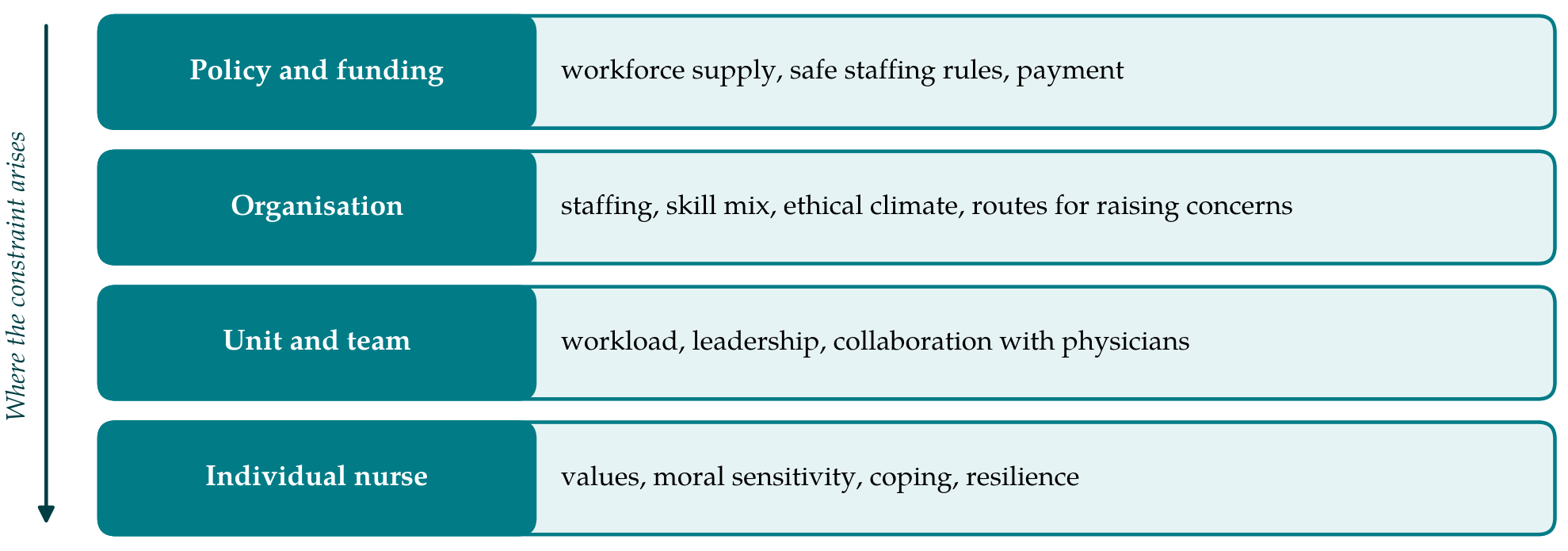
For professional and regulatory bodies the implication is to hold both sides of an obligation that is already written down. The code of ethics of the American Nurses Association states that the nurse, through individual and collective effort, establishes, maintains and improves the ethical environment of the work setting (American Nurses Association, 2015). Collective effort requires channels through which it can have effect, and regulators and accrediting bodies can require those channels of employers. At the level of national policy, the argument adds a further reason for investment in the nursing workforce. The World Health Organization estimated a global shortfall of close to six million nurses (World Health Organization, 2020), and a system that drives out those it has through avoidable moral distress deepens a shortage that it is paying to correct.
For researchers, the agenda shifts from the nurse to the setting. Most studies of moral distress are cross-sectional surveys of individuals. Designs that treat the unit as the level of analysis, that follow moral distress over time as staffing changes, and that evaluate structural interventions with the same care that has been given to resilience training would test the claim made here. If moral distress does not respond to improved conditions, the workforce reading is wrong, and that would be worth knowing.
7. Conclusion
Moral distress was defined from the outset by the constraints that cause it. The instruments used to measure it list those constraints, and the research on its correlates points to staffing, climate and voice. Treating it as a deficit of personal resilience mistakes the casualty for the cause and leaves in place the conditions that will distress the next nurse. Resilience has value as support for individuals and none as a substitute for adequate staffing and an ethical working environment. Health systems that wish to keep their nurses should count moral distress among their workforce indicators and manage it where it arises.
Conflict of interest
To be declared by the author(s) before publication.
Funding
To be declared by the author(s) before publication.