1. Introduction
The demonstration that blocking CTLA-4 with ipilimumab prolonged survival in metastatic melanoma (Hodi et al., 2010) and that antibodies against PD-1 induced regressions across several tumor types (Topalian et al., 2012) changed oncology. These drugs do not attack the tumor. They remove inhibitory signals from T cells, and their effect therefore depends on a sequence of events that the drug itself does not supply: tumor antigens must be released and presented, T cells must be primed, must travel to the tumor, enter it, recognize their targets and kill. Chen and Mellman (2013) described this sequence as the cancer-immunity cycle, and a failure at any step can leave a checkpoint inhibitor with nothing to release.
That is the common outcome. Outside a few highly responsive settings, such as melanoma, Hodgkin lymphoma and tumors with mismatch-repair deficiency, most patients given a PD-1 or PD-L1 antibody alone do not have an objective response, and a proportion of those who do respond later progress. Resistance is the central clinical problem of the field. This review sets out the mechanisms that have been identified and considers how far the combination strategies now in the clinic or in trials are grounded in them.
2. Scope and Definitions
The article is a narrative review of the published literature, built around landmark mechanistic studies in patient material, the randomized trials that tested combinations, and the principal conceptual reviews. It does not attempt a systematic search and makes no claim to completeness in a field that publishes at great volume.
Terms need care. Sharma et al. (2017) distinguished primary resistance, in which a tumor never responds, from acquired resistance, in which it responds and then escapes, and added adaptive resistance for the case in which the tumor is recognized by the immune system but protects itself by adjusting to the attack. In clinical practice the categories blur, because a brief response is hard to tell from none. A task force of the Society for Immunotherapy of Cancer has proposed working definitions for trials, based on the duration of drug exposure and the best response achieved before progression (Kluger et al., 2020). Their adoption matters because a combination that works after acquired resistance may do nothing for a tumor that was never inflamed.
3. Tumor-Intrinsic Mechanisms
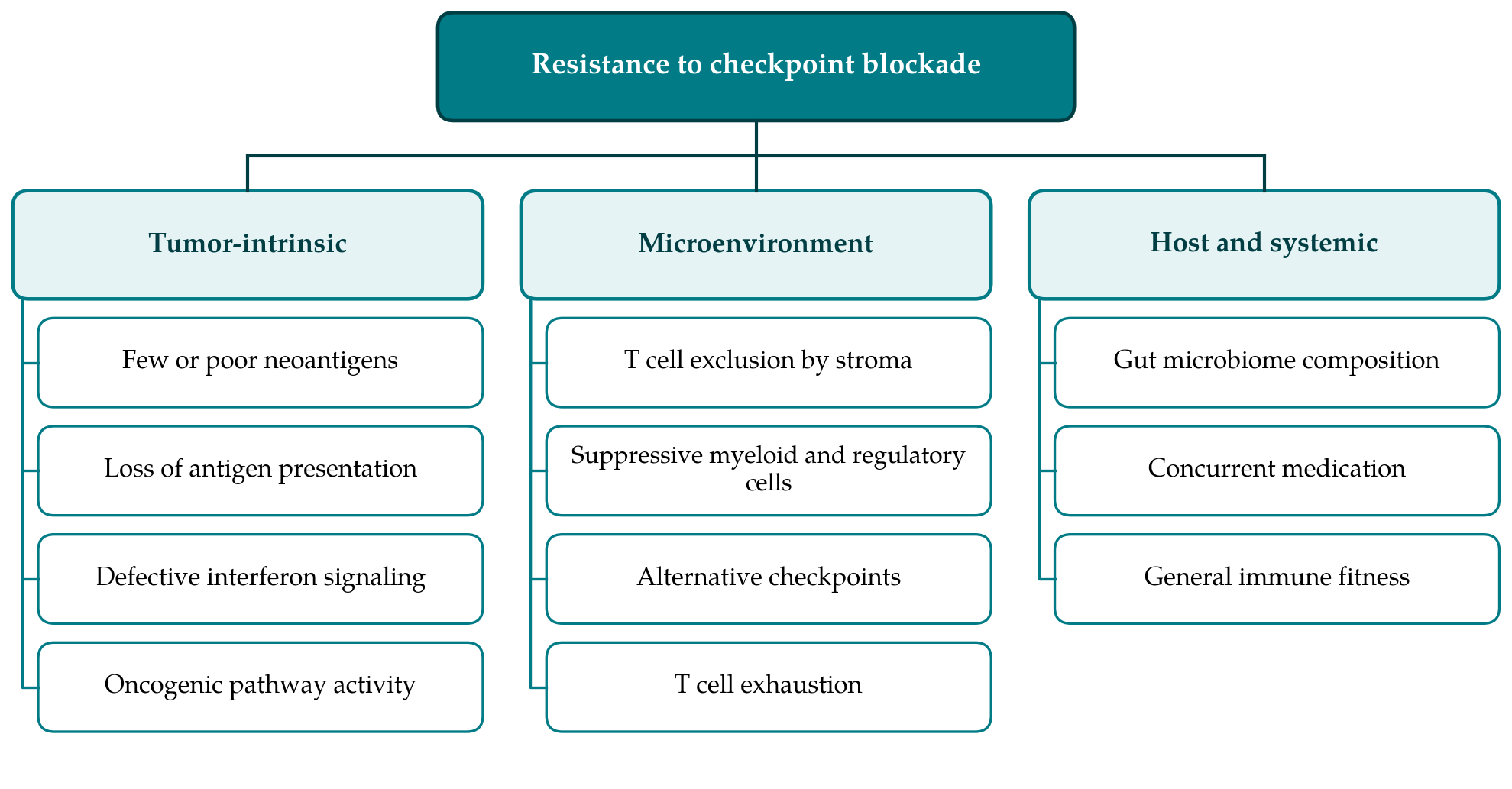
Resistance can be traced to properties of the cancer cell, of its surroundings or of the patient. Figure 1 arranges the main mechanisms under those three headings, and the sections that follow take them in turn, beginning with the tumor cell.
3.1. Antigenicity
T cells can only attack what they can recognize. Tumors with many somatic mutations generate more altered peptides, and sensitivity to PD-1 blockade in non-small cell lung cancer was shown to track mutational burden (Rizvi et al., 2015). The clearest illustration is mismatch-repair deficiency, which produces very large numbers of mutations and confers a high likelihood of response whatever the organ of origin (Le et al., 2015). The converse also holds: tumors with few mutations, such as most pancreatic and microsatellite-stable colorectal cancers, rarely respond. Mutational burden is nonetheless an imperfect guide, since many heavily mutated tumors resist treatment and some sparsely mutated ones respond.
3.2. Antigen presentation and interferon signaling
Even an antigen-rich tumor escapes if it stops displaying antigen. Class I HLA molecules require β2-microglobulin, and a tumor cell that loses the B2M gene can no longer be seen by CD8-positive T cells. The most direct evidence comes from paired biopsies taken before treatment and at relapse. Zaretsky et al. (2016) sequenced such pairs from patients with melanoma who progressed after a long response to pembrolizumab and found inactivating mutations in JAK1 or JAK2 in some and a truncating mutation in B2M in another.
The JAK findings point to interferon-γ. This cytokine, released by activated T cells, slows tumor cell growth and increases antigen presentation, and tumor cells that cannot respond to it are sheltered from both effects. Loss of genes in the interferon-γ pathway was also reported in melanomas that did not respond to ipilimumab (Gao et al., 2016). The same pathway induces PD-L1, so a tumor with defective interferon signaling may show no PD-L1 and no response for a single underlying reason.
3.3. Oncogenic signaling
Some oncogenic pathways shape the immune environment directly. In melanoma, activation of the WNT/β-catenin pathway in tumor cells was associated with an absence of T cells, and in mouse models it prevented the recruitment of the dendritic cells needed to prime them (Spranger et al., 2015). Loss of the tumor suppressor PTEN, which activates the PI3K pathway, reduced T cell infiltration and killing and was associated with poorer outcome on PD-1 inhibitors (Peng et al., 2016). Findings of this kind suggest that targeted drugs might convert a non-inflamed tumor into an inflamed one, an idea that remains under clinical test.
4. The Tumor Microenvironment
Pathologists describe three broad patterns. In inflamed tumors T cells lie among the cancer cells. In immune-excluded tumors they are present but confined to the surrounding stroma. In immune-desert tumors they are absent (Chen and Mellman, 2017). Response to PD-1 blockade is concentrated in the first group: Tumeh et al. (2014) showed that melanomas which regressed had CD8-positive T cells at the invasive margin before treatment, and that these cells proliferated and moved inward during it.
Exclusion has identifiable causes. In urothelial cancers treated with atezolizumab, lack of response in excluded tumors was associated with a signature of transforming growth factor β signaling in fibroblasts, and in a mouse model blocking that cytokine together with PD-L1 allowed T cells to enter (Mariathasan et al., 2018). Abnormal tumor vessels, regulatory T cells, myeloid-derived suppressor cells and tumor-associated macrophages add further layers of suppression, as do metabolic conditions such as hypoxia and the depletion of nutrients that T cells need.
T cells that do reach the tumor may be unable to function. Chronic exposure to antigen drives them into exhaustion, a state marked by sustained expression of several inhibitory receptors and by epigenetic changes that PD-1 blockade only partly reverses (Wherry and Kurachi, 2015). Blocking one receptor can be met by a rise in others. In lung cancer models and in specimens from patients, progression on PD-1 therapy was accompanied by increased TIM-3 on T cells (Koyama et al., 2016). This observation is the rationale for targeting second and third checkpoints.
5. Host Factors
The patient is more than a carrier of the tumor. Two studies published together reported that the composition of the gut microbiome differed between responders and non-responders to PD-1 therapy and that the difference could be transferred to mice by fecal transplantation. One associated response in epithelial tumors with particular commensal species and found worse outcomes in patients who had recently taken antibiotics (Routy et al., 2018). The other linked response in melanoma to greater bacterial diversity (Gopalakrishnan et al., 2018). The species implicated have not been consistent between cohorts, and how gut bacteria act on a distant tumor is still being worked out.
6. Combination Strategies
Each mechanism suggests a remedy, and many remedies have reached trials. Table 1 pairs the principal mechanisms with the strategies directed at them and notes how far each has come.
| Mechanism | Strategy | Status of the evidence |
|---|---|---|
| Compensating checkpoints | Add antibodies to CTLA-4 or LAG-3 | Randomized benefit in melanoma (Larkin et al., 2015; Tawbi et al., 2022) |
| Poor priming, low antigen release | Add platinum-based chemotherapy | Standard in lung cancer (Gandhi et al., 2018) |
| Abnormal vessels, suppressive stroma | Add an anti-angiogenic agent | Standard in renal cancer (Rini et al., 2019) |
| Tryptophan catabolism by IDO1 | Add an IDO1 inhibitor | No benefit in a phase 3 trial (Long et al., 2019) |
| Stromal exclusion through TGF-β | Block TGF-β with PD-L1 | Preclinical rationale (Mariathasan et al., 2018); unproven clinically |
| Unfavorable microbiome | Fecal microbiota transplantation | Early clinical signal (Davar et al., 2021) |
| Too few effective T cells | Infuse expanded tumor-infiltrating lymphocytes | Randomized benefit in melanoma (Rohaan et al., 2022) |
6.1. Dual checkpoint blockade
CTLA-4 acts mainly during priming in lymphoid tissue and PD-1 mainly in the tumor, so blocking both was an early proposal. In untreated advanced melanoma the combination of nivolumab and ipilimumab produced longer progression-free survival than ipilimumab alone, at the cost of considerably more high-grade immune-related toxicity (Larkin et al., 2015). A second pairing, the LAG-3 antibody relatlimab with nivolumab, improved progression-free survival over nivolumab alone with less added toxicity (Tawbi et al., 2022). Antibodies against TIM-3 and TIGIT have been taken into trials on similar reasoning, and their place has yet to be established.
6.2. Chemotherapy and anti-angiogenic agents
The combinations in widest use pair a checkpoint inhibitor with a treatment already known to be active. Pembrolizumab added to platinum and pemetrexed prolonged survival in metastatic non-squamous lung cancer irrespective of PD-L1 expression (Gandhi et al., 2018), and pembrolizumab with the vascular endothelial growth factor receptor inhibitor axitinib was superior to sunitinib in advanced renal cell carcinoma (Rini et al., 2019). Plausible immunological explanations exist: cytotoxic drugs release antigen and deplete suppressive cells, and normalizing vessels helps T cells enter. The trials do not show whether the two treatments cooperate or simply each benefit different patients, and the distinction bears on whether such regimens overcome resistance or merely widen coverage.
6.3. Lessons from a failed target
The enzyme IDO1 degrades tryptophan and suppresses T cells, and early single-arm studies of the IDO1 inhibitor epacadostat with pembrolizumab looked promising. The randomized phase 3 trial in melanoma showed no improvement over pembrolizumab alone (Long et al., 2019). The episode is widely cited as a caution against moving to large trials on the strength of uncontrolled response rates, without evidence that the drug reached its target in the tumor and without selecting patients in whom the mechanism was active.
6.4. Microbiome modification and cell therapy
Two approaches address resistance after it has declared itself. In a small clinical study, patients with melanoma refractory to PD-1 therapy received a fecal transplant from a donor who had responded, followed by further PD-1 blockade, and some then responded (Davar et al., 2021). The result needs confirmation in controlled trials, and questions of donor selection and safety are unresolved. Adoptive transfer of tumor-infiltrating lymphocytes, expanded outside the body and reinfused after lymphodepleting chemotherapy, bypasses the need for the patient to generate effective T cells. In a randomized trial in advanced melanoma, most of whose participants had already received a PD-1 inhibitor, it gave longer progression-free survival than ipilimumab (Rohaan et al., 2022).
7. Gaps and Future Directions
Several weaknesses run through the field. Much mechanistic knowledge comes from melanoma, where tissue is accessible and responses are frequent, and may not carry over to other tumors. Biopsies at the time of progression are still uncommon, so the frequency of each acquired mechanism is poorly known. Most combinations have been tested in unselected populations, which makes a drug aimed at one mechanism look ineffective if that mechanism is present in a minority.
Three developments would help. The first is routine paired sampling, before treatment and at progression, analyzed for the defects described above. The second is trial designs that assign a combination according to the mechanism found, with the consensus definitions of primary and acquired resistance applied at entry (Kluger et al., 2020). The third is honest accounting of toxicity. Combinations add immune-related adverse events, and a regimen that helps a subset while harming many is no advance unless the subset can be identified. Tumors with irreversible loss of antigen presentation may need treatments that do not depend on HLA class I at all.
8. Conclusion
Resistance to checkpoint blockade is not one phenomenon. A tumor may offer nothing to recognize, may hide what it has, may keep T cells out or disable those that enter, and the patient's own microbial and immune state affects the outcome. The combinations that have succeeded so far pair checkpoint inhibitors with a second checkpoint antibody or with established active drugs. Those aimed at single suppressive pathways have a mixed record, and the reasons for failure are reasonably clear. The task ahead is to determine, for each patient, which barrier is present, and to choose the partner drug on that basis.
Conflict of interest
To be declared by the author(s) before publication.
Funding
To be declared by the author(s) before publication.