1. Introduction
Operators of industrial plants walk fixed rounds to read gauges, listen to pumps, look for leaks and check that valves stand where the control system believes them to be. The work is repetitive, it is sometimes carried out in places that are hot, noisy or potentially explosive, and on unmanned or lightly manned installations it requires travel to site. Reviews of robotics in the oil and gas sector and in infrastructure inspection document a steady movement towards mobile robots that carry cameras, thermal imagers, microphones and gas detectors along such rounds (Shukla and Karki, 2016; Lattanzi and Miller, 2017).
A plant is an inconvenient place for a robot. Its floors are a patchwork of concrete, steel plate and open grating. Levels are joined by stairs and ladders. Doorways have raised sills, storage areas are ringed by containment walls, and temporary scaffolding, hoses and cable trays appear and disappear with maintenance work. The clutter in the title refers to this combination of permanent discontinuities and changing obstacles, all built around the dimensions and abilities of a person on foot.
The form of locomotion determines which parts of such a site a robot can reach, how long it can stay out, and what happens when it fails. This review compares legged and wheeled platforms on those terms. It does not rank products, and it reports no trials of its own.
2. Scope and Approach
The article is a narrative review of the published literature. Sources were drawn from the established textbooks on mobile robots and ground vehicles, from journal and conference papers that describe legged and wheeled machines intended for field use, from accounts of robot deployments in disaster response and competitions, and from the standards that govern equipment in explosive atmospheres. No systematic search protocol was followed, and the selection reflects a judgement of which sources are most informative for an engineer choosing a platform. Aerial robots, crawlers that move along pipes or tank walls, and rail-mounted systems are outside the scope, although in practice they compete for some of the same tasks.
3. The Platform Classes
Four classes of ground platform appear in the inspection literature. Their general characteristics are summarised in Table 1 and discussed in the subsections that follow.
| Criterion | Wheeled | Tracked | Legged |
|---|---|---|---|
| Stairs and steps | Not passable without ramps | Passable with flippers on regular stairs | Passable, including irregular steps |
| Open grating and gaps | Good if wheels are large | Good | Needs foot design or perception |
| Energy use on flat floor | Lowest | Higher, especially when turning | Highest of the three |
| Stability when stopped | Inherent | Inherent | Static if standing; lost if joints unpowered |
| Mechanical complexity | Few actuators | Moderate; tracks wear | Many actuators and joints |
| Floor loading and damage | Low | Can scuff coatings | Concentrated at the feet |
| Representative sources | Siegwart et al., 2011 | Nagatani et al., 2013 | Hutter et al., 2017 |
3.1. Wheeled platforms
The wheel is the default for good reason. On a hard, level surface, rolling resistance is small, the body does not rise and fall, and a differential or skid-steer base with two to four motors is easy to build, model and control. The kinematics of the common wheel arrangements were classified long ago (Campion et al., 1996) and are standard textbook material (Siegwart et al., 2011). The limitation is equally well understood. A rigid wheel climbs a step only if the step is a modest fraction of the wheel radius, and the mechanics of wheel and ground interaction developed for off-road vehicles show how quickly performance falls as obstacles grow relative to the wheel (Bekker, 1956; Wong, 2008). A wheeled inspection robot is therefore confined to one level unless the site provides ramps or lifts.
Wheeled inspection robots have a further merit that is easily overlooked. With no impact at each step, their structure, connectors and sensor mounts see little vibration, and long unattended operation is correspondingly easier to achieve. Larger compliant tyres widen the range of floor joints, cable covers and grating that can be crossed, but a longer wheelbase turns less readily in the narrow walkways between skids and pipe racks. Turning space, more than obstacle height, is often what limits a wheeled machine inside a process module.
3.2. Tracked platforms
Tracks extend the reach of rolling locomotion. With articulated flippers, a tracked robot can bridge the nosings of a staircase and climb it, and this is the form that most disaster-response robots have taken (Murphy, 2014). The machines sent into the reactor buildings at Fukushima Daiichi were tracked, and the account of that work is frank about the difficulties: steep and narrow stairs, landings too small to turn on, debris, and communication cables that snagged (Nagatani et al., 2013). Tracks also carry penalties in routine service. Skid steering wastes energy and abrades floor coatings, and the tracks themselves are wear parts.
3.3. Legged platforms
Legs replace continuous contact with a sequence of discrete footholds, so the ground between the footholds no longer matters. The principles of dynamic balance were established in the 1980s (Raibert, 1986), and hydraulic quadrupeds later demonstrated walking on rough natural terrain. The machines relevant to inspection are the electric quadrupeds that followed, built around torque-controllable actuators and designed to be sealed, carried and maintained in the field (Hutter et al., 2016; Hutter et al., 2017).
Two developments made these robots credible outside the laboratory. The first was actuator and mechanical design that brought efficiency and impact tolerance to practical levels (Seok et al., 2013). The second was the use of controllers trained in simulation by reinforcement learning and transferred to hardware, which proved markedly more robust to slippery, yielding or unexpected ground than earlier model-based controllers (Hwangbo et al., 2019; Lee et al., 2020), and which were then combined with onboard terrain perception (Miki et al., 2022). Field reports describe quadrupeds completing autonomous missions in industrial settings and underground (Bellicoso et al., 2018; Tranzatto et al., 2022).
Stairs and grating deserve particular mention because industrial sites have them in abundance. Industrial stairs are steep, frequently open between the treads and made of serrated grating, so a foot can catch under a tread or a small foot can settle into an opening. Controllers that rely on proprioception alone treat each such event as a disturbance and recover from it (Lee et al., 2020). Perceptive controllers try to place the feet deliberately, but they depend on terrain maps that become unreliable on open, reflective or obscured surfaces, which is why Miki et al. (2022) let the controller fall back on proprioception when the map and the felt ground disagree.
3.4. Hybrid platforms
The division between rolling and walking is not absolute. Quadrupeds fitted with driven wheels in place of feet roll where the floor allows and step where it does not, and whole-body controllers have been published that coordinate the two modes (Bjelonic et al., 2019). The idea has a notable precedent in humanoid robotics: at the finals of the DARPA Robotics Challenge, where many bipeds fell, the winning robot could kneel onto wheels for travel over flat ground (Krotkov et al., 2017). Hybrids inherit the actuator count of a legged machine and add wheel drives, so their appeal lies in efficiency and speed, not in simplicity.
4. Criteria for Inspection Work
Locomotion capability is only one of the properties an inspection platform needs. The literature allows five others to be discussed with some confidence.
4.1. Energy and endurance
The classic comparison of vehicles by specific resistance, the power required per unit of weight and speed, placed wheeled vehicles on hard surfaces far below walking machines and animals (Gabrielli and von Kármán, 1950), and the same dimensionless measure, now usually called cost of transport, is used for animals (Tucker, 1975) and robots alike. Modern electric quadrupeds have narrowed the gap to animals of similar mass (Seok et al., 2013), but a legged robot still expends energy to support its weight when standing with bent legs, which a wheeled robot does not. For an inspection round that includes long pauses at measurement points, this standing cost can matter as much as the cost of travel. The practical consequence is shorter missions or more frequent returns to a charging dock.
4.2. Stability and the consequences of failure
A wheeled or tracked robot that loses power stops where it is. A legged robot that loses power, or whose controller fails, collapses, and a machine of several tens of kilograms falling against instrument tubing or onto a stair is a hazard of a different order from one that merely blocks a walkway. Wheeled robots are not immune to accidents, since they can tip on ramps or drop a wheel over an unguarded edge, but their failure modes are fewer and slower. Learned controllers have made falls much rarer (Lee et al., 2020), yet published work reports robustness mostly as success in traversing test courses, not as failure rates over long service, which is the quantity a plant safety case needs.
4.3. Sensor placement and data quality
Inspection is a measurement task, and the platform is a moving tripod. Gauges and sight glasses are mounted at eye height for a standing person, so a low wheeled base needs a mast, which raises the centre of gravity. A quadruped can raise, lower and tilt its body to aim a sensor, and can hold still on uneven ground. Its gait, however, shakes the payload, and images and acoustic recordings are best taken at a standstill. Localisation, on which repeatable measurement positions depend, uses the same probabilistic methods on either platform (Thrun et al., 2005), with the difference that wheel odometry is a simple and fairly reliable input on firm floors while leg odometry suffers from foot slip and must lean more heavily on lidar or vision.
4.4. Hazardous areas
Where flammable gas or dust may be present, equipment must not become an ignition source. In the European Union this is governed by the ATEX directive (European Parliament and Council, 2014), and internationally by the IEC 60079 series of standards (IEC, 2017). The recognised protection concepts, such as flameproof enclosure, pressurisation, encapsulation and intrinsic safety, add mass and volume to every motor, battery and electronics housing. The burden grows with the number of actuators, which counts against legged designs, and static charge on feet, tracks or tyres must be controlled in all cases. Certification also freezes a design, which slows the pace at which fast-moving locomotion research reaches classified areas.
4.5. Maintenance and cost of ownership
A quadruped has twelve actuated joints where a wheeled base has two to four drive motors. Each joint has a gearbox, bearings, seals and sensors that wear, and legs take repeated impact loads that wheels on a smooth floor do not. Design reviews of legged machines treat actuator durability as a central concern (Kim and Wensing, 2017). The literature nevertheless contains very little on mean time between failures, spare-part consumption or total cost of ownership for either class in industrial service, and what exists comes largely from developers. This is the weakest part of the evidence base and the part an operator most needs.
5. Choosing a Platform
Taken as a whole, the literature suggests that two properties of the site decide most cases: how many discontinuities the route contains, and how far the robot must travel on each round. Figure 1 arranges the platform classes on these two axes. Where the route is level and long, as in a tank farm or a single-storey production hall, a wheeled platform is hard to argue against. Where the round is short but crosses stairs and sills, access is the deciding factor and a legged or tracked machine is needed. Long routes with scattered obstacles are the natural territory of wheel-leg hybrids.
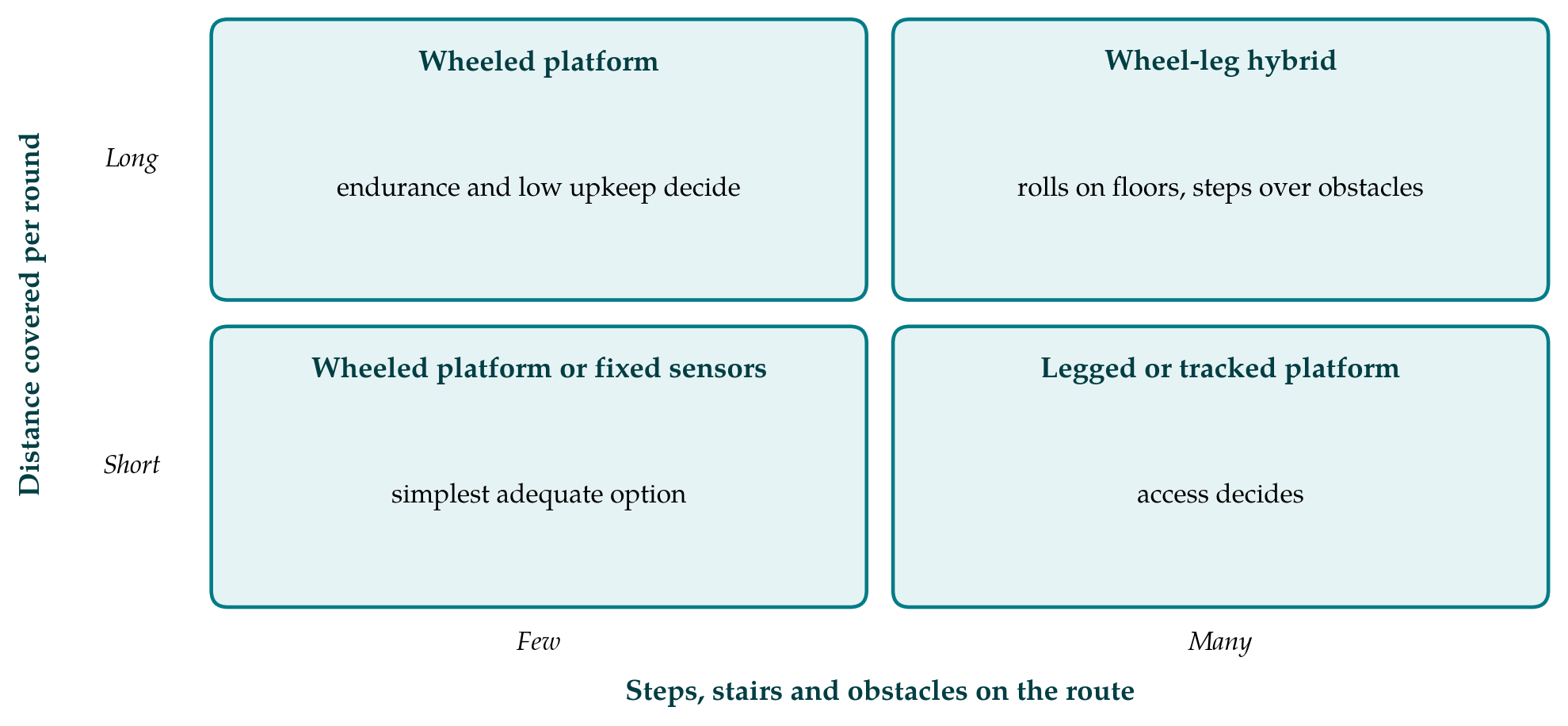
Payload and duty also enter the decision. A platform that only looks and listens can be small, but one that must carry a manipulator to press a button, open a cabinet or take a sample needs a stable base and reserves of power, which favours wheeled or tracked machines and the larger quadrupeds. A site with several kinds of area may reasonably run a mixed fleet, a wheeled robot for the level production floor and a legged one for the structures above it, provided that both report into the same inspection records.
The alternative of changing the site should not be overlooked. Ramps over sills, a lift call interface, or a second wheeled robot on the upper level may cost less than a more capable machine, and new plants can be laid out with robot routes in mind. The opposite case also arises: on an ageing installation where modifications require lengthy approval, a robot that copes with the plant as built has a value that a comparison of energy figures does not capture.
6. Gaps and Future Work
Three gaps stand out. First, comparisons between platform classes on the same route with the same payload are scarce; most papers describe one robot. Second, reliability is under-reported. Long-term records of interventions, falls, lost missions and component replacements, published by operators and not developers, would do more for decision making than further demonstrations of agility. Third, competitions and benchmarks have rewarded traversal and exploration (Krotkov et al., 2017; Tranzatto et al., 2022), whereas inspection rewards the quality and repeatability of measurements, for which accepted metrics are lacking. Work on certified hazardous-area designs, on safe behaviour after a fall, and on standard interfaces between robots and plant infrastructure such as doors and lifts would also be of practical value.
7. Conclusion
Legged robots have removed the access barrier that kept mobile inspection out of multi-level, obstacle-strewn plants, and the published evidence for their locomotion ability is strong. Wheeled platforms keep clear advantages in efficiency, simplicity and benign failure wherever the floor permits their use. The decision between them is therefore a matter of matching the platform to the terrain and length of a given round, with hybrids and modest site changes as serious options. What the literature cannot yet supply is the long-term reliability and cost data on which such a decision ought finally to rest.
Conflict of interest
To be declared by the author(s) before publication.
Funding
To be declared by the author(s) before publication.