1. Introduction
Across India, patches of forest dedicated to a deity or an ancestral spirit have been left standing while the land around them was cleared. Gadgil and Vartak (1976) drew scientific attention to these sacred groves in the Western Ghats, and later work has confirmed their value as refuges for forest plants in farmed landscapes and as examples of community management (Ormsby and Bhagwat, 2010). Protection by custom has limits, however. Many groves are only a few hectares in extent, are surrounded by fields and roads, and have been opened up by lopping, grazing and the construction of shrines. Their edges and gaps offer ideal ground for light-demanding invasive shrubs.
The most widespread of these is Lantana camara, a shrub of tropical American origin brought to India as an ornamental in the nineteenth century and now established in forests throughout the country (Sharma et al., 2005). It forms dense thickets that shade the ground layer and hinder tree regeneration. Two centuries of control effort in India, Australia and South Africa have not contained it (Bhagwat et al., 2012). Within a small grove, though, complete clearance is feasible, and it is being attempted in many places.
Clearance is usually judged a success when the shrub is gone. The purpose, which is the return of the native understorey, is rarely measured. This article proposes a design by which it could be. The design is addressed to botanists and foresters working with the custodians of one grove, and it is presented as a plan that has yet to be carried out.
2. What Earlier Removal Studies Leave Unanswered
Kettenring and Adams (2011) reviewed experiments on the control of invasive plants and found recurring weaknesses: most ran for a short time, used small plots, and reported the decline of the invader while paying little attention to the response of native vegetation. Where native plants were measured, recovery was far from assured. Removal can open the ground to other weeds, and the invader may have altered soil, litter or the seed bank in ways that persist (Zavaleta et al., 2001; D'Antonio and Meyerson, 2002). For Lantana, Gooden et al. (2009) showed in Australian forest that native species richness falls steeply once the shrub exceeds a threshold of cover, which implies that recovery may depend on how far below that threshold cover is held.
Three lessons follow for design. Native vegetation must be the response measured. Observation must continue for several growing seasons. And there must be something to compare the cleared plots with, because understorey vegetation in seasonal forest changes from year to year with rainfall whether or not anything is removed.
3. Constraints Set by the Grove
A sacred grove is not an experimental forest. Custom may forbid cutting any native plant, entering certain parts, working on particular days or removing material from the site. The custodians, who may be a temple trust, a lineage or a village council, decide what is done. These rules shape the method. They rule out destructive sampling of native plants and may limit where plots can be placed. They also make the custodians partners in the study, since they often know the history of the grove, including when the shrub arrived and what grew there before.
Size imposes a second constraint. A grove of a few hectares cannot hold many large plots, and all plots share one site history. Results from one grove describe that grove. Replication within it guards against mistaking chance differences between plots for an effect of treatment, the error that Hurlbert (1984) named pseudoreplication, but it does not license generalisation to other groves. That requires the same design to be repeated elsewhere.
4. The Proposed Design
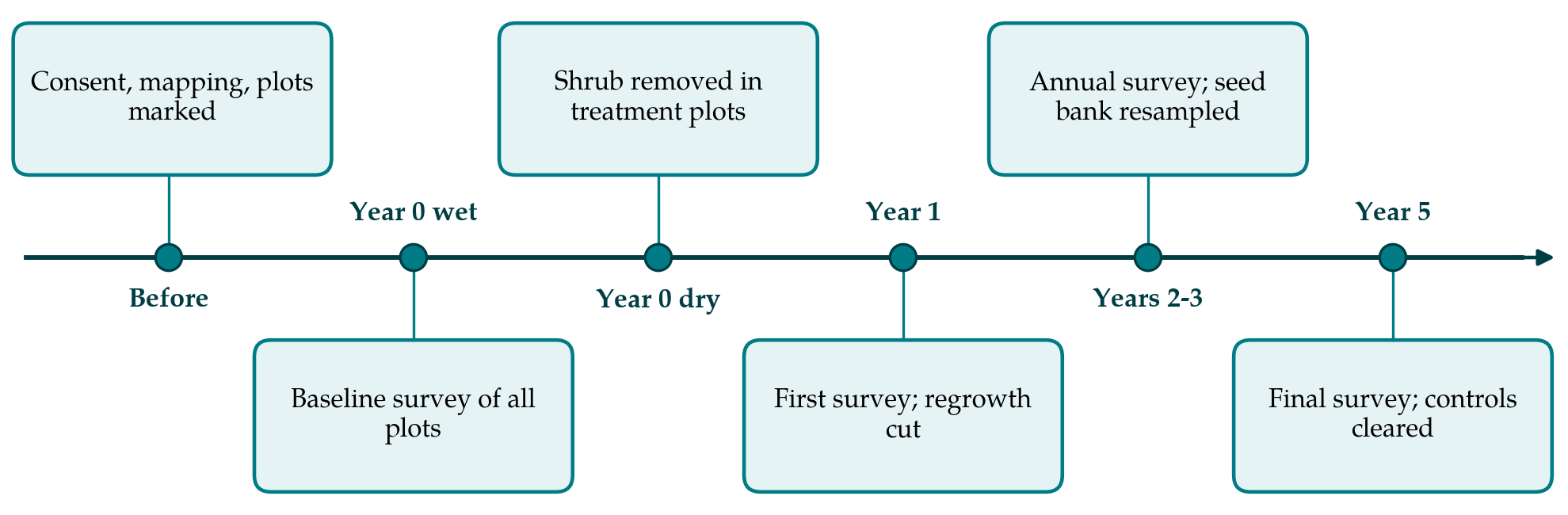
The design is a before-after-control-impact layout, in which treated and untreated units are measured both before and after the intervention so that change due to the treatment can be separated from change that would have happened anyway (Stewart-Oaten et al., 1986). Underwood (1992) showed that a single control is insufficient and that several are needed. Figure 1 gives the sequence over the proposed five years.
4.1. Agreement with the custodians
Before any plot is marked, the work is explained to the custodians and their consent is obtained in the form they consider binding. The discussion covers which areas may be entered, what may be cut, how removed shrub material is to be disposed of, and the proposal to leave some invaded plots uncleared for a fixed period. That last point asks the community to tolerate the weed for the sake of the comparison, and a written undertaking to clear those plots at the end of the study should be given.
4.2. Plot layout
The grove is first mapped on foot to mark the extent of invasion, canopy gaps, paths and shrines. Three classes of plot are then established. Removal plots lie in invaded areas and are cleared. Invaded control plots lie in comparable invaded areas and are left. Reference plots lie in the least disturbed, uninvaded part of the grove and show what the understorey could become. Plots of 10 m by 10 m, with five or more of each class where space allows, are suggested as a starting point. Removal and invaded control plots are assigned at random within pairs matched for canopy cover and distance from the edge. A buffer strip is cleared around each removal plot so that the surrounding thicket does not shade it.
4.3. Removal treatment
The shrub is removed by one method applied uniformly, so that method does not become a hidden variable. For Lantana, the cut rootstock method described by Love et al. (2009) is appropriate: the stem is severed just below the soil surface and the plant is lifted and left to dry upside down, with little disturbance to the soil. Burning and heavy uprooting are avoided. Regrowth and new seedlings of the invader are cut in removal plots at each annual visit, and the effort this takes is recorded.
4.4. Variables and timing
Table 1 lists what is recorded. The core measurement is the composition of the understorey, taken in small quadrats nested within each plot, with every vascular plant below a set height identified and its cover estimated on a standard scale (Mueller-Dombois and Ellenberg, 1974).
| Variable | Method | When | Purpose |
|---|---|---|---|
| Understorey composition | Species and cover in 1 m quadrats | Baseline, yearly | Main response to removal |
| Tree seedlings, saplings | Counts by species and height | Baseline, yearly | Canopy regeneration |
| Invader and other weeds | Cover; invader stems cut per visit | Every visit | Treatment held; new invasion |
| Canopy openness, litter | Densiometer; litter depth points | Baseline, yearly | Covariates for light, sites |
| Soil seed bank | Seedling emergence from cores | Baseline, mid-study | Can natives return unaided |
Tree seedlings and saplings are counted separately from the herb layer because their fate determines the future canopy. The soil seed bank is sampled by the seedling emergence method (Ter Heerdt et al., 1996) at the start and again after two or three years, since it indicates whether native species can return unaided or must be introduced. Surveys are made at the same phenological stage each year, soon after the main rains, when most herbaceous species can be identified. Specimens of doubtful identity are collected only outside the plots and only where custom permits, and are otherwise photographed.
4.5. Analysis
Recovery is defined in advance as movement of the removal plots towards the reference plots, in keeping with the principle that restoration is assessed against a reference ecosystem (Gann et al., 2019). Native species richness is compared after standardising for sampling effort by rarefaction (Chao et al., 2014). Cover and counts are analysed with mixed-effects models that include treatment, year and their interaction, with plot and pair as random effects to account for repeated measurement (Bates et al., 2015). The interaction term carries the answer: it shows whether removal plots changed differently from invaded controls. Change in composition as a whole is tested by permutational multivariate analysis of variance on a dissimilarity matrix (Anderson, 2001) and displayed by ordination, with the reference plots as the target.
Two safeguards protect the analysis from hindsight. The response variables, the model and the definition of recovery are written into a short plan before the baseline survey, and that plan is lodged with the custodians and with the institution responsible for the work. Field sheets are entered twice and reconciled, and each record keeps the plot, quadrat, date and observer, so that differences between observers in estimating cover can be examined. Photographs taken from fixed points at every visit give an independent visual record against which the numerical results can be checked.
5. Putting the Design into Practice
The work is within the means of a college botany department or a forest range office. It needs people who can identify the local flora in a vegetative state, which is the scarcest resource, together with tapes, quadrat frames, a camera and trays for seed bank samples. One baseline season before removal is the minimum; removal is best done in the dry season, when the shrub is easier to handle and ground flora is dormant. Annual reports to the custodians, in their language and with photographs from fixed points, keep the agreement alive and often bring out observations that the plots miss.
Where the understorey shows no sign of return after two or three seasons and the seed bank holds few native species, the design allows a further step: half of each removal plot may be planted or sown with native understorey species from the grove's own reference area, turning the study into a test of whether active restoration is required.
6. Limitations and What Remains to Be Shown
This design has not been implemented, and its adequacy is untested. The number of plots that a small grove can hold may be too few to detect any but large effects, and a pilot season would be needed to estimate variation between plots before the numbers are fixed. Five years is short against the time forest understoreys take to reassemble. Invaded control plots may be cleared early if the community loses patience, which would weaken the comparison. Reference plots in a degraded grove are themselves altered and offer a modest target. Finally, the design concerns one grove; only repetition across groves of different size, forest type and management would show how general any result is.
7. Conclusion
Removing an invasive shrub from a sacred grove is a means, and the end is a recovering native understorey. The design proposed here makes that end measurable by pairing cleared plots with uncleared and reference plots, recording native vegetation before and after, and building the consent of the custodians into the procedure. Applied in one grove it would give that community evidence on which to decide what to do next. Applied in many, it would begin to supply the comparative record that the management of these forests currently lacks.
Conflict of interest
To be declared by the author(s) before publication.
Funding
To be declared by the author(s) before publication.