1. Introduction
Pumping liquid through a pipe costs energy in proportion to the wall shear stress, and that stress changes character with the Reynolds number. In laminar flow the friction factor follows the Hagen-Poiseuille result, 64/Re, and nothing done to the wall alters it unless the no-slip condition itself is relaxed. In turbulent flow friction is several times higher and is governed by the quasi-streamwise vortices that sit just above the wall. Between the two lies a range of Reynolds numbers in which laminar and turbulent patches coexist, a range first described by Reynolds (1883) and still an active subject of research (Eckhardt et al., 2007; Mullin, 2011).
Two passive surface treatments have been shown repeatedly to lower friction. Riblets, fine grooves aligned with the stream, act on the turbulent near-wall cycle (Walsh, 1983; Bechert et al., 1997). Superhydrophobic surfaces hold a layer of gas within a water-repellent texture, so that the liquid slides over part of the wall (Rothstein, 2010). The first works only when the flow is turbulent; the second works in laminar flow and, under the right conditions, in turbulent flow as well. A ribbed surface whose crests or valleys are themselves superhydrophobic promises to join the two effects.
The transitional range is where such a surface is least understood and, arguably, where it has most to offer. A wall that postpones the appearance of turbulence keeps the pipe on the laminar friction curve, and the saving is then far larger than the few per cent obtainable by trimming turbulent friction. This review assembles what is known from the published literature about the ingredients of that proposition and states plainly where direct evidence is missing.
2. Scope and Approach
The article is a narrative review. It reads the established experimental, numerical and theoretical literature on three topics, riblets, superhydrophobic slip and pipe-flow transition, with one question in mind: what should be expected when a superhydrophobic riblet lining is placed in a pipe operating near transition. Sources were chosen for their standing in the field, landmark experiments, direct numerical simulations and the principal review articles, and no claim is made to exhaustive coverage. Flows of water and aqueous liquids in rigid circular pipes are the focus. Polymer additives, compliant walls, liquid-infused textures and active control are outside its scope, although several raise related questions.
3. Riblets: Mechanism and Limits
The drag-reducing action of riblets is understood in terms of two virtual origins. A grooved wall presents less resistance to flow along the grooves than to flow across them, so the streamwise mean flow appears to start from a plane deeper inside the texture than the plane felt by cross-flow fluctuations. Bechert and Bartenwerfer (1989) and Luchini et al. (1991) computed these protrusion heights for viscous flow and showed that their difference fixes the initial slope of the drag-reduction curve. Because the quasi-streamwise vortices are pushed away from the wall relative to the mean flow, the momentum they carry toward the surface falls. Direct numerical simulation by Choi et al. (1993) confirmed the picture and found that the vortices sit above riblets of drag-reducing size, touching only the tips.
The benefit is bounded. Drag reduction grows roughly in proportion to the rib spacing in wall units while the spacing is small, peaks when the spacing is around fifteen viscous lengths, and then falls away until the surface behaves as ordinary roughness. For thin blade-like ribs the peak measured in the careful oil-channel experiments of Bechert et al. (1997) is close to ten per cent, and for the triangular profiles that can be manufactured cheaply it is lower. García-Mayoral and Jiménez (2011) traced the breakdown to spanwise rollers that form above the grooves through a Kelvin-Helmholtz-like instability, and showed that the optimum collapses across rib shapes when size is expressed as the square root of the groove cross-section.
Two consequences matter here. A given rib geometry is tuned to one wall shear stress, so a pipe whose flow rate varies spends part of its life off the optimum. And riblets do nothing useful in steady laminar flow: with no near-wall vortices to displace, the extra wetted area is all that remains. A riblet lining by itself therefore has no obvious way to influence whether a pipe flow becomes turbulent, although it does change the shear that a disturbance meets at the wall.
4. Superhydrophobic Walls and Effective Slip
A rough hydrophobic solid can hold water on the tips of its texture with gas trapped beneath, the state analysed by Cassie and Baxter (1944) and made familiar by the lotus leaf. Over the gas pockets the liquid meets an interface that supports very little shear. Averaged over the pattern, the wall behaves as though the velocity vanished a small distance below the surface, the effective slip length. For alternating no-slip and no-shear strips the problem can be solved exactly, and Lauga and Stone (2003) worked out the pipe-flow cases, confirming that strips aligned with the flow give a markedly longer slip length, about twice as long when the pattern is fine, than strips lying across it.
Laminar measurements agree with this theory. Ou et al. (2004) recorded reduced pressure drop in microchannels with regular hydrophobic posts and ridges, and Watanabe et al. (1999) reported lower laminar friction in pipes with a highly water-repellent, finely cracked wall coating, in diameters of order ten millimetres. The size of the effect depends on the ratio of slip length to pipe radius, which is why textures that are impressive in a microchannel can be invisible in a pipe of ordinary size (Lee et al., 2016).
Turbulent flow changes the accounting. In the simulations of Min and Kim (2004) slip in the streamwise direction lowered friction, whereas slip in the spanwise direction strengthened the near-wall vortices and raised it. Fukagata et al. (2006) turned this into a predictive relation between slip lengths in wall units and drag. Experiments with streamwise micro-ridges by Daniello et al. (2009) and with larger gratings by Park et al. (2014) found substantial reductions once the texture period became comparable with the thickness of the viscous sublayer. Randomly rough coatings give mixed results, and the reviews agree that they help only when the roughness is small compared with the sublayer (Golovin et al., 2016). Table 1 sets the main surface types side by side.
| Surface | How it acts | Where a benefit is documented | Principal limit |
|---|---|---|---|
| Plain riblets | Offsets near-wall vortices from the mean flow Luchini et al., 1991 | Turbulent flow, spacing near fifteen wall units | Tuned to one shear stress; none in laminar flow |
| Superhydrophobic posts or random texture | Isotropic slip over trapped gas | Laminar microchannels Ou et al., 2004 | Spanwise slip; roughness when the gas is lost |
| Superhydrophobic streamwise ridges | Slip mainly along the flow | Laminar and turbulent channels Daniello et al., 2009 | Interface deflection and depletion of gas |
| Water-repellent pipe coating | Slip over fine cracks holding gas | Laminar pipe flow Watanabe et al., 1999 | Small slip length relative to radius |
| Superhydrophobic riblets | Rib offset plus slip in the grooves | Expected across regimes; direct pipe evidence sparse | Two length scales to tune; gas retention |
5. Transition in Pipes
Laminar pipe flow is linearly stable at all Reynolds numbers examined, so turbulence has to be triggered by a disturbance of finite size. Once triggered at moderate Reynolds number it takes the form of localised puffs, described in the classic experiments of Wygnanski and Champagne (1973), which travel downstream at close to the mean speed with laminar flow ahead and behind. Each puff is transient. It may decay, suddenly and without warning, or it may split and seed a second puff. Avila et al. (2011) measured the time scales of both processes and placed the onset of sustained turbulence where they cross, at a Reynolds number of about 2040. Above that point the fraction of the pipe that is turbulent rises continuously, and at higher Reynolds numbers puffs give way to expanding slugs.
For drag the implication is that the friction factor in the transitional range is a weighted mean of a laminar and a turbulent value, with the weight set by puff dynamics. Anything that shortens puff lifetimes or inhibits splitting moves the whole curve toward the laminar branch. The experiments of Hof et al. (2010) made the point directly: puffs depend on the inflection in the velocity profile at their upstream edge, and flattening that profile caused them to collapse. A wall with slip also reshapes the profile, by lowering shear at the wall for a given flow rate, which is the reason to expect that a superhydrophobic lining could interact with puffs and not merely with the laminar friction beneath them.
6. Combining Ribs and Slip
Rib offsets and slip lengths are the same kind of quantity. Both describe a wall by the depth at which the streamwise and spanwise velocities appear to vanish, and in both cases it is the difference between the two depths that controls turbulent friction. A riblet whose grooves hold gas should therefore add the slip of the gas-liquid interface to the geometric offset of the ribs, and it should do so mostly in the streamwise direction because the ribs confine the interface laterally. This is the theoretical case for the combined surface. It also suggests why isotropic superhydrophobic coatings have disappointed in turbulent flow: they offer the cross-flow as much slip as the mean flow.
6.1. Expectations for the transitional regime
The most relevant computation is that of Min and Kim (2005), who imposed slip conditions on channel flow and followed disturbances through transition. Streamwise slip stabilised the flow and delayed breakdown; spanwise slip promoted the growth of three-dimensional disturbances and brought transition forward. Carried over to a pipe, the result implies that a lining of streamwise superhydrophobic ribs should raise the Reynolds number at which puffs become self-sustaining, while a coating of posts or random roughness could leave it unchanged or lower it. Figure 1 summarises how the roles of ribs and slip change from one regime to the next.
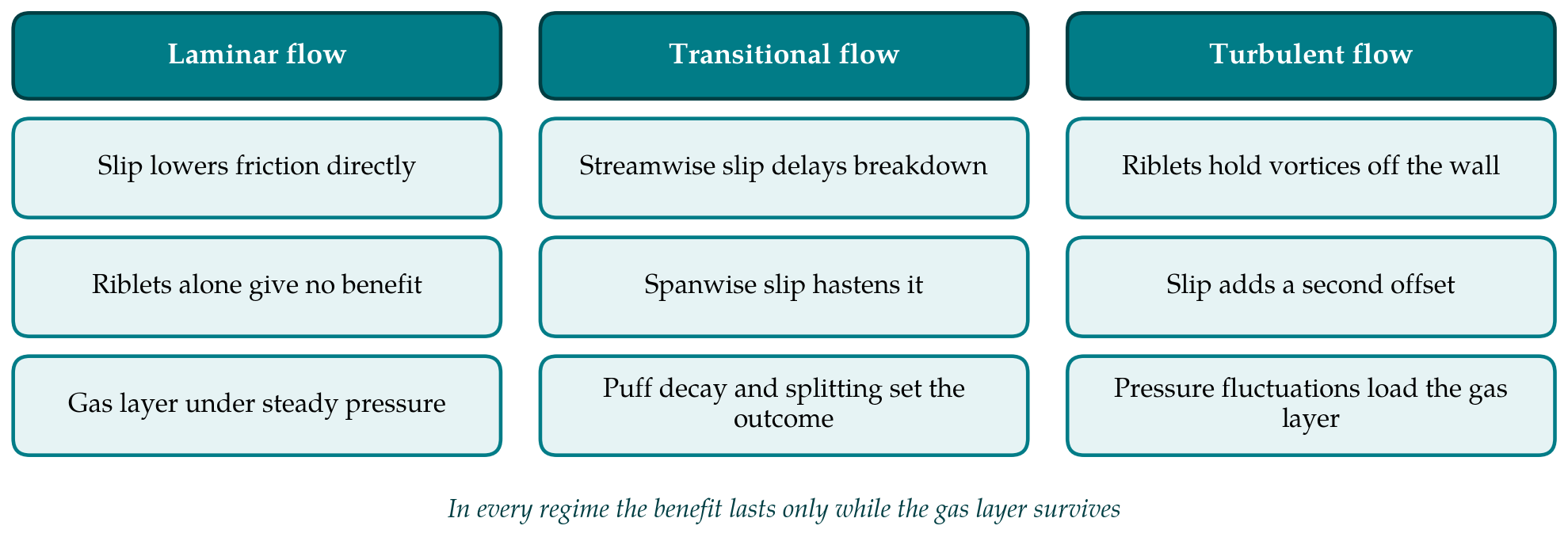
That inference rests on channel simulations with idealised boundary conditions, and three reservations apply. Transition in a pipe is governed by finite-amplitude puffs and not by the growth of small disturbances, so a stability result need not translate into a change in puff lifetime. Real textures impose slip patchwise, at a scale that may not be small compared with the structures inside a puff. And any texture is also a roughness, which is a classic trigger of early transition when its crests are exposed. The laminar pipe measurements of Watanabe et al. (1999) were designed to quantify slip and not to follow puffs, so they cannot settle the matter either way.
6.2. Survival of the gas layer
Every benefit described above disappears if the grooves flood. The gas layer is held by capillary pressure across menisci pinned on the texture, and it is lost when the liquid pressure exceeds what those menisci can bear, when the gas dissolves into undersaturated water, or when shear drags it downstream. In turbulent flow the wall-pressure fluctuations add an unsteady load, and Seo et al. (2015) showed that the resulting interface motion sets an upper bound on the texture size that remains stable. Transitional flow has its own version of the problem, since each passing puff brings a sharp change in wall shear and pressure. Narrow grooves resist flooding but give short slip lengths; wide grooves do the reverse. Golovin et al. (2016) regard this trade as the main obstacle between laboratory demonstrations and durable engineering surfaces.
7. Gaps and Research Needs
The literature leaves the central question open. What is missing is an experiment in the style of the modern transition studies, a long, temperature-controlled pipe with a quiet inlet and controlled perturbations, in which puff lifetimes and splitting times are measured over a superhydrophobic riblet wall and over a geometrically identical wetted wall. Pressure drop alone cannot separate reduced laminar friction from a lower turbulent fraction, so intermittency has to be recorded as well. The state of the gas layer must be monitored throughout, since an undetected loss of gas turns a slip experiment into a roughness experiment.
Simulation can prepare the ground. Direct numerical simulation of puffs in pipes with anisotropic slip conditions is within reach of current methods and would show whether the stability argument survives contact with localised turbulence. Texture-resolving simulations with a deformable interface are costlier but are needed to learn how a puff loads the menisci. Scaling deserves attention too. Slip lengths are set by texture period, which is limited by capillary stability to a small fraction of a millimetre, so the effect on a laminar profile weakens as pipe diameter grows; whether the effect on transition weakens in the same way is not known.
8. Conclusion
Riblets and superhydrophobic textures reduce friction by related means, and the published theory gives good reason to expect that the two can be combined so that slip is concentrated in the streamwise direction. In the transitional range of pipe flow the same reasoning predicts a delay in the onset of sustained turbulence, which would be worth far more than any trimming of turbulent friction. The evidence for that prediction is indirect: laminar slip measurements, channel-flow simulations of transition with slip, and experiments showing how sensitive puffs are to the mean profile. A direct measurement of puff statistics over a superhydrophobic riblet wall, with the gas layer verified, has not been reported and remains the decisive test.
Conflict of interest
To be declared by the author(s) before publication.
Funding
To be declared by the author(s) before publication.